关税政策

Search documents
特朗普关税砍向盟友 加拿大数万岗位危矣
Jin Tou Wang· 2025-09-23 09:53
Core Insights - The impact of the Trump administration's tariff policy is significantly affecting Canada's forestry industry, which is valued at 87 billion CAD (approximately 63 billion USD), leading to a contraction in the Canadian job market [1] - The imposition of a 35.19% tariff on Canadian softwood lumber in August, combined with a slowdown in the U.S. housing sector, has drastically reduced demand for Canadian lumber [2] - The share of Canadian lumber exported to the U.S. has dropped to only 10% this year, down from the historical range of 30% to 40% [1] - Lumber prices have plummeted by 25% from early August to September 11, resulting in minimal profitability for Canadian producers [1] - The Canadian forestry sector is one of the largest employment sectors in the country, providing 200,000 direct jobs, and the tariff impact could lead to significant job losses [1] Industry Impact - The U.S. housing industry, a major customer for Canadian lumber, is experiencing a downturn, exacerbated by tariffs that effectively act as a tax on builders, homebuyers, and consumers [2] - The U.S. Census Bureau reported that the seasonally adjusted number of new housing starts in August fell to the lowest level in nearly five years, influenced by rising home prices and a weak job market [2] - Interfor, the third-largest lumber producer in North America, announced a 12% production cut by year-end due to the ongoing weak market environment and economic uncertainty [2] - Canadian Prime Minister Carney announced a 1.2 billion CAD investment in the forestry sector, including 700 million CAD in loan guarantees, to address the direct pressures facing the softwood industry [2]
亚洲赴美国集装箱运量8月增4%,中国出发减少
日经中文网· 2025-09-23 09:24
Key Points - The volume of goods transported from Southeast Asia and South Asia has seen significant growth, with Vietnam increasing by 40%, Thailand by 16%, Sri Lanka by 77%, India by 33%, and Singapore by 21% [4] - Conversely, the volume of goods transported from mainland China has decreased by 6%, Japan by 7%, South Korea by 10%, and Taiwan by 3% [4] - According to Descartes Datamyne, the volume of sea containers shipped from Asia to the U.S. in August increased by 4% year-on-year, reaching 1,862,590 TEUs, although it decreased by 3% compared to July [2] - The largest category of transported goods, furniture, grew by 5%, while six other categories, including plastics (up 15%) and machinery (up 3%), exceeded last year's levels [4] - The U.S. National Retail Federation (NRF) predicts that container import volumes will decrease by 3.4% in 2025 compared to 2024, citing tariff policies as a significant factor for a slowdown in goods transportation by the end of the year [4]

Trump’s Controversial Tariffs Generate Nearly $350 Billion, Becoming ‘Very Significant’ US Revenue Source, Says Economist - Invesco QQQ Trust, Series 1 (NASDAQ:QQQ), SPDR S&P 500 (ARCA:SPY)
Benzinga· 2025-09-23 08:39
Core Insights - The tariffs imposed by President Trump have generated approximately $350 billion in annualized revenue for the U.S. government, becoming a significant source of federal revenue [1][2][3] Revenue Generation - Tariffs now account for about 18% of annual household income tax payments, indicating their substantial impact on the U.S. economy and trade policy [2] - The current annualized tariff collection is among the largest in recent history, highlighting the importance of this revenue stream [3] Economic Implications - The tariffs are seen as a potential tool to help manage the national debt, which stands at $37 trillion, as noted by the Committee for a Responsible Federal Budget [4] - The Congressional Budget Office estimates that tariffs could reduce the deficit by up to $4 trillion over the next decade, although economists believe this will primarily slow debt growth rather than eliminate it [5] Market Stability - Initially viewed as a concern, tariffs have become crucial for U.S. financial stability, helping to shield the country from global bond market turmoil [6] - The tariffs have created a policy dilemma for the Federal Reserve, as they may contribute to economic slowdown and rising unemployment [7] International Impact - While tariffs have benefited U.S. revenue, countries like China are withdrawing from the U.S. market, as evidenced by a net purchase of only $2 billion in U.S. securities by foreign investors in July 2025 [8] Business Concerns - Over 100 leading business figures, including Fortune 500 CEOs, have expressed concerns regarding the economic effects of Trump's policies, acknowledging both short-term benefits and long-term risks [9] Market Performance - Amid the tariffs, the SPDR S&P 500 ETF Trust and Invesco QQQ Trust have seen year-to-date increases of 14.06% and 18.03%, respectively [10]
美国出现内讧,特朗普遭“自己人”背刺,央媒6个字揭开美国现状
Sou Hu Cai Jing· 2025-09-23 04:12
Core Insights - The unexpected decline in the Producer Price Index (PPI) for August, which fell by 0.1% month-on-month and saw a year-on-year drop from 3.1% to 2.6%, indicates potential underlying economic issues amidst ongoing trade tensions [5][10] - The primary driver of the PPI decrease was a 1.7% drop in trade services prices, suggesting that retailers and wholesalers are compressing their profit margins [6][9] - Despite the overall PPI decline, core PPI, which excludes volatile food, energy, and trade services, rose by 0.3% month-on-month and 2.8% year-on-year, indicating persistent inflationary pressures [8][10] Economic Indicators - The Federal Reserve's recent decision to cut interest rates by 25 basis points reflects a slowdown in U.S. economic growth, with only one dissenting vote advocating for a larger cut [6][9] - The significant 1.7% drop in trade services prices is the largest decline in the past 12 months, highlighting the pressures faced by businesses [9] Market Reactions - Financial markets displayed cautious optimism, with the Dow Jones slightly down by 0.14%, while the S&P 500 and Nasdaq rose by 0.4%, indicating a temporary alleviation of inflation concerns [10] - Consumer prices are expected to rise, with predictions of a 0.3% month-on-month increase in the Consumer Price Index (CPI) for August, potentially reaching a year-on-year rate of 2.9%, the highest since January [10] Broader Implications - The ongoing trade war and its economic ramifications may have far-reaching effects on global markets, as U.S. price fluctuations could influence trade and capital flows worldwide [13] - The socio-political climate in the U.S. poses additional risks, with increasing political violence and societal division potentially impacting economic stability [11][13]
中国订单至今为零!美国豆农感受痛苦,喊话特朗普
Sou Hu Cai Jing· 2025-09-23 04:11
(羊城晚报•羊城派综合中国基金报、环球时报) 据美国农业部海外农业局统计,2024年美国对华大豆出口额达128亿美元。但今年,农户们还未接到来 自中国市场的订单。伊利诺伊州、艾奥瓦州、明尼苏达州和印第安纳州作为大豆核心产区,所受影响尤 为深重,这些州的大豆产量约占全美总产量的一半。 据报道,通常到本季时,美国对华大豆年销量中已有约1/3完成交易。这意味着,当前本应有占美国大 豆总产量8%至9%的大豆销往中国,但实际成交量为零。 美国豆农正感受着特朗普政府关税政策带来的痛苦。近日,美国广播公司播出了一段对美国大豆协会主 席拉格兰的采访。画面中,拉格兰坐在拖拉机上,再次提到目前美国大豆正值收获季,而中国的订购量 至今为"零"。 拉格兰向美国总统特朗普发出紧急呼吁:"我们需要的是市场和机遇,中国市场对我们的生计至关重 要。"拉格兰此前接受美国《财富》杂志采访时就警告称,美国大豆迎来收获季,但最大买家却未下任 何订单,豆农面临的形势"极其严峻"。 拉格兰的发言代表了绝大多数美国豆农的心声。"我躬耕一生,今年是记忆中最黑暗的一年。"44岁的豆 农唐纳在接受采访时感叹道。唐纳一家的农场坐落于阿肯色州东北部,种植棉花、玉米 ...
集运日报:SCFIS持续下跌,但运价接近盈亏线,盘面止跌反弹,不建议继续加仓,设置好止损。-20250923
Xin Shi Ji Qi Huo· 2025-09-23 02:13
Report Industry Investment Rating No relevant content provided. Core Viewpoints - SCFIS is continuously falling, but the freight rate is approaching the break - even line, and the futures market has stopped falling and rebounded. It is not recommended to increase positions and stop - loss should be set [1]. - The tariff issue has a marginal effect, and the core is the trend of spot freight rates. The main contract may be in the bottom - building process. It is recommended to participate with a light position or wait and see [4]. - For short - term strategies, the main contract remains weak, and it is advisable to stop losses on long positions and wait for the bottom - building opportunity. For arbitrage strategies, it is recommended to wait and see or try with a light position. For long - term strategies, it is advisable to take profits when the contract price rises and wait for the price to stabilize after a pull - back [4]. Summary by Related Contents Freight Rate Index - On September 22, the Shanghai Export Container Settlement Freight Index (SCFIS) for the European route was 1254.92 points, down 12.9% from the previous period; for the US West route, it was 1193.64 points, down 11.6% from the previous period [2]. - On September 19, the Shanghai Export Container Freight Index (SCFI) was 1198.21 points, down 199.90 points from the previous period; the SCFI price for the European route was 1052 USD/TEU, down 8.8% from the previous period; for the US West route, it was 1636 USD/FEU, down 31.0% from the previous period [2]. - On September 19, the Ningbo Export Container Freight Index (NCFI) (composite index) was 783.71 points, down 13.24% from the previous period; for the European route, it was 673.61 points, down 7.65% from the previous period; for the US West route, it was 944.89 points, down 23.30% from the previous period [2]. - On September 19, the China Export Container Freight Index (CCFI) (composite index) was 1125.30 points, down 2.1% from the previous period; for the European route, it was 1537.28 points, down 6.2% from the previous period; for the US West route, it was 757.45 points, down 2.2% from the previous period [2]. PMI Data - The preliminary value of the Eurozone's manufacturing PMI in August was 50.5, the service PMI was 50.7, and the composite PMI was 51.1, showing continuous improvement [3]. - China's manufacturing PMI in August was 49.4%, up 0.1 percentage point from the previous month, and the composite PMI output index was 50.5%, up 0.3 percentage point from the previous month, indicating an acceleration in the overall expansion of business production and operation activities [3]. - The preliminary value of the US S&P Global manufacturing PMI in August was 53.3, and the service PMI was 55.4, both higher than expected [3]. Contract Information - On September 22, the main contract 2510 closed at 1093.7, with a 2.00% increase, a trading volume of 4.49 million lots, and an open interest of 4.60 million lots, a decrease of 1685 lots from the previous day [4]. - The daily limit for contracts 2508 - 2606 was adjusted to 18%, and the company's margin for these contracts was adjusted to 28%. The daily opening limit for all contracts 2508 - 2606 was set at 100 lots [4].
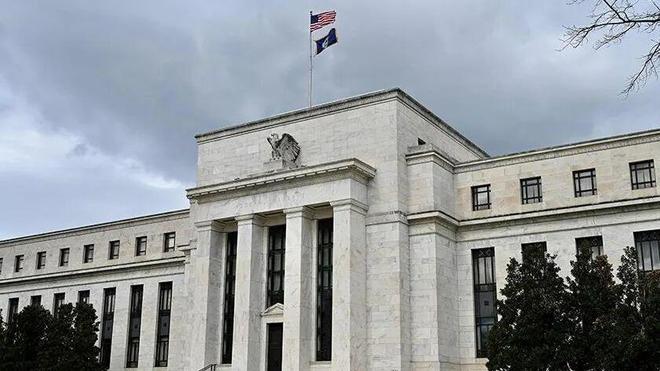
美联储官员本周密集发声,能否定调10月决议
Di Yi Cai Jing Zi Xun· 2025-09-23 00:06
Core Viewpoint - The Federal Reserve has restarted its easing cycle, but there are significant divisions among officials regarding the necessity of further rate cuts, with some advocating for a more aggressive approach while others emphasize the importance of controlling inflation [3][4][5]. Group 1: Interest Rate Decisions - The Federal Reserve cut rates by 25 basis points recently, but there is a notable split among officials about the need for additional cuts, with some projecting two more cuts by the end of 2025 [3][4]. - Stephen Miran, a newly appointed member of the Federal Reserve Board, argues for substantial rate cuts to prevent harm to the labor market, suggesting a target federal funds rate around 2.5%, nearly 2 percentage points lower than the current rate [3]. - Some officials, like Alberto Musalem and Raphael Bostic, express caution regarding further rate cuts, emphasizing the need to prioritize inflation control despite rising unemployment risks [4][5]. Group 2: Economic Indicators and Employment - The upcoming employment report for September is critical, with the unemployment rate currently at a relatively low 4.3%, but job creation has slowed [6]. - The labor market's stability is attributed to stagnant job-seeking numbers, influenced by tightened immigration policies [6]. - Policymakers are monitoring various indicators, including unemployment rates among minorities and job prospects for young workers and graduates, to gauge economic trends [6]. Group 3: Inflation Concerns - The Federal Reserve's inflation target is set at 2%, but projections indicate that inflation may remain above this target through 2025, with core PCE inflation expected to rise to 3.1% by year-end [8]. - Concerns about inflation are partly linked to the impact of tariffs, which are believed to have a temporary effect on price levels, with estimates suggesting tariffs contribute approximately 0.3 to 0.4 percentage points to core PCE inflation [9]. - The Fed's view is that the inflationary impact of tariffs will eventually diminish as the costs are absorbed by businesses rather than fully passed on to consumers [9].
开润股份(300577):进一步收购嘉乐20%股权至81%,增厚业绩
HUAXI Securities· 2025-09-22 15:22
Investment Rating - The investment rating for the company is "Buy" [1] Core Views - The company plans to acquire an additional 20% stake in Shanghai Jiale, increasing its total ownership to 81.4%, which is expected to enhance performance in Q4 2025 [2] - The company has announced the early termination of a share reduction plan by its controlling shareholder, which is seen as a positive market signal [2] - The company is expected to experience significant profit growth in Q3 due to improved net margins and accelerated revenue growth in the second half of the year [3] Financial Projections - Revenue forecasts for 2025, 2026, and 2027 have been adjusted to 52.38 billion, 60.02 billion, and 68.74 billion CNY respectively, down from previous estimates [5] - Net profit forecasts for the same years have been revised to 4.28 billion, 5.73 billion, and 6.92 billion CNY [5] - The earnings per share (EPS) estimates have been adjusted to 1.78, 2.39, and 2.89 CNY for 2025, 2026, and 2027 respectively [5] Business Growth Drivers - The company's 2B bag manufacturing business is projected to achieve double-digit growth in 2025, with net margin recovery expected from improved capacity utilization and reduced foreign exchange impacts [4] - The 2C business is anticipated to benefit from changes in the profit-sharing model with Xiaomi, leading to improved profit margins [4] - The acquisition of Shanghai Jiale opens up a larger market in garment manufacturing, creating a second growth curve for the company [4] Financial Summary - The company reported a revenue of 3,105 million CNY in 2023, with projections of 4,240 million CNY in 2024 and 5,238 million CNY in 2025, reflecting a year-on-year growth of 13.3% and 36.6% respectively [7] - The net profit for 2023 was 116 million CNY, with projections of 381 million CNY in 2024 and 428 million CNY in 2025, indicating a significant year-on-year increase of 146.5% and 12.3% respectively [7] - The gross margin is expected to stabilize around 22.9% in 2024 and 22.8% in 2025 [7]

韩美关税磋商陷僵局,李在明发声:屈从美方会重演亚洲金融危机
Guo Ji Jin Rong Bao· 2025-09-22 15:06
Core Viewpoint - The increase in U.S. tariffs has led to a significant decline in South Korea's exports, raising concerns for the trade-dependent South Korean economy. Ongoing tariff negotiations between the U.S. and South Korea are currently at a standstill, with South Korean President Yoon Suk-yeol publicly questioning the U.S. demands as excessively harsh [1][3]. Export Decline - South Korea's exports have been adversely affected by U.S. tariff pressures, with a reported 10.6% year-on-year decline in total imports and exports for the first 20 days of September, compared to a 6% increase in August [2]. - Despite this, unadjusted figures show a 13.5% increase in exports and a 9.9% increase in imports for the same period, resulting in a trade surplus of $1.89 billion. Semiconductor exports remained strong, growing by 27%, while automotive exports increased by approximately 15% [2]. - The imposition of a 15% tariff on South Korean goods has created greater challenges for exporters, particularly as there are warnings that semiconductors may be included in future tariff lists [2]. Negotiation Stalemate - A preliminary agreement was reached in July, where South Korea committed to establishing a $350 billion investment fund in exchange for a reduction in U.S. tariffs from 25% to 15%. However, negotiations have stalled due to disagreements over the investment structure and the need for a currency swap agreement [4]. - U.S. Commerce Secretary Howard Lutnick emphasized that South Korea must accept the terms or face higher tariffs, citing Japan's acceptance of similar terms as a precedent [4]. Domestic Concerns - President Yoon expressed concerns that accepting U.S. demands without adequate safeguards could lead to a repeat of the 1997 Asian financial crisis, highlighting the disparity in foreign exchange reserves between South Korea and Japan [4]. - The South Korean government is monitoring export trends and seeking multilateral cooperation to mitigate the impact of tariffs, but there are fears that an expansion of tariffs could undermine the recovery of South Korean exports [3]. Labor Issues - Recent enforcement actions in Georgia against a South Korean battery plant, resulting in the detention of over 300 workers, have heightened diplomatic tensions and added uncertainty to trade negotiations. President Yoon expressed anger over the treatment of workers but maintained that this incident would not damage the bilateral alliance [6].

美降息后市场焦点转向经济数据,美股高位调整风险加剧
2 1 Shi Ji Jing Ji Bao Dao· 2025-09-22 11:12
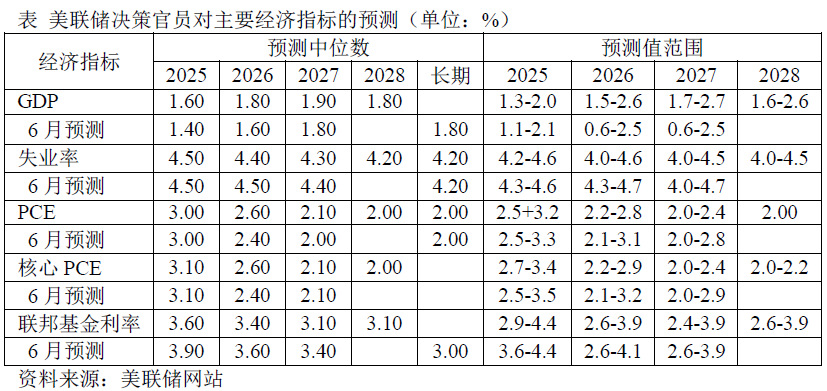
美联储决策基于经济数据,但缺乏对未来经济走势的准确预判,货币政策被人诟病。如表,美联储官员认为,今年美 国经济增长速度为1.6%,未来几年增速低于2%。令人不解的是,尽管就业市场走软,美联储依然坚持年末失业率为 4.5%,与6月份预测一样。此外,特朗普政府新关税政策暂缓执行期于8月7日结束,关税政策预计会对物价水平形成上 涨压力,而美联储6月和9月对PCE和核心PCE的预测值几乎没什么变化。他们内部形成了共识:关税政策影响是暂时 的。 与6月相比,美联储官员更倾向于年内还有至少两次降息,但从长远预测值看,明年至多有一次降息,2027年还有一 次,2028年不变。换言之,美联储的中性利率为3.1%左右,比通货膨胀目标值2.0%高出了110个基点。从19位经济学 家预测结果看,10位预测2025年末联邦基金利率为3.6%,有6位认为维持在4.10%。经济学家们对2026年的看法分歧很 大,只有6位认为利率维持在3.6%,有5位预测低于3%。 就业形势变了,通胀形势也变了,但这些变化并未影响美联储决策官员对经济走势的看法。在他们看来,这些变化只 是暂时的,不会改变长期趋势。7月30日会上,两名由特朗普任命的理事—— ...