供应链重构

Search documents
关税冲击下首份美联储《褐皮书》:107次提及关税,淡化通胀影响
Sou Hu Cai Jing· 2025-04-24 12:11
Group 1: Trade Policy Impact - The tariff policies have significantly affected key industries such as steel, aluminum, and automotive parts, forcing companies to shorten pricing cycles and implement daily price adjustments to transfer cost pressures [2] - Consumer behavior has shifted, with a surge in demand for durable goods before tariffs took effect, while non-durable goods consumption has declined, indicating concerns over future price increases [2] - Companies in regions like Atlanta and St. Louis have paused capital expenditures due to policy uncertainty, with some manufacturers stating that the environment is too chaotic for investment [2] Group 2: Inflation and Wage Dynamics - The Beige Book reveals signs of stagflation, with most regions reporting accelerated wage growth, contradicting signs of layoffs in manufacturing [3] - The healthcare sector continues to expand, driving up labor costs, while low-skilled jobs are shrinking due to industry shifts [3] - Input cost pressures are expected to rise further, with companies anticipating increased costs over the next six months, leading to a situation where consumers will ultimately bear these costs [3] Group 3: Federal Reserve Policy Dilemma - The Federal Reserve faces a dilemma between slowing economic growth and persistent inflation, with expectations of a rate cut in June despite inflation remaining above target [4][5] - Core PCE inflation expectations have been raised to 2.8%, while GDP growth forecasts have been downgraded from 2.1% to 1.7% [5] - The Fed's attempt to slow down balance sheet reduction has been interpreted as a dovish signal, reinforcing expectations for rate cuts [5] Group 4: Global Supply Chain Restructuring - The tariff situation is accelerating the restructuring of global supply chains, with companies facing challenges such as skyrocketing costs and order uncertainties [6][7] - For instance, U.S. agricultural exporters have been severely impacted, with the cost of soybeans rising from 4,000 yuan/ton to 7,000 yuan/ton, leading buyers to shift to South American markets [7] - Companies are adopting varied strategies to mitigate risks, including short-term measures to expedite shipments and long-term strategies like localizing supply chains [7] Group 5: Political and Market Pressures - The Trump administration's pressure on the Federal Reserve has reached new heights, with public calls for immediate rate cuts impacting market dynamics [8] - Despite the Fed's emphasis on policy independence, the acknowledgment of deteriorating economic prospects suggests that monetary policy is influenced by political factors [8] - Market reactions have been mixed, with Bitcoin rebounding and tech stocks performing well, while concerns over economic recession are reflected in deepening yield curve inversions [8]

“对等关税”冲击波之下 专家智库献策供应链重构
Zhong Guo Jing Ying Bao· 2025-04-19 02:34
美国近期推出的"对等关税"政策,对全球经济的冲击仍在持续。 《中国经营报》记者注意到,在"对等关税"冲击波延续情形下,如何进一步提升供应链稳定性成为市场 关注焦点。复旦大学全球供应链研究中心近日则发布"中国对外商品贸易及供应链波动指数"(以下简 称"波动指数"),力求为市场主体提供及时的数据支持与趋势判断。 "当然,任何指数模型都无法完全捕捉复杂多变的现实世界。"不过复旦大学管理学院管理科学系教授、 复旦大学全球供应链研究中心主任吴肖乐仍强调,上述波动指数"为用户提供更有针对性的观察与理 解,使这一工具逐步成为连接中国与全球经济互动的一扇窗口"。 "脱胎于"千万条外贸数据 在美国关税政策下,全球供应链稳定性正受到极大挑战。 "美国的'本土化'和'友岸化'政策导致供应链区域化分割,企业需承担多重合规成本与地缘政治风险。波 士顿咨询预测,美国企业可能因供应链调整损失40%利润。此外,全球贸易体系趋向碎片化,WTO多 边机制被区域协定(如美墨加协定)取代,加剧国际经贸规则的不确定性。"中信建投研报认为。 而复旦大学全球供应链研究中心团队也认为,当前,全球供应链面临多重挑战,包括中美关税摩擦延 续、地缘政治风险上升和 ...
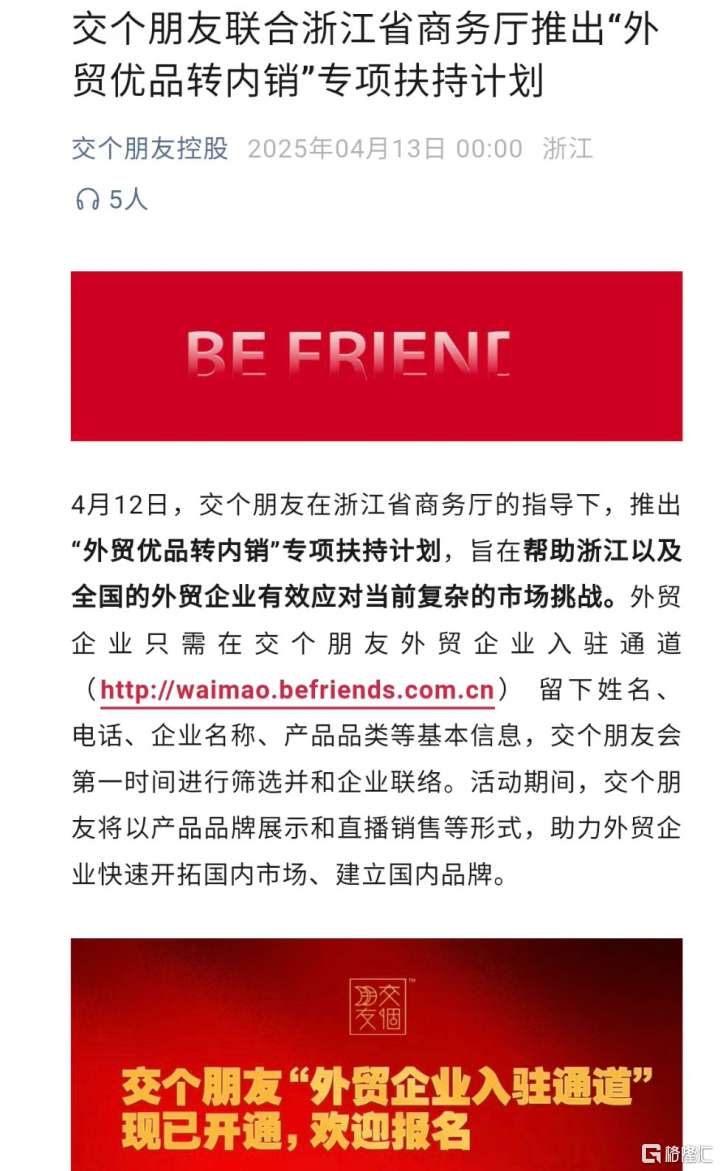
交个朋友控股(01450.HK)Q1业绩验证成长韧性 重磅新推“外贸优品转内销”计划扶持外贸商家发力国内市场
Ge Long Hui· 2025-04-14 08:38
一、业绩解码:增长与转型的双重奏 根据交个朋友控股2024年业绩公告,公司在报告期内实现GMV达150.8亿元,同比增长 19.58%,2022- 2024年公司GMV复合增长速度约45.8%;营收达12.51亿元,同比增长16.4%,连续五年稳居直播电商行 业第一梯队。 二、全球化战略:第二增长曲线的破局之路 2024年,交个朋友控股海外战略布局顺利落地,实现从0到1突破,多点开花,成效斐然——公司于珠海 横琴设立子公司,搭建起海外业务核心枢纽;2024年4月开始进军欧美市场,其中美国市场首秀GMV突 破百万美元,与TikTok合作主播单小时交易额实现了高倍数增长,充分体现出平台赋能海外达人的效 果,其一站式全流程代运营服务能力在付诸于实践行动中得到良好的体现。 目前,出海业务已成为交个朋友控股发展的第二增长曲线,为企业发展注入强劲新动能。 在全球化的战略定位上,交个朋友控股延续国内成熟的 "产业带直播+ AI运营" 模式,以开放、合作、 共赢为理念,持续优化海外业务结构,加速全球市场拓展。通过输出适配本土化需求的直播电商解决方 案,不仅为全球客户提供优质高效服务,更推动中国直播电商经验在国际市场的创新实践 ...
关税升级重构供应链,内需迎发展契机
HTSC· 2025-04-07 08:56
Investment Rating - The report maintains an "Overweight" rating for the consumer discretionary sector [7] Core Insights - The escalation of tariffs is reshaping global supply chains, leading to a structural impact on China's exports, while domestic demand is expected to benefit [1][11] - Companies with high domestic sales ratios are positioned to capitalize on the emerging opportunities in the local market as domestic brands continue to rise [1] Summary by Sections Home Appliances - Major home appliance companies like Haier are leveraging localization and production in Mexico to mitigate tariff impacts, thereby strengthening their market share in the U.S. [2][15] - The black appliance sector is seeing a shift towards Mexican production to buffer supply chain pressures, with companies like Hisense and TCL benefiting from cost control [2][16] Cleaning Appliances - The U.S. market remains highly dependent on Chinese manufacturing for cleaning appliances, with significant price increases expected due to high tariffs on imports from China and Vietnam [3][20] - Chinese companies are rapidly iterating products to gain market share in the U.S., with brands like Roborock surpassing local competitors in revenue [25][26] Light Industry and Home Furnishings - Southeast Asian production is likely to face challenges due to increased tariffs, but Chinese companies are actively seeking to adapt by expanding export regions and enhancing price transmission capabilities [4][29] - The reliance on the U.S. market for home furnishings has decreased, with exports expected to recover post-tariff adjustments [30][31] Cross-Border E-commerce - The supply chain disruptions are evident, but the competitive landscape may improve as smaller sellers face greater pressure due to the cancellation of the $800 tax exemption policy [5][39] - Major players are expected to benefit from market share consolidation as smaller competitors exit the market [40][41]



交通运输行业周报:关税对交运影响:内需与供应链重构迎来机遇-2025-04-07
Hua Yuan Zheng Quan· 2025-04-07 01:38
Investment Rating - The investment rating for the transportation industry is "Positive" (maintained) [4] Core Views - The logistics sector is experiencing stable growth, with national freight logistics operating smoothly, showing a slight increase in cargo transport and express delivery volumes [4] - The restructuring of supply chains due to tariff policies presents structural opportunities, particularly in the road transport sector, which is currently in a stable growth phase [4] - The logistics industry may face increased cost pressures due to high tariffs, potentially accelerating the formation of a unified logistics market where scale and technology become core competitive advantages [5] - The aviation sector is expected to benefit from improved domestic demand and lower oil prices, while facing challenges from increased costs due to tariffs on imported aircraft and parts [6][10] - The shipping industry is threatened by the ongoing trade tensions and tariffs, which could lead to a restructuring of global trade routes and supply chains, favoring oil transportation and intra-Asian shipping [10][11] Summary by Sections Logistics - National logistics operations have been orderly, with significant increases in cargo transport and express delivery volumes during the monitored period [4] - The road transport sector saw a year-on-year increase in freight volume and passenger flow, indicating a potential for growth driven by domestic manufacturing [4] Aviation - The aviation sector is expected to see a rebound in demand due to macroeconomic recovery, with a focus on key airlines such as China Southern Airlines and Air China [16] - The supply chain for aircraft manufacturing is under pressure due to tariffs, which could increase costs for airlines [6] Shipping - The shipping industry faces challenges from U.S. tariffs, which have significantly impacted global trade volumes, particularly in long-distance trade between the U.S. and Asia [10] - The oil shipping segment may benefit from increased demand due to geopolitical factors and sanctions affecting oil trade [11] Express Delivery - The express delivery sector is showing resilience, with major players like ZTO Express and SF Express expected to benefit from cyclical recovery and cost reduction efforts [16] - The competitive landscape is stabilizing, providing opportunities for long-term investment in leading companies [17]
申万宏源交运一周天地汇:美国对等关税对航运三阶段影响,OPEC+5月计划日均增产41万桶
Shenwan Hongyuan Securities· 2025-04-06 06:46
Investment Rating - The report maintains a positive outlook on the transportation industry, particularly focusing on the shipping sector and logistics recovery [2][3]. Core Insights - The report outlines a three-phase impact of the U.S. tariff policy on shipping, emphasizing initial pessimism followed by gradual recovery as trade negotiations progress [3][22]. - It highlights the importance of shipping asset pricing, which is determined by capacity utilization and upstream-downstream price differentials [3][22]. - The report suggests that the logistics sector, especially express delivery, is expected to see significant growth due to rising e-commerce demand and favorable policies [3][22]. Summary by Sections 1. Industry Performance - The transportation index increased by 0.76%, outperforming the Shanghai Composite Index by 2.13 percentage points [4]. - The shipping sector showed mixed performance, with the coastal dry bulk freight index rising by 0.20% and the Shanghai export container freight index increasing by 4.96% [4]. 2. Shipping Sector Analysis - The report identifies three phases of tariff impact: initial negative pricing, followed by recovery as negotiations progress, and potential price increases due to supply chain disruptions [3][22]. - It emphasizes that the tariff impacts will compress profit margins and affect shipping valuations, particularly before the tariffs take effect [3][22]. 3. Oil and Freight Rates - OPEC+ plans to increase production by 410,000 barrels per day starting in May, which is higher than market expectations [3][25]. - VLCC rates decreased by 3% to $37,276 per day, while Suezmax rates fell by 6% to $49,895 per day [3][25]. - The report notes a significant drop in MR average rates by 14% to $20,442 per day due to demand slowdown [3][26]. 4. Express Delivery and Logistics - The report expresses optimism for direct logistics recovery, particularly for leading companies like JD Logistics and SF Express, as demand rebounds [3][22]. - It highlights the expected rapid growth in e-commerce express delivery demand in 2025, driven by clear policy support for optimizing logistics costs [3][22]. 5. Railway and Highway Transport - Railway freight volume and highway truck traffic continue to rise, indicating a sustained spring peak in logistics activity [3][22]. - The report mentions a government directive aimed at optimizing railway pricing policies, which could enhance the efficiency of freight transport [3][22]. 6. High Dividend Stocks - The report lists high dividend yield stocks in the transportation sector, including Bohai Ferry with a TTM yield of 10.19% and Daqin Railway with a yield of 6.95% [3][18]. - It suggests that these stocks may provide stable returns amid market fluctuations [3][18].
环旭电子2024年营收与上年基本持平 拟每10股派发现金红利2.30元
Zheng Quan Ri Bao Wang· 2025-03-31 13:16
Core Viewpoint - The company reported stable revenue but a decline in net profit for the fiscal year 2024, highlighting challenges in the global supply chain and increased operational costs due to new factory constructions and acquisitions [1] Revenue Performance - The company achieved a revenue of 60.691 billion yuan, remaining flat compared to the previous year, while net profit decreased by 15.16% to 1.652 billion yuan [1] - Automotive and cloud storage products were the main drivers of revenue growth, with automotive electronics revenue increasing by 16.24% and cloud storage products by 13.35% [2] Product Segment Analysis - Revenue from communication, consumer electronics, and industrial products experienced varying degrees of decline, attributed to changes in industry demand and customer inventory adjustments [2][3] - The growth in automotive electronics was significantly influenced by the consolidation of Hesseman Automotive Communications, while cloud storage growth was driven by increased demand for AI-related server products [2] Global Operations and Expansion - The company operates 30 manufacturing service sites across Asia, Europe, the Americas, and Africa, and continues to expand its global footprint [4] - New factories in Poland and Mexico have commenced operations, and a partnership with TechMahindra aims to establish an engineering offshore development center in Bangalore, India [4] - The company emphasizes the importance of a diversified supplier system and aims to strengthen relationships with clients and partners amid supply chain restructuring in the consumer electronics sector [4]

汽车行业观察:比亚迪全球新能源领跑;福耀玻璃加速美国产能布局
Jin Rong Jie· 2025-03-28 07:02
Group 1 - The new 25% tariff on imported cars and key components announced by the U.S. President Trump will reshape the global automotive industry competitive landscape [1] - Japanese and South Korean automakers are the most affected, with U.S. imports from these countries contributing significantly to the market [2] - U.S. automakers are also impacted, as a high dependency on imported parts complicates the transition to localized production [2] Group 2 - The rising costs due to tariffs may lead to increased new car prices, potentially boosting the second-hand car market in the U.S. [3] - Chinese automakers are accelerating their globalization strategy, with limited direct impact from tariffs on vehicle exports but facing challenges in parts exports [4] - Leading Chinese parts manufacturers are adapting by expanding their presence in North America and leveraging technological partnerships [4] Group 3 - Chinese automakers are shifting from regional breakthroughs to a comprehensive rise in the global market, with BYD leading in global sales [5] - The integration of the new energy vehicle supply chain and differentiation in smart technology will be key competitive advantages for Chinese companies [5]

“走出去”更要“融进去”,中国企业如何扎根海外?| 出海峰会
吴晓波频道· 2025-03-15 15:25
Core Viewpoint - The article discusses the evolution of Chinese companies' globalization strategies, emphasizing the transition from merely exporting products to becoming integral participants in local cultures and economies, highlighting the importance of localization and cultural integration in international business [1][3][15]. Group 1: Globalization Challenges - The article identifies three major challenges faced by Chinese companies in the era of globalization 3.0: geopolitical changes, technological shifts, and cultural transformations [3][4][5]. - Geopolitical changes include trade uncertainties due to tariffs imposed by the U.S., prompting companies to adopt a "China + n" strategy [3]. - Technological shifts involve the impact of AI and the need for companies to balance technological innovation with supply chain restructuring [4]. - Cultural transformations require companies to transition from being mere product exporters to becoming active participants in local cultures, necessitating a deep integration into local ecosystems [5]. Group 2: Recent Trends in Globalization - In 2023, China's outward direct investment flow reached $177.29 billion, marking an 8.7% increase from the previous year, maintaining its position among the top three globally for 12 consecutive years [10]. - The current wave of globalization for Chinese companies is shifting from market expansion to ecological reconstruction, indicating a need for companies to evolve from being "global factories" to "global innovation networks" [10][11]. - The article emphasizes the importance of building new supply chain systems abroad, with companies taking their entire industrial chain overseas [11]. Group 3: Support for Globalization - The article highlights that the current wave of globalization involves not only large enterprises but also a significant number of medium-sized and small enterprises, which face unique challenges [13]. - It stresses the need for external support and collaboration for smaller companies, contrasting their resource limitations with the greater capabilities of larger firms [14]. - The upcoming summit will focus on the role of various stakeholders, including industry leaders and experts, in supporting these companies during their globalization efforts [14]. Group 4: Cultural Integration - The article discusses the cultural clashes that arise when Chinese companies operate abroad, citing examples of misunderstandings in work ethics and management styles [15]. - It emphasizes the need for Chinese companies to approach globalization with a mindset of rationality and constructive engagement, rather than aggressive expansion [15]. - The ultimate goal for these companies is to become nodes within a global civilization network, participating in the creation of new rules rather than merely exporting their standards [15].