
美联储降息预期

Search documents
2月15日黄金价格行情:国际金价站稳5000关口,国内回调现分化
Sou Hu Cai Jing· 2026-02-15 09:52
Group 1 - International gold prices surged due to expectations of interest rate cuts by the Federal Reserve, global central bank gold purchases, increased risk aversion, and a weaker dollar, with funds entering the market [4] - Domestic gold prices experienced a pullback attributed to profit-taking before the holiday, decreased market activity during the break, and a technical correction after previous high gains, indicating no trend reversal [4] - The short-term outlook suggests high volatility, a moderate bullish trend in the medium term, and a long-term bullish market structure, with $5000 potentially becoming a new price center [4] Group 2 - The current gold recovery price is high, with a recommendation for idle assets to be converted into cash through reputable platforms like Shanghai Hengtian Luxury Goods, which offers higher recovery prices than ordinary stores [6] - The Shanghai Hengtian platform provides transparent transactions, immediate fund transfers, and free home service across Shanghai, making it a reliable choice for citizens looking to recycle gold and luxury items [7]


AI恐慌交易蔓延,美股“2月寒流”何时结束?
Di Yi Cai Jing Zi Xun· 2026-02-15 04:44
2026.02.15 本文字数:2162,阅读时长大约3分钟 作者 | 第一财经 樊志菁 受所谓"AI恐慌交易"以及1月非农就业后美联储短期维持政策不变的概率上升影响,美国股市本周下 跌。 虽然华尔街迎来了投资者通常会乐见的宏观环境——就业增长稳健、通胀放缓,但由于市场对科技企业 成本与利润率压力的担忧抑制了乐观情绪,股市始终难以获得上行动能。 未来一周,科技股能否企稳,美联储降息预期是否强化或成为市场止跌与否的关键。 美联储降息预期小幅升温 下周投资者需要消化大量经济数据,整体表现喜忧参半。 月度零售销售数据表现疲软,去年12月零售销售环比持平,低于前值0.6%和预期0.4%。控制组(剔除 汽油、汽车、建材等波动项)环比下滑0.1%,预期上升0.4%。受此影响,亚特兰大联储GDPNow模型 对于美国去年第四季度GDP预测从上周的4.2%下修至3.7%。但零售月率此前已连续多个月表现强劲, 单一数据点未必代表趋势转变。 太平洋投资管理公司PIMCO经济学家维尔丁(Tiffany Welding)表示,通胀报告"表面上看相当令人鼓 舞",主要有两个积极的进展。首先,自疫情以来一直持续上涨的住房价格,现在确实正在 ...

AI恐慌交易蔓延,美股“2月寒流”何时结束?
第一财经· 2026-02-15 04:37
2026.02. 15 本文字数:2162,阅读时长大约3分钟 作者 | 第一财经 樊志菁 受所谓"AI恐慌交易"以及1月非农就业后美联储短期维持政策不变的概率上升影响,美国股市本周下 跌。 虽然华尔街迎来了投资者通常会乐见的宏观环境——就业增长稳健、通胀放缓,但由于市场对科技企业 成本与利润率压力的担忧抑制了乐观情绪,股市始终难以获得上行动能。 未来一周,科技股能否企稳,美联储降息预期是否强化或成为市场止跌与否的关键。 美联储降息预期小幅升温 下周投资者需要消化大量经济数据,整体表现喜忧参半。 月度零售销售数据表现疲软,去年12月零售销售环比持平,低于前值0.6%和预期0.4%。控制组(剔除 汽油、汽车、建材等波动项)环比下滑0.1%,预期上升0.4%。受此影响,亚特兰大联储GDPNow模 物价指标显示压力有所缓解。消费者价格指数(CPI)1月环比上升0.2%,低于预期的0.3%,同比增 长2.4%,低于预期的2.5%。核心CPI环比增加0.3%,同比增加2.5%,均与预期一致。值得一提的 是,同比涨幅为2021年4月以来最低水平。无独有偶,密歇根大学2月消费调查也显示,1年期通胀预 期从4.0%降至3.5 ...

美股点金丨AI恐慌交易蔓延 美股“2月寒流”何时结束?
Di Yi Cai Jing· 2026-02-15 03:25
Group 1 - The US stock market experienced a decline this week due to "AI panic trading" and increased probabilities of the Federal Reserve maintaining its policy unchanged after the January non-farm employment report [1] - Despite a generally favorable macro environment with steady job growth and easing inflation, concerns over cost and profit margin pressures for tech companies have dampened investor optimism [1] - The ability of tech stocks to stabilize and the strengthening of interest rate cut expectations from the Federal Reserve will be crucial for market recovery in the coming week [1] Group 2 - The Federal Reserve's interest rate cut expectations have slightly increased, with mixed economic data being digested by investors [2] - Retail sales data showed weakness, with December sales flat month-on-month, below the previous value of 0.6% and the expected 0.4% [2] - The January non-farm payroll report indicated a significant increase of 130,000 jobs, surpassing the market expectation of 65,000, with the unemployment rate dropping to 4.3% [2] Group 3 - Economic signals are mixed, with the January employment report contradicting the narrative of stagnant hiring, while retail sales data challenges the view of strong consumer spending [3] - The yield curve for US Treasury bonds has flattened, with the 2-year yield dropping to its lowest level since 2022, approaching 3.40% [3] - The inflation report appears encouraging, with housing prices slowing and tariff-related impacts diminishing, leading to expectations of two interest rate cuts later this year [3] Group 4 - The recent decline in retail sales is viewed as a temporary pause following strong spending, with tax refunds and robust wage growth expected to support consumption recovery in the coming months [4] - The significant increase in non-farm employment is concentrated, raising questions about its sustainability due to demographic constraints and weakening labor demand in other sectors [4] Group 5 - The US stock indices fell over the past week, with investors continuing to reduce exposure to tech stocks, leading to a decline in the S&P 500 index [5] - Concerns regarding the impact of new AI tools on specific industries have caused market volatility, initially affecting software and financial stocks, and later spreading to real estate and logistics companies [5] Group 6 - The financial sector experienced the largest decline this week, down 4.8%, followed by communication services down 3.5%, while utilities saw a significant increase of 7.1% due to safe-haven inflows [6] - Other sectors such as real estate and materials also recorded gains of over 3%, while energy, consumer staples, and industrial sectors showed positive performance [6] Group 7 - The introduction of AI tools by companies like Altruist has raised concerns about job displacement, leading to a cautious sentiment among traders [7] - The market's reaction to AI-related news has resulted in a "sell first, ask questions later" approach, with fears of AI disruption affecting various sectors beyond just software [7] Group 8 - The outlook for the next week suggests that a significant decline in Treasury yields could typically act as a bullish catalyst for the stock market, but bearish signals in the tech sector indicate potential further downside risks [8] - The volatility index (VIX) remains around 20, indicating that the market is seeking protective measures and may maintain higher-than-average volatility in the short term [8]
美股点金丨AI恐慌交易蔓延,美股“2月寒流”何时结束?
Di Yi Cai Jing Zi Xun· 2026-02-15 03:25
Group 1 - The US stock market experienced a decline this week due to "AI panic trading" and increased probabilities of the Federal Reserve maintaining its policy unchanged after the January non-farm employment report [1] - Concerns over cost and profit margin pressures for technology companies have suppressed optimism, despite a generally favorable macroeconomic environment characterized by steady job growth and easing inflation [1] - The ability of technology stocks to stabilize and the strengthening of interest rate cut expectations from the Federal Reserve will be critical for market recovery in the coming week [1] Group 2 - The retail sales data showed weakness, with December retail sales unchanged month-on-month, below the previous value of 0.6% and the expected 0.4% [2] - The Atlanta Fed's GDPNow model revised its forecast for Q4 GDP from 4.2% to 3.7% due to the retail sales performance [2] - The January non-farm payrolls increased by 130,000, significantly above the market expectation of 65,000, with the unemployment rate dropping to 4.3% from 4.4% [2] - The Consumer Price Index (CPI) for January rose by 0.2% month-on-month, lower than the expected 0.3%, and the year-on-year increase was 2.4%, also below the expected 2.5% [2] Group 3 - Economic signals are mixed, with the January employment report contradicting the narrative of stagnant hiring, while retail sales data challenges the view of strong consumer spending [3] - The flattening of the US Treasury yield curve indicates a significant drop in long-term yields, with the 2-year yield approaching 3.40%, and the probability of two rate cuts this year nearing 90% [3] - The inflation report shows encouraging signs, particularly with housing prices slowing and tariff-related impacts diminishing, which may lead the Federal Reserve to consider rate cuts later this year [3] Group 4 - The recent signals are unlikely to persist, as the decline in retail sales may be a temporary pause following strong spending, and the sustainability of the significant increase in non-farm employment is questionable [4] - The cooling inflation data provides a favorable environment for the Federal Reserve to potentially restart rate cuts later in the year [4] Group 5 - The US stock indices fell over the past week, with investors continuing to reduce exposure to technology sectors, and the S&P 500 index turned negative for the year [5] - Concerns regarding the impact of new AI tools on specific industries have led to market volatility, initially affecting software and financial stocks, and later spreading to real estate and logistics sectors [5] Group 6 - The financial sector experienced the largest decline this week, down 4.8%, followed by communication services down 3.5%, and both non-essential consumer goods and technology sectors fell over 2% [6] - Utility stocks surged by 7.1% due to safe-haven inflows, while real estate and materials rose over 3% [6] Group 7 - The launch of AI tools by companies like Altruist and Anthropic has heightened fears of job displacement, leading to a cautious sentiment among traders regarding US stock exposure [7] - The sell-off pressure in the market is primarily driven by concerns over the disruptive effects of AI, affecting not only software stocks but also real estate and logistics [7] Group 8 - The significant decline in US Treasury yields typically serves as a bullish catalyst for the stock market, but bearish confirmation signals in the Nasdaq indicate potential further downside risks [8] - The volatility index (VIX) remains around 20, suggesting that the market is seeking protective measures and may maintain higher-than-average volatility in the short term [8]
黄金深夜狂飙!前一日刚大跌,今夜突破5040美元,特朗普证实将派第二艘航母
Sou Hu Cai Jing· 2026-02-15 03:07
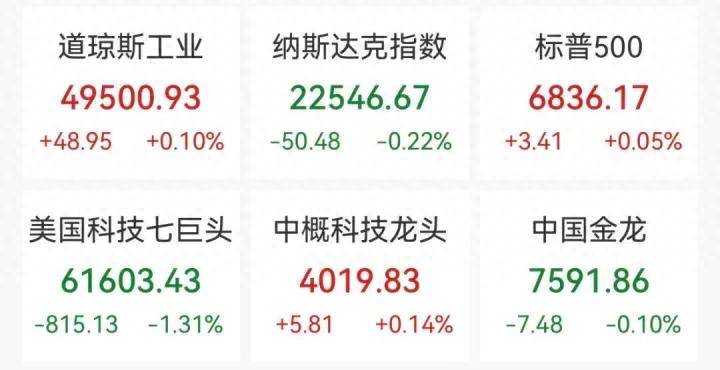
Economic Indicators - The latest CPI data from the US shows a decrease in the annual rate from 2.7% to 2.4%, the lowest since May 2025, with market expectations at 2.5% [1] - The core CPI annual rate fell from 2.6% to 2.5%, marking the lowest level since March 2021, aligning with market expectations [1] - Following the CPI release, the probability of the Federal Reserve easing policies in June increased from 63% to 69%, with a 50% chance of a third rate cut this year [1] Stock Market Performance - The three major US stock indices showed mixed results, with the Dow Jones up 0.1%, S&P 500 up 0.05%, and Nasdaq down 0.22% [2] - Over the week, the Dow Jones fell by 1.23%, S&P 500 by 1.39%, and Nasdaq by 2.1% [2] Individual Stock Movements - Major tech stocks experienced declines, with Apple and Nvidia down over 2%, while Tesla saw a slight increase of 0.09% [4] - Semiconductor stocks performed well, with the Philadelphia Semiconductor Index rising by 0.66%, driven by significant gains in Applied Materials and ARM [4] - Gold stocks showed strong performance, with several companies like Coeur Mining and Harmony Gold seeing increases of over 6% [4] Commodity Prices - Gold and silver prices surged, with gold closing at $5042.808 per ounce, up over 2.4%, and silver reaching $77.338 per ounce after a rise of over 5% [6] Geopolitical Developments - The US is increasing military presence in the Middle East, with President Trump confirming the deployment of a second aircraft carrier strike group to pressure Iran into negotiations [8] - Trump emphasized the need for a deal with Iran within a month, warning of severe consequences if negotiations fail [9] - Israeli officials expressed skepticism about the potential agreement, stressing the importance of including issues related to Iran's nuclear capabilities and missile programs [9]


国盛证券:增长韧性与通胀粘性博弈延续 5月后美联储政策空间或现转机
智通财经网· 2026-02-15 02:09
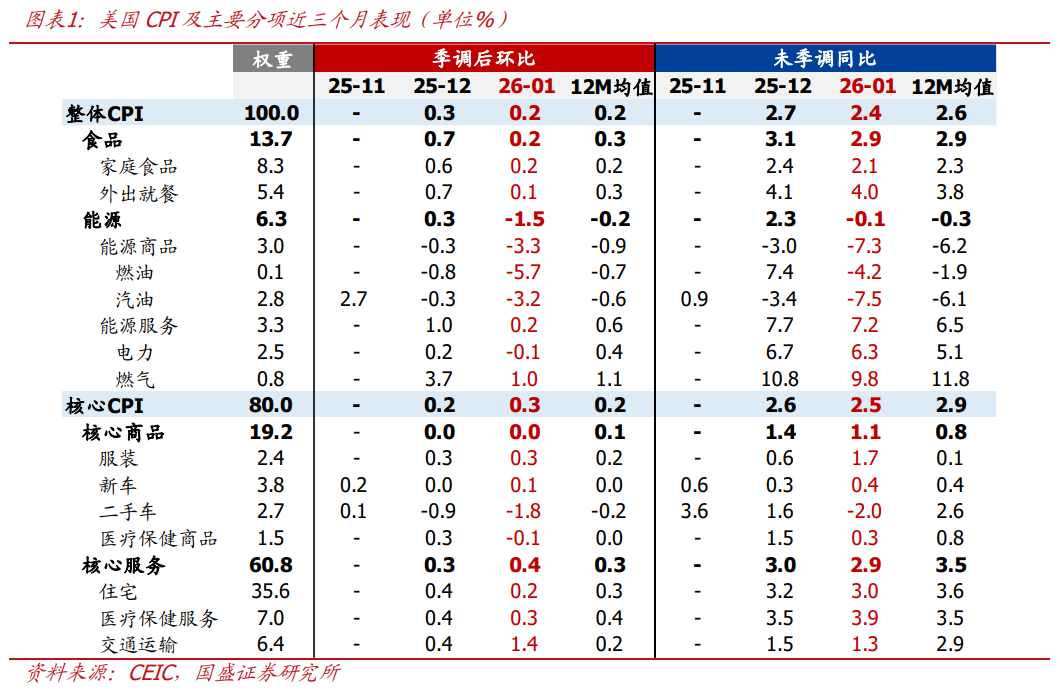
Core Viewpoint - The report from Guosheng Securities indicates that the recent strong non-farm payrolls and weak CPI data have caused significant disturbances in asset prices, leading to fluctuating expectations for Federal Reserve interest rate cuts. The combination of these data suggests that the weaker CPI has somewhat alleviated the hawkish pressure from the strong non-farm data. The firm believes that the Fed may struggle to provide clear signals for easing in the short term, and asset prices will continue to oscillate around the dynamics of growth resilience and inflation stickiness. A significant change in policy space is likely to occur after the leadership transition in May, with potential adjustments under Warsh's leadership possibly opening up more room for rate cuts in the second half of the year [1][23]. CPI Summary - In January, the CPI was reported at 2.4% year-on-year, lower than expectations and previous values, marking a three-month decline. The core CPI remained at 2.5%, in line with expectations but below the previous value. The seasonally adjusted CPI increased by 0.2% month-on-month, matching the 12-month average, while the core CPI rose by 0.3%, exceeding the 12-month average of 0.2% [2][3]. - Key components of the CPI showed a decline in food prices from 3.1% to 2.9% year-on-year, and energy prices fell from 2.3% to -0.1%. Core goods and services also exhibited slight decreases in inflation rates, indicating persistent service inflation pressures [2][3]. Non-Farm Payroll Summary - The January non-farm payrolls added 130,000 jobs, significantly exceeding the expected 65,000, marking the highest increase since April 2025. The unemployment rate fell to 4.3%, below expectations and the previous rate of 4.4%, reaching a new low since September 2025. The labor force participation rate was 62.5%, higher than anticipated [6][11]. - Job growth was primarily concentrated in the education and healthcare sectors, which contributed nearly 80% of the new jobs. Other sectors like professional services and construction showed modest improvements, while information and finance sectors continued to decline [11][16]. Asset Price Movements - Following the non-farm report, U.S. stock indices and bond yields initially rose before declining, with gold prices experiencing similar fluctuations. After the CPI release, stock indices showed mixed results, while bond yields and the dollar index fell, and gold prices increased [18][20]. - Market expectations for Fed rate cuts fluctuated, with a decrease in anticipated cuts following the non-farm data, but a slight increase after the CPI release. The implied number of rate cuts for 2026 decreased from 2.4 to 2.12 after the non-farm data, while it rose from 2.36 to 2.53 after the CPI data [20][23]. Future Outlook - The combination of strong non-farm data and sticky service inflation suggests that while employment remains resilient, inflation pressures persist. The Fed is unlikely to signal clear easing in the short term, and asset prices will continue to be influenced by these dynamics. A potential shift in policy may occur after the leadership change in May, with the possibility of more significant rate cuts in the latter half of the year [23][24].

基金研究周报:市场结构性分化持续,成长强势(2.9-2.13)
Wind万得· 2026-02-14 22:20
Market Overview - The A-share market exhibited a structural upward trend last week, with the Shanghai Composite Index closing at 4082.07 points, remaining stable throughout the week [2] - The Growth sector performed strongly, with the STAR 50 Index surging by 3.37%, highlighting robust momentum in technology and innovation themes [2] - In contrast, the Value sector showed relative weakness, with the SSE 50 and CSI Dividend Index experiencing slight declines [2] - The U.S. stock indices collectively fell, with the S&P 500 down by 1.39%, while European markets saw moderate gains [4] - Asian markets performed strongly, with the Korean Composite Index soaring by 8.21% and the Nikkei 225 rising by 4.96% [4] Industry Performance - The Information Technology sector rose by 3.62%, and the Communication Services sector increased by 2.43%, demonstrating strong performance [12] - Conversely, the Consumer Staples sector declined by 2.45%, and the Financial sector fell by 1.41%, indicating weaker performance [12] - The rise of AI technologies has propelled the TMT (Technology, Media, and Telecommunications) sector, leading to accelerated sector rotation during the earnings forecast period [12] Fund Issuance and Performance - A total of 64 funds were launched last week, including 24 equity funds, 19 mixed funds, 8 bond funds, 2 QDII funds, and 11 FOF funds, with a total fundraising amount of 58.33 billion [17] - The overall fund performance showed the Wind All Fund Index rising by 0.79%, with equity funds significantly outperforming bond funds [7][17] - The Wind Ordinary Equity Fund Index increased by 1.40%, while the Mixed Equity Fund Index rose by 1.52%, indicating strong performance in equity-related funds [7]

国盛证券:美联储政策空间的真正变化节点大概率出现在5月主席换届之后 目前市场对美联储丧失独立性的计价可能不足
Sou Hu Cai Jing· 2026-02-14 11:46
Group 1: CPI Analysis - The January CPI in the US was 2.4% year-on-year, lower than expected and the previous value, marking a decline for three consecutive months since September 2025 [3][4] - Core CPI remained at 2.5%, in line with expectations but lower than the previous value, while the seasonally adjusted CPI increased by 0.2%, also below expectations [3][4] - Energy price declines, along with decreases in used car prices and slight slowdowns in housing and food inflation, contributed to the overall CPI being below expectations [4] Group 2: Non-Farm Employment Report - The US added 130,000 non-farm jobs in January, significantly exceeding the expected 65,000, marking the highest increase since April 2025 [6][12] - The unemployment rate fell to 4.3%, lower than the expected and previous rate of 4.4%, reaching a new low since September 2025 [6][12] - Employment improvements were primarily driven by a few sectors, particularly education and healthcare, which contributed nearly 80% of the new jobs, indicating a lack of broad-based recovery [12][14] Group 3: Market Reactions and Interest Rate Expectations - Following the release of the non-farm data, US stock markets, bond yields, and the dollar index experienced fluctuations, while gold prices initially fell before rising [16][17] - Market expectations for Federal Reserve rate cuts fluctuated, with the implied number of cuts for 2026 increasing from 2.36 to 2.53 after the CPI release, indicating a slight warming of rate cut expectations [17][21] - The combination of strong non-farm data and weak CPI has led to a complex interplay in asset prices, with ongoing debates about growth resilience and inflation persistence [21][22]
海外市场点评:1月美国CPI:“鹰”派担忧的缓解?
Guolian Minsheng Securities· 2026-02-14 11:41
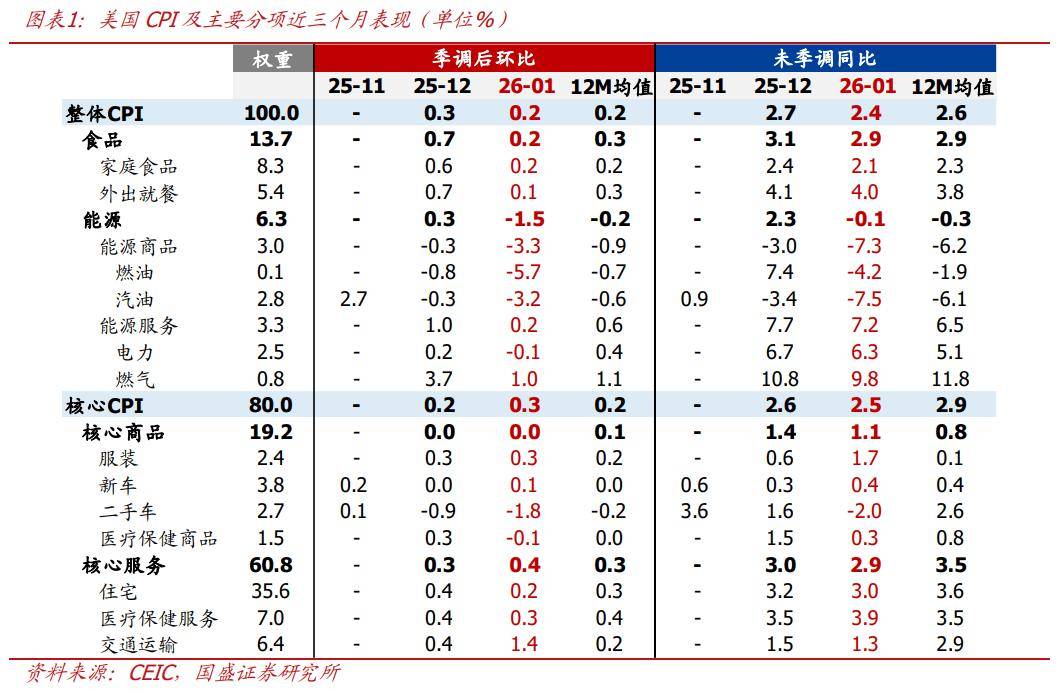
Inflation Data Summary - January CPI in the U.S. showed a year-on-year increase of 2.4%, below the expected 2.5% and previous value of 2.7%[2] - Core CPI remained steady at 2.5%, matching expectations but down from 2.6% previously[2] - The decline in energy inflation was a key driver for the lower CPI, with international oil prices weakening year-on-year[2] Market Reactions - The mild inflation data alleviated concerns about the Federal Reserve's liquidity tightening, providing temporary relief to capital markets[2] - Following the release of the CPI data, market expectations for interest rate cuts were pushed forward, with projections indicating potential cuts as early as June[2] - Precious metals, particularly gold, saw significant gains, with prices reaching around $5000 per ounce[2] Economic Indicators - The manufacturing PMI returned to the expansion zone, indicating positive momentum in the manufacturing sector[2] - Non-farm payrolls exceeded market expectations, contributing to a shift in market sentiment regarding Federal Reserve policies[2] Seasonal Factors - January typically experiences seasonal inflationary pressures, but the CPI's moderation was notable given these trends[2] - The end of holiday discounts and the timing of corporate price adjustments usually contribute to inflationary increases at the start of the year[2] Risks and Considerations - Potential risks include significant changes in U.S. trade policies and geopolitical factors that could lead to increased market volatility[3]