全国统一大市场

Search documents
努力破除“小循环” 更好拥抱大市场——加快建设全国统一大市场一线观察之三
Xin Hua She· 2025-07-08 16:04
Group 1 - Breaking local protectionism and market segmentation is crucial for building a unified national market, as emphasized in the Central Government's opinions [1][5] - The construction of a unified market is leading to changes in market dynamics, mechanisms, and perceptions, promoting a more integrated economic environment [1][3] - The beer industry exemplifies the shift from localized brands to national ones, with companies like Wusu Beer becoming widely available across regions [2][3] Group 2 - The government is implementing measures to facilitate cross-regional business operations, such as streamlined registration processes for company relocations [4][6] - Local governments are actively correcting discriminatory policies and enhancing market regulations to eliminate barriers to competition [5][8] - The establishment of cross-regional benefit-sharing mechanisms is being adopted to ensure equitable distribution of economic gains from industrial projects [7][9] Group 3 - Local governments are recognizing the importance of avoiding "policy lowlands" and "small markets," which can lead to financial burdens and inefficiencies [8][9] - The focus is on leveraging comparative advantages and optimizing resource allocation while respecting regional differences [9][10] - There is a shift from merely dismantling barriers to proactively building a conducive environment for industry growth and collaboration [10]
农林牧渔行业周报:猪价继续反弹,关注生猪板块投资机会-20250708
Yong Xing Zheng Quan· 2025-07-08 11:02
Investment Rating - The industry investment rating is maintained as "Increase" for the agricultural sector [6] Core Viewpoints - The agricultural sector outperformed the market by 1.01 percentage points during the week of June 30 to July 4, 2025, with a weekly increase of 2.55% [15][17] - The pig farming sector is highlighted as a key investment opportunity due to the recovery of breeding profits and the ongoing rise in pig prices [4][2] - The report emphasizes the importance of cost control for listed pig farming companies to navigate the pig cycle effectively [4] Summary by Sections Market Review - The agricultural sector index closed at 2,729.26, ranking 7th among 31 first-level industries in terms of weekly performance [15][17] - The fishery sector showed the best performance with a 5.13% increase, followed by breeding, agricultural product processing, feed, and planting sectors with respective increases of 3.12%, 2.96%, 2.30%, and 1.63% [17][19] Industry Dynamics - Pig prices continued to rise, with the national average price reaching 15.35 yuan/kg, a week-on-week increase of 4.28% [2] - Self-breeding profits increased to 119.72 yuan/head, while external piglet breeding profits improved to -26.26 yuan/head [2] - In the poultry sector, chicken prices remained under pressure due to high inventory levels, with broiler chick prices dropping to 1.36 yuan/chick, a 20% decrease week-on-week [2] Agricultural Products - Prices for wheat, corn, and soybean meal showed a week-on-week increase, with wheat averaging 2,451.06 yuan/ton (up 0.19%), corn at 2,367.14 yuan/ton (up 0.61%), and soybean meal at 2,928.00 yuan/ton (up 0.76%) [3][34] Investment Recommendations - The report suggests focusing on the pig farming sector, particularly companies with strong cost control such as Muyuan Foods, Wens Foodstuff Group, and others [4] - In the poultry sector, it recommends looking at integrated industry leaders like Shennong Development and Lihua Stock for yellow feathered chickens [4] - For feed, it highlights industry leaders like Haida Group and regional leaders like Hefeng Stock as beneficiaries of the recovery in livestock demand [4] - The report also emphasizes the importance of food security, recommending companies like Suqian Agricultural Development and Beidahuang [4]


政策与大类资产配置周观察:“反内卷”与“大而美”
Tianfeng Securities· 2025-07-08 07:15
策略报告 | 投资策略 "反内卷"与"大而美" 证券研究报告 政策与大类资产配置周观察 海内外政策要闻 习近平主持召开中央财经委员会第六次会议。中共中央总书记、国家主席、中央 军委主席、中央财经委员会主任习近平7月1日上午主持召开中央财经委员会第六 次会议,研究纵深推进全国统一大市场建设、海洋经济高质量发展等问题。统一 大市场方面,会议指出,纵深推进全国统一大市场建设,基本要求是"五统一、 一开放";海洋经济方面,会议强调推动海洋经济高质量发展。 李强总理出席金砖国家领导人第十七次会晤第一阶段会议。当地时间7月6日,国 务院总理李强在里约热内卢出席金砖国家领导人第十七次会晤第一阶段会议,就 "和平与安全、全球治理改革"议题发表讲话。金砖成员国领导人与会,巴西总统 卢拉主持会议。 美国国会微弱优势通过"大而美"法案。美国国会众议院7月3日下午以218票赞 成、214票反对的表决结果通过总统特朗普推动的"大而美"税收与支出法案。 该法案主要内容包括延长特朗普在其第一个任期内于2017年通过的企业和个人 减税措施,让小费和加班工资收入免于纳税等,其核心条款是降低企业税。 国内外政策导向分析 上周(6.30-7.4) ...
支持企业充分利用国际国内两个市场两种资源
Ren Min Ri Bao· 2025-07-07 22:28
Core Viewpoint - The "Sweet Potato Economy" theory encourages local enterprises to expand beyond their regions while reinvesting in their home industries, fostering a symbiotic growth effect that enhances both local and global competitiveness [2][3]. Group 1: Theoretical Insights - The "Sweet Potato Economy" metaphor illustrates local enterprises extending their reach to gather resources while maintaining a strong local foundation, promoting a dual growth model [2]. - This theory emphasizes a pragmatic approach, encouraging businesses to venture outside their localities to enhance their own growth and contribute to local industry development [2]. - It reflects a spirit of innovation and resilience, urging companies to focus on their unique strengths and long-term development while engaging in broader market opportunities [2]. Group 2: Policy Implications - The current push for a unified national market and high-level openness is seen as a strategic advantage for leveraging China's vast market resources [3]. - Breaking down regional protectionism and market entry barriers is essential for facilitating resource flow and enhancing productivity [3]. - Expanding international cooperation will strengthen China's global economic ties and improve resource allocation efficiency [3]. Group 3: Actionable Strategies - Accelerate the establishment of a unified national market to provide better support for domestic and international investments [4]. - Optimize the business environment by ensuring fair regulatory practices and protecting the rights of various business entities [4]. - Foster collaborative relationships between government and businesses to enhance administrative efficiency and responsiveness [4]. - Promote resource flow by encouraging cross-regional cooperation and utilizing digital platforms for better industry coordination [4]. - Support the growth of specialized industries through targeted policies and collaboration between local industries and educational institutions [4].
推进设施联通 助力物畅其流——加快建设全国统一大市场一线观察之二
Zhong Guo Jin Rong Xin Xi Wang· 2025-07-07 13:33
Core Viewpoint - The article emphasizes the importance of high-standard connectivity of market facilities as a foundational prerequisite for breaking geographical barriers and accelerating the flow of factors, which is essential for building a unified national market [1]. Infrastructure Connectivity - The construction of the Tianshan Victory Tunnel, the longest highway tunnel in the world, is expected to significantly reduce logistics costs by approximately 70 million yuan for logistics companies in Xinjiang [1]. - The integration of transportation networks, including highways, railways, and airways, is enhancing the efficiency of the flow of people, vehicles, and goods across regions [2]. - The implementation of multimodal transport solutions, such as the "Hefei-Ningbo Zhoushan Port" sea-rail intermodal service, has reduced transit times for large export shipments from 40 days to 27 days [3]. Digital and Soft Connectivity - The introduction of virtual service windows allows businesses to complete administrative tasks remotely, enhancing the efficiency of inter-regional business operations [7]. - The establishment of a multi-level interconnected government data sharing platform aims to facilitate cross-regional and cross-departmental data sharing, improving the overall experience for businesses and citizens [7]. - The promotion of electronic procurement platforms has enabled suppliers to sell across the province with a single registration, significantly increasing the number of available products and suppliers [9]. Economic Integration and Resource Flow - The development of a unified infrastructure system supports both domestic and international market connections, facilitating the flow of resources and goods across regions [14]. - The successful transportation of high-value products via the China-Europe Railway Express demonstrates the growing sophistication of logistics networks connecting China with Central Asia [14]. - The construction of the Pinglu Canal is expected to enhance trade routes from the southwestern region of China to Southeast Asia, further integrating domestic and international markets [14][15]. Future Outlook - The continuous improvement of infrastructure and digital platforms is anticipated to enhance the efficiency of economic circulation, fostering stronger development momentum in the future [15].
上财报告:中国经济在多重挑战中实现稳定增长
Xin Hua Cai Jing· 2025-07-07 08:49
Group 1 - The report from Shanghai University of Finance and Economics predicts stable growth for China's economy in 2025 despite external uncertainties and internal transformation challenges [1] - On the supply side, industrial transformation continues, with new industries like new energy and new materials becoming new growth drivers, while traditional industries face overcapacity and profit shrinkage [1] - The demand side is slowly recovering but remains fragile, with households preferring to save more and reduce debt, which could have long-term implications for macroeconomic demand [1] Group 2 - The report suggests balancing short-term demand stabilization with long-term reforms, including targeted easing to alleviate debt pressure and support high-end manufacturing [2] - There is a need to break market segmentation and accelerate the construction of a unified national market to enhance market confidence and stimulate consumption and investment [2] - The current macroeconomic concern is persistently low price levels, with industries experiencing faster profit declines than cost reductions, necessitating a shift to a new governance model led by the government [2]
“反内卷”强化供给侧国家治理预期,有望推动实现更高质量增长
Orient Securities· 2025-07-07 02:33
Group 1: Policy Implications - The "anti-involution" initiative aims to address chaotic low-price competition among enterprises, guiding improvements in product quality and enhancing national governance expectations[5] - The initiative emphasizes quality enhancement, technological investment, and protection of workers and small enterprises, focusing on "increasing quantity and improving quality" rather than merely price concerns[5] - Recent high-level discussions and meetings have repeatedly highlighted the importance of breaking "involution-style" competition to achieve high-quality development, with various industries responding positively[5] Group 2: Industry Responses - Industries under profit pressure, such as traditional sectors like cement and steel, are beginning to respond to the "anti-involution" measures, with some companies agreeing to production cuts[5] - The government is expected to implement further nationwide optimizations in procurement and bidding systems, enhancing the allocation of public resources[5] - Local government investment attraction models are anticipated to evolve, moving away from unsustainable fiscal subsidies towards regions with strong industrial chains and research infrastructure[5] Group 3: Long-term Outlook - The "anti-involution" approach is not about suppressing competition but rather facilitating a transformation in corporate governance and investment attraction practices, leading to long-term improvements in governance expectations[5] - The current policy shift is expected to prioritize quality and technological advancements, contrasting with previous supply-side reforms that focused on capacity reduction and deleveraging[5] - The establishment of a high-quality development assessment system will likely reduce the emphasis on GDP growth metrics while enhancing the focus on new and old kinetic energy conversion[5]
证券ETF(512880)上一交易日净流入超1.2亿元,金融行业资产重估优势获关注
Sou Hu Cai Jing· 2025-07-07 01:48
Group 1 - The non-bank financial sector is expected to benefit from higher market activity in Q2 2025, becoming one of the structural highlights [1] - The People's Bank of China has revised the rules for the RMB Cross-Border Payment System (CIPS), emphasizing foresight and flexibility to accommodate innovations like blockchain and digital currencies [1] - The central government is focusing on deepening financial openness and innovation in the Shanghai Free Trade Zone, including the development of offshore bonds and optimizing free trade account functions [1] Group 2 - The Securities ETF tracks a securities company index compiled by China Securities Index Co., which reflects the overall performance of listed companies related to the securities industry [2] - The constituent stocks of the index mainly consist of major domestic securities firms, indicating high industry concentration and market representation [2]
格林大华期货股指早盘提示-20250707
Ge Lin Qi Huo· 2025-07-07 01:45
研究员: 于军礼 从业资格: F0247894 交易咨询资格:Z0000112 联系方式:yujunli@greendh.com 早盘提示 Morning session notice 更多精彩内容请关注格林大华期货官方微信 格林大华期货研究院 证监许可【2011】1288 号 2025 年 7 月 7 日星期一 | 板块 | 品种 | 多(空) | 推荐理由 【行情复盘】 周五在银行板块拉升的带动下,上证指数向 3500 点整数位发起冲击,未能冲过后, | | --- | --- | --- | --- | | | | | 卖盘涌出,日线收出长上影。两市成交额 1.42 万亿元,温和放量。中证 1000 指数 收 6312 点,跌 30 点,跌幅-0.48%;中证 500 指数收 5911 点,跌 11 点,跌幅-0.19%; 沪深 300 指数收 3982 点,涨 14,涨幅 0.36%;上证 50 指数收 2740 点,涨 15 点, | | | | | 涨幅 0.58%。行业与主题 ETF 中涨幅居前的是游戏 ETF、银行 ETF、金融科技 ETF、 | | | | | 创新药 ETF、科创医药 ET ...
趋势研判!2025年中国体育服务行业产业链、产业规模、行业政策、重点企业及发展路径分析:产业规模将达2.78万亿元,行业升级驱动体育产业高质量发展 [图]
Chan Ye Xin Xi Wang· 2025-07-07 01:31
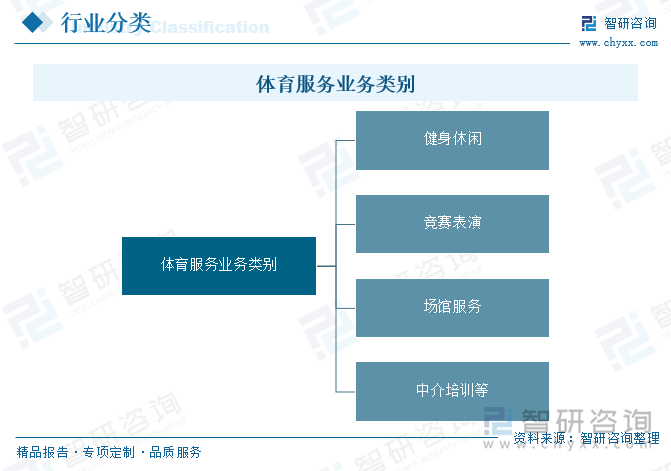
Core Insights - The sports service industry is a crucial part of the sports sector, providing non-material products related to sports through specialized and market-oriented methods [1][3][4] - In 2023, China's sports industry reached a total scale of 3.67 trillion yuan, with the sports service sector accounting for 2.11 trillion yuan, or 57.30% of the total [1][4][7] - The sports service industry is expected to grow significantly, with projections of 2.61 trillion yuan in 2024 (67.02% of the total) and 2.78 trillion yuan in 2025 (68% of the total) [1][7][25] Industry Definition and Business Categories - The sports service industry encompasses a wide range of activities, including fitness and leisure, competition performances, venue services, and intermediary training [3][4] - It aims to meet diverse needs such as health, entertainment, competition, and education [3][4] Current Development Status - The sports service industry has seen rapid growth, with a reported revenue increase of 24.1% year-on-year in the first three quarters of 2024 [7] - The industry is becoming increasingly important within the broader sports sector, reflecting rising consumer spending power [4][7] Industry Chain Structure - The industry chain includes upstream suppliers of sports equipment and venue construction, midstream service providers, and downstream consumers such as event attendees and fitness enthusiasts [9][11] Competitive Landscape - The sports service industry features a diverse competitive landscape with numerous players, including state-owned, private, and foreign enterprises [18] - Key companies include Lisheng Sports, Zhongti Industry, Feifan Lingyue, and Amer Sports, which hold significant market positions [18][20] Development Environment and Policies - National policies promoting sports and fitness have significantly boosted the growth of the sports service industry [15][17] - Recent policies focus on enhancing consumer engagement and supporting high-quality sports events and activities [15][17] Future Development Path - The sports service industry is expected to contribute to high-quality economic development and improved living standards, while also adapting to new market demands and technological advancements [25] - The integration of emerging technologies like AI and virtual reality is anticipated to transform the industry, offering personalized sports products and services [25]