
人民币汇率

Search documents
中国银行周景彤:金融需要进一步加大对稳增长和外贸等领域的支持
Jing Ji Guan Cha Bao· 2025-04-17 04:27
Core Viewpoint - The financial sector needs to increase support for stable growth and foreign trade in light of the complex external environment and uncertainties facing the economy [2][3] Economic Performance - In Q1, China's GDP reached 318,758 billion yuan, growing by 5.4% year-on-year, exceeding market expectations and demonstrating economic resilience [1] - The total social financing increased by over 15 trillion yuan in Q1, which is 2.37 trillion yuan more than the same period last year [1] Financing Characteristics - The financing structure remains favorable, with rapid growth in key areas such as inclusive finance, small and micro enterprises, and manufacturing, all outpacing the overall loan growth rate [1] - The overall financing costs have decreased, with the weighted average interest rates for new corporate loans and personal housing loans in March at 3.3% and 3.1%, respectively, down approximately 45 and 60 basis points year-on-year [1] Currency Exchange Rate - The RMB exchange rate has shown fluctuations, initially appreciating to around 7.20 against the USD in mid-March, then depreciating to 7.34 due to external factors, and stabilizing around 7.30 recently [2] Financial Support Strategies - The financial sector should focus on four key areas: 1. Targeting stable growth through timely adjustments in reserve requirements and interest rates to counter external shocks [3] 2. Ensuring market stability by preventing systemic financial risks and monitoring external impacts, particularly from US tariffs [3] 3. Supporting foreign trade by enhancing financial assistance to foreign trade enterprises, especially small and micro businesses [3] 4. Promoting long-term industrial upgrades by supporting innovation in key sectors such as technology, green initiatives, and consumption [3]

弘则研究 150%关税依然不用涨价? - 中美关税战实际影响的探讨
2025-04-16 15:46
Summary of Conference Call Notes Industry or Company Involved - The discussion primarily revolves around the impact of the US-China trade war on the currency exchange rates, particularly the Chinese Yuan (RMB), and the implications for traditional trade enterprises and e-commerce. Core Points and Arguments 1. **RMB Exchange Rate Fluctuations**: The RMB has been oscillating between 7.3 and 7.35, with market expectations divided on its future trajectory due to the ongoing US-China trade tensions and central bank policies [1][4][10]. 2. **Impact of Tariffs on Trade**: Traditional trade enterprises are significantly affected by tariffs, leading to a halt in US export orders or a shift to overseas factories. E-commerce sellers are mitigating tariff impacts through low declaration methods [2][25]. 3. **Market Volatility Post-Tariff Announcement**: Following the announcement of reciprocal tariffs by the Trump administration, global asset markets experienced significant volatility, with the RMB showing relatively small fluctuations compared to the overall depreciation of the USD [3][5]. 4. **Divergent Views on RMB Future**: There are mixed opinions on the RMB's future, with some predicting continued depreciation due to the trade war, while others see potential for appreciation given the overall weakness of the USD [4][10][13]. 5. **Tariff Policy and Dollar Weakness**: The extensive nature of the tariffs has accelerated global trade decoupling, weakening the USD's reserve status and leading to a decline in the dollar index below 100 [5][6]. 6. **Euro Valuation**: The Euro is considered undervalued against the USD, with a reasonable valuation around 1.2, suggesting potential for appreciation if trade tensions escalate further [6][12]. 7. **Current State of US-China Trade Relations**: The trade war is currently at a stalemate, with no significant escalation or comprehensive tariffs being implemented [7][8]. 8. **RMB Pricing and Tariff Risks**: The current RMB exchange rate has already priced in tariff risks, with the depreciation being less severe than during the 2018-2019 trade war period [9][10]. 9. **Potential for RMB Appreciation**: If US-China negotiations lead to a resolution, the additional risk pricing due to tariffs could be eliminated, potentially causing a sharp appreciation of the RMB [12][13]. 10. **Traditional Trade Enterprises' Strategies**: Different types of traditional trade enterprises are responding variably to the tariff situation, with some maintaining operations through local factories in the US, while others are exploring non-US markets [16][17]. Other Important but Possibly Overlooked Content 1. **E-commerce Seller Adaptability**: E-commerce sellers can absorb a certain percentage of tariff increases without raising prices, indicating a resilience in their business model compared to traditional trade [26]. 2. **Logistics and Shipping Adjustments**: The shipping industry is adjusting to reduced trade volumes, with a significant drop in traditional trade leading to a reduction in shipping capacity [29][30]. 3. **Investment Considerations for Enterprises**: Companies looking to expand overseas must consider political stability, tax incentives, and local regulations to mitigate risks associated with international investments [18][19][22]. 4. **Financial Risks in Emerging Markets**: Investing in regions with unstable currencies, such as some African nations, poses significant financial risks due to potential currency fluctuations [24]. This summary encapsulates the key insights from the conference call, highlighting the intricate dynamics of the US-China trade war and its broader implications for currency valuation and international trade strategies.
摩根士丹利:中国思考-中国如何对冲关税冲击
摩根· 2025-04-15 14:26
Investment Rating - The report does not explicitly provide an investment rating for the industry [2]. Core Insights - High tariffs are expected to remain elevated in the short term, posing substantial downward pressure on the economy, leading to heightened market focus on China's policy responses and the direction of the RMB exchange rate [3][11]. - The policy framework is likely to remain reactive, with incremental stimulus measures dependent on economic performance and existing policy effectiveness, suggesting that significant new stimulus may not be introduced until next year [4][12]. - The central bank may allow for a moderate depreciation of the RMB to align with monetary easing, but the potential for disorderly depreciation is considered low due to concerns over capital outflows [13]. Summary by Sections Tariff Impact and Policy Response - The escalating tariffs between the US and China increase the risk of long-term trade decoupling, with the US administration indicating a reluctance to further raise tariffs, complicating China's ability to increase imports from the US [3][4]. - The focus is shifting towards China's policy responses, with expectations that the government will expedite the implementation of existing policies rather than introduce new stimulus measures in the immediate term [11]. Economic Outlook - The GDP growth forecast for this year is set at 4.5%, but it faces downward risks due to the sustained high levels of tariffs, which may lead to a rapid decline in economic growth starting in the second quarter [12][13]. - Incremental stimulus measures are anticipated to be in the range of 1-1.5 trillion RMB, potentially boosting economic growth by 0.5-0.8 percentage points [12]. Currency Management - The central bank has already guided the RMB to depreciate by 0.4% against the USD since April 2, 2025, as part of a strategy to enhance currency flexibility in response to high tariffs [13]. - The forecast for the USD/RMB exchange rate by the end of the year is 7.50, but this target faces upward risks due to unexpected tariff impacts [13].
经观季度调查 |2025年一季度经济学人问卷调查:“稳增长”与“防风险” 再平衡 保持关税冲击下的增长韧性
Jing Ji Guan Cha Bao· 2025-04-14 15:01
Group 1 - The core challenges facing the economy include the restructuring of global trade, deep adjustments in the real estate market, and long-term pressure from insufficient domestic demand [1] - 68% of economists predict that the GDP growth rate in Q1 2025 will be between 5.0% and 5.2%, while 24% expect it to be between 4.7% and 4.9% [3][4] - The stability of wage and property income is crucial for residents' spending willingness, with income being the primary influencing factor for consumption at 81% [1][6] Group 2 - Economists emphasize the need for macroeconomic policies to balance "stabilizing growth" and "preventing risks," with a stronger focus on growth while also addressing risk prevention [1][14] - The impact of U.S. tariffs is expected to create significant challenges for labor-intensive industries and consumer electronics, necessitating policy adjustments [12][13] - The survey indicates that 72% of economists believe China may initiate cuts in reserve requirements and interest rates in April to counteract the effects of U.S. tariffs [13] Group 3 - The current economic environment necessitates a focus on stabilizing employment, with 48% of economists identifying stimulating market vitality as a key strategy [10] - The need for increased fiscal support in areas such as consumption, livelihood, and broad infrastructure is highlighted as essential for achieving the 5% growth target [14] - The anticipated expansionary fiscal policy for 2025 is projected to reach 8 trillion yuan, reflecting the need to address external influences and employment pressures [13]
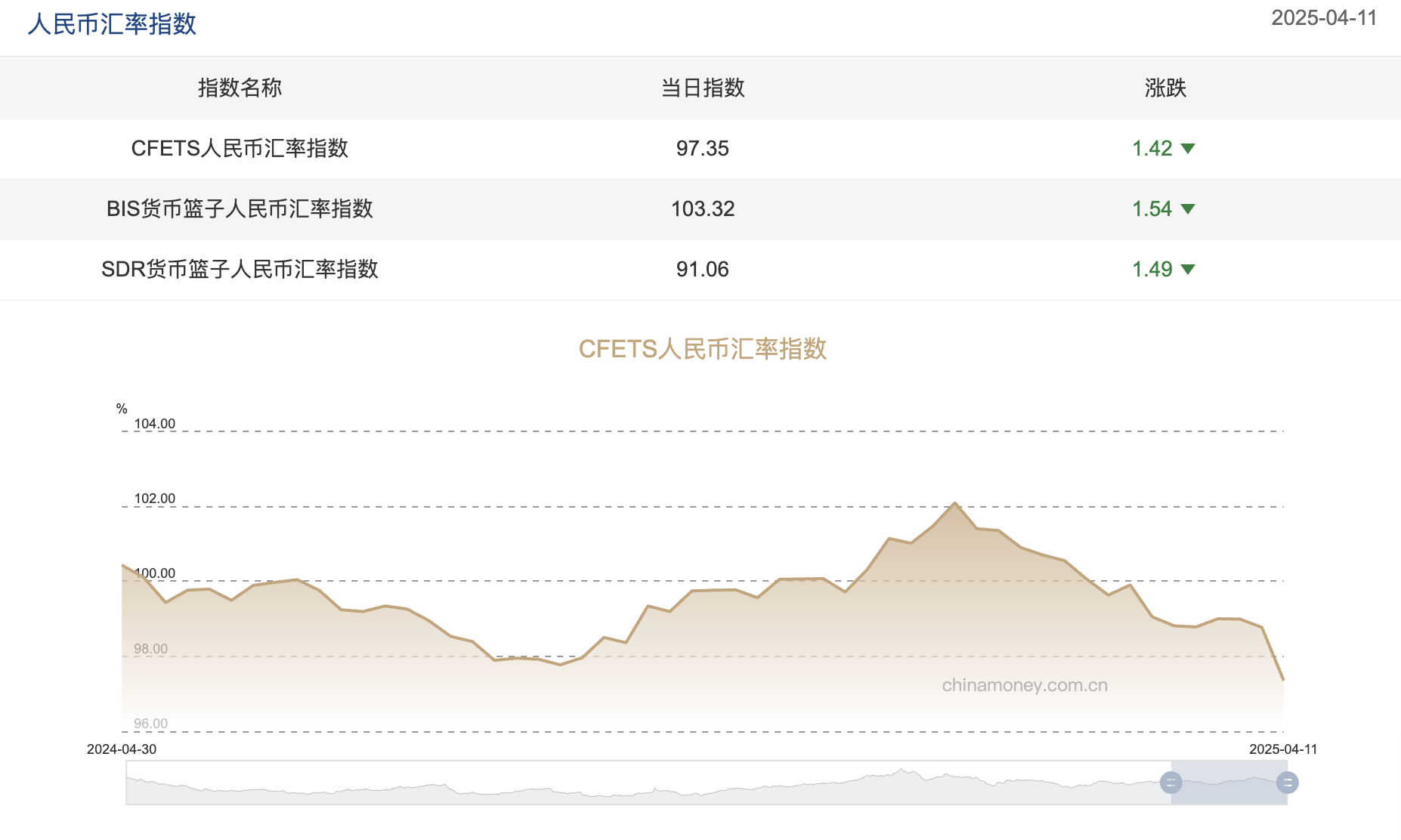
三大人民币汇率指数均下挫 CFETS指数按周跌1.42
Xin Hua Cai Jing· 2025-04-14 08:07
新华财经上海4月14日电(葛佳明) 中国外汇交易中心公布数据显示,4月11日当周三大人民币汇率指数全线下跌,CFETS人民币汇率指数报97.35,按周跌 1.42,创2023年9月以来低位;BIS货币篮子人民币汇率指数报103.32,按周跌1.54,创2024年1月以来低位;SDR货币篮子人民币汇率指数报91.06,按周跌 1.49,创2020年8月以来低位。 | 指数名称 | 当日指数 | | --- | --- | | CFETS人民币汇率指数 | 97.35 | | BIS货币篮子人民币汇率指数 | 103.32 | | SDR货币篮子人民币汇率指数 | 91.06 | 上周(4月7日至11日),市场对美国资产的信心因关税政策反复持续受挫,美国金融市场出现了股、债、汇三杀的局面,美元指数跌穿100整数关口,全周 累计跌幅达到3.06%,收报99.769,为2022年以来低位。 主要货币对美元多数上涨,瑞郎和日元上周受益于其避险属性涨幅居前,瑞郎上周涨至2015年以来高点周内大幅收涨5.3%;日元上周涨2.37%;欧元上周涨 幅约为3.59%,澳元和新元则同样受益于市场风险偏好的回暖均涨超4%。 高盛北亚 ...

道指重挫1000点,黄金创新高;美舆论质疑特朗普阵营操控股市牟利;中方是否会继续对美加征更高关税?商务部回应;普拉达收购范思哲丨每经早参
Mei Ri Jing Ji Xin Wen· 2025-04-10 22:10
Market Overview - US stock indices collectively declined, with the Nasdaq falling by 4.31%, S&P 500 down by 3.46%, and Dow Jones dropping by 1014.79 points, a decrease of 2.5% [4] - Major tech stocks also fell significantly, with Tesla down over 7%, Meta down over 6%, and Nvidia, Amazon, Apple, Google, and Microsoft all experiencing declines of more than 2% [4] - The Nasdaq Golden Dragon China Index decreased by 1.14%, with most Chinese concept stocks declining, while Li Auto and Xpeng Motors saw gains of over 5% and 3%, respectively [4] Economic Indicators - The US Consumer Price Index (CPI) for March showed a year-on-year increase of 2.4%, below the expected 2.6% and down from the previous 2.8% [4] - Month-on-month, the CPI decreased by 0.1%, contrasting with the expected increase of 0.1% and the previous increase of 0.2% [4] Commodity Market - Gold prices surged, with spot gold rising by 3.02% to $3175.03 per ounce, marking a new historical high, while COMEX gold futures increased by 3.73% to $3194.2 per ounce [5] - International oil prices saw significant declines, with WTI crude oil down by 3.40% to $60.23 per barrel and Brent crude down by 2.93% to $63.56 per barrel [5] Corporate Developments - CATL has been approved for listing on the Hong Kong Stock Exchange, which is expected to enhance its international visibility and support overseas business expansion [16][17] - IFBH Limited, a leading coconut water brand, has submitted an IPO application to list on the Hong Kong Stock Exchange, aiming to expand its market share [18][19] - Prada announced plans to acquire Versace for approximately $1.375 billion, which will strengthen its position in the fashion industry [20][21] - Anta Sports plans to fully acquire Jack Wolfskin for $290 million, aiming to expand its outdoor equipment market presence [22] - JD.com is launching a significant subsidy program for its food delivery service, investing over $1 billion to enhance market competitiveness [24][25] Regulatory and Policy Updates - The Chinese government is encouraging private enterprises to participate in the construction of new toll road mechanisms through various investment methods [9] - The State Administration of Foreign Exchange expressed confidence in the resilience of China's economic fundamentals and foreign exchange market, anticipating a stable outlook [8] International Relations - A study from Yale University indicated that tariffs could cost American households an average of $4,400, with the effective tariff rate reaching 25.3%, the highest since 1909 [13] - The US State Department announced the resignation of the US Ambassador to Ukraine, amid ongoing geopolitical tensions [13]


汇市观察|离岸人民币汇率震荡加剧,持续贬值可能性不大
Bei Jing Shang Bao· 2025-04-06 10:18
北京商报讯(记者 岳品瑜 董晗萱)受美国特朗普政府再度加征高关税等因素影响,北京商报记者注意到,4月以来,在岸、离岸人民币汇率波动加大,节前 两个交易日离岸人民币对美元汇率振幅近1000基点。 "短期内人民币走势会相对稳定,持续大幅贬值的可能性不大,特别是在美元指数承压的背景下;相反,若汇市波动水平持续处于高位,稳汇市措施可能出 手,以防范单边预期过度聚集及人民币超调风险。"东方金诚首席宏观分析师王青表示。 事实上,"双向波动"是人民币汇率的常态,在分析人士看来,特朗普政府所谓高关税对于人民币的冲击有限。面对"对等关税",中方已宣布,"将坚决采取 反制措施维护自身权益"。王青表示,预计接下来中美关税谈判将较快展开,后期实际执行关税有下调空间。特朗普政府本轮关税策略很可能是"先提价、再 打折",而美国自身物价和就业市场也无法承受"对等关税"的猛烈冲击。 王青判断,接下来一段时间的关税谈判进程、美元指数变化,以及国内宏观政策走向,将是牵动人民币汇率的主要因素。由于加征关税还会对美元形成一定 压制效应,以及美国加征关税无疑会加快国内宏观政策对冲步伐,预计二季度降准降息有望落地,都将对人民币汇率形成支撑。 中信证券首 ...

【笔记20250328— 央行:降准降息再等一下是对的】
债券笔记· 2025-03-29 00:21
2015 年 10 月 -2016 年 1 月,人民币快速贬值,央行开始收紧资金面,稳定汇率。 2016 年 1 月 22 日,央行行长助理张晓慧表示:"现阶段管理流动性要 高度关注人民币汇率的稳定,降准的政策信号过于强。" ——笔记哥《分析》 【笔记20250328— 央行:降准降息再等一下是对的(-央行继续净回笼资金-央行原副行长称降准降息再等一下是对的-传央行指导卖超长债+股市偏弱+资 金面均衡偏松=中上)】 资金面均衡偏松,长债收益率明显上行。 央行公开市场开展785亿元7天期逆回购操作,今日有930亿元逆回购到期,净回笼145亿元。 资金面均衡偏松,资金价格仍偏贵,DR001在1.72%附近、DR007在2.05%附近。 | | | | 银行间资金 | (2025.03.28) | | | | | | --- | --- | --- | --- | --- | --- | --- | --- | --- | | 同购代码 | 加权利率 | 变化 | 利率走势 | 最高利率 | 变化 | 成交量 | 变化量 | 成交量占 | | | (%) | (bp) | (近30天) | (%) | (bp) | ...
落空的美联储降息,对人民币汇率有什么影响?
21世纪经济报道· 2025-03-20 14:09
作 者丨林秋彤 编 辑丨张铭心 图 源丨2 1世纪经济报道 梁远浩 摄 3月以来,人民币汇率月线上呈现稳中有升趋势。 月内,美元自高位回落,美国总统特朗普的关税政策落地不及此前市场预期,加之关税政策反 复导致市场对美经济前景担忧,美元指数持续走低,在岸、离岸人民币汇率自3月首个交易日 (3月3日)的7 . 2 9 3 1、7 . 3 0 2 6一度升破7 . 2 3。 3月1 7日、3月1 8日离岸和在岸人民币汇率分 别触及月内最高值 ,为7 . 2 2 6 2、7 . 2 2 1 6。 北京时间3月2 0日凌晨,美联储议息会议决定将联邦基金目标利率维持在4 . 2 5%至4 . 5%区间 不 变 。 同 时 , 美 联 储 将 2 0 2 5 年 美 国 关 键 通 胀 指 标 PCE 同 比 增 速 从 1 2 月 预 估 的 2 . 5% 上 调 至 2 . 7%、核心PCE同比增速从1 2月预估的2 . 5%上调至2 . 8%。 点阵图显示,1 9位美联储官员中,有4位预计2 0 2 5年不降息,有4位预计将降息1次,9位预计 降息2次,2位预计降息3次及以上。中金公司分析称,点阵图显示2 0 2 5 ...
今年人民币汇率怎么走?田轩:或在波动中逐渐趋稳
Zhong Guo Jing Ji Wang· 2025-03-09 10:02
Core Viewpoint - The RMB exchange rate is expected to show a trend of gradual stabilization amidst fluctuations by 2025, influenced by both external and internal factors [1] External Factors - Increased uncertainty in the global economic environment, particularly due to the U.S. government's intensified measures against China, is likely to lead to greater volatility in the RMB exchange rate [1] - Recent market concerns regarding Trump's tariff threats have diminished, contributing to a weaker U.S. dollar index and declining U.S. Treasury yields, which may help stabilize the RMB [1] Internal Factors - Domestic issues such as insufficient demand and economic structural adjustments are also impacting the stability of the RMB exchange rate [1] - Continuous policy efforts are expected to improve the economic fundamentals in China, providing strong support for the RMB exchange rate [1] - Specific measures include the implementation of moderately loose monetary policy, potential reductions in reserve requirements and interest rates, and a fiscal deficit target of around 4% to boost consumption and investment efficiency [1] Central Bank Actions - In extraordinary circumstances, the central bank may take various measures, such as moderate intervention in the foreign exchange market and adjustments to foreign exchange reserves, to ensure the exchange rate remains stable at a reasonable equilibrium level [1]