市场情绪

Search documents
【光大研究每日速递】20251203
光大证券研究· 2025-12-02 23:06
Group 1 - The new stock fundraising scale has decreased month-on-month, with a total of 11 new stocks listed in November 2025, raising 10.188 billion yuan, but still maintaining a fundraising level above 10 billion yuan [4] - The average first-day increase for new stocks on the main board and the dual innovation board was 177.8% and 267.7%, respectively, indicating strong initial market performance [4] - The number of offline inquiry accounts continues to grow, reflecting sustained high demand for new stock subscriptions [4] Group 2 - The market sentiment has cooled slightly, with the proportion of rising stocks in the CSI 300 index decreasing month-on-month, although it remains above 50% [5] - Momentum indicators show a downward trend, suggesting a cautious outlook for the near future [5] - The CSI 300 index is currently in a non-prosperous emotional zone, indicating potential challenges ahead [5] Group 3 - The inbound tourism market in China is entering a high-quality development phase, driven by visa-free policies and cultural outreach, with significant growth potential [6] - Leading OTA companies like Ctrip and Trip.com are expected to benefit from the inbound tourism boom, while Tongcheng Travel is expanding into international markets [6] - Zhongxin Tourism is gradually starting its inbound tourism business, leveraging its rich domestic and international supply chain resources [6] Group 4 - The price of electrolytic cobalt reached 400,000 yuan per ton, with a month-on-month increase of 1.8%, indicating rising costs in the materials sector [7] - The price of carbon fiber remained stable at 83.8 yuan per kilogram, with a gross profit margin of -9.53 yuan per kilogram [7] Group 5 - The commercial aerospace sector is entering a new phase of rapid development, with the introduction of a three-year action plan and the establishment of a commercial aerospace department by the National Space Administration [7] - Investment opportunities in the commercial aerospace industry are being highlighted as a result of these developments [7] Group 6 - Xiaopeng Motors reported a year-on-year increase of 18.9% in deliveries, totaling 36,728 vehicles, while NIO saw a significant year-on-year increase of 147.9% [8] - Li Auto's deliveries decreased by 31.9% year-on-year, totaling 33,181 vehicles, indicating varying performance among new energy vehicle manufacturers [8] Group 7 - Shuiyang Co., Ltd. announced an employee stock ownership plan, reflecting long-term development confidence, with a funding source of up to 51.04 million yuan [8] - The plan involves a maximum of 938 participants and includes stock repurchased at a price of 20.46 yuan per share, accounting for 0.64% of the total share capital [8]

宏观金融类:文字早评2025/12/02-20251202
Wu Kuang Qi Huo· 2025-12-02 02:27
Report Industry Investment Rating No relevant content provided. Core Viewpoints of the Report - The overall market shows a complex situation with different trends in various sectors. In the stock index market, the policy supports the capital market, and the technology - growth sector remains the main line, with a long - term bullish view on the index. In the bond market, the fourth - quarter bond supply - demand pattern may improve, and the market is expected to remain volatile. For precious metals, silver is strong due to expectations of Fed's easing policies. In the non - ferrous metal market, most metals have different supply - demand situations and price trends. In the black building materials market, the steel and iron ore markets face different challenges, and the glass - soda ash and other sub - sectors also have their own characteristics. In the energy - chemical market, different products have different supply - demand and price trends. In the agricultural products market, different products such as livestock, grains, and oils also show different supply - demand and price trends [4][6][7]. Summary by Relevant Catalogs Macro - Financial Stock Index - **Market Information**: French President Macron will visit China from December 3 - 5. Many cities are implementing new housing subsidy policies. The Ministry of Industry and Information Technology encourages Chinese advantageous enterprises to "go global". The market's expectation of Fed's interest rate cut has increased, and the price of London spot silver has reached a new high [2]. - **Strategy Viewpoint**: The market rotation has accelerated, and the risk preference has decreased. The policy support for the capital market remains unchanged, and the technology - growth sector is the main line. The long - term view is to buy on dips [4]. Treasury Bonds - **Market Information**: On Monday, the main contracts of TL, T, TF, and TS had different price changes. The Bank of Japan governor mentioned future interest - rate hike paths. The CSRC is promoting the REITs market. The central bank conducted 1076 billion yuan of 7 - day reverse repurchase operations, with a net withdrawal of 2311 billion yuan [5]. - **Strategy Viewpoint**: The manufacturing PMI in November improved, but the service industry was weak. The social financing growth rate may remain weak at the end of the year. The central bank maintains a positive attitude towards funds. The bond market is expected to remain volatile, and attention should be paid to the stock - bond linkage and liquidity [6]. Precious Metals - **Market Information**: Shanghai gold and silver prices rose. COMEX gold and silver also had certain prices. The US economic data was lower than expected, pushing up the silver price. The US 11 - month ISM manufacturing PMI was 48.2 [7]. - **Strategy Viewpoint**: The silver price is expected to continue to rise strongly next week, with attention to the resistance level of 14,500 yuan/kg. Gold is recommended to buy on dips. The reference ranges for Shanghai silver and gold are provided [8]. Non - Ferrous Metals Copper - **Market Information**: The copper price rose, with LME copper up 0.51% and Shanghai copper at 89,380 yuan/ton. The LME copper inventory was flat, and the domestic copper inventory decreased. The spot import loss increased [10]. - **Strategy Viewpoint**: The market sentiment is positive due to the expected Fed's interest rate cut. The copper raw material supply is tight, and the price is expected to be strong. The reference ranges for Shanghai copper and LME copper are provided [11]. Aluminum - **Market Information**: The aluminum price rose, with LME aluminum up 0.8% and Shanghai aluminum at 21,885 yuan/ton. The domestic and LME aluminum inventories decreased. The market sentiment was weak [12]. - **Strategy Viewpoint**: The aluminum price is expected to rise further due to inventory reduction, supply disturbances, and copper price increase. The reference ranges for Shanghai aluminum and LME aluminum are provided [13]. Zinc - **Market Information**: The zinc price rose, with Shanghai zinc up 0.75% and LME zinc at 3065.5 dollars/ton. The zinc inventory decreased, and the import loss was high [14]. - **Strategy Viewpoint**: The zinc industry has a weak supply - demand situation, and the price is expected to fluctuate widely. The zinc market has low attractiveness to speculative funds [16]. Lead - **Market Information**: The lead price fell, with Shanghai lead down 0.10% and LME lead at 1982.5 dollars/ton. The lead inventory decreased, and the import profit was positive [17]. - **Strategy Viewpoint**: The lead price is expected to be strong in the short term due to the positive sentiment in the non - ferrous metal industry during the Fed's interest - rate cut cycle [18]. Nickel - **Market Information**: The nickel price rebounded, with Shanghai nickel at 117,850 yuan/ton. The nickel ore price was stable, and the nickel iron price decline slowed down [19]. - **Strategy Viewpoint**: The nickel price may fluctuate in the short term. Attention should be paid to the trends of nickel iron and ore prices. It is recommended to wait and see [20]. Tin - **Market Information**: The tin price rose, with Shanghai tin at 306,580 yuan/ton. The tin supply was tight, and the demand was weak. The inventory decreased [21]. - **Strategy Viewpoint**: The tin price is expected to be strong in the short term due to supply disturbances. It is recommended to wait and see. The reference ranges for domestic and overseas tin are provided [22]. Carbonate Lithium - **Market Information**: The carbonate lithium price rose, with the MMLC index up 1.07%. The futures price also rose [23]. - **Strategy Viewpoint**: The future demand expectation has differences, and the price may fluctuate greatly. It is recommended to wait and see or use options. The reference range for the futures contract is provided [23]. Alumina - **Market Information**: The alumina price fell, with the index at 2716 yuan/ton. The inventory decreased, and the import profit was positive [24]. - **Strategy Viewpoint**: The alumina price is expected to be stable in the short term. It is recommended to wait and see. Attention should be paid to supply - side policies and Fed's policies [26]. Stainless Steel - **Market Information**: The stainless - steel price rose, with the main contract at 12,445 yuan/ton. The supply was high, and the demand improved marginally. The inventory increased [27]. - **Strategy Viewpoint**: The stainless - steel price is expected to fluctuate widely due to high supply and cost pressure [27]. Cast Aluminum Alloy - **Market Information**: The cast aluminum alloy price rose, with the main contract at 21,055 yuan/ton. The inventory decreased [28]. - **Strategy Viewpoint**: The cast aluminum alloy price is expected to follow the aluminum price trend due to cost support and supply disturbances [29]. Black Building Materials Steel - **Market Information**: The steel price rose, with rebar and hot - rolled coil prices increasing. The export to South Korea may be affected by anti - dumping duties [31]. - **Strategy Viewpoint**: The steel demand has entered the off - season, and the hot - rolled coil inventory pressure remains. Attention should be paid to the production - cut rhythm and important meetings [32]. Iron Ore - **Market Information**: The iron ore price rose, with the main contract at 801 yuan/ton. The supply and demand situation changed, and the inventory increased [33]. - **Strategy Viewpoint**: The iron ore price is expected to fluctuate within a range. Attention should be paid to the overall commodity environment [34]. Glass and Soda Ash - **Glass** - **Market Information**: The glass price fell, with the main contract at 1036 yuan/ton. The inventory decreased, and the demand was weak [35]. - **Strategy Viewpoint**: The glass market is in the bottom - exploring stage, and the price is expected to fluctuate widely. It is recommended to short on rallies [36]. - **Soda Ash** - **Market Information**: The soda - ash price was stable, with the main contract at 1176 yuan/ton. The inventory decreased, and the demand was weak [37]. - **Strategy Viewpoint**: The soda - ash price is expected to be stable in the short term. It is recommended to be bearish [37]. Manganese Silicon and Ferrosilicon - **Market Information**: The manganese - silicon and ferrosilicon prices rose. The manganese - silicon price was supported at 5600 yuan/ton, and the ferrosilicon price was in a downward channel [38]. - **Strategy Viewpoint**: The black - building materials market is expected to have a rebound opportunity. The manganese - silicon price is unlikely to fall significantly, and attention should be paid to the manganese - ore situation. The ferrosilicon has low operability [40][42]. Industrial Silicon and Polysilicon - **Industrial Silicon** - **Market Information**: The industrial - silicon price rose, with the main contract at 9145 yuan/ton. The inventory increased, and the demand was weak [43]. - **Strategy Viewpoint**: The industrial - silicon price is expected to be stable in the short term. The supply and demand are weak, and it is easily affected by market sentiment [44]. - **Polysilicon** - **Market Information**: The polysilicon price rose, with the main contract at 57,705 yuan/ton. The supply is expected to decrease, and the demand is weak. The inventory decreased [45]. - **Strategy Viewpoint**: The polysilicon price is expected to be unstable in the short term. Attention should be paid to the platform - company situation [47]. Energy - Chemical Rubber - **Market Information**: The rubber price fell, and the technical pattern was broken. The supply and demand situation was complex, and the inventory increased [49]. - **Strategy Viewpoint**: It is recommended to wait and see or use short - term trading. A hedging strategy is also recommended [54]. Crude Oil - **Market Information**: The crude - oil price rose, with the INE main contract at 455.7 yuan/barrel. The refined - oil inventories changed [55]. - **Strategy Viewpoint**: The crude - oil price is expected to be stable in the short term. It is recommended to wait and see and test the OPEC's export - support intention [56]. Methanol - **Market Information**: The methanol price rose, with the main contract at 2136 yuan/ton. The supply and demand improved, and the inventory decreased [57]. - **Strategy Viewpoint**: The methanol price is expected to be stable in the short term. It is recommended to wait and see and pay attention to the positive - spread opportunity [57]. Urea - **Market Information**: The urea price rose, with the main contract at 1675 yuan/ton. The supply and demand improved, and the inventory decreased [58]. - **Strategy Viewpoint**: The urea price is expected to bottom out. It is recommended to buy on dips [59]. Pure Benzene and Styrene - **Market Information**: The pure - benzene and styrene prices were stable. The supply and demand situation changed, and the inventory increased [60]. - **Strategy Viewpoint**: The styrene non - integrated profit has room for upward repair. It is recommended to buy when the inventory situation reverses [61]. PVC - **Market Information**: The PVC price rose, with the main contract at 4553 yuan/ton. The supply was high, and the demand was weak. The inventory increased [62]. - **Strategy Viewpoint**: The PVC price is expected to be weak in the short term. It is recommended to short on rallies [64]. Ethylene Glycol - **Market Information**: The ethylene - glycol price fell, with the main contract at 3882 yuan/ton. The supply and demand situation changed, and the inventory increased [65]. - **Strategy Viewpoint**: The ethylene - glycol price is expected to be weak in the medium term. It is recommended to short on rallies [66]. PTA - **Market Information**: The PTA price rose, with the main contract at 4762 yuan/ton. The supply and demand situation changed, and the inventory decreased [67]. - **Strategy Viewpoint**: The PTA price is expected to have a short - term rebound opportunity. It is recommended to buy on dips [68]. p - Xylene - **Market Information**: The p - xylene price rose, with the main contract at 6930 yuan/ton. The supply and demand situation changed, and the inventory increased [69]. - **Strategy Viewpoint**: The p - xylene price is expected to be stable in the short term. It is recommended to buy on dips [70]. Polyethylene (PE) - **Market Information**: The PE price rose, with the main contract at 6803 yuan/ton. The supply and demand situation changed, and the inventory decreased [71]. - **Strategy Viewpoint**: The PE price is expected to be stable in the short term. It is recommended to short the LL1 - 5 spread on rallies [72]. Polypropylene (PP) - **Market Information**: The PP price fell, with the main contract at 6397 yuan/ton. The supply and demand situation changed, and the inventory decreased [73]. - **Strategy Viewpoint**: The PP price is expected to be stable in the short term. It may be supported in the first quarter of next year [75]. Agricultural Products Live Pigs - **Market Information**: The pig price rose in some areas and fell in others. The supply was high, and the demand was weak [77]. - **Strategy Viewpoint**: The pig price is expected to be weak. It is recommended to short near - month contracts or use reverse - spread strategies [78]. Eggs - **Market Information**: The egg price was stable or rose. The supply was stable, and the demand was weak [79]. - **Strategy Viewpoint**: The egg price is expected to be strong in the short term and weak in the medium term. A short - long and long - short strategy is recommended [80]. Soybean and Rapeseed Meal - **Market Information**: The soybean price fell, and the import cost decreased. The domestic soybean and meal inventories were high [81]. - **Strategy Viewpoint**: The soybean and meal prices are expected to fluctuate. The import cost has a bottom, and the inventory is large [83]. Oils - **Market Information**: The palm - oil price was weak, and the export data decreased. The domestic oil inventories decreased [84]. - **Strategy Viewpoint**: The palm - oil price may reverse if the Indonesian production decreases. It is recommended to buy on dips [86]. Sugar - **Market Information**: The sugar price was stable. The domestic sugar production decreased, and the global supply was expected to be in surplus [87]. - **Strategy Viewpoint**: The sugar price is expected to be weak. It is recommended to short on rallies [88]. Cotton - **Market Information**: The cotton price rose. The supply was high, and the demand was medium [89]. - **Strategy Viewpoint**: The cotton price is expected to fluctuate. It is difficult to have a unilateral trend [91].
双融日报-20251202
Huaxin Securities· 2025-12-02 01:33
Core Insights - The report indicates that the current market sentiment score is 81, categorizing it as "overheated," suggesting a high level of investor optimism and potential market risks [4][8][20] - Key investment themes identified include non-ferrous metals, banking, and low-altitude economy, each with specific drivers and related stocks [4][8] Non-Ferrous Metals - The non-ferrous metals theme is driven by expectations of demand increase due to potential US interest rate cuts and AI data center growth, leading to a price increase for copper and aluminum [4] - Copper prices are supported by financial attributes, supply constraints, and resilient traditional demand, while aluminum faces tight domestic capacity and limited overseas growth [4][8] Banking Sector - The banking sector is highlighted for its high dividend yield, with the China Securities Bank Index yielding 6.02%, significantly above the 10-year government bond yield [4] - In a slowing economy with increased market volatility, bank stocks are seen as stable investment options for long-term funds like insurance and social security [4][8] Low-Altitude Economy - The low-altitude economy is positioned for growth, with the upcoming Asia General Aviation Exhibition expected to attract over 300 companies from 21 countries, indicating significant international interest [4] - The report emphasizes the vast market potential in this sector, particularly in infrastructure and aircraft manufacturing, enhanced by improved information processing capabilities [4][8] Market Sentiment and Strategy - The report suggests that when market sentiment is above 70, it may indicate resistance, while levels below 30 could provide support, guiding investment strategies [8][20] - Investors are advised to consider reducing positions in an overheated market to avoid potential losses from market corrections [20]
文投控股:公司股票价格走势受到宏观经济等多种因素影响
Zheng Quan Ri Bao Wang· 2025-12-01 14:12
Core Viewpoint - The stock price of the company is influenced by various factors including macroeconomic conditions, industry policies, market sentiment, and investor preferences, leading to a volatile trend [1] Group 1 - The company aims to enhance its operational management and actively promote orderly development of both existing and new businesses to create long-term value for investors [1] - The company emphasizes the importance of communication with investors and plans to strengthen engagement through earnings briefings, announcements, and responses on the Shanghai Stock Exchange interactive platform [1] - The company is committed to guiding long-term and stable market value expectations among investors [1]

——金融工程量化月报20251201:市场情绪降温,基金抱团程度加强-20251201
EBSCN· 2025-12-01 13:05
- The "Market Sentiment Tracking" system includes the "Proportion of Rising Stocks Sentiment Indicator," which calculates the proportion of stocks with positive returns in the past N days within the CSI 300 Index. This indicator helps identify market sentiment by detecting market bottoms when the proportion increases and potential overheating when the proportion is high. However, it has limitations in avoiding market downturns and may miss gains during sustained market rallies[12][13][15] - The "Proportion of Rising Stocks Timing Strategy" applies two smoothing windows (N1=50, N2=35) to the sentiment indicator. When the short-term smoothed line exceeds the long-term smoothed line, it signals a bullish market view. Conversely, when the short-term line falls below the long-term line, it indicates a cautious market outlook[13][15][16] - The "Moving Average Sentiment Indicator" uses an eight-moving-average system (parameters: 8, 13, 21, 34, 55, 89, 144, 233) to assess the CSI 300 Index's trend. The indicator assigns values of -1, 0, or 1 based on the moving average range, correlating with the index's performance. A bullish signal is generated when the current price exceeds the moving average values for more than five of the eight averages[21][26] - The "PB-ROE-50 Strategy" is based on the PB-ROE pricing model and incorporates factors like SUE and ROE growth to identify stocks with expectation gaps. The strategy selects 50 stocks to form a portfolio, aiming to enhance returns by leveraging expectation differences and additional alpha factors[30][33][34] - The "Institutional Research Strategy" includes "Public Fund Research Stock Selection" and "Private Fund Research Tracking." These strategies utilize institutional research data, such as the number of times a company is researched and its pre-research performance relative to benchmarks, to identify alpha opportunities[37][39][40] - The "Leverage Ratio Negative List" introduces three leverage ratio metrics: traditional, strict, and relaxed. The relaxed leverage ratio includes additional liabilities like other current liabilities and non-current liabilities due within one year, providing more opportunities for short-selling gains compared to traditional metrics[42][43][45] - The "Financial Cost Burden Ratio" measures a company's interest payment pressure using the formula: Financial Cost Burden Ratio = Interest Expense / EBIT. This metric focuses on interest expenses post-2018, offering a clearer view of financial costs and identifying companies with high repayment pressure[46][47][48] - The "Proportion of Rising Stocks Sentiment Indicator" showed a slight month-on-month decline as of November 28, 2025, with a value above 50%, indicating cooling market sentiment[12] - The "Proportion of Rising Stocks Timing Strategy" indicated a cautious market view as the short-term smoothed line was below the long-term smoothed line in the past month[16] - The "Moving Average Sentiment Indicator" suggested the CSI 300 Index was in a non-prosperous sentiment zone as of November 28, 2025[21] - The "PB-ROE-50 Strategy" delivered negative excess returns in November 2025: -0.08% for the CSI 500 pool, -1.09% for the CSI 800 pool, and -3.26% for the entire market pool[30][34] - The "Institutional Research Strategy" showed mixed results in November 2025: the "Public Fund Research Stock Selection" achieved a 3.49% excess return relative to the CSI 800, while the "Private Fund Research Tracking" recorded a -1.36% excess return relative to the CSI 800[37][39]
红利风格择时周报(1124-1128)-20251201
GUOTAI HAITONG SECURITIES· 2025-12-01 11:04
Group 1 - The core point of the report indicates that the comprehensive factor value of the dividend style timing model for the week of November 24 to November 28, 2025, is -0.69, which is relatively stable compared to -0.66 from the previous week, remaining below 0 and not issuing a positive signal [1][6]. - The marginal changes in various factors this week are minimal compared to last week, with the slight decrease in the comprehensive factor attributed to weaker excess performance of dividends and reduced positive contribution from the momentum factor [9][12]. - The main negative contributions to the dividend scoring are due to the downward trend in U.S. Treasury yields and the recovery in industry analyst sentiment, while market sentiment and the dividend momentum factor provide positive contributions [9][12]. Group 2 - The report includes a detailed breakdown of the latest factor values as of November 28, 2025, showing various indicators such as the non-manufacturing PMI for services at -0.12, M2 year-on-year growth at 0.83, and the 10-year U.S. Treasury yield at -1.32 [12]. - The report highlights that the financing net purchase factor is at -1.38, indicating a significant negative sentiment in financing activities, while the industry average sentiment is at 2.07, reflecting a stable outlook [12].
自称“投机”的400多亿私募创始人,做了一场让价值投资者无比共鸣的分享……
聪明投资者· 2025-12-01 07:04
Core Viewpoint - The discussion emphasizes the importance of understanding the distinction between investment and speculation, highlighting that successful speculation requires a solid foundation in investment principles [5][11][97]. Group 1: Investment Philosophy - Honesty is crucial in investment, and one must respect facts and changing realities rather than relying solely on past research [6][7]. - Continuous research on each company is essential, with quarterly reports serving as opportunities to validate or refute investment judgments [7][62]. - The investment approach should be specific to each industry rather than making broad assumptions about the economy [8][75]. Group 2: Speculation Insights - Speculation is defined as earning returns based on price differences of the same stock at different times, while investment is about increasing a company's intrinsic value [26][28]. - Successful speculation requires understanding market emotions and the underlying value of companies, as market sentiment can significantly influence stock prices in the short term [34][36]. - The company adopts a strict stop-loss discipline, with a focus on controlling losses rather than proving investment judgments correct [46][91]. Group 3: Market Dynamics - The company believes that market emotions can often overshadow fundamental values, especially in the short term, making it essential to analyze historical price movements to gauge current sentiment [63][64]. - The approach to speculation involves being skeptical of both the market and oneself, maintaining a balance between confidence and doubt [41][44]. - The company emphasizes the need to adapt to changing market conditions and avoid rigid long-term commitments without ongoing evaluation [60][62]. Group 4: Risk Management - The company employs a diversified strategy across multiple markets and industries to mitigate risks, with strict loss limits in place [12][46]. - Understanding the cyclical nature of industries is vital, and the company focuses on short to medium-term changes rather than long-term predictions [87][88]. - The company’s stop-loss strategy is based on the ability to bear losses rather than subjective judgments about market conditions [91][92].

黑色建材日报-20251201
Wu Kuang Qi Huo· 2025-12-01 03:15
1. Report Industry Investment Rating - No relevant information provided 2. Core Viewpoints - The steel demand has officially entered the off - season, and the hot - rolled coil inventory pressure remains. Attention should be paid to the actual progress of the production reduction rhythm and the tone of important meetings [2]. - The iron ore price is expected to operate within an oscillatory range, with high overall inventory and existing structural contradictions [5]. - The ferroalloy shows a weak trend, but there's no need to be overly pessimistic. It is recommended to focus on the inflection point of market sentiment and corresponding price changes [9]. - The industrial silicon market presents a situation of weak supply and demand with limited marginal changes, and the price is easily affected by the capital sentiment of other new - energy varieties [13]. - The polysilicon market has obvious contradictions between reality and expectation, and the inventory pressure before the Spring Festival is difficult to relieve. Attention should be paid to the final implementation of the platform company [15]. - The glass industry is still at the bottom - exploring stage, and the market is expected to continue wide - range oscillations. It is advisable to consider short - selling at high levels [18]. - The soda ash price is expected to remain stable in the short term, but it should be regarded as bearish before the demand side improves significantly [20]. 3. Summary by Related Catalogs Steel - **Market Quotes** - The closing price of the rebar main contract was 3,110 yuan/ton, up 17 yuan/ton (0.549%) from the previous trading day. The spot prices in Tianjin and Shanghai increased by 10 yuan/ton [1]. - The closing price of the hot - rolled coil main contract was 3,302 yuan/ton, up 9 yuan/ton (0.273%) from the previous trading day. The spot price in Lecong increased by 10 yuan/ton, and that in Shanghai remained unchanged [1]. - **Strategy Views** - Rebar supply and demand both declined, and inventory continued to be depleted, with a neutral overall performance. Hot - rolled coil production increased, apparent demand slightly declined, and inventory was only slightly depleted [2]. - South Korea's anti - dumping tax on Chinese hot - rolled thick steel plates will affect steel exports to some extent [2]. Iron Ore - **Market Quotes** - The main contract of iron ore (I2601) closed at 794.00 yuan/ton on Friday, with a change of - 0.69% (- 5.50), and the position changed by - 23,368 lots to 391,000 lots. The weighted position was 920,100 lots. The spot price of PB powder at Qingdao Port was 794 yuan/wet ton, with a basis of 49.54 yuan/ton and a basis rate of 5.87% [4]. - **Strategy Views** - In terms of supply, the overseas iron ore shipment volume decreased month - on - month. In terms of demand, the daily average pig iron output decreased, the number of blast furnace overhauls increased, and the steel mill profitability rate dropped to a near - three - year low. The port inventory increased month - on - month, and the steel mill inventory was slightly consumed [5]. - The iron ore overall inventory is still high, but there are structural contradictions, and the spot has certain support. The price is expected to operate within an oscillatory range [5]. Manganese Silicon and Ferrosilicon - **Market Quotes** - On November 28, the main contract of manganese silicon (SM601) closed down 0.25%, at 5,612 yuan/ton. The spot price in Tianjin was 5,630 yuan/ton, with a premium of 208 yuan/ton over the futures [7]. - The main contract of ferrosilicon (SF603) closed flat at 5,390 yuan/ton. The spot price in Tianjin was 5,400 yuan/ton, with a premium of 10 yuan/ton over the futures [8]. - Last week, the manganese silicon price fluctuated narrowly at the lower edge of the range, and the ferrosilicon price slowly declined [8]. - **Strategy Views** - The market sentiment has improved, but the black - metal sector is still weak, and the ferroalloy is also affected. There's no need to be overly pessimistic, and attention should be paid to the inflection point of market sentiment [9]. - The manganese silicon fundamentals are not ideal, and it is difficult to drive the price down significantly. Attention should be paid to the manganese ore situation. The ferrosilicon supply - demand fundamentals have no obvious contradictions, and the operability is low [10]. Industrial Silicon and Polysilicon - **Market Quotes** - The main contract of industrial silicon (SI2601) closed at 9,130 yuan/ton on Friday, with a change of + 0.16% (+ 15). The weighted contract position changed by - 28,495 lots to 381,451 lots [12]. - The main contract of polysilicon (PS2601) closed at 56,425 yuan/ton on Friday, with a change of + 2.15% (+ 1,190). The weighted contract position changed by + 5,632 lots to 260,870 lots [14]. - **Strategy Views** - The production of industrial silicon has been declining, the demand from polysilicon is weakening, the demand from silicone is stable in the short term, and the cost support is stable. The price is easily affected by the capital sentiment of other new - energy varieties [13]. - The polysilicon production is expected to decline in December, the downstream silicon wafer production cut is expected to increase, and the inventory pressure is difficult to relieve. The price is affected by the delivery game and the platform company's implementation expectations [15]. Glass and Soda Ash - **Market Quotes** - The glass main contract closed at 1,041 yuan/ton on Friday, up 0.39% (+ 4). The inventory of float - glass sample enterprises decreased by 941,000 boxes week - on - week (- 1.49%) [17]. - The soda ash main contract closed at 1,176 yuan/ton on Friday, up 0.09% (+ 1). The inventory of soda ash sample enterprises decreased by 57,000 tons week - on - week (- 1.49%) [19]. - **Strategy Views** - The glass supply has shrunk, the market sentiment has briefly improved, but the overall trading atmosphere in the spot market is still light, and the inventory has decreased slightly. The market is expected to continue wide - range oscillations [18]. - The soda ash production load has slightly increased, the inventory has slightly decreased, and the price is supported by cost and pending orders. It is expected to remain stable in the short term, but should be regarded as bearish before the demand improves [20].
元鼎证券|如何提高打新中签率与上市首日的收益确定性
Sou Hu Cai Jing· 2025-12-01 01:47
Core Insights - The article discusses strategies to improve the success rate of new stock subscriptions and the certainty of returns on the first day of listing [1][3] Group 1: Strategies for Improving Subscription Success Rate - Effective fund management is crucial to ensure sufficient capital for new stock subscriptions, as excessive funds may lower the success rate due to allocation based on subscription quantity [1] - Staying informed about new stock information, including company fundamentals, industry outlook, and financial status, aids in assessing investment value and enhances subscription success probability [3] - Choosing the right subscription timing by analyzing historical data and market trends can help avoid peak periods, typically selecting a time frame from two days before the issuance to the subscription day [3] Group 2: Techniques to Enhance First-Day Return Certainty - Utilizing multiple accounts for subscription can increase the chances of success if conditions permit [3] - Participating in offline subscriptions generally yields a higher success rate due to the larger participation of institutional and major individual investors [3] - Understanding market sentiment is vital, as positive market conditions encourage more investors to subscribe, thereby increasing success rates [3] Group 3: Long-Term Investment Considerations - Long-term holding of fundamentally strong companies with growth potential can yield satisfactory returns, even if the initial subscription success rate is low [3] - Diversifying investments across different stocks or sectors can mitigate risks and enhance overall return certainty [3] - Continuous monitoring of market performance post-listing is essential, as both first-day performance and subsequent market behavior are critical for strategy adjustments [3] Group 4: Knowledge and Experience Sharing - Learning investment knowledge and exchanging experiences with other investors can elevate overall investment skills, thereby improving subscription success rates and first-day return certainty [3]
后续!“主力请拉涨停救子”感动网友,是巧合还是回应?
Sou Hu Cai Jing· 2025-11-30 19:10
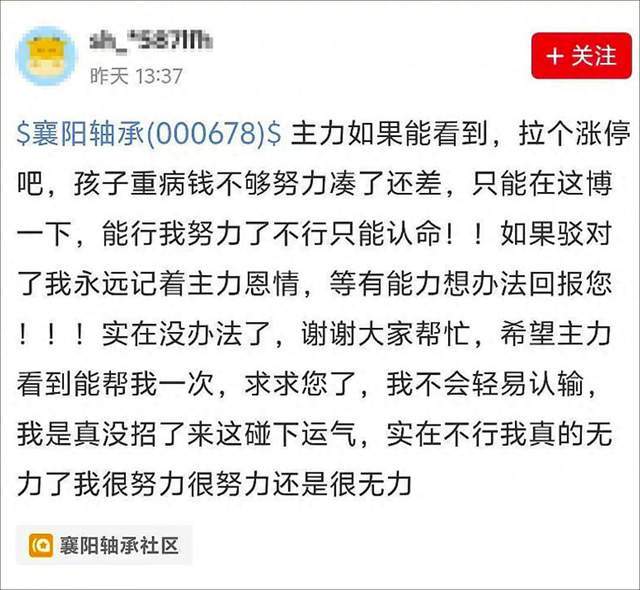
Core Viewpoint - The stock price of Xiangyang Bearing surged to the daily limit of 14.76 CNY per share, coinciding with a desperate plea from a shareholder seeking help to fund his sick child's medical expenses, which sparked widespread discussion and emotional responses among investors [1][3]. Group 1: Market Reaction - On November 28, the stock initially opened lower but quickly rose to the daily limit, with a net inflow of 444.5 million CNY from institutional investors, indicating strong capital involvement [3]. - Many investors expressed their gratitude towards the "main force" in online communities, with some planning to buy shares on December 1 to show support [3]. Group 2: Emotional and Ethical Considerations - The plea from the shareholder may have touched the "sympathy" or "emotions" of some investors, potentially triggering a "retail investor rally" or a chain reaction in market sentiment [5]. - There are concerns regarding the authenticity of the plea, with some arguing that using a child's medical funds for stock investment is a highly irresponsible gamble [4][9]. Group 3: Company Fundamentals and Market Dynamics - Despite the stock's sharp rise, it is noted that Xiangyang Bearing is currently in a loss-making position, suggesting that the price increase may be more influenced by market sentiment and speculative trading rather than the company's fundamentals [9]. - The incident highlights the phenomenon of "emotional trading" in the A-share market, where stock prices can be driven by narratives and sentiments rather than underlying financial performance [5][9].