稳增长

Search documents
2026年度宏观展望:承前启后,“质”创未来
Shanghai Securities· 2025-12-04 11:05
Group 1: Economic Trends - Domestic demand and real estate are weak, while exports show resilience, with fixed asset investment growth declining to -1.7% in October 2025[9] - From January to October 2025, trade surplus increased by $174.7 billion compared to the same period in 2024, contributing positively to the economy[16] - Consumer retail sales growth for January to October 2025 was 4.3%, but October saw a drop to 2.9%[24] Group 2: Financing and Inflation - Financing demand remains poor, with social financing growth primarily driven by government bonds, while credit growth is declining[46] - M2 money supply growth in October 2025 was 8.2%, with a significant portion attributed to month-on-month increases[49] - CPI growth was negative for several months, with October's CPI at 0.2%, indicating ongoing deflation risks[52] Group 3: Policy Outlook - The GDP growth target for 2025 is around 5.0%, with a need for a 4.6% growth in Q4 to meet this target[56] - The People's Bank of China is expected to maintain a supportive monetary policy, with potential interest rate cuts in 2026[59] - The government budget for 2025 is set at CNY 29.7 trillion, with a 4.4% year-on-year increase, but actual spending is lagging behind targets[33] Group 4: Five-Year Plan Execution - The Five-Year Plan addresses current economic issues, with a projected increase in household consumption share by 15-20% over the next five years[80] - Employment and income growth are critical, with a focus on enhancing service sector contributions to job creation[85] - The report emphasizes the need for innovation and self-sufficiency in key technologies to address manufacturing capacity issues[92]
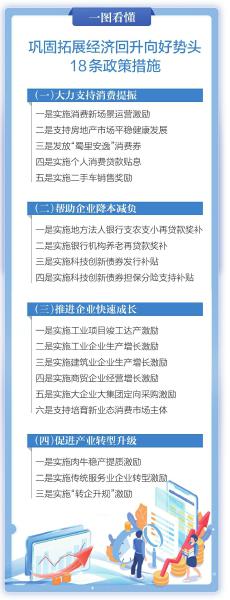
四川出台新一轮稳增长政策,巩固拓展经济回升向好势头 新“18 条”延续了啥?调整了啥?
Si Chuan Ri Bao· 2025-12-04 08:41
Core Viewpoint - The Sichuan Provincial Government has issued a new set of policies, referred to as the "new 18 measures," aimed at consolidating and expanding the positive momentum of economic recovery, focusing on consumption, production, circulation, and boosting expectations [4][8]. Group 1: Policy Framework - The new policies emphasize systematic planning and coordination with central and previously issued policies to enhance overall policy effectiveness and create a synergistic effect [3][5]. - The new 18 measures include 18 specific initiatives that support consumption, reduce costs for enterprises, promote rapid growth of businesses, and facilitate industrial transformation and upgrading [4][6]. Group 2: Continuity and Adjustments - The new 18 measures retain several initiatives from previous policies, such as incentives for second-hand car sales and targeted procurement by large enterprises, while also introducing new adjustments [5][6]. - The fiscal incentives for newly established industrial projects have been increased, with the maximum subsidy raised from 1 million yuan to 1.5 million yuan for projects meeting specific criteria [6]. Group 3: Targeted Measures - The new policies introduce measures to help enterprises reduce costs, such as subsidies for issuing technology innovation bonds, with increased support for first-time issuers [7]. - There is a focus on cultivating new market entities in the consumption sector, with financial incentives for service-oriented e-commerce platforms that achieve significant growth [7][8].

机构:钢铁行业未来存在估值修复的机会
Zheng Quan Shi Bao Wang· 2025-12-04 00:55
Core Viewpoint - The steel industry in China is currently facing supply-demand contradictions, but with the implementation of "stabilizing growth" policies, steel demand is expected to remain stable or slightly increase, supported by real estate stabilization, steady infrastructure investment, continuous manufacturing development, and high steel exports [1] Group 1: Production and Demand - In October, China's stainless steel crude steel production reached 3.6244 million tons, an increase of 78,700 tons month-on-month, representing a growth of 2.22% [1] - The overall profit of the steel industry is declining, but the total steel demand is anticipated to remain stable due to various supportive factors [1] Group 2: Supply and Industry Structure - The supply side is expected to tighten under the influence of policy expectations, leading to increased industry concentration [1] - The macro trend of high-quality economic development and new productive forces is expected to benefit high-end steel products, particularly those with high barriers and added value [1] Group 3: Investment Opportunities - The steel industry is expected to see a stable and improving industrial pattern, with some companies currently undervalued, presenting structural investment opportunities [1] - Companies with high gross margins and strong cost control, as well as leading steel enterprises benefiting from economies of scale, are likely to have valuation recovery opportunities in the future [1] Group 4: Long-term Outlook - Under the ongoing supply-side "anti-involution," steel production capacity is concentrating on quality leading companies [1] - On the demand side, special steel is expected to benefit from manufacturing upgrades and AI transformation, while leading companies in the ordinary steel sector may benefit from improvements in the industry supply-demand structure in the medium to long term [1]
四季度以来一批重大项目建设顺利推进
Zheng Quan Ri Bao· 2025-12-02 16:17
Group 1 - The core viewpoint of the articles highlights the acceleration of major project construction across various regions in China, aiming to boost effective investment and stabilize economic growth by the end of 2025 [1][2]. - In Fujian Province, a total of 130 projects with an investment of 701.26 billion yuan were included in a concentrated commencement and completion event, with 65 projects starting construction and 65 being completed [1]. - Chongqing launched 177 major projects with a total investment exceeding 180 billion yuan, covering multiple sectors such as modern industry, infrastructure, social welfare, and ecological protection [1]. Group 2 - Investment in major projects is seen as a "ballast stone" for stabilizing economic growth, creating a closed loop of "investment-production-revenue" that activates the industrial chain's collaborative effects [2]. - Guangdong Province has planned 1,500 key construction projects with an annual investment target of 1 trillion yuan, achieving 96% of its investment goal by October 2025 [2]. - The construction of infrastructure projects is expected to improve public services and enhance the overall living experience, laying a foundation for future industrial development and economic upgrades [2]. Group 3 - To ensure the sustained acceleration of major project construction, local policies should focus on five core areas: resource assurance, efficiency in approvals, financial empowerment, environmental optimization, and mechanism protection [3]. - Streamlining approval processes through "parallel approvals and acceptance of incomplete applications" is recommended to simplify project initiation and land use [3]. - Encouraging local enterprises to participate in project subcontracting and material supply can help reduce construction costs and enhance the precision of industrial chain support [3].
地方债年度发行规模首次突破10万亿元
Xin Hua Cai Jing· 2025-12-02 12:19
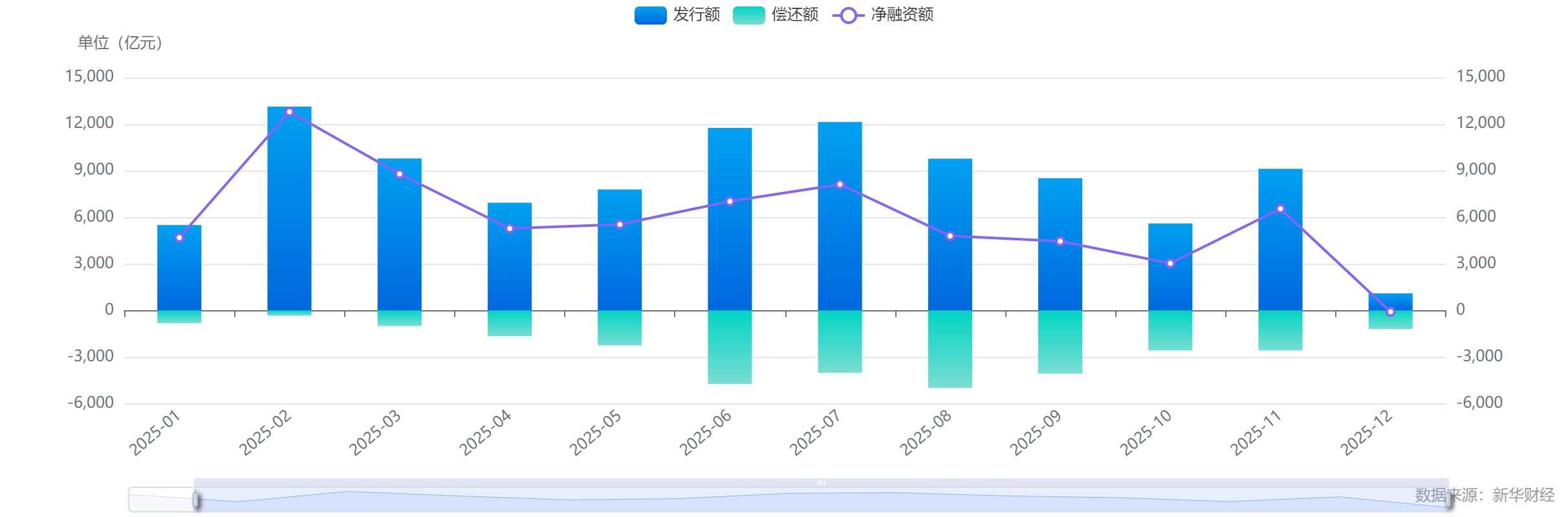
Core Insights - The total issuance of local government bonds in China for 2025 has surpassed 10 trillion yuan, marking the first time this annual scale has crossed the 10 trillion yuan threshold [1][3] - The increase in local bond issuance is seen as a necessary measure for stabilizing growth and managing long-term debt risks, emphasizing the need to balance growth and risk prevention [1][3] Group 1: Local Government Bond Issuance - As of December 2, 2025, the net financing amount of local government bonds is approximately 7.1 trillion yuan, with total issuance around 10.1 trillion yuan, including 2.55 trillion yuan in general bonds and 7.56 trillion yuan in special bonds [1] - The issuance scale for local government bonds has been notably high in 2025, with approximately 2.8 trillion yuan, 2.6 trillion yuan, and 3 trillion yuan issued in the first three quarters respectively [1] Group 2: Special Bonds and Project Financing - The issuance of new special bonds is accelerating, which is expected to facilitate the advancement of major local projects and increase tangible work output [3] - The planned issuance of local government bonds for December 2025 totals 1.05 billion yuan, with 213 million yuan allocated for new special bonds, a significant decrease compared to the previous year [3] - The new special bond issuance is expected to reach a record high, taking into account the "negative list" management of fund allocation and the saturation of traditional infrastructure projects [3] Group 3: Future Projections - For 2026, the limit for new local government special bonds is anticipated to reach 5 trillion yuan, with specific allocations for debt repayment, land acquisition, and project construction [4] - The special bond quota for debt repayment is projected at 1.6 trillion yuan, while the quota for project construction is expected to increase by 1 trillion yuan compared to 2025 [4]
流动性相对宽松,国债期货涨跌分化
Hua Tai Qi Huo· 2025-12-02 02:26
1. Report Industry Investment Rating - Not provided in the content 2. Core Viewpoints of the Report - The bond market fluctuates between stable growth and easing expectations, affected by the stock market, delayed Fed rate - cut expectations, and increased global trade uncertainties. It is recommended to pay attention to the policy signals at the end of the month in the short term [1][3] - For trading strategies, the 2603 contract of treasury bond futures is neutral for unilateral trading; pay attention to the decline of the 2603 basis for arbitrage; and short - side investors can use far - month contracts for appropriate hedging due to the medium - term adjustment pressure [4] 3. Summary by Relevant Catalogs 3.1 Interest Rate Pricing Tracking Indicators - Price indicators: China's CPI (monthly) has a month - on - month and year - on - year increase of 0.20%; China's PPI (monthly) has a month - on - month increase of 0.10% and a year - on - year decrease of 2.10% [9] - Economic indicators (monthly update): Social financing scale is 437.72 trillion yuan, with a month - on - month increase of 0.64 trillion yuan and a growth rate of 0.15%; M2 year - on - year is 8.20%, with a decrease of 0.20 percentage points and a decline rate of 2.38%; Manufacturing PMI is 49.20%, with an increase of 0.20 percentage points and a growth rate of 0.41% [10] - Economic indicators (daily update): The US dollar index is 99.42, with a decrease of 0.05 and a decline rate of 0.05%; The US dollar against the offshore RMB is 7.0710, with a change of 0.000 and a decline rate of 0.01%; SHIBOR 7 - day is 1.45, with an increase of 0.02 and a growth rate of 1.18%; DR007 is 1.46, with a decrease of 0.01 and a decline rate of 0.60%; R007 is 1.51, with a decrease of 0.02 and a decline rate of 1.24%; The 3 - month inter - bank certificate of deposit (AAA) is 1.59, with a change of 0.00 and a decline rate of 0.11%; The AA - AAA credit spread (1Y) is 0.10, with a change of 0.00 and a decline rate of 0.11% [10] 3.2 Overview of the Treasury Bond and Treasury Bond Futures Market - On December 1, 2025, the closing prices of TS, TF, T, and TL were 102.41 yuan, 105.84 yuan, 108.04 yuan, and 114.37 yuan respectively, with the corresponding price changes of 0.03%, 0.10%, 0.12%, and - 0.08% [3] - The average net basis of TS, TF, T, and TL was - 0.037 yuan, - 0.149 yuan, - 0.143 yuan, and - 0.139 yuan respectively [3] - There are multiple figures showing the closing price trends, price changes, capital flow, position ratios, etc. of treasury bond futures [7][12][15] 3.3 Overview of the Money Market Funding Situation - From January to October 2025, the general public budget revenue increased by 0.8% year - on - year, with tax revenue improving for eight consecutive months, but non - tax revenue dragging down the overall growth rate. The general public budget expenditure increased only by 2% year - on - year and slowed down for three consecutive months [2] - At the end of October, the social financing and credit maintained a low - level expansion, while government bond issuance remained strong, and the financing demand of enterprises and residents was weak. The M1 declined, and the M2 - M1 gap widened, indicating weak business vitality in the real economy [2] - On December 1, 2025, the central bank conducted 107.6 billion yuan of 7 - day reverse repurchase operations at a fixed interest rate of 1.4% [2] - The main term repurchase rates of 1D, 7D, 14D, and 1M were 1.307%, 1.454%, 1.477%, and 1.519% respectively, and the repurchase rates have rebounded recently [2] - There are multiple figures showing the Shibor rate trends, inter - bank certificate of deposit yields, bank - to - bank pledged repurchase transactions, and local government bond issuance [7][26][29] 3.4 Spread Overview - There are multiple figures showing the inter - term spread trends of treasury bond futures and the term spread between spot bonds and cross - variety spreads of futures [7][28][33] 3.5 Two - year Treasury Bond Futures - There are figures showing the implied interest rate and maturity yield of the two - year treasury bond futures main contract, the IRR of the TS main contract and the funding rate, and the three - year basis and net basis trends of the TS main contract [7][36][46] 3.6 Five - year Treasury Bond Futures - There are figures showing the implied interest rate and maturity yield of the five - year treasury bond futures main contract, the IRR of the TF main contract and the funding rate, and the three - year basis and net basis trends of the TF main contract [7][48][52] 3.7 Ten - year Treasury Bond Futures - There are figures showing the implied yield and maturity yield of the ten - year treasury bond futures main contract, the IRR of the T main contract and the funding rate, and the three - year basis and net basis trends of the T main contract [7][54][56] 3.8 Thirty - year Treasury Bond Futures - There are figures showing the implied yield and maturity yield of the thirty - year treasury bond futures main contract, the IRR of the TL main contract and the funding rate, and the three - year basis and net basis trends of the TL main contract [7][61][67]
建信期货国债日报-20251202
Jian Xin Qi Huo· 2025-12-02 01:34
行业 国债日报 日期 2025 年 12 月 2 日 研究员:何卓乔(宏观贵金属) 18665641296 hezhuoqiao@ccb.ccbfutures.com 期货从业资格号:F3008762 研究员:黄雯昕(国债集运) 请阅读正文后的声明 #summary# 每日报告 | | 表1:国债期货12月1日交易数据汇总 | | | | | | | | | | --- | --- | --- | --- | --- | --- | --- | --- | --- | --- | | 合约 | 前结算价 | 开盘价 | 收盘价 | 结算价 | 涨跌 | 涨跌幅 (%) | 成交量 | 持仓量 | 仓差 | | TL2512 | 114.690 | 114.450 | 114.600 | 114.600 | -0.090 | -0.08 | 336 | 6844 | -346 | | TL2603 | 114.460 | 114.450 | 114.370 | 114.470 | -0.090 | -0.08 | 85367 | 148056 | 666 | | TL2606 | 114.610 | 114.5 ...
月度金股组合(2025年12月)-20251201
Zhongyuan Securities· 2025-11-30 23:30
Group 1 - The A-share market experienced a significant adjustment in November 2025, with high valuation growth stocks undergoing notable corrections while value and dividend stocks showed relative resilience [2][17] - Economic data for November indicated a weak recovery in investment and consumption, with exports declining due to high base effects and holiday impacts. However, CPI growth turned positive, and PPI declines narrowed, suggesting a mild recovery in prices [2][17] - The central bank's report emphasized maintaining relatively loose social financing conditions to support "steady growth," alongside various policies aimed at stimulating domestic demand and private investment [2][17] Group 2 - For December 2025, a balanced investment strategy is recommended, focusing on high-dividend defensive assets like banks and power companies due to cautious investor sentiment, while also gradually positioning in high-growth sectors like TMT and industrial machinery as valuations have returned to reasonable levels [3][18] - The recommended stocks for December 2025 include: 002850.SZ Keda Li, 300037.SZ Xinzhou Bang, 601058.SH Sailun Tire, 603755.SH Richen Co., 300442.SZ Runze Technology, 002046.SZ Guoji Precision, 002714.SZ Muyuan Foods, 688041.SH Haiguang Information, 688498.SH Yuanjie Technology, and 688313.SH Shijia Photon [4][22] Group 3 - The monthly gold stock portfolio for November 2025 yielded a return of -2.16%, outperforming the CSI 300 index by 0.21 percentage points and the ChiNext index by 1.82 percentage points [6][9] - The cumulative return of the monthly gold stock portfolio as of November 28, 2025, was 42.86%, surpassing the CSI 300 index by 27.73 percentage points, while slightly underperforming the ChiNext index by 0.01 percentage points [13]


高盛2026宏观展望,今年经济开局,政策加码稳5%增长?
Sou Hu Cai Jing· 2025-11-30 14:47
关键时刻政策密集出手,降息、财政扩张、楼市消费新政齐上阵,这波组合拳能否稳住5%增长目标? 背后的逻辑和看点值得细细说道。 2025年的经济走势真是让人猜不透,一边是出口逆势狂飙给市场送惊喜,一边是房地产和消费拖后腿让 人捏把汗。 十五五"开局这盘棋,到底能不能下赢?关键还得看政策这波神操作。 新能源车出口大增 哈喽大家好,今天小无带大家聊聊"十五五"开局的经济大棋局。一边是出口顶着关税压力逆势狂飙,成 为稳增长的硬核支撑;一边是房地产、消费深陷调整泥潭,拖累经济步伐。 先说说最让人意外的出口表现,简直是逆袭中的战斗机!谁能想到,美国对华关税4月飙到100%以上, 5月才回落至30%。 这么折腾下来,中国全年出口增速居然有望冲到8%,而且各行各业都跟着发力。这可不是靠运气,也 不是短期抢出口能撑起来的,而是中国制造业实打实的硬实力。 现在咱们的出口早就不是单一产品厉害,而是形成了技术、产业链、服务一条龙的综合优势。 冶金、化工这些老产业通过升级改造,既保住了质量又没乱涨价,传统市场守得牢,新兴市场也打得 开。 | 举办时间 | 国外劳商 | 会议名称 | 王霞 | 地点 | | --- | --- | --- ...

多部门最新回应,关于促进家电家居等大宗消费
Sou Hu Cai Jing· 2025-11-30 12:09
Core Insights - The Chinese government has introduced a plan to enhance the adaptability of supply and demand in consumer goods, aiming to create three trillion-level consumption sectors and ten hundred-billion-level consumption hotspots by 2027, with a focus on high-quality development by 2030 [1] Group 1: Development Goals - By 2027, China aims to establish three trillion-level consumption sectors and ten hundred-billion-level consumption hotspots [1] - By 2030, the goal is to achieve a high-quality development pattern where supply and consumption interact positively, with a steady increase in consumption's contribution to economic growth [1] Group 2: Key Consumption Areas - The three trillion-level consumption sectors include elderly products, smart connected vehicles, and consumer electronics [1] - The ten hundred-billion-level consumption hotspots cover categories closely related to daily life, such as baby products, smart wearables, cosmetics, fitness equipment, outdoor products, pet food, civilian drones, trendy toys, jewelry, and national fashion apparel [1] Group 3: Current Market Trends - In the first ten months of this year, the trade-in policy for consumer goods has generated over 2.4 trillion yuan in sales, benefiting more than 360 million people [3] - Retail sales of home appliances, furniture, and communication equipment have seen approximately 20% year-on-year growth, maintaining a rapid growth rate [3] Group 4: Regulatory and Standardization Efforts - The State Administration for Market Regulation has released 22 national standards related to energy and water consumption for daily consumer goods, enhancing the supply of quality products to meet consumer demand [3] - The plan emphasizes the development of energy-efficient and environmentally friendly products suitable for rural areas, including efficient range hoods, gas stoves, water heaters, and bathroom products [3][4]