
美元信用

Search documents
深夜暴跌!黄金急速跳水超5%瞬间跌破4100美元 发生了什么?
Sou Hu Cai Jing· 2025-10-21 18:52
来源:市场资讯 (来源:都市现场) 10月21日晚间,金银价格直线跳水。截至23:30,现货黄金盘中跌幅超过5%,创2020年8月以来最大日内跌幅,并瞬间跌破4100美元/盎司;现货白银跌 势更大,盘中跌超7%并跌破49美元/盎司。 分析人士指出,资金获利回调是引发此次跳水的主要原因之一。另外,全球贸易紧张局势暂时缓解,导致避险需求下降,也压制了金银价格。而美元指数 的走强,也使贵金属对大多数买家来说变得更加昂贵。 此外,俄乌局势的变化,也让黄金市场出现较大变数。据新华社报道,法国总统府10月21日发布一份多名欧洲领导人关于乌克兰问题的联合声明,称"强 烈支持"美国总统特朗普在乌克兰问题上的立场,即俄罗斯与乌克兰立即停火,以当前战线作为谈判起点。声明写道:"我们依然坚持这一原则:国际边界 不得通过武力改变。"声明称,将加大对俄罗斯施压,持续支持乌克兰。为此,联署这则声明的欧洲领导人正在制定方案,将利用被冻结的俄罗斯资产支 援乌克兰。他们将于本周晚些时候举行相关会议。 金银价格大幅跳水 中场休息还是下跌开始? 今年以来,在地缘政治与贸易紧张局 势、美联储降息预期升温,以及各国央行购 金和 ETF 资金持续流入等 ...


别傻等了!黄金破1000元/克,不搞懂这些会亏惨!
Sou Hu Cai Jing· 2025-10-21 11:53
Core Viewpoint - The recent surge in gold prices, with international gold nearing $4,400 and domestic gold prices reaching ¥1,000 per gram, is driven by two main factors: the U.S. debt crisis and global inflation [2][4][6]. Group 1: U.S. Debt Crisis - The U.S. debt burden has become alarming, leading to concerns about the reliability of the dollar as a global currency, which in turn boosts gold's appeal as a safe haven [2][4]. - The total market value of gold has surpassed $30 trillion, nearly matching the scale of U.S. national debt and significantly exceeding the total market value of A-shares [2]. Group 2: Global Inflation - Gold serves as a measure of currency value, and its price increase reflects the devaluation of money due to excessive money printing by central banks worldwide [4][6]. - The current inflationary environment has made gold increasingly valuable as a hedge against currency depreciation [4][6]. Group 3: Investment Timing - Despite the long-term bullish outlook for gold, the recent 20% price increase over a month is historically rare and suggests caution for short-term investors [5][6]. - Historical patterns indicate that after previous surges, gold prices often experience a correction, making it risky for investors to chase prices during such volatile periods [5][6]. Group 4: Investment Strategy - Investors are advised to remain rational and wait for a more favorable entry point after the current surge subsides, rather than succumbing to market emotions [7]. - Gold is better suited for long-term holding rather than short-term speculation, emphasizing the importance of strategic asset allocation [6][7].
黄金对阵白银:84%涨幅背后的风险差异!现在该买哪个?避免踩坑必看
Sou Hu Cai Jing· 2025-10-20 05:03
Group 1 - The recent surge in gold prices, which increased from over $2,600 at the beginning of the year to above $4,300, represents a 60% rise, driven by structural changes rather than just inflation or safe-haven demand [3][8] - Central banks, especially in emerging markets, have significantly increased their gold purchases, with net purchases exceeding 1,000 tons annually for three consecutive years, reflecting a decline in confidence in the US dollar [3][10] - The US federal debt has surpassed $37 trillion and is growing at a rate of $1.5 to $2 trillion per year, leading investors to seek protection in gold [5][10] Group 2 - The Federal Reserve's shift towards a dovish monetary policy, with expectations of interest rate cuts, reduces the opportunity cost of holding non-yielding assets like gold, enhancing its attractiveness [6][10] - Major financial institutions have made bullish predictions for gold prices, with Goldman Sachs forecasting $4,900 per ounce by December 2026 and Bank of America predicting a rise to $6,000 in the spring of next year [8][10] - Historical data suggests that gold prices could potentially double in the coming years, with projections indicating a peak of $5,800 per ounce by 2027 based on the relationship between US debt and gold prices [10] Group 3 - Silver has outperformed gold with an 84% increase year-to-date, driven by both gold's rise and strong industrial demand [12][13] - The demand for silver is being propelled by its use in solar panels, electric vehicles, and 5G technology, leading to a widening supply-demand gap [13] - Silver's market size is only one-ninth that of gold, making it more susceptible to price volatility and less supported by central bank demand [13] Group 4 - Different investment strategies are recommended for various types of investors in the current market, including holding positions for long-term investors and using dollar-cost averaging for those looking to enter the market [15][17] - Conservative investors are advised to consider gold ETFs for gradual investment, while aggressive investors may look into gold mining stocks to capitalize on both production and consumption opportunities [17] - Despite significant price increases in gold over the past two years, less than 30% of investors have realized actual profits, highlighting the risks of impulsive trading strategies [17]

黄金牛市会在什么情况下终结?
雪球· 2025-10-19 13:01
Core Viewpoint - The article discusses the historical context and potential future risks associated with gold price fluctuations, emphasizing that while gold has been a strong performer, it is not immune to significant declines under certain conditions [3][5][31]. Historical Echoes: Major Gold Price Crashes - The article outlines five significant historical instances of gold price crashes, each linked to shifts in macroeconomic conditions and investor sentiment [6]. 1. 1975-1976: First Crisis of Faith (-44%) - The gold price experienced a near halving due to U.S. government intervention and profit-taking by early investors after a significant price surge following the end of the Bretton Woods system [7][8][9][10]. 2. 1980-1982: "Volcker Shock" and the Start of a Two-Decade Bear Market (-65%) - A dramatic price drop occurred as the Federal Reserve raised interest rates to combat inflation, reversing the attractiveness of gold as a non-yielding asset [13][14][15][16][17]. 3. 1996-1999: "Barbaric Relic" Abandoned (-40%) - The rise of the internet and technology stocks led to a decline in gold's appeal, compounded by significant selling from central banks, particularly in Europe [19][20][21]. 4. 2008 Global Financial Crisis: "Indiscriminate Selling" (-34%) - During the financial crisis, gold prices fell sharply as institutions liquidated assets for cash, despite gold's status as a safe haven [23][24]. 5. 2011-2015: End of the QE Feast (-45%) - The end of quantitative easing led to a significant market shift, with investors fleeing gold in anticipation of reduced monetary stimulus [27][28][29]. Current Reality: Conditions for a Major Gold Price Decline - The article identifies several conditions that could lead to a significant decline in gold prices, emphasizing the need for a structured framework to assess risks [31]. Condition 1: Return to Hawkish Monetary Policy - A shift back to hawkish monetary policy and rising real interest rates could significantly increase the opportunity cost of holding gold [32]. Condition 2: Global Return to Stability - A reduction in geopolitical risks and a return to strong economic growth could diminish the demand for gold as a safe haven [33]. Condition 3: Reversal of Central Bank Gold Purchases - A halt or reversal in gold purchases by central banks, particularly in China, could undermine the current bull market [35]. Condition 4: Technical Breakdown and Liquidity Crisis - A breach of key technical support levels could trigger automated selling, while a liquidity crisis could lead to gold being sold off to cover losses in other areas [36]. Conclusion - The article concludes that while the current gold bull market is driven by unique narratives, the ultimate threats remain high real interest rates and strong risk appetite. Investors should remain vigilant and prepared to protect profits when certain historical indicators emerge [37][38].
金价“狂飙”何时歇?三个信号预示“降温”拐点
Sou Hu Cai Jing· 2025-10-15 15:22
Core Point - The article discusses the potential cooling of gold prices, highlighting three key signals that may indicate a turning point for the market [1] Group 1: Federal Reserve Policy - The direction of the Federal Reserve's monetary policy is a critical factor influencing gold prices, with current high prices largely driven by strong expectations for interest rate cuts [2] - A divergence between market expectations and official statements from the Fed poses risks, as seen in past instances where over-optimistic rate cut expectations led to significant price drops [2] - Historical patterns show that tightening monetary policy by the Fed has historically been detrimental to gold prices, with examples from 1980 and 2013 illustrating this relationship [2] Group 2: Dollar Credit and Safe-Haven Demand - The long-term pricing of gold is closely tied to the credibility of the US dollar, while short-term fluctuations are heavily influenced by safe-haven demand [3] - A recovery in dollar credit could diminish gold's appeal as an alternative asset, particularly if the US effectively reduces its fiscal deficit [3] - The retreat of safe-haven demand can lead to short-term selling pressure on gold, as evidenced by historical instances where geopolitical tensions eased, resulting in price declines [4] Group 3: Market Signals - Current market indicators suggest a potential short-term turning point, with noticeable signs of capital withdrawal from gold investments [5] - A decline in open interest in gold futures and a reduction in holdings in major gold ETFs indicate that large investors are exiting positions, contrasting with retail investors who are still buying [5] - Technical analysis shows a divergence in momentum indicators, suggesting weakening buying pressure, with critical support levels potentially at risk of being breached [5][6] Conclusion - The article concludes that a short-term correction in gold prices is likely, driven by signals from the Federal Reserve, changes in dollar credit, and market dynamics [8] - Despite potential short-term declines, the long-term outlook for gold remains supported by strategic purchases by central banks and ongoing uncertainties in the global economy [8]

拐点已至,白宫敲响美元丧钟?
Hu Xiu· 2025-10-15 06:06
Core Insights - For the first time since 1996, global central banks are valuing gold more than U.S. Treasury bonds, indicating a significant shift in asset preferences [1] - This change is not merely a simple asset adjustment; it reflects underlying cracks in the credibility of the U.S. dollar [1] Summary by Categories - **Central Bank Behavior** - Central banks are prioritizing gold over U.S. Treasury bonds, marking a historic shift in investment strategy [1] - **Economic Implications** - The preference for gold suggests growing concerns regarding the stability and trustworthiness of the U.S. dollar [1]
最亮眼资产之一!年内飙涨超50%!后市如何?
Jing Ji Ri Bao· 2025-10-15 04:18
Core Viewpoint - The international gold price continues to rise, recently surpassing $4,100 per ounce, with a year-to-date increase of over 50%, making it one of the best-performing assets globally [1][2]. Group 1: Factors Driving Gold Price Increase - The surge in gold prices began in late August, with a price increase of over 23.2% from August 21 to October 14, driven by rising global risk aversion and declining confidence in the US dollar [1]. - The Federal Reserve's interest rate cuts are a key trigger for the gold price increase, with expectations of further cuts strengthening since August [1][4]. - Multiple risk factors, including the US government shutdown crisis and escalating global trade tensions, have intensified market risk aversion, leading to increased investment in gold [1][2]. Group 2: Central Bank Gold Purchases - Central banks worldwide have been significant buyers of gold, with a reported increase of 166 tons in global official gold reserves in Q2 of this year, marking a historical high [2]. - It is projected that annual gold purchases by central banks will exceed 1,000 tons from 2022 to 2024, indicating a sustained trend of increasing gold investment [2]. Group 3: Long-term Outlook for Gold - Analysts predict that gold prices may continue to strengthen due to factors such as further interest rate cuts by the Federal Reserve, high US government debt, and increasing geopolitical risks [2][3]. - Goldman Sachs has raised its forecast for the international gold price in December 2026 from $4,300 to $4,900 per ounce, citing diversification in investments and increased ETF holdings as contributing factors [3]. Group 4: Market Dynamics and Investor Sentiment - The current gold price increase is seen as driven by short-term risk aversion, with significant inflows into gold ETFs in North America and Europe since late August [3]. - Despite the positive outlook, there are concerns about potential profit-taking and market corrections due to rapid price increases, suggesting a need for caution among investors [4].
瞭望 | 美元信用加速透支
Sou Hu Cai Jing· 2025-10-14 02:55
Core Viewpoint - The decline of the dollar's dominance is attributed to structural issues within the U.S. economy, including the erosion of industrial foundations, increasing debt, political polarization, and governance failures, rather than isolated events or policy mistakes [23]. Group 1: Dollar Asset Safety - The traditional perception of U.S. Treasury bonds as "safe assets" has weakened significantly, as evidenced by simultaneous declines in the stock, bond, and currency markets, indicating a shift in investor risk perception [4][5]. - Following the implementation of the "reciprocal tariff" policy, U.S. stock indices experienced their largest single-day drop in five years, while the yield on 10-year Treasury bonds surged by 48.5 basis points, marking the largest weekly increase since November 2001 [4]. - The dollar index fell nearly 10% from 109 to approximately 98 since the beginning of 2025, with a notable single-day drop of 2% on April 10, 2025, the largest since 2022 [4]. Group 2: Structural Issues in the Dollar System - The U.S. dollar system has inherent structural contradictions, such as the "Triffin Dilemma," which highlights the inability of a single sovereign currency to meet global liquidity needs while maintaining stable value [9]. - The U.S. has increasingly relied on unconventional methods to address capital cycle disruptions, leading to repeated erosion of dollar credit and accelerating the process of "de-dollarization" globally [9][10]. - The dollar's role as a global reserve currency has created significant asymmetrical dependencies, allowing the U.S. to externalize its balance of payments adjustments and exploit global wealth [8]. Group 3: Economic Foundations - The share of U.S. manufacturing output in the global market has declined from 25% in 2000 to 15.9% in 2024, with manufacturing's contribution to U.S. GDP dropping below 10% [11]. - The U.S. has seen a fundamental shift towards a "virtual economy," with 34% of GDP derived from financial services, indicating a move away from traditional manufacturing [11]. - The U.S. faces a diminishing comparative advantage in technological innovation, exacerbated by reduced federal investment in research and education, which has reached its lowest level since 1955 [12]. Group 4: Policy Implications - The "America First 2.0" policy under the Trump administration, characterized by high tariffs and fiscal tightening, has led to increased fiscal burdens and a growing national debt, undermining confidence in U.S. Treasury bonds [19]. - The introduction of stablecoins, which are backed by U.S. Treasury bonds, has created a risky leverage cycle that could threaten the stability of the bond market and the dollar's credibility [20][21]. - Inflationary pressures resulting from high tariffs and fiscal stimulus have forced the Federal Reserve to maintain high interest rates, which could further strain the economy and diminish the dollar's competitive edge [22].
金价突破4000美元,历史性行情会否重演?
Sou Hu Cai Jing· 2025-10-13 11:46
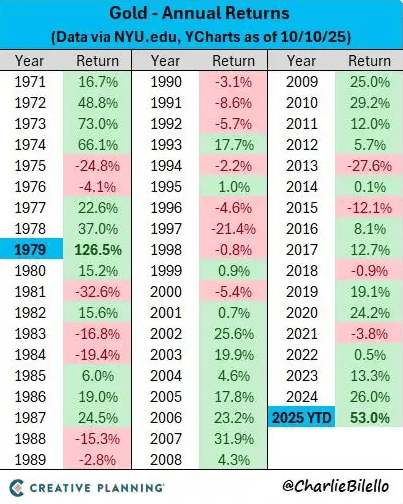
Core Insights - Gold prices have recently surged, surpassing the historical threshold of $4000 per ounce, with predictions suggesting it could reach $10,000 per ounce by mid-2028 to early 2029 if the momentum continues [1] Group 1: Historical Context - In 1979, gold experienced a dramatic increase of 130% for the year, with prices soaring from $400 to $850 in just three months due to high inflation, economic stagnation, and geopolitical crises [3] - The inflation rate reached 13.3% in the U.S., while the unemployment rate peaked at 10.8%, contributing to the surge in gold prices as a safe-haven asset [3] Group 2: Current Market Dynamics - The current rise in gold prices mirrors the conditions of 1979, with the Federal Reserve having cut interest rates and expectations for further reductions, leading to a weaker dollar and stronger gold prices [6] - Central banks globally are increasing their gold reserves, with China adding 40,000 ounces in September alone, indicating a shift away from U.S. debt [6] Group 3: Investment Considerations - Investors are advised to consider various channels for gold investment, such as bank gold bars for high purity and low fees, gold ETFs for liquidity, and paper gold for short-term trading [8] - A recommended allocation for gold in a household's total assets is between 5% to 10%, serving as a stabilizing asset rather than a full investment [8]
贵金属日报2025-10-13:贵金属-20251013
Wu Kuang Qi Huo· 2025-10-13 01:38
Report Industry Investment Rating - Not provided in the document Core Viewpoints - The uncertainty in US trade and economic policies has led to significant concerns about the credit of US Treasury bonds and US dollar assets, making gold a better choice for global central bank reserves and investor asset allocation, and Trump's tariff actions are favorable for the medium - term gold price [2] - The shortage of silver spot in London is difficult to ease in the short term, which will drive the international silver price to be strong, and it is recommended to buy precious metals on dips, especially focusing on the rising opportunity of silver price [3][4] Summary by Related Catalogs Market Information - On the given day, Shanghai gold rose 0.42% to 913.26 yuan/gram, Shanghai silver fell 1.37% to 11059.00 yuan/kilogram; COMEX gold rose 1.53% to 4061.40 US dollars/ounce, COMEX silver rose 2.23% to 48.30 US dollars/ounce; the US 10 - year Treasury yield was 4.05%, and the US dollar index was 99.03 [2] - London silver spot price rose 1.87% to 50.126 US dollars/ounce, and the spread between COMEX silver near - month contract and London silver reached 2.73 US dollars/ounce, a recent high, and the one - month implied lease rate of London silver spot has risen to 40.3% [2] Future Outlook - The shortage of silver spot is difficult to ease in the short term. COMEX silver inventory decreased from 16531 tons on September 29 to 16251 tons on October 10, but the shortage in London is difficult to be alleviated by the inflow of New York silver, and the total position of COMEX silver is at the highest level in the same period in the past five years [3] Strategy Viewpoint - It is recommended to buy precious metals on dips, with the reference operating range of Shanghai gold main contract being 898 - 950 yuan/gram and that of Shanghai silver main contract being 10937 - 12000 yuan/kilogram [4] Data Table - The data shows the price, volume, position, inventory and other information of gold and silver in different markets such as COMEX, London, and Shanghai Futures Exchange on October 10, 2025, as well as the data changes compared with the previous trading day [5][8] Price Structure and Spread - The document shows the near - far month structure of COMEX gold and silver, and the price spreads between Shanghai and overseas markets (COMEX, LBMA) for gold and silver on October 10, 2025 [22][25][36][57]