
货币宽松

Search documents
高市早苗扩张性财政政策加剧日元贬值担忧 美元兑日元汇率重新站上153
智通财经网· 2025-10-24 09:01
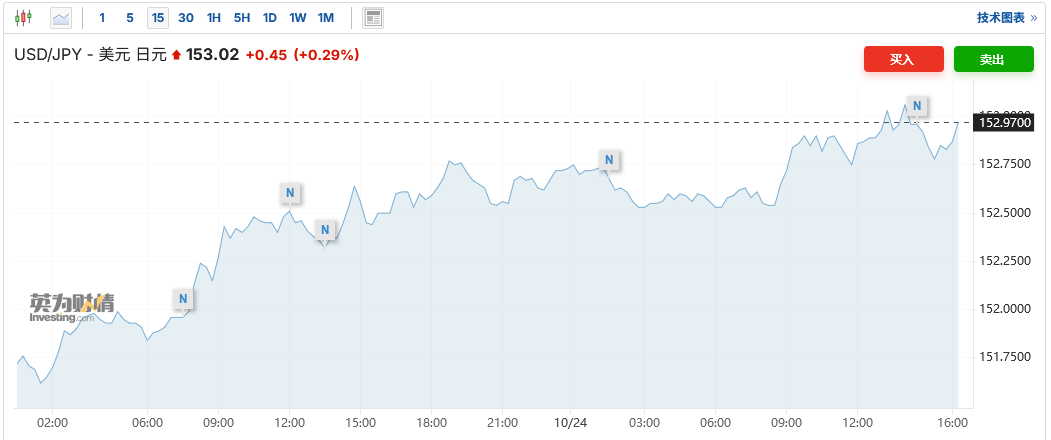
Group 1 - The Japanese yen continues to weaken, being the worst performer among G10 currencies, with the USD/JPY exchange rate surpassing 153, reflecting a cumulative depreciation of approximately 1.5% this week, more than double the decline of other G10 currencies [1] - Newly appointed Prime Minister Sanna Takashi is expected to implement a "strategic and responsible" expansionary fiscal policy, potentially leading to "Abenomics 2.0" to revitalize Japan's sluggish economic growth [3] - The anticipated spending plan under Takashi is expected to exceed the previous 13.9 trillion yen proposal by former Prime Minister Shigeru Ishiba, indicating a significant increase in fiscal stimulus [3] Group 2 - Takashi's stance on fiscal stimulus has led to new highs in the Japanese stock market, although it exerts pressure on the yen and Japanese government bonds, which saw a slight increase as no significant bond issuance was mentioned [3] - The new Finance Minister Satsuki Katayama hinted at the possibility of issuing additional government bonds if existing resources are insufficient to fund Takashi's economic plans, indicating a reliance on higher-than-expected tax revenues and unused budget funds [4] - Market participants are closely monitoring the monetary policy outlook for both Japan and the US, with upcoming discussions on interest rates by both central banks, particularly focusing on the US CPI data and the Bank of Japan's policy meeting [4]

日本央行加息预期大幅推迟至年末,高市早苗上任成关键变量
智通财经网· 2025-10-23 03:45
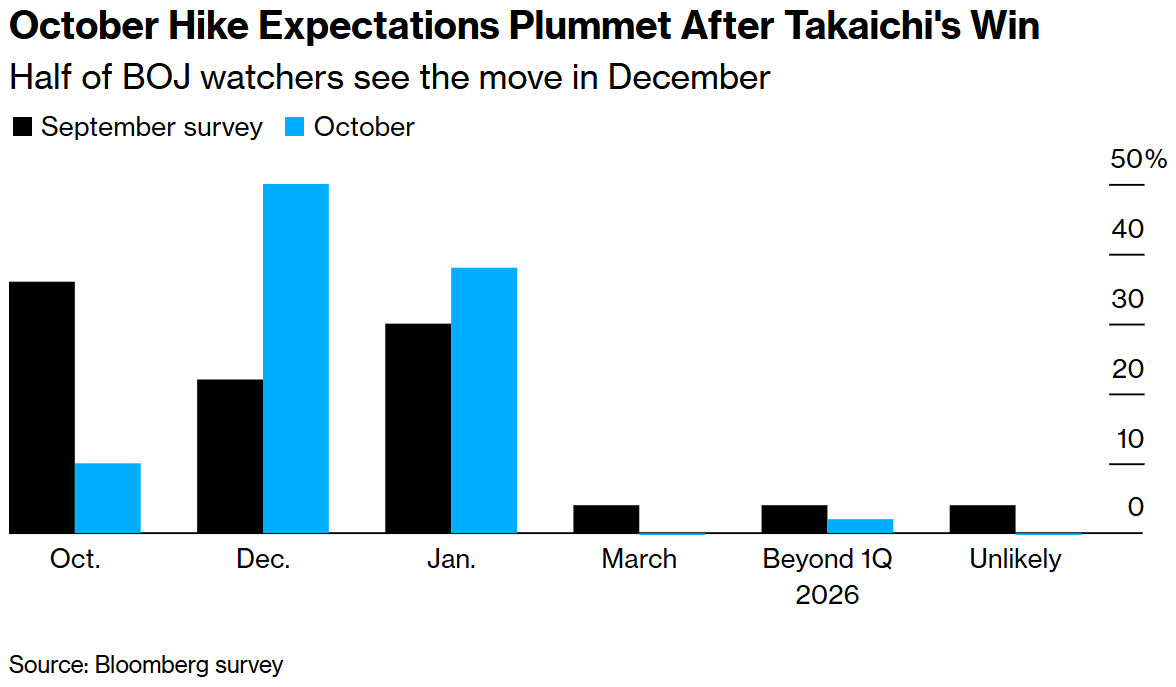
Core Viewpoint - The expectations for a rate hike by the Bank of Japan have significantly decreased following the election of Prime Minister Sanna Takagi, with most economists now predicting a potential hike in December rather than in the immediate future [1][4]. Group 1: Economic Predictions - Only about 10% of economists expect a rate hike at the upcoming October 30 meeting, a sharp decline from 36% in the previous survey [1]. - December is now the most anticipated month for a rate hike, with 50% of economists predicting action then, followed by 38% expecting a hike in January [1]. - The median forecast for the terminal rate of the current rate hike cycle is now expected to be 1%, indicating two more hikes, down from a previous expectation of 1.25% [4]. Group 2: Political Influence - The election of Prime Minister Sanna Takagi, known for advocating monetary easing, has led to a more cautious approach regarding rate hikes, with 72% of respondents indicating that Japan's unstable political situation reduces the likelihood of a hike this month [4]. - Economists believe that under Takagi's leadership, the Bank of Japan will need to communicate more carefully with the government regarding rate hikes [4]. Group 3: Market Reactions - Market expectations for a policy adjustment this month are hovering around 10%, a stark contrast to the 95% expectation seen before the January rate hike [5]. - The Bank of Japan faces the challenge of maintaining market expectations for a rate hike to prevent further depreciation of the yen, which recently fell to an eight-month low against the dollar [8]. - There is a focus on whether the Bank of Japan can convey a "hawkish hold" stance to avoid excessive yen depreciation while minimizing friction with the Takagi government [8].
货币政策如何化解财政难题?——联储独立性与货币宽松展望
2025-10-22 14:56
Summary of Key Points from the Conference Call Industry Overview - The discussion primarily revolves around the **U.S. fiscal policy** and its implications on **monetary policy** and **debt management**. The focus is on the challenges faced by the U.S. government regarding rising interest payments and their impact on fiscal health and economic sectors sensitive to interest rates. Core Insights and Arguments 1. **Fiscal Challenges**: The U.S. government is experiencing a significant imbalance between spending and revenue, with interest payments consuming a larger portion of the budget compared to Japan and the EU, approximately **13%-14%** of general fiscal spending [2][2][2]. 2. **Rising Interest Payments**: Since 2020, U.S. interest payments have escalated rapidly, projected to reach **twice** the 2020 levels by 2025, with an average debt interest rate of about **3.5%** [5][5][5]. 3. **Debt Management Strategies**: To alleviate fiscal pressure, the U.S. needs to reduce interest payments by **$180 billion** if no deficit growth occurs in FY 2026, or by **$80 billion** to return to 2024 levels [5][5][5]. 4. **Impact of Monetary Policy**: The potential for a **rate cut** after Powell's term in 2026 could lead to a decrease in short-term bond rates, while long-term rates may still rise, complicating the overall debt servicing costs [3][8][8]. 5. **Debt Structure**: The current debt structure shows a high proportion of short-term debt (under one year), which is sensitive to interest rate changes. This strategy was adopted to manage costs during rising interest rates [5][8][8]. 6. **Long-term Debt Sensitivity**: Historical data indicates that short-term bonds are more sensitive to interest rate cuts, while long-term bonds show less responsiveness, which could lead to increased overall costs for the government [9][9][9]. Additional Important Content 1. **Quantitative Analysis**: Two scenarios were presented indicating the necessity for significant reductions in interest payments to ease fiscal pressures [4][4][4]. 2. **Debt Refinancing**: The refinancing of maturing debt at lower rates could help reduce future interest costs, particularly for the portion of debt that is due for renewal [6][6][6]. 3. **Market Reactions**: The fiscal challenges have raised concerns in the market regarding the U.S. debt repayment capacity, leading to increased long-term bond yields, which adversely affects sectors like manufacturing and real estate [1][2][2]. This summary encapsulates the critical aspects of the conference call, focusing on the U.S. fiscal and monetary landscape, the implications of rising interest payments, and the strategies for managing debt effectively.
黄金股早盘集体回暖 招金矿业涨超5% 多因素助推金价强势反弹
Zhi Tong Cai Jing· 2025-10-22 11:55
Group 1 - Gold stocks experienced a collective rebound in early trading, with notable increases in share prices: Zhaojin Mining rose by 4.91% to HKD 32.02, Zijin Mining increased by 3.33% to HKD 33.56, Shandong Gold rose by 2.35% to HKD 36.56, Lingbao Gold increased by 2.18% to HKD 19.22, and Chifeng Jilong Gold rose by 1.81% to HKD 30.3 [3] - The surge in gold prices was driven by ongoing concerns over a potential U.S. government shutdown, leading to increased market expectations for a Federal Reserve rate cut and central banks globally increasing their gold holdings [3] - As of the close, the December gold futures price on the New York Mercantile Exchange reached USD 4,359.4 per ounce, marking a 3.47% increase [3] Group 2 - HSBC's recent commodity outlook report indicates that the upward momentum for gold is expected to continue until 2026, supported by strong gold purchases from central banks, ongoing fiscal concerns in the U.S., and expectations for further monetary easing [3] - The target price for gold set by HSBC is USD 5,000 per ounce, reflecting the anticipated sustained demand and market conditions [3]


贵金属有色金属产业日报-20251022
Dong Ya Qi Huo· 2025-10-22 10:35
1. Report Industry Investment Rating No relevant content provided. 2. Core Views of the Report - For precious metals, the push for a cease - fire in the Russia - Ukraine conflict by Europe has led to a sharp drop in hedging demand, but the fundamental support factors remain unchanged. The Fed is expected to cut interest rates by 25 basis points each in the next week and December, and the medium - to - long - term monetary easing environment will continue. The global demand for gold allocation remains stable, and institutional investors are still optimistic about the medium - term outlook after the short - term sharp decline [3]. - For copper, the spot market atmosphere is average, downstream sentiment is low and demand is mainly for rigid needs. With the replenishment of domestic and imported supplies, the increase in spot circulation has led to a downward adjustment of premiums [18]. - For aluminum, macro data shows that China's core CPI growth rate expanded to 1% in September, indicating a mild recovery in domestic demand. Overseas, the Fed is expected to cut interest rates, which is positive for aluminum prices. The market believes that the probability of tariff negotiation success is high. The fundamentals of Shanghai aluminum are stable this week, and the continuous destocking of electrolytic aluminum social inventory provides some support for aluminum prices. In the short term, Shanghai aluminum will fluctuate at a high level. Alumina is in an oversupply situation, and prices are falling. Cast aluminum alloy has strong follow - up to Shanghai aluminum and has strong support at the bottom [37]. - For zinc, the fundamentals have not changed significantly recently. Domestic smelting supply is stable, while overseas there are production cuts. The price spread has been widening due to inconsistent fundamentals. The domestic zinc market is in a situation of strong supply and weak demand. Low inventory provides short - term price support. Attention should be paid to the opening of the export window and the possibility of macro - upward driving forces [60]. - For the nickel industry chain, the fundamentals have not changed significantly. There are still expectations of interest rate cuts this year at the macro level, and the progress of Sino - US tariffs affects risk appetite. In the nickel ore market, Indonesia's new quota regulations may lead to a decline in 2026 quotas. The new energy sector is in the peak season, with strong demand. Nickel iron prices are weak, and stainless steel prices may decline slightly. Attention should be paid to the follow - up development of Sino - US tariffs and interest rate cut expectations [75]. - For tin, the fundamentals have not changed. Yunnan's production has declined, and concentrate imports have dropped sharply. Supply is weaker than demand. In the short term, it is difficult to solve the supply - side disturbances, and Shanghai tin is still strong, with support expected around 276,000 yuan [92]. - For lithium carbonate, market demand is good, and warehouse receipts are continuously and significantly destocked. Before the end of the year, the demand of downstream lithium - battery material enterprises is expected to continue to grow month - on - month, which will support the futures price [106]. - For the silicon industry chain, for industrial silicon, as the dry season approaches, enterprise production cuts are expected to increase, and the price center may move up slightly, but the price increase is limited due to high inventory. For polysilicon, there are production cuts in the southwest region, and the specific impact needs further observation [118]. 3. Summary by Relevant Catalogs Precious Metals - **Price and Market Analysis**: The report presents the price trends of SHFE gold and silver futures, COMEX gold, and the gold - silver ratio, as well as the relationship between gold and the US dollar index, US Treasury real interest rates, and long - term gold and silver fund holdings [4][9][12]. - **Outlook**: Short - term sharp decline but medium - term outlook remains positive due to long - term monetary easing and stable global gold allocation demand [3]. Copper - **Spot and Futures Data**: Spot copper prices in various regions have declined, with daily price drops ranging from 0.89% to 0.9%. Futures prices of Shanghai copper have slightly increased, with a daily increase of 0.02%. The premium of Shanghai copper spot has decreased by 40% [23][24]. - **Supply - Demand Analysis**: The spot market is weak, and the increase in supply has led to a decline in premiums [18]. Aluminum - **Price and Spread**: Aluminum and alumina futures prices have increased slightly, with daily increases ranging from 0.36% to 0.79%. There are various price spreads among different contracts, such as the spread between Shanghai aluminum continuous and consecutive contracts [38][41]. - **Market Fundamentals**: Macro data is positive for aluminum prices, and the destocking of electrolytic aluminum social inventory provides support. Alumina is in an oversupply situation [37]. Zinc - **Price and Inventory**: Zinc futures prices have increased slightly, with daily increases ranging from 0.09% to 0.32%. Zinc inventory has decreased, with a daily decrease of 1.6% for Shanghai zinc warehouse receipts and 5.3% for LME zinc inventory [61][71]. - **Market Outlook**: The domestic market is in a situation of strong supply and weak demand, and low inventory provides short - term support [60]. Nickel Industry Chain - **Price and Market Data**: Nickel and stainless - steel futures prices show different trends. Nickel spot average prices are presented. The new energy sector has strong demand, while nickel iron prices are weak, and stainless - steel prices may decline slightly [76][83][75]. - **Macro Factors**: Attention should be paid to Sino - US tariffs and interest rate cut expectations [75]. Tin - **Price and Inventory**: Tin futures prices have increased slightly, with daily increases ranging from 0.26% to 0.5%. Tin inventory has increased slightly, with a 1.17% increase in Shanghai tin warehouse receipts [93][101]. - **Market Outlook**: Supply is weaker than demand, and short - term prices are strong [92]. Lithium Carbonate - **Price and Inventory**: Lithium carbonate futures prices have increased, with daily increases ranging from 0.34% to 0.54%. Inventory has decreased, with a 2.92% decrease in Guangzhou Futures Exchange warehouse receipts [107][115]. - **Market Outlook**: Strong demand before the end of the year will support the price [106]. Silicon Industry Chain - **Price and Production**: Industrial silicon prices have little change, and some prices have decreased slightly. Southwest polysilicon production cuts need further observation. The price of industrial silicon may increase slightly as the dry season approaches [118]. - **Inventory and Outlook**: High inventory restricts the price increase of industrial silicon [118].
崩了!金价巨震!创12年来最大单日跌幅
Sou Hu Cai Jing· 2025-10-22 03:11
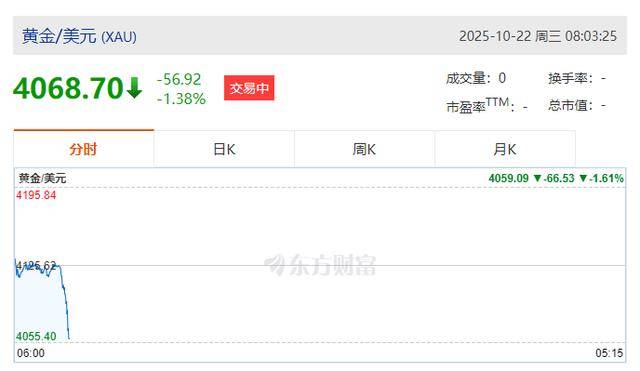
Core Viewpoint - The recent sharp decline in gold prices, dropping over 6.3% to below $4100 per ounce, is attributed to easing geopolitical tensions and a softening of trade attitudes from Trump, leading to profit-taking in the precious metals market [1][3]. Group 1: Market Performance - On October 21, gold prices experienced a significant drop, falling from around $4342 to $4068.7 per ounce within hours, marking the largest single-day decline since April 2013 [1]. - Prior to the drop, gold had surged over 2.5% on October 20, reaching a historical high of $4381.29 per ounce before closing at $4356.26 [3]. - The volatility in gold and silver prices indicates a potential overheating in the market, with the implied volatility of gold options exceeding 20, suggesting increased trading risks [3]. Group 2: Future Outlook - HSBC forecasts that gold's upward momentum may continue until 2026, with a target price of $5000 per ounce, driven by strong central bank purchases and ongoing concerns over U.S. fiscal deficits [5]. - The demand for gold is increasingly viewed as a hedge against debt sustainability risks and potential dollar weakness, particularly among emerging market central banks [5]. - However, HSBC warns that if the Federal Reserve's rate cuts are fewer than market expectations, the upward trajectory of gold prices may face challenges [5].
现货黄金跌回4002美元,贵金属是否进入“打折季”?
Di Yi Cai Jing Zi Xun· 2025-10-22 02:40
Core Viewpoint - The recent sharp decline in gold and silver prices is attributed to a combination of profit-taking by investors and easing macroeconomic tensions, despite a long-term bullish outlook for precious metals driven by central bank purchases and monetary easing expectations [2][3][4]. Group 1: Market Movements - On October 22, gold and silver futures opened with significant drops, with gold reaching a low of 933 CNY per gram and London spot gold hitting a low of 4002 USD per ounce [2]. - On October 21, gold prices fell by 6.18%, while silver experienced an 8.72% drop, falling below 50 USD per ounce [2]. - The rapid shift from a "hot" to a "frozen" market for gold prices indicates a correction after a period of sustained overbuying [2]. Group 2: Economic Factors - Easing trade tensions and geopolitical news contributed to the decline in precious metal prices, alongside a backdrop of rising short-term risks [2]. - Recent disclosures of loan fraud and bad debts by two U.S. banks triggered a credit crisis, leading to a sell-off in the stock market, particularly affecting regional banks [2]. - Despite the short-term volatility, the fundamental outlook for gold remains unchanged, with ongoing expectations for monetary easing and persistent market risk aversion [2][4]. Group 3: Institutional Perspectives - HSBC's commodity outlook report suggests that gold's upward momentum may continue until 2026, driven by strong central bank purchases and ongoing fiscal concerns in the U.S., with a target price of 5000 USD [3]. - Huashan Fund indicates that the current trading environment for gold is overheated, with implied volatility levels exceeding 20, signaling potential short-term risks [3]. - Analysts believe that while central bank purchases and investment demand will support long-term price increases, short-term adjustments may still pose challenges for investors [4].

现货黄金跌回4002美元,贵金属是否进入“打折季”?
第一财经· 2025-10-22 02:33
Core Viewpoint - The recent sharp decline in gold and silver prices is attributed to a combination of profit-taking by investors and easing macroeconomic tensions, despite a generally positive long-term outlook for precious metals driven by monetary easing expectations [3][4]. Group 1: Market Performance - On October 22, gold and silver prices experienced a significant drop, with Shanghai gold futures falling over 5% to a low of 933 CNY per gram, and London spot gold hitting a low of 4002 USD per ounce [3]. - On October 21, gold prices reached a peak of 4086 USD per ounce before declining by 6.18%, while silver prices fell by 8.72%, dropping below 50 USD per ounce [3]. Group 2: Market Analysis - Analysts suggest that despite the short-term volatility, the underlying fundamentals for precious metals remain strong, with expectations of continued monetary easing supporting a bullish medium-term outlook [4]. - HSBC forecasts that gold's upward momentum could persist until 2026, driven by strong central bank purchases, ongoing fiscal concerns in the U.S., and further expectations of monetary easing, with a target price of 5000 USD [4]. Group 3: Investment Sentiment - The recent volatility in gold trading is indicated by a high implied volatility (IV) level, which has surpassed 20, suggesting that the market is currently experiencing a crowded trade [4]. - While central bank purchases and growing investment demand are expected to support higher precious metal prices in the long term, short-term adjustments and event-driven shocks may pose risks for investors [5].

深夜突发,金价崩了!短短7小时,就跌掉240多美元,网友懵圈:我今天刚买啊
Sou Hu Cai Jing· 2025-10-21 15:15
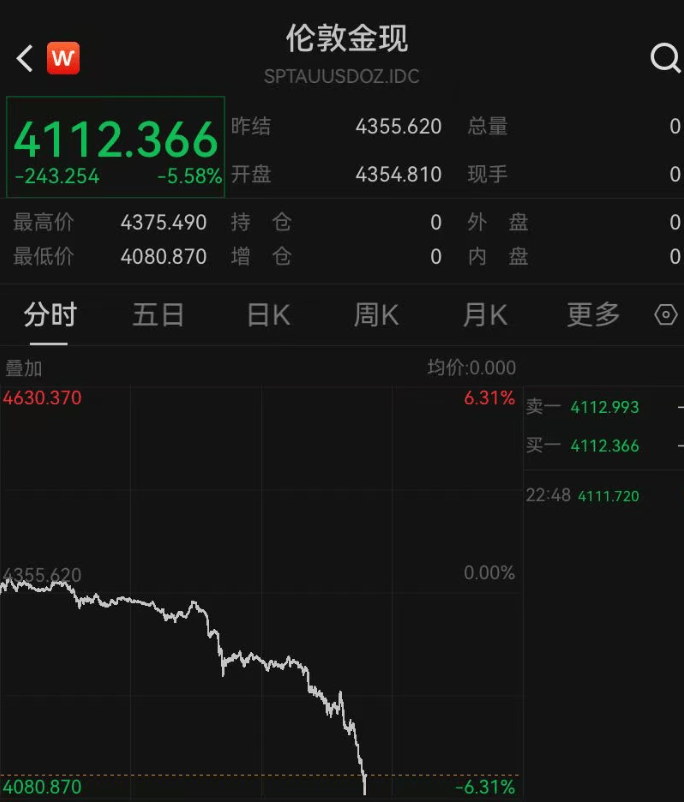
Core Viewpoint - The gold and silver markets experienced a significant crash, with gold prices dropping over 6% within a short period, leading to concerns among investors about the sustainability of recent price increases [1][3][4]. Market Performance - As of the latest report, spot gold fell to $4,112.37 per ounce, down 5.58%, while COMEX futures were at $4,145 per ounce, down 4.92% [1][2]. - Silver also saw a sharp decline, with London silver trading at $48.18 per ounce, down 8.02%, and COMEX silver futures dropping 7.69% to $47.44 per ounce [3][4]. Investor Behavior - The recent price drop is attributed to profit-taking by investors after a period of strong performance, driven by expectations of further interest rate cuts by the Federal Reserve and strong safe-haven demand [6][8]. - Social media reactions indicate confusion among new gold investors who recently entered the market [7]. Market Analysis - Analysts suggest that the combination of profit-taking and reduced inflow of safe-haven funds has pressured gold prices. However, any price corrections are viewed as potential buying opportunities if the Fed maintains its current rate-cutting path [8]. - The rapid increase in precious metal prices, including gold and silver, has led to concerns of market overheating, especially with easing geopolitical tensions and a softening trade stance from the U.S. [6][8]. Future Outlook - The future trajectory of gold prices remains uncertain, with some analysts suggesting that the likelihood of a decline is greater than further increases. The sustainability of high-net-worth individual investments in gold is a key factor [9]. - HSBC's commodity outlook report indicates that gold's upward momentum may continue until 2026, driven by strong central bank purchases and ongoing fiscal concerns in the U.S., with a target price of $5,000 per ounce [10].
当前债市,买方谨慎,卖方乐观:债券研究周报-20251021
Guohai Securities· 2025-10-21 10:03
Report Summary 1. Report Industry Investment Rating No relevant content provided. 2. Core Viewpoints - From October 13th to October 20th, the sentiment of bond market sellers continued to rise, while that of buyers declined. Sellers' consensus further solidified after the market warmed up, but buyers remained cautious and still focused on potential downside risks [4]. - Sellers were generally bullish on the bond market, with sentiment rising compared to the period from September 29th to October 12th. Among 23卖方机构, 4% were bullish, 48% were moderately bullish, and 48% were neutral [5]. - Buyers' overall view was moderately bullish with a neutral bias, and the sentiment index decreased. Among 26固收买方机构, 35% were moderately bullish, 58% were neutral, and 7% were moderately bearish [6]. 3. Summary by Directory 1.1 Seller Market Interest Rate Bond Sentiment Index - From October 13th to October 20th, the tracked weighted index was 0.34, up 0.09 from September 29th - October 12th, and the proportion of bullish views increased. The untracked weighted index was 0.57, up 0.23 from the previous period. Currently, institutions are generally neutral - bullish, with 1 bullish, 11 moderately bullish, and 11 neutral [12]. - 4% of institutions were bullish, citing factors such as consumption subsidy overdraft of demand, declining bank liability costs, and trade frictions [12]. - 48% of institutions were moderately bullish, believing that Sino - US trade frictions were beneficial to the bond market, internal economic pressure strengthened the expectation of monetary easing, and capital flows sought safe - havens [12]. - 48% of institutions were neutral, stating that interest rates had partially reflected economic expectations, the uncertainty of new public fund sales regulations, limited downside in the bond market, and the balance between positive and negative factors [12]. 1.2 Buyer Market Interest Rate Bond Sentiment Index - From October 13th to October 20th, the tracked weighted sentiment index was 0.17, mainly neutral, down from September 29th - October 12th. The untracked weighted index was 0.27, down 0.21 from the previous period. Currently, institutions are generally neutral - bullish, with 9 moderately bullish, 15 neutral, and 2 moderately bearish [13]. - 35% of institutions were moderately bullish, driven by risk - aversion sentiment, supported by the easing cycle, and expecting the asset shortage pattern to continue [13]. - 58% of institutions were neutral, believing that positive and negative factors were balanced, and the market preferred technical corrections rather than fundamental - driven trends [13]. - 7% of institutions were moderately bearish, citing factors such as new fund sales regulations, the stock - bond seesaw effect, and Fed rate - cut constraints [13].