
通胀

Search documents
11月CPI报告只是“过场戏”?引爆市场的门槛可能极高!
Jin Shi Shu Ju· 2025-12-17 12:28
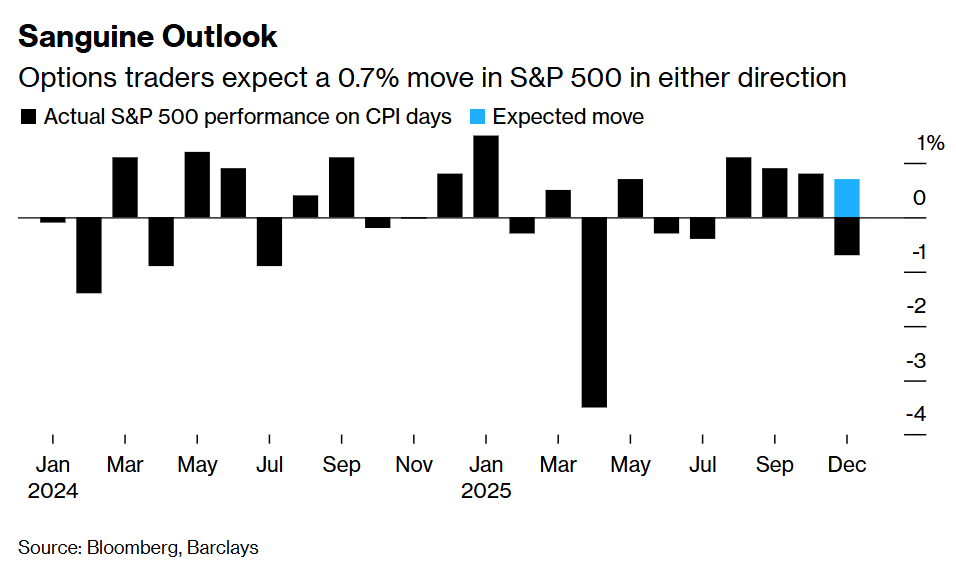
Core Insights - The upcoming November CPI report is anticipated to have limited impact on the stock market, with traders expecting a volatility of only 0.7% for the S&P 500 index, significantly lower than the 1% average seen in previous reports [1][3] - The Federal Reserve's focus has shifted towards labor market signals rather than minor fluctuations in inflation rates, indicating a potential for interest rate stability in the near future [3][4] - The reliability of the November CPI report is questioned due to the absence of October data, which may affect the overall assessment of inflation trends [3][4] Market Sentiment - Market participants are adopting a more indifferent stance towards the CPI data, suggesting that it may be deemed either unimportant or unreliable [3][4] - The sentiment is further influenced by the ongoing low employment growth and rising unemployment rates, which reflect a cooling labor market [4][5] Federal Reserve Outlook - The Federal Reserve is expected to maintain interest rates in January, as policymakers are likely to wait for more comprehensive economic data before making decisions [3][4] - Some Fed officials continue to emphasize the importance of inflation, with concerns about tariffs impacting prices, while others focus on employment risks [4][5] Expectations for CPI Data - Analysts predict that the year-on-year CPI increase will remain around 3%, with any significant deviation potentially surprising traders [5][6] - The importance of CPI reports is diminishing as the Federal Reserve prepares for a leadership change, which may lead to a more aggressive stance on interest rate cuts [5][6] Seasonal Factors - Seasonal trends may also contribute to the muted expectations for the CPI data, as the stock market approaches a traditional bull market phase [7] - The S&P 500 index has recently experienced a decline, closing just 1.5% below its historical high, indicating a potential for upward movement [8]

期权交易员认为延迟发布的通胀报告“无关痛痒”
Xin Lang Cai Jing· 2025-12-17 12:04
Core Viewpoint - Investors are showing indifference towards the upcoming November inflation report, contrasting with previous anxieties, as the Federal Reserve's focus has shifted more towards labor market weakness than minor fluctuations in inflation rates [2][3]. Group 1: Market Sentiment and Expectations - Option traders expect the S&P 500 index to fluctuate within a range of ±0.7%, significantly lower than the average 1% volatility observed after the release of previous inflation reports this year [2]. - The November inflation report's timeliness is considered weaker than usual due to its delay and the impact of government shutdowns on data collection, leading to concerns about its reliability [2][3]. - Market consensus suggests that the inflation data will either be inconsequential or of questionable quality, thus not becoming a focal point for market attention [2][3]. Group 2: Federal Reserve Policy Outlook - The upcoming report is not expected to alter the Federal Reserve's decision at the January policy meeting, with a general belief that rates will remain unchanged as officials await more reliable economic data [3][8]. - The Federal Reserve has recently completed its third consecutive 25 basis point rate cut, indicating a cautious approach towards monetary policy amid ongoing labor market challenges [3][8]. - There is a notable focus on employment risks among Federal Reserve officials, with some expressing concerns about inflation pressures despite the prevailing emphasis on labor market conditions [3][8]. Group 3: Inflation Rate Predictions - Analysts expect the year-over-year inflation rate to remain around 3%, with potential surprises if the data deviates significantly from this expectation, either upwards to 3.5% or downwards to 2.7% or lower [4][9]. - The importance of the consumer price index report has diminished partly due to the impending term expiration of Federal Reserve Chairman Jerome Powell, with expectations that his successor may favor aggressive rate cuts regardless of economic data [4][9][10]. Group 4: Market Trends and Stock Performance - The S&P 500 index has experienced a decline for three consecutive days, closing just 1.5% below its previous all-time high, indicating a potential bullish sentiment among traders as they anticipate a rise to new highs [5][10].
美国经济:就业小幅走弱
Zhao Yin Guo Ji· 2025-12-17 10:52
Employment Trends - In October, the U.S. added 105,000 non-farm jobs, a significant drop from September's 108,000, but rebounded to 64,000 in November, exceeding market expectations of 50,000[8] - The unemployment rate unexpectedly rose to 4.6% in November, the highest in nearly four years, up from 4.44% in September[8] - Initial claims for unemployment benefits and continuing claims showed slight improvement, indicating resilience in the job market[2] Economic Outlook - The U.S. economy is expected to see growth and unemployment rates stabilize by 2026, with inflation initially declining before rising again[2] - The Federal Reserve may consider a rate cut in June as a political gesture, with inflation potentially rebounding in the second half of the year[2] - The labor participation rate increased from 62.3% to 62.5%, with the broader U6 unemployment rate rising to 8.7%[8] Sector Performance - Job growth was primarily concentrated in construction, healthcare, and education services, while manufacturing jobs continued to decline for the seventh consecutive month[8] - Retail sales, excluding automobiles and gasoline, maintained rapid growth in October, indicating consumer resilience[2] - The service sector's PMI employment index and job postings on Indeed showed a slow recovery, suggesting ongoing demand for labor[2]
IC平台:数据喜忧参半+停摆延迟披露,美国劳动力市场已现松动?
Sou Hu Cai Jing· 2025-12-17 10:29
Economic Indicators - The US non-farm payroll report for November showed an increase of 64,000 jobs, exceeding market expectations of 50,000, but the October data was revised down to a decrease of 105,000 jobs, primarily due to significant cuts in government employment [3] - The US unemployment rate rose to 4.6%, higher than the expected 4.4% and above the Federal Reserve's forecast of 4.5% for the year [3] - The market currently anticipates a 6 basis point rate cut in January and a 50% probability of a 13 basis point cut in March [3] Market Reactions - The US stock market exhibited mixed reactions, with the S&P 500 and Dow Jones Industrial Average declining by 0.2% and 0.6% respectively, while the Nasdaq 100 rose by 0.3%, supported by strong performances from major tech stocks [1] - The US dollar index increased by 0.3% during European trading hours, particularly against the Japanese yen [1] - US Treasury yields rose, with the 10-year yield increasing by over 2 basis points to 4.17% [1] Commodity Market - The commodity market saw a boost, with WTI crude oil prices rising by 1.4% due to a directive from the Trump administration to block Venezuelan oil tanker transport, potentially ending a four-day decline [1] - Precious metals continued their strong performance, with gold prices nearing a historical high of $4,381 and silver prices reaching a record peak of approximately $66, reflecting a year-to-date increase of 130% [1] UK Economic Outlook - The Bank of England is expected to lower the benchmark interest rate by 25 basis points from 4.00% to 3.75%, with a high probability of a 92% for this cut [4] - The UK's unemployment rate rose to 5.1%, the highest level since early 2021, and the October wage growth also showed signs of cooling [5] - The November CPI inflation data in the UK was significantly below expectations, likely solidifying the case for a rate cut in the upcoming decision [5] European Central Bank - The European Central Bank is not expected to provide significant new signals in its upcoming meeting, with President Lagarde likely to reiterate that current monetary policy is appropriate and will not commit to a specific rate path [6]

刚刚,降息25个基点
中国基金报· 2025-12-17 10:12
Core Viewpoint - The Bank of Thailand has lowered its benchmark interest rate by 25 basis points to 1.25%, the lowest level since 2022, in an effort to support a fragile economy amid a strong baht and rising political uncertainty [4][9]. Economic Conditions - The Thai economy is facing significant challenges, including the impact of U.S. tariffs, severe flooding in the southern provinces, and fatal border conflicts with Cambodia [4]. - The central bank has revised its growth forecast for next year from 1.6% to 1.5% due to slowing consumption and exports [4][10]. Monetary Policy Decisions - The Monetary Policy Committee (MPC) unanimously voted to lower the overnight repurchase rate, marking the fifth rate cut in the past 14 months [4][9]. - The decision aims to create a more accommodative financial environment to support economic recovery and alleviate the debt burden on vulnerable groups [4][9]. Currency and Inflation - The Thai baht has appreciated over 8% this year, making it the second-best performing currency in Asia, which has negatively impacted exports and tourism [6][11]. - Consumer prices in Thailand have been in negative growth since April, primarily due to supply-side factors, with inflation struggling to stabilize within the central bank's target range of 1% to 3% [8][11]. Future Economic Projections - The MPC projects economic growth rates of 2.2%, 1.5%, and 2.3% for 2025, 2026, and 2027, respectively, with a noted slowdown in private consumption and exports due to external pressures [10]. - Overall inflation is expected to remain low, with forecasts of -0.1%, 0.3%, and 1.0% for the years 2025, 2026, and 2027, respectively, primarily influenced by declining global energy prices and limited demand-driven inflation [11]. Financial Stability and Credit Conditions - Despite multiple rate cuts, credit remains constrained, reflecting weak private spending and investment amid rising uncertainty [11][12]. - The central bank will continue to monitor credit growth closely and support targeted financial measures to assist vulnerable groups, particularly small and medium-sized enterprises (SMEs) facing liquidity pressures [11][12].

英国通胀超预期降温,降息“圣诞礼物”有望兑现!
Jin Shi Shu Ju· 2025-12-17 09:30
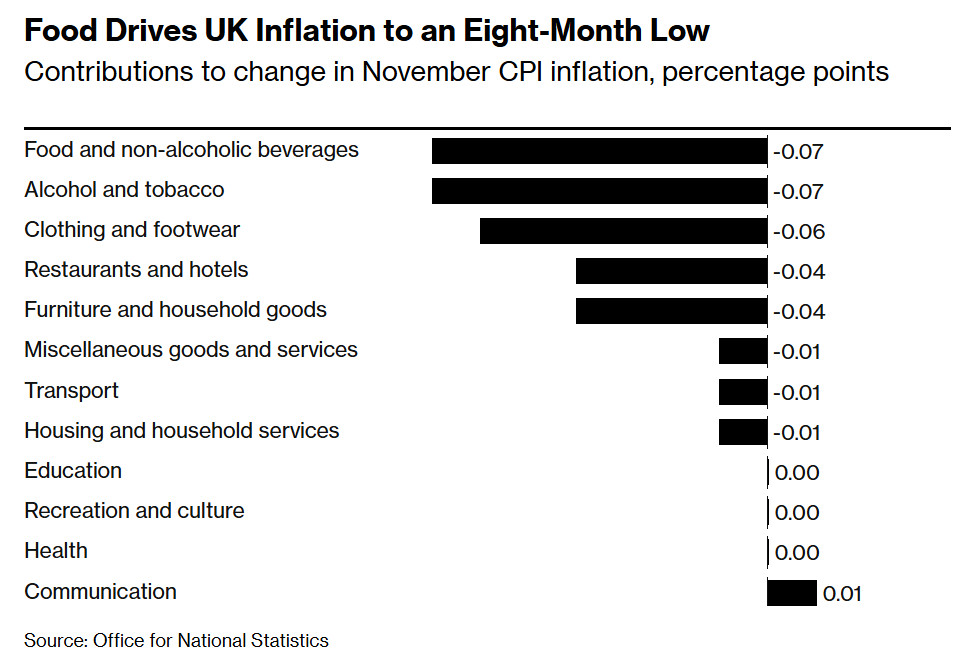
Core Points - The UK inflation rate has dropped to its lowest level in eight months, with the Consumer Price Index (CPI) rising only 3.2% year-on-year in November, down from 3.6% in October, primarily due to falling prices of cakes, biscuits, and breakfast cereals [1][4] - This unexpected decline in inflation has led traders to believe that a rate cut by the Bank of England is now almost certain, with the market fully pricing in two rate cuts by the end of April next year [4][6] Group 1 - The inflation rate of 3.2% is below economists' expectations of 3.5% and the Bank of England's forecast of 3.4%, resulting in a 0.7% drop in the GBP/USD exchange rate [4] - The Chief UK Economist at Capital Economics noted that the speed of inflation decline was faster than anticipated, suggesting that this would likely prompt the Bank of England to consider a rate cut [6] - The service sector prices increased by 4.4% year-on-year, slightly better than the Bank of England's current expectation of 4.5%, providing crucial data ahead of the Bank's decision [6] Group 2 - The UK economy contracted for the second consecutive month in October, influenced by market speculation ahead of the budget announcement, which aims to alleviate cost-of-living pressures [7] - The Bank of England's preliminary analysis indicates that government policies could reduce the inflation rate by up to 0.5 percentage points by next spring [8] - Producer input prices have continued to rise, with fuel and raw material costs increasing by 1.1% year-on-year, marking the fastest growth in over a year [8] Group 3 - The Chief Economist at RSM UK suggested that while December's inflation rate might see a slight uptick due to tobacco tax and potential food price rebounds, the significant drop in November's inflation opens the door for further rate cuts in early next year [9] - Analysts from Bloomberg indicated that the substantial slowdown in November's inflation sets the stage for a rate cut by the Bank of England in December, although they expect only one more cut next year due to lingering cost pressures [9]
瑞达期货贵金属期货日报-20251217
Rui Da Qi Huo· 2025-12-17 08:57
1. Report Industry Investment Rating - No information provided about the industry investment rating in the report 2. Core Viewpoints - The overall non - farm payroll report is weak, increasing the probability of the Fed cutting interest rates in March next year. The London silver price soared in the early session, and the Shanghai silver main contract broke through the significant threshold of 15,000 yuan per kilogram, hitting a new record high [1] - The growth of employment in the US in November remains weak, and the unemployment rate rises, indicating a continued cooling in the labor market. There are differences within the Fed regarding whether to be more worried about inflation or the employment market, and FOMC officials currently show low willingness to continue cutting interest rates [1] - In the context of easing tariff tensions, the core inflation approaching the target range paves the way for further actions. If subsequent non - farm data is stronger than expected, the Fed's internal stance may turn hawkish [1] - In the short term, considering the market has fully priced in the Fed's interest rate cut, the recent pulse - like rise in silver may increase the risk of short - term corrections, and the gold - silver ratio is expected to stabilize and rebound in the short term [1] 3. Summary by Relevant Catalogs 3.1 Futures Market - The closing price of the Shanghai gold main contract is 979.720 yuan/gram, up 8.3 yuan; the closing price of the Shanghai silver main contract is 15,512 yuan/kilogram, up 846 yuan [1] - The main contract holding volume of Shanghai gold is 197,105 hands, up 899 hands; that of Shanghai silver is 18,292 hands, up 938 hands [1] - The main contract trading volume of Shanghai gold is 275,889 hands, down 18,015 hands; that of Shanghai silver is 1,627,068 hands, up 55,692 hands [1] - The warehouse receipt quantity of Shanghai gold is 91,722 kilograms, up 420 kilograms; that of Shanghai silver is 911,924 kilograms, up 21,209 kilograms [1] 3.2 Spot Market - The spot price of gold on the Shanghai Gold Exchange is 972.71 yuan/gram, up 7.82 yuan; the spot price of Huatong No.1 silver is 15,190 yuan/kilogram, up 318 yuan [1] 3.3 Basis - The basis of the Shanghai gold main contract is - 7.01 yuan/gram, down 0.48 yuan; the basis of the Shanghai silver main contract is - 322 yuan/kilogram, down 528 yuan [1] 3.4 Supply and Demand - The SPDR gold ETF holding is 1,051.68 tons, unchanged; the SLV silver ETF holding is 16,018.29 tons, down 42.31 tons [1] - The non - commercial net long position of gold in CFTC (weekly) is 204,588 contracts, down 5,751 contracts; that of silver is 32,188 contracts, down 1,828 contracts [1] - The total quarterly supply of gold is 1,313.07 tons, up 86.24 tons; the total annual supply of silver is 32,056 tons, up 482 tons [1] - The total quarterly demand for gold is 1,257.90 tons, up 174.15 tons; the total annual demand for silver is 35,716 tons, down 491 tons [1] 3.5 Macroeconomic Data - The US dollar index is 98.22, down 0.06; the real yield of the 10 - year US Treasury bond is 1.92%, down 0.01% [1] - The VIX volatility index is 16.48, down 0.01; the ratio of S&P 500 to gold price is 1.57, down 0.01; the gold - silver ratio is 68.66, up 1.09; the CBOE gold volatility indicator is 20.18, down 1.02 [1] 3.6 Industry News - The US added 64,000 non - farm jobs in November, higher than the expected 50,000, but the unemployment rate unexpectedly rose to 4.6%, the highest since September 2021. The non - farm jobs in October decreased significantly by 105,000, far exceeding the expected 25,000 decline, and the figures for August and September were also revised down by 33,000 in total. The average hourly wage in November increased 3.5% year - on - year, the lowest growth rate since May 2021 [1] - The US retail sales in October were flat month - on - month, slightly lower than the expected 0.1% growth, mainly dragged down by a 1.6% decline in auto sales. Core retail sales increased 0.5% month - on - month, slightly exceeding the expected 0.4% growth [1] - The preliminary value of the US S&P Global Manufacturing PMI in December dropped to 51.8, a 5 - month low. The preliminary value of the service PMI dropped from 54.1 to 52.9, and the preliminary value of the composite PMI dropped to 53, all hitting 6 - month lows [1] - US Treasury Secretary Bessent expressed optimism about the US economic outlook, expecting the full - year GDP growth rate in 2025 to reach 3.5%. Bessent pointed out that Trump will announce the candidate for the Fed Chairman in early January next year [1]
2025是美国例外论终结元年?通胀和债务成致命隐患
Sou Hu Cai Jing· 2025-12-17 08:21
"我认为今年是美国市场例外论终结的起点,这一趋势可能首先在货币市场显现,进入2026年后,还将 延伸至其他风险资产,"坦普尔周二在接受CNBC采访时表示。 坦普尔认为,投资者准备调整美国资产敞口的原因有以下几点。 对美联储的担忧:今年以来,关于美联储公信力的议论日益增多。这家全球最重要的央行正面临美国总 统特朗普要求其大幅降息的压力——这一举措可能引发更多通胀。 对债务的担忧:美国国债今年突破38万亿美元的历史纪录,这加剧了长期以来的担忧——美国的借贷与 支出模式已难以为继。 来源:市场资讯 来源:金十数据 对美国金融市场而言,今年或许标志着一个独特时代开始走向终结。 Lazard首席市场策略师罗恩·坦普尔(Ron Temple)表示,他认为2025年标志着美国金融市场例外论终结 的开端。坦普尔负责该公司的咨询与资产管理业务,他指出,这一判断源于市场对美国宏观经济前景的 普遍担忧,未来几年,这可能促使投资者开始远离美元,并最终抛售美国资产。 与此同时,美联储还面临着一项艰巨的平衡任务:既要支持就业市场,又要遏制物价上涨。尽管通胀率 仍高于2%的目标水平,央行官员们今年已实施了第三次降息。 "坦率地说,我认为当 ...
【环球财经】星展银行:警惕AI泡沫风险 建议超配债券与亚洲资产
Xin Hua Cai Jing· 2025-12-17 08:05
Core Insights - The report by DBS Bank highlights the need for a defensive asset allocation strategy in 2026 due to rising "fiscal dominance" risks and persistent inflation, recommending an overweight in bonds and gold while focusing on valuation recovery opportunities in Asian equities excluding Japan [1][3]. AI Bubble Debate - The report analyzes the current "AI bubble" concerns, noting that while the U.S. stock market exhibits bubble-like characteristics, the macroeconomic conditions are more favorable compared to the 2000 internet bubble, with the Federal Reserve in a rate-cutting cycle and major tech firms maintaining strong cash flows [2]. - The capital expenditure for generative AI is currently about 1.2% of U.S. GDP, significantly lower than the 5.0% during the 19th-century railroad bubble and the 5.1% during the 2000 tech bubble, indicating that current investment levels are manageable relative to the economy [2]. - Investors are advised to shift focus from AI infrastructure to "Adapters," large non-tech companies that can leverage AI to enhance operational efficiency and profitability [2]. Macro Challenges - The report warns of an "extreme era" shaped by geopolitical changes and U.S. debt issues, with U.S. debt-to-GDP ratio reaching 100% and high interest payments posing "fiscal dominance" risks, potentially leading to a long-term rise in inflation [3]. - Investors are encouraged to allocate to physical assets to hedge against inflation, with a maintained overweight rating on gold due to concerns over U.S. fiscal sustainability and geopolitical uncertainties [3]. Asset Allocation - DBS Bank's model indicates that bonds are currently more attractive than stocks, recommending an overweight in fixed income assets and focusing on high-quality investment-grade bonds while avoiding high-yield bonds with poor risk-reward ratios [4]. - In the equity market, a more nuanced allocation strategy is suggested, with a strong overweight rating on Asian equities (excluding Japan) due to a 32.4% discount compared to developed markets and a projected earnings growth of 18.9% for 2026, surpassing the 11.8% expected for developed markets [4]. - The report highlights potential for further gains in the Chinese market driven by policy stimulus, a rebound in AI-related capital expenditures, and improved corporate earnings outlook [4]. - For the European market, while maintaining a lower allocation stance, the report suggests focusing on the defense sector, which is expected to see a 24% earnings growth in 2026 as NATO members commit to increasing defense spending to 5% of GDP [4]. - Additionally, the report recommends allocating some funds to alternative assets, including private equity and hedge funds, to diversify risks amid increasing market volatility [4].
大有期货:政策预期与数据博弈 金银延续高位震荡
Jin Tou Wang· 2025-12-17 08:03
Macro News - The New York Fed President Williams stated that the recent interest rate cut by the Federal Reserve positions it well to address future challenges, believing that inflation will decline as the job market cools [1] - Williams noted that the Fed's recent rate cut shifted its policy stance from moderately restrictive to neutral, asserting that the impact of tariffs on prices is likely to be one-time [1] - Boston Fed President Collins expressed support for the Fed's recent rate cut decision due to changes in the inflation outlook [1] - Fed Governor Milan indicated that the Fed's past purchases of mortgage-backed securities have injected significant credit into the housing market, potentially exacerbating current housing affordability issues [1] - CNBC reported that some aides to President Trump oppose the candidacy of Powell's potential successor, Hasset, due to concerns over his close relationship with the President [1] - Milan commented that financial markets are more concerned with the actual outcomes of Fed policies rather than the motivations of officials or their relationships with the President [1] Housing Market - U.S. homebuilder confidence rose to its highest level in eight months at 39 in December, but construction activity remains constrained by rising building costs due to import tariffs [2] - The confidence index has been below the neutral level of 50 for 20 consecutive months, with economic uncertainty and potential homebuyers hesitating due to affordability issues also contributing to the slowdown [2] Employment Data - The U.S. non-farm payroll data for November showed a complex signal with an increase of 64,000 jobs, surpassing market expectations of 45,000, but the previous month's figure was significantly revised down to a loss of 105,000 [2] - The unemployment rate rose to 4.6%, higher than expected and the highest since September 2021, indicating a cooling labor market despite apparent resilience [2] - The combination of upward revisions in job numbers, rising unemployment, and downward adjustments in historical data suggests a gradual cooling of the job market [2] - Weak labor market data typically supports gold and silver prices, as it reinforces market expectations for Fed rate cuts, putting pressure on the dollar and U.S. Treasury yields [2] - However, persistent inflation and economic resilience keep the Fed's stance cautious, leading to high uncertainty regarding a potential rate cut in January [2] - The market is likely to experience a high-level oscillation pattern, awaiting further economic data and clearer signals from the Fed regarding policy direction [2]