
十五五规划

Search documents
开放中国为世界经济提供“稳定锚”(和音) ——读懂中国的确定性③
Ren Min Ri Bao· 2025-11-02 22:27
Core Viewpoint - China is committed to high-level openness and aims to create greater development opportunities for countries worldwide by aligning with the trends of economic globalization and the new technological revolution [1][4]. Group 1: High-Level Openness - The "14th Five-Year Plan" emphasizes expanding autonomous openness, promoting innovative trade development, and enhancing bilateral investment cooperation [1][2]. - China has reduced the negative list for foreign investment and eliminated restrictions in the manufacturing sector, demonstrating a significant increase in openness [2][3]. - Over the past five years, China has established 22.9 million new foreign-funded enterprises, indicating strong foreign confidence in the Chinese market [2][3]. Group 2: Global Trade and Cooperation - China has signed 23 free trade agreements with over 30 countries and regions, leading to the largest scale of goods and services trade globally [3]. - The China-Laos railway has transported over 15 million tons of goods, and the China-Europe freight trains have operated over 110,000 times, showcasing the success of the Belt and Road Initiative [3][4]. - China's commitment to open trade is seen as a stabilizing force in the current global trade tensions, contributing to global economic development [4]. Group 3: Market Potential - With a population of over 1.4 billion and more than 400 million middle-income individuals, China's vast market is viewed as a significant opportunity for international businesses [2]. - The World Economic Forum's executive director highlighted China's attractive market space and stable policy expectations for global enterprises [2]. Group 4: Future Outlook - China will continue to open its doors wider, implementing decisions from the 20th National Congress of the Communist Party to create broader opportunities for global development [4]. - The ongoing modernization efforts in China are expected to generate more benefits for people worldwide [4].
拓展增量 提升效益 畅通循环 锚定三方面重点任务 建设强大国内市场
Zhong Guo Zheng Quan Bao· 2025-11-02 20:39
Group 1: Core Insights - The "15th Five-Year Plan" emphasizes the importance of a strong domestic market as a strategic foundation for Chinese modernization, focusing on expanding domestic demand and enhancing the interaction between supply and demand [1][2][3] - Key tasks include boosting consumption, increasing effective investment, and removing barriers to the construction of a unified national market [1][6] Group 2: Consumption Boosting Strategies - The plan prioritizes boosting consumption, leveraging China's large population and the expected growth of the middle-income group to tap into market potential [2] - Measures include increasing public service spending to enhance consumer capacity and implementing inclusive policies to support livelihoods [2][4] Group 3: Supply-Side Enhancements - The strategy involves leading new supply with new demand, focusing on high-quality, personalized, and green products and services to meet the evolving needs of consumers [3][4] - Institutional guarantees will be established to optimize the consumption environment, encouraging consumer spending [3][5] Group 4: Effective Investment Focus - "Investment in people" is highlighted as a key approach to drive economic and social structural transformation, with a focus on enhancing public service and human capital investment [4][5] - The plan aims to optimize investment structure, improve investment efficiency, and reform the investment financing system to better allocate government funds [4][5] Group 5: Market Barrier Removal - The removal of market barriers is crucial for efficiently aggregating domestic and international resources, facilitating a unified national market [6][7] - The plan outlines systematic deployments to eliminate local protectionism and market segmentation, aiming to create a high-standard market system [6][7]
锚定三方面重点任务 建设强大国内市场
Zhong Guo Zheng Quan Bao· 2025-11-02 20:16
Group 1 - The core viewpoint of the news is that the "14th Five-Year Plan" emphasizes the importance of a strong domestic market as a strategic foundation for China's modernization, focusing on expanding domestic demand and enhancing the interaction between supply and demand [1][6] - The plan aims to reshape the supply-demand structure and achieve a balance between new and old growth drivers, enhancing economic resilience [1][6] - Key tasks include boosting consumption, expanding effective investment, and removing barriers to the construction of a unified national market [1][5] Group 2 - The plan prioritizes boosting consumption as the first task in building a strong domestic market, leveraging the potential of over 1.4 billion people and an expected middle-income group exceeding 800 million in the next decade [1][2] - Measures to enhance consumer capacity include increasing public service spending and implementing inclusive policies to directly benefit consumers [2][3] - The focus on supply-side reforms will involve creating high-quality, personalized, and green products and services to meet the growing demands of consumers [2][3] Group 3 - Effective investment is emphasized, particularly in "investing in people," which is seen as crucial for economic and social structural transformation [3][4] - The plan suggests optimizing investment structure by increasing funding for public services and human capital, which is vital for sustained economic growth [3][4] - Specific measures to improve investment efficiency include enhancing government investment management and reforming investment approval processes [4] Group 4 - The removal of market barriers is highlighted as essential for efficiently aggregating domestic and international resources, thereby unlocking the potential of the vast market [5][6] - The plan outlines the need for a unified national market to facilitate smooth circulation of resources and enhance market efficiency [5][6] - The construction of a high-standard market system is crucial for addressing local protectionism and market fragmentation [6]
“十五五”时期仍有七大“红利”
Sou Hu Cai Jing· 2025-11-02 19:59
Economic Growth Dividend - China's economy has maintained an average annual growth rate of 8.9% from 1979 to 2023, surpassing the world average of 3% during the same period, contributing 24.8% to global economic growth, ranking first globally [1] - The GDP for 2024 is projected to reach 135 trillion yuan, with a compound annual growth rate of 6.0% over five years based on 2019 figures, and a year-on-year growth of 5.2% in the first three quarters of this year, with an annual expectation of around 5.0% [1] Market Dividend - The total retail sales of consumer goods in 2024 are expected to exceed 48 trillion yuan, with logistics totaling 360.6 trillion yuan and foreign trade imports and exports surpassing 43 trillion yuan, leading to a combined market scale of 500 trillion yuan, which is expected to double by 2035 [2] - The private sector contributes over 50% of tax revenue, 60% of GDP, 70% of technological innovations, 80% of urban employment, and 90% of the number of enterprises in China, highlighting the significant role of private enterprises in the economy [2] Manufacturing Dividend - China is the world's largest manufacturing country, accounting for over 30% of global manufacturing output, and has maintained this position for 15 consecutive years [3] - In 2024, the export value of chips is expected to reach 1.14 trillion yuan, making it the largest export commodity, with a daily output of 1.2 billion pieces [3] Technological Innovation Dividend - China is making breakthroughs in technology, with advancements in quantum communication, quantum computing, and 5G/6G technologies, which are globally competitive [4] - By 2025, the contribution of the digital economy to GDP growth is expected to exceed 60% [4] R&D Investment Dividend - R&D investment in China is projected to reach 2.68% of GDP by 2024, with over 70% of R&D funding coming from market entities [5] - Companies like Huawei have invested over 1.2 trillion yuan in R&D over the past decade, with R&D accounting for 25.1% of its revenue in 2023 [5] Digital Infrastructure Dividend - China is building a national integrated computing power system, with significant advancements in 5G coverage and the development of 6G standards, which account for 39.8% of the global market [6] - The digital economy is expected to account for 55% of GDP this year, contributing significantly to economic growth [6] Regional Economic Development Dividend - Major regional strategies such as the Beijing-Tianjin-Hebei coordinated development and the Guangdong-Hong Kong-Macau Greater Bay Area are driving economic growth, with 27 cities in mainland China exceeding a GDP of 1 trillion yuan [7] - China has established strong trade relationships with ASEAN, becoming a model for open economies [7] Institutional and Strategic Dividend - China is advancing institutional openness, implementing visa-free transit policies for over 50 countries, and extending the stay duration for transit visitors to 240 hours [8] - The country has also implemented zero tariffs for 43 least developed countries, showcasing its commitment to open trade [8]
关键点位后如何应对|每周研选
Shang Hai Zheng Quan Bao· 2025-11-02 16:01
Core Viewpoint - The A-share market is experiencing a new round of upward momentum due to the approval of the "14th Five-Year Plan" recommendations, the temporary alleviation of external disturbances, and the disclosure of third-quarter reports, with the Shanghai Composite Index surpassing 4000 points, reaching a ten-year high [1] Group 1: Market Analysis - The current index level of 4000 points is significantly stronger than in 2015, with lower valuation levels, suggesting that there is no need to overly focus on the index itself [3] - Structural opportunities in the A-share market remain, with the importance of timing decreasing as external disturbances have subsided and third-quarter reports have been released [3] - The market is expected to maintain a focus on technology and high-end manufacturing as key areas for growth, with a more balanced market style anticipated compared to the third quarter [5] Group 2: Investment Strategies - Investment strategies for the year-end market include focusing on technology growth and low-position cyclical sectors that benefit from supply-side clearing and structural changes in demand [5][9] - The market is entering a phase where theme investments are becoming more active, with a shift towards long-term thematic clues as short-term performance becomes less correlated with quarterly earnings [7] - Investors are advised to focus on low-valuation sectors with expected profit recovery, such as consumer electronics, while being cautious of frequent style switching due to the clear monthly rotation characteristics of the A-share market [9] Group 3: Future Outlook - The market is likely to enter an upward phase from November to December, driven by policy and liquidity improvements, with a potential for style switching [17] - The focus on technology as a main investment theme remains, but investors need to be precise in timing their investments based on catalysts [19] - The upcoming months are expected to see active participation from growth themes, with opportunities in sectors like AI applications, robotics, and software [21]






胡向东:发展农产品加工业和乡村特色产业 促进农民增收
Sou Hu Cai Jing· 2025-11-02 14:37
Core Insights - The "14th Five-Year Plan" emphasizes enhancing agricultural production capacity and quality, promoting the construction of beautiful and livable rural areas, and particularly focusing on increasing farmers' income [1][5]. Group 1: Agricultural Modernization - The strategy for agricultural modernization includes three main areas: advancing agricultural modernization, promoting beautiful rural construction, and increasing farmers' income [5]. - The integration of primary, secondary, and tertiary industries is essential, with a focus on developing processed products that combine agriculture with cultural tourism [9]. Group 2: Farmers' Income Increase - To promote farmers' income, there is a need to enhance the quality and efficiency of the agricultural product processing industry, leveraging local advantages to develop specialty products [7]. - Regions should identify and utilize their unique strengths to cultivate specialized villages and towns, such as apple villages and mushroom towns, to create distinctive agricultural products [7]. Group 3: Agricultural Production Capacity and Quality - Current grain production stands at 1.4 trillion jin, with initiatives aimed at increasing production capacity through technological advancements and policy support [11]. - The focus is on improving the quality of arable land and constructing high-standard farmland, addressing challenges posed by climate change [11]. Group 4: Challenges in Rural Revitalization - The five key areas of rural revitalization include industrial, talent, organizational, cultural, and ecological revitalization, with a critical emphasis on the normal flow of resources [13]. - Talent mobility between urban and rural areas is essential for empowering rural revitalization and breaking down institutional barriers [13].


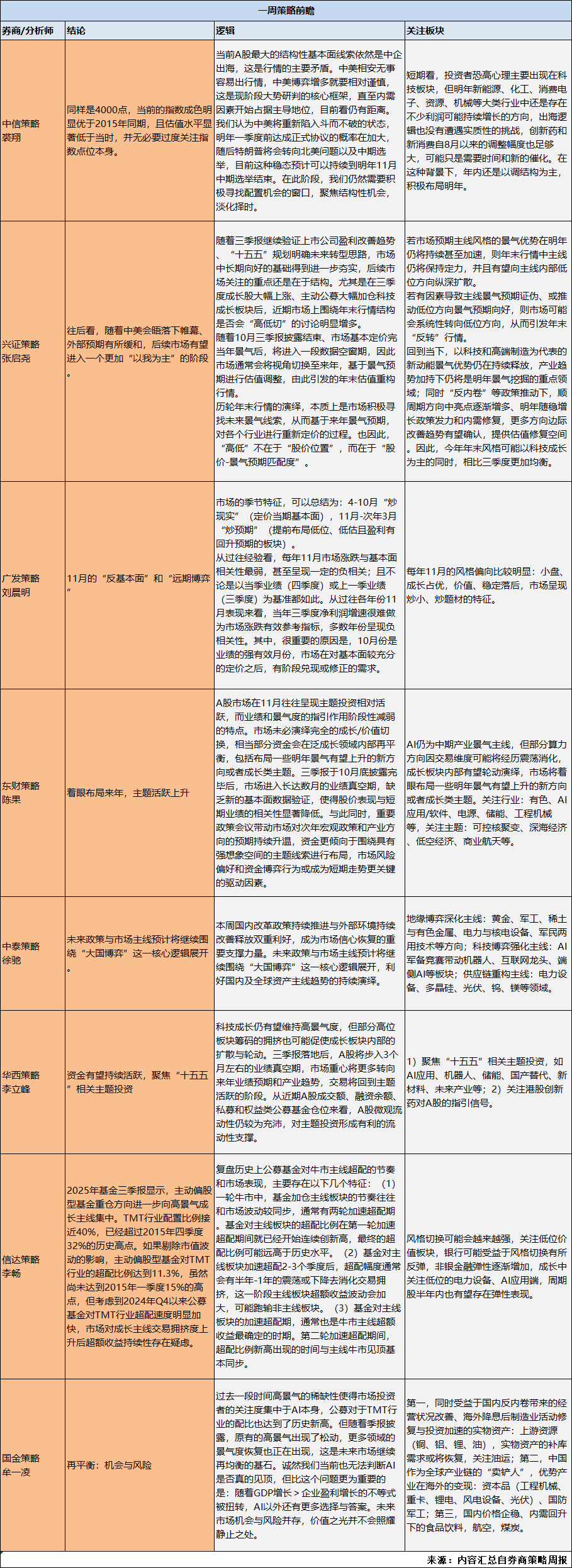
A股分析师前瞻:历史上的11月风格更偏向炒小、炒题材?
Xuan Gu Bao· 2025-11-02 13:55
Group 1 - The core viewpoint of the articles discusses the historical market trends in November and year-end, highlighting a shift from "pricing current fundamentals" from April to October to "pricing expectations" from November to March of the following year [1][5] - Historical data indicates that the correlation between market performance in November and fundamentals is weak, often showing a negative correlation, as October is a strong earnings month leading to a need for market correction [1][5] - The market style in November tends to favor small-cap and growth stocks while value and stability lag behind, reflecting a trend of speculative investments in smaller themes [1][5] Group 2 - The year-end market performance is characterized by a search for future economic clues, leading to a revaluation of various industries based on next year's economic expectations [2][3] - The technology and high-end manufacturing sectors are expected to continue their growth momentum, becoming key areas for economic exploration in the coming year [2][3] - The "anti-involution" policies are expected to enhance cyclical sectors, with more areas showing marginal improvement trends, providing room for valuation recovery [2][3] Group 3 - The market is anticipated to enter a more balanced phase with a focus on technology growth, compared to the previous quarter [3] - The scarcity of high-growth sectors has led to increased investor focus on AI, with public funds heavily weighted towards the TMT sector, reaching historical highs [3][6] - As earnings reports conclude, the market is expected to shift focus towards next year's performance expectations and industry trends, leading to a more active thematic investment phase [5][6]
策略周末谈:做时间的朋友
Western Securities· 2025-11-02 12:42
Core Conclusions - The bull market is entering its second phase, transitioning from a "technology bull" to a "wealth bull" [1] - After the "super macro month" in October, the market is expected to favor cyclical stocks as a better allocation choice due to high valuations and potential adjustments if EPS does not improve [1][5] - Current market conditions present an optimal window for investing in cyclical stocks, supported by five key reasons [1] Reason 1: Cyclical Stocks as "Friends of Time" - Since Q3, the market has begun to trade based on changes in profitability (△ROE), indicating a return to investment in economic recovery [21] - Cyclical stocks have lagged behind in price compared to improvements in fundamentals, making them more favorable during market adjustments [21][24] Reason 2: Potential Requirements of the "14th Five-Year Plan" - The "14th Five-Year Plan" suggests that by 2035, per capita GDP should reach the level of moderately developed countries, requiring an annual growth rate of 4.1% plus inflation and currency appreciation [2][30] - Achieving this goal necessitates a combination of moderate inflation and currency appreciation to establish a growth baseline for cyclical industries [2][31] Reason 3: Cross-Border Capital Inflow, Repeating 2019-2021 - Recent reports emphasize that cross-border capital inflow will effectively support domestic demand, with signs of cyclical improvement already emerging [3][33] - The return of cross-border capital is expected to drive a revaluation of global commodities and domestic manufacturing, similar to the core asset bull market seen post-pandemic [3][36] Reason 4: New Regulations for Public Funds Guiding "Rebalancing" - The introduction of new regulations for public funds is expected to lead to a rebalancing of holdings between TMT and cyclical stocks [4][39] - As public funds have not significantly increased new issuances, the shift from cyclical to TMT stocks has resulted in a decrease in the pricing power of TMT stocks [4][40] Reason 5: Slowdown in Incremental Capital Inflows, Entering a Competitive Phase - Since September, there has been a noticeable slowdown in the inflow of various types of capital, indicating a shift in market dynamics [5][44] - The market is transitioning into a phase of competition, with cyclical stocks likely to benefit from this change [5][51] Investment Recommendations: Transitioning from "Technology Bull" to "Wealth Bull" - The report suggests continuing to invest in cyclical stocks, particularly in sectors such as non-ferrous metals, new consumption, and high-end manufacturing, as these areas are expected to benefit from the current economic conditions [5][54]
管涛:“十五五”高水平对外开放如何“领跑”
Di Yi Cai Jing· 2025-11-02 12:35
Core Viewpoint - The "15th Five-Year Plan" emphasizes high-level opening up as a key strategy for China's modernization, aiming to share opportunities and promote development with the world [1][4]. Group 1: Strategic Framework - The "15th Five-Year Plan" consists of 15 parts and 61 articles, focusing on strategic tasks and major initiatives for the next five years, with a significant emphasis on expanding high-level opening up [1]. - The plan reflects China's confidence and determination to enhance international cooperation and economic integration amid a changing global landscape [1][4]. Group 2: External Challenges - The plan acknowledges the coexistence of strategic opportunities and risks, highlighting the rise of unilateralism and protectionism, as well as the potential for external shocks [2][3]. - It identifies the need for proactive measures to navigate complex international dynamics and maintain development momentum [3]. Group 3: High-Level Opening Up - High-level opening up is deemed essential for driving high-quality development, with a focus on technological self-reliance and innovation [4][5]. - The plan aims to create a market-oriented, law-based, and international business environment to enhance economic vitality and support socialist market economy reforms [5]. Group 4: Global Economic Role - China positions itself as a responsible major power in promoting economic globalization, despite facing challenges from protectionist policies in other countries [6][8]. - The country has maintained its status as a leading exporter and importer, with significant trade volumes and ongoing initiatives like the China International Import Expo [6][8]. Group 5: Policy Initiatives - The plan outlines specific measures for institutional opening, including aligning with international trade rules and expanding market access, particularly in the service sector [10]. - It emphasizes the importance of trade innovation, investment cooperation, and financial market opening to enhance China's global economic engagement [11][12].

中信建投:沪指突破4000点 年末如何应对?
智通财经网· 2025-11-02 12:32
Core Viewpoint - The market is expected to face a new round of horizontal adjustment in November due to the exhaustion of previous upward momentum and the concentration of three major favorable factors at the end of October, suggesting investors should pause on increasing positions [1][3]. Group 1: Market Performance and Trends - The market experienced a surge, with the Shanghai Composite Index breaking through 4000 points, reaching a nearly ten-year high, driven by the recovery of technology stocks and the positive impact of the "14th Five-Year Plan," Sino-U.S. trade negotiations, and the disclosure of third-quarter reports from key industries [2]. - The third-quarter reports indicate a positive recovery trend in A-share performance, with significant growth in major sectors, particularly in traditional cyclical industries and technology sectors, showing strong recovery signs [2][3]. Group 2: Sector Focus and Recommendations - The report highlights three main directions for investment: 1) Focus on sectors with positive economic signals, particularly renewable energy (energy storage, solid-state batteries) and non-bank financials (brokerage, insurance); 2) Year-end portfolio adjustments favoring sectors with lower performance in the first ten months, such as coal, oil and petrochemicals, public utilities, food and beverage, and transportation; 3) Short-term switches to sectors that experienced the largest declines in October, including media, beauty care, and automotive [3]. - Key sectors to watch include coal, oil and petrochemicals, renewable energy (energy storage, solid-state batteries), non-bank financials (brokerage, insurance), public utilities, media, food and beverage, and transportation [1][3].
