再生铝

Search documents
文莱国家投资基金sdc明确资金入股华航铝业总投资额30%
Zhong Guo Jin Rong Xin Xi Wang· 2025-09-20 07:04
Core Insights - Brunei's Guangxi Huahang Aluminum Industry (Brunei) has received the first import license for recycled aluminum, with the Brunei National Investment Fund committing to invest 30% of the total project cost, which amounts to 30% equity in the company [1] - The project aims to establish a stable import channel for recycled aluminum through the Brunei-Guangxi Economic Corridor, previously reliant on Malaysia and Indonesia [1] - The project will be developed in three phases, with an initial investment of 10 million Brunei dollars (approximately 56 million RMB) to achieve an annual production of 200,000 tons of recycled aluminum [1] Company Developments - The Huahang Aluminum project in Brunei plans to expand its production capacity through three phases, with total investments of 10 million, 20 million, and 200 million Brunei dollars, respectively, leading to a total annual production of 80 tons of aluminum products [1] - The company has achieved a 20% increase in the strength of recycled aluminum alloys and a 35% reduction in weight, with 30% of its annual capacity of 100,000 tons being exported [2] - The unique technology developed by the company allows for 95% recycling of aluminum, significantly reducing carbon emissions compared to electrolytic aluminum production [2] Industry Trends - The push for recycled non-ferrous metals is gaining momentum in China, with ports accelerating the expansion of overseas sourcing channels [3] - The establishment of innovative customs clearance models for recycled metals, such as the one implemented by Ningbo Customs for recycled copper, is being suggested for Guangxi to enhance its position in the global aluminum processing market [3]
中孚实业(600595):公司点评报告:电解铝权益产能提升,公司业绩不断修复
Zhongyuan Securities· 2025-09-17 10:38
Investment Rating - The report assigns an "Increase" rating for the company, indicating a potential price increase of 5% to 15% relative to the CSI 300 index over the next six months [23]. Core Views - The company has shown significant profit growth due to a decrease in raw material prices and an increase in aluminum prices, with a net profit of 707 million yuan in the first half of 2025, representing a year-on-year increase of 59.55% [6][9]. - The improvement in performance is attributed to enhanced profitability in aluminum deep processing and increased electrolytic aluminum capacity, alongside reduced costs from alumina and electricity [9]. - The company completed a 24% equity acquisition in Zhongfu Aluminum, raising its electrolytic aluminum capacity to 750,000 tons per year, and is advancing its green aluminum development strategy [9]. Summary by Sections Financial Performance - In the first half of 2025, the company achieved operating revenue of 10.574 billion yuan, a year-on-year decline of 3.82%, while the net profit attributable to shareholders increased by 59.55% [6]. - The gross profit margin improved to 11.66%, up 1.40 percentage points from the previous year, and the net profit margin rose to 5.93%, an increase of 1.59 percentage points [9]. Cost and Pricing Dynamics - The average alumina price in the first half of 2025 was 3,450.64 yuan per ton, down 1.17% year-on-year, while the electrolytic aluminum price was 20,315.42 yuan per ton, up 2.66% [9]. - The price of thermal coal decreased by 26.81% year-on-year, contributing to cost improvements [9]. Strategic Developments - The company is focusing on green low-carbon transformation, with a new distributed photovoltaic capacity of approximately 21.5 MW added in the first half of 2025, bringing the total to about 77.55 MW [9]. - The proportion of recycled aluminum in deep processing products reached 61%, further reducing the carbon footprint [9]. Shareholder Returns - The company initiated an employee stock ownership plan, with employees purchasing approximately 330 million shares, representing 8.21% of total shares, at an average price of 3.21 yuan per share [9]. - A cash dividend plan was established, aiming to distribute at least 60% of the distributable profits in cash annually from 2025 to 2027, reflecting confidence in future profitability [9]. Earnings Forecast - The company is projected to achieve operating revenues of 24.108 billion yuan, 24.469 billion yuan, and 24.861 billion yuan for 2025, 2026, and 2027, respectively, with net profits of 2.126 billion yuan, 2.232 billion yuan, and 2.390 billion yuan [10].

明泰铝业: 明泰铝业2025年半年度报告
Zheng Quan Zhi Xing· 2025-08-22 16:29
Core Viewpoint - The report highlights the financial performance and strategic initiatives of Henan Mingtai Aluminum Industry Co., Ltd. for the first half of 2025, emphasizing its focus on high-end manufacturing, low-carbon circular economy, and the expansion of recycled aluminum applications. Company Overview and Key Financial Indicators - The company reported a revenue of approximately 16.99 billion RMB, an increase of 11% compared to the same period last year [2] - The total profit decreased by 10.9% to approximately 1.07 billion RMB, while the net profit attributable to shareholders fell by 12.11% to about 940 million RMB [2] - The net cash flow from operating activities increased by 80.56% to approximately 1.1 billion RMB [2] - Total assets grew by 20.38% to approximately 28.08 billion RMB, and net assets increased by 5.36% to about 18.23 billion RMB [2] Industry and Main Business Situation - The aluminum plate, strip, and foil industry maintained resilience supported by demand from the new energy sector, while recycled aluminum applications expanded rapidly due to policy and technological advantages [3] - The company has developed into a leading player in both diversified aluminum processing and recycled aluminum applications, with products used in various sectors including new energy, transportation, electronics, and military [3][4] - The company operates four hot-rolling production lines and has advanced recycling technology, with an annual processing capacity of over 1 million tons of waste aluminum [3] Operational Analysis - The company employs a "sales-driven production" model, ensuring stable procurement of raw materials through long-term agreements with suppliers [4] - The company focuses on high-end intelligent manufacturing and low-carbon circular economy, aiming to enhance product structure and management efficiency [5] - The company has made significant advancements in technology, including the development of high-performance aluminum foil for solid-state batteries and lightweight aluminum structures for robotics and aerospace applications [5][6] Financial Performance and Cost Management - The company reported an increase in operating costs by 18.96% to approximately 15.96 billion RMB, while sales expenses decreased by 13.99% [11] - The company has implemented measures to reduce costs and improve efficiency, including the use of recycled aluminum to lower raw material costs [7] - The company achieved a sales volume of 780,000 tons in the first half of 2025, with a revenue of 17 billion RMB [7] Competitive Advantages and Future Outlook - The company has established a strong competitive position through continuous technological innovation and a focus on green production practices [8] - The company has received multiple certifications for its green manufacturing processes and aims to further enhance its recycling capabilities in response to new regulations [8][13] - The company is actively pursuing international procurement of recycled aluminum to expand its supply network and reduce carbon emissions [13] Governance and Investor Relations - The company has undergone a board restructuring to enhance decision-making efficiency and governance practices [14] - The company emphasizes transparent communication with investors and has implemented a systematic investor relations management framework [15]

中孚实业(600595):电解铝权益提升增弹性,分红在即未来可期
Huachuang Securities· 2025-08-18 13:05
Investment Rating - The report gives a "Buy" rating for Zhongfu Industrial with a target price of 6.3 CNY [3][12]. Core Views - The company is positioned to benefit from increased electrolytic aluminum capacity and a decline in raw material costs, leading to improved profitability and asset quality [9][10]. - The company is set to initiate its first dividend in years, indicating a strong commitment to shareholder returns [10][46]. - The transition towards green electricity consumption in the electrolytic aluminum sector presents a significant competitive advantage for the company [10][11]. Financial Summary - Total revenue is projected to grow from 22,761 million CNY in 2024 to 27,764 million CNY by 2027, with a compound annual growth rate (CAGR) of approximately 4.7% [4]. - Net profit attributable to shareholders is expected to rebound from 704 million CNY in 2024 to 2,688 million CNY in 2027, reflecting a significant recovery [4]. - Earnings per share (EPS) is forecasted to increase from 0.18 CNY in 2024 to 0.67 CNY in 2027 [4]. Company Overview - Zhongfu Industrial is a veteran in the electrolytic aluminum industry, with a diversified business model encompassing coal, electricity, and aluminum processing [8][15]. - The company has undergone significant restructuring since 2021, improving its financial health and operational efficiency [8][17]. - As of 2024, the company has a production capacity of 690,000 tons of deep-processed aluminum and 750,000 tons of electrolytic aluminum, positioning it among the top players in China's aluminum sector [15][27]. Growth Drivers - The completion of 100% control over electrolytic aluminum assets is expected to enhance production capacity by 19.3% [10][58]. - The company is actively working on cost optimization through self-supplied electricity and high self-sufficiency in carbon materials [10][61]. - The upcoming regulatory changes regarding green electricity consumption in the electrolytic aluminum industry are anticipated to favor companies like Zhongfu that are investing in green energy solutions [10][11]. Dividend Policy - The company plans to distribute at least 60% of its distributable profits as cash dividends from 2025 to 2027, reflecting a strong commitment to returning value to shareholders [10][47]. - The expected dividend yield for 2025-2027 is projected to be between 2.5% and 7.7%, depending on the approach to covering past losses [10][50].
顺博合金: 2025年半年度报告
Zheng Quan Zhi Xing· 2025-08-06 16:09
Core Viewpoint - The report highlights the financial performance and operational strategies of Chongqing Shunbo Aluminum Alloy Co., Ltd. for the first half of 2025, showcasing significant growth in revenue and net profit, alongside a focus on sustainable practices in the recycling aluminum industry [5][10]. Financial Performance - The company's operating revenue for the reporting period reached CNY 7,126,279,774.01, representing an increase of 11.75% compared to CNY 6,376,853,691.63 in the same period last year [6][18]. - The net profit attributable to shareholders was CNY 151,055,661.76, a substantial increase of 114.05% from CNY 70,570,447.33 year-on-year [6][18]. - Basic earnings per share rose to CNY 0.27, up 58.82% from CNY 0.17 [6][18]. Business Overview - The company operates primarily in the recycling aluminum alloy ingot production and sales, contributing to resource conservation and environmental sustainability [8][9]. - The main business segments include casting aluminum alloy, deformed aluminum alloy, and hazardous waste disposal [8][9]. Production Capacity and Expansion - The company has established four production bases in Chongqing, Guangdong, Hubei, and Anhui, with a total capacity of 1.05 million tons, targeting major consumption markets in Southwest, South, East, and Central China [7][13]. - The Anhui Shunbo Phase I project has released 400,000 tons of casting aluminum alloy capacity, with ongoing capacity ramp-up [7][9]. Market Position and Strategy - As a leading player in the recycling aluminum industry, the company aims to enhance its market share through strategic regional expansions and customer relationship management [9][16]. - The company’s products are widely used in various industries, including automotive, machinery, and electronics, with a growing focus on lightweight materials for new energy vehicles [15][16]. Technological Advancements - The company has developed a comprehensive core technology system covering the entire industry chain, emphasizing cost reduction and quality improvement [15][16]. - Continuous innovation in production processes and technology is a priority, with a focus on high-value, intelligent, and low-carbon solutions [15][16].
顺博合金: 2025年度向特定对象发行A股股票方案的论证分析报告
Zheng Quan Zhi Xing· 2025-07-22 16:27
Core Viewpoint - The company, Chongqing Shunbo Aluminum Alloy Co., Ltd., plans to issue A-shares to specific investors to meet funding needs for business development and enhance capital strength and profitability [1][2]. Group 1: Background and Purpose of the Issuance - The issuance is in response to national policies promoting the recycling of resources and the development of a circular economy, particularly in the aluminum industry [1][2]. - The company aims to raise up to 600 million yuan to fill a funding gap for projects including a 630,000-ton aluminum alloy ingot project and a 500,000-ton aluminum plate and strip project [2][3]. Group 2: Necessity of the Securities Issuance - The issuance will involve domestic RMB ordinary shares (A-shares) with a face value of 1.00 yuan each [3]. - The previous fundraising was reduced from 1.5 billion yuan to 600 million yuan due to market conditions, necessitating this new issuance to complete the required investments [2][3]. Group 3: Selection of Issuance Objects - The issuance will target up to 35 specific investors, including qualified institutional investors and other legal entities [4][5]. - All investors will subscribe to the shares in cash, ensuring compliance with regulatory requirements [5]. Group 4: Pricing Principles and Methods - The pricing will be based on the average trading price of the company's shares over the 20 trading days prior to the issuance date, set at no less than 80% of that average [6][7]. - The final pricing will be determined by the board of directors in consultation with the lead underwriter after regulatory approval [6][7]. Group 5: Feasibility of the Issuance Method - The issuance complies with relevant laws, including the Company Law and Securities Law, ensuring that all shares have equal rights [8][9]. - The issuance process has been approved by the company's board and supervisory board, and will be subject to shareholder approval and regulatory review [12][13]. Group 6: Fairness and Reasonableness of the Issuance Plan - The issuance plan has been reviewed and approved by independent directors and the board, ensuring it aligns with shareholder interests [12][13]. - The company commits to transparency by disclosing the issuance details to shareholders, safeguarding their rights [12][13]. Group 7: Impact on Shareholder Rights and Measures to Mitigate Dilution - The issuance may dilute existing shareholders' immediate returns, but the company plans to enhance capital strength and market competitiveness to mitigate this effect [13][14]. - Measures include expanding market reach and increasing product development to improve profitability and shareholder returns [13][14]. Group 8: Commitment to Regulatory Compliance and Governance - The company has established a robust governance structure and internal controls to ensure compliance with laws and protect shareholder interests [15][16]. - Commitments from major stakeholders to uphold shareholder rights and ensure the effectiveness of measures to mitigate dilution risks have been made [16]. Conclusion - The planned issuance of A-shares is deemed necessary and feasible, aligning with the company's strategic goals and benefiting shareholders [17].
顺博合金: 向特定对象发行A股股票募集资金使用可行性分析报告
Zheng Quan Zhi Xing· 2025-07-22 16:27
Group 1 - The company plans to raise up to 150 million yuan by issuing A-shares to enhance its core competitiveness and profitability, focusing on two main projects: a 630,000-ton low-carbon aluminum alloy ingot project and a 500,000-ton green high-performance aluminum plate project [1][4][9] - The total investment for the aluminum alloy ingot project is estimated at 78,234,000 yuan, with 20,000,000 yuan from the raised funds, while the aluminum plate project has a total investment of 289,244,000 yuan, with 100,000,000 yuan from the raised funds [1][4] - As of June 30, 2025, the previous fundraising has been fully utilized, with the company having invested 26,314,000 yuan in the ingot project and 38,117,000 yuan in the plate project [1][4][9] Group 2 - The company aims to complete the construction of 200,000 tons of aluminum plates and supporting aluminum alloy ingots by the end of March 2026, with further expansions planned for 2026 and 2027 [3][22] - The aluminum alloy ingot project is designed to have a production capacity of 630,000 tons, while the aluminum plate project is set at 500,000 tons, with both projects expected to achieve an 80% capacity utilization rate [27][30] - The aluminum plate products will primarily serve various industries, including new energy vehicles, packaging, and consumer electronics, indicating a strong market demand [10][12][14] Group 3 - The company has established a comprehensive sales network and plans to enhance its marketing team to support the sales of the new products, leveraging existing customer relationships and expanding market share [32][21] - The aluminum plate products are expected to cater to the growing demand in sectors such as battery casings for electric vehicles and packaging materials, aligning with national policies promoting recycling and sustainability [8][13][16] - The company has a strong procurement strategy for raw materials, primarily using recycled aluminum, which is crucial for controlling production costs in the aluminum alloy ingot project [18][19] Group 4 - The aluminum industry is experiencing growth driven by the demand for lightweight materials in transportation and packaging, with the market for aluminum plates projected to expand significantly [10][12][13] - The company is positioned to benefit from the increasing focus on green and sustainable practices in manufacturing, aligning with national strategies for carbon reduction and resource recycling [9][13][14] - The overall market for aluminum products is expected to grow due to the rising demand in various sectors, including construction, automotive, and electronics, providing a favorable environment for the company's expansion plans [11][12][13]
华东再生铝调研:废料紧缺给予强支撑,仓单或为博弈核心
Dong Zheng Qi Huo· 2025-07-22 09:01
1. Report Industry Investment Rating No relevant content provided. 2. Core Viewpoints of the Report - The current tight supply of scrap aluminum provides strong support for the market. Despite the serious over - capacity and low operating rate in the recycled aluminum industry, the scrap aluminum supply shortage and the delayed arrival of the scrap peak in 2 - 3 years give a solid foundation to the market. There is a potential for a soft squeeze - out situation in the ADC12 market if the peak - season demand is fulfilled and the spot price is at a premium to the futures price [3][14][19]. - In terms of investment strategies, an arbitrage strategy of going long on AD and short on AL can be considered currently, with profit expected to be realized in October. For unilateral trading, there are opportunities to go long at low prices [3][28]. 3. Summary by Relevant Catalogs 3.1. Research Objects and Purposes - The research objects are 5 recycled aluminum plants and 2 scrap aluminum recyclers in Nantong, Baoying, Kunshan, and Shanghai. The purpose is to discuss aspects such as production capacity, output, scrap aluminum supply and demand, costs, prices, inventory strategies, and hedging intentions after the listing of aluminum alloy futures, and to think about subsequent trading logic [10]. 3.2. Key Research Findings and Analyses 3.2.1. Scrap Aluminum Procurement - Scrap aluminum procurement is tight due to limited imports (US tariff policies, port congestion in Malaysia, and environmental regulations in Thailand), limited domestic scrap aluminum increment but increasing demand, and some large factories only purchasing from large - scale ticket - issuing recyclers to avoid information asymmetry risks [14][17]. 3.2.2. Production and Operation - The surveyed recycled aluminum plants have an operating rate higher than the industry average, with an aluminum liquid direct - supply ratio of over 50 - 60% and a maximum transportation distance of 300km. The ADC12 production ratio is around 40 - 50%, and orders are mainly long - term contracts. There is a potential soft squeeze - out risk in the ADC12 market [18][19]. - The use ratio of raw and cooked aluminum in scrap aluminum is flexibly adjusted according to prices. The natural gas consumption per ton is 80 cubic meters, and the total processing fee is 800 - 1200 yuan/ton. The comprehensive tax burden in Jiangsu and Shanghai is about 2 percentage points higher than that in Anhui, but some enterprises can make up for this cost through local procurement and sales, and product quality premiums [23][24]. - The raw material inventory of surveyed enterprises is generally 7 - 10 days' usage, and the finished product inventory is about 1000 - 1500 tons, with some enterprises having no finished product inventory but a high aluminum liquid direct - supply ratio [25]. 3.2.3. Warehouse Receipts - Currently, surveyed enterprises are open to delivering warehouse receipts but are mostly in a wait - and - see mode, mainly referring to the futures price and basis in September - October. The storage time of ADC12 alloy ingots is limited, and the high standards of futures delivery products may reduce the willingness of downstream enterprises to take delivery from the futures market [27]. 3.3. Investment Recommendations 3.3.1. Arbitrage - Consider the strategy of going long on AD and short on AL. The current price difference between ADC12 and A00 fluctuates between - 1500 yuan and + 500 yuan/ton, and the profit is expected to be realized in October. In the long - term, the price difference between ADC12 and A00 may gradually decrease [28]. 3.3.2. Unilateral Trading - Look for opportunities to go long at low prices. The tight scrap aluminum supply and the potential for a soft squeeze - out situation provide support for long - side trading [3][29]. 3.4. Research Minutes 3.4.1. Aluminum Alloy Plant A - Raw materials are mainly domestic scrap aluminum, with less than 20% imported. The annual production capacity is 24.99 tons, and the annual output is 22 tons. The ADC12 production ratio is over 40%. The enterprise does not stock finished products and sells based on orders [30]. 3.4.2. Aluminum Alloy Plant B - The import ratio of scrap aluminum is 30%, and the domestic ratio is 70%. The designed annual production capacity is 20 tons, and the current annual output is 7 - 8 tons. The enterprise plans to use a new production line for futures delivery products [33]. 3.4.3. Aluminum Alloy Plant C - Raw materials are mainly domestic. The Baoying base has a production capacity of 11.85 tons. The aluminum liquid ratio is over 60%, and the ADC12 ratio in aluminum ingots is less than 35%. The enterprise participates in hedging and has views on industry development [35][36]. 3.4.4. Aluminum Alloy Plant D - The Kunshan production line has a total approved production capacity of 12 tons, and the Anhui production line will focus on delivery. The ADC12 production ratio is 20 - 30%. The enterprise is positive about futures trading [37][38]. 3.4.5. Aluminum Alloy Plant E - The monthly scrap aluminum procurement is 4000 - 5000 tons. The current production capacity is 7 tons, and the monthly output is about 6000 tons. The enterprise is cautious about the increase in ADC12 social inventory [39][41]. 3.4.6. Scrap Aluminum Recycling Enterprise A - It has recycling centers in Shanghai and Fujian, with a large trading volume. It mainly recycles new scrap aluminum from aluminum processing enterprises and conducts business through long - term contracts [42]. 3.4.7. Scrap Aluminum Recycling and Aluminum Alloy Trading Enterprise B - It is a benchmark enterprise in scrap aluminum supply. The monthly ADC12 trading volume is about 1000 tons, and it may participate in delivery in November. It mainly conducts long - term contract business and hedges when purchasing scrap aluminum [44][45].
中孚实业(600595):电解铝强α标的,高盈利弹性+高股东回报加码有望迎价值重估
Tianfeng Securities· 2025-07-19 07:19
Investment Rating - The report assigns an "Accumulate" rating for the company with a target price of 5.2 CNY, based on a current price of 4.49 CNY [6]. Core Views - The company is positioned as a strong player in the electrolytic aluminum sector, with high profitability elasticity and increased shareholder returns expected to lead to a revaluation of its value [2]. - The company has successfully transitioned from a restructuring phase to a growth phase, significantly improving its operational status and financial health [1][14]. Summary by Sections Company Overview - The company, established in 1993, has developed a synergistic operating model focusing on aluminum and deep processing, supported by coal mining, thermal power generation, and carbon products [1]. - The current production capacity includes 690,000 tons of deep-processed aluminum, 750,000 tons of electrolytic aluminum, 150,000 tons of carbon products, and 90,000 kW of electricity [1]. Financial Performance - The company has shown a significant recovery post-restructuring, with a projected net profit of 1.83 billion CNY in 2025, reflecting a year-on-year increase of 159.7% [4]. - Revenue is expected to grow from 227.61 billion CNY in 2024 to 235.40 billion CNY in 2025, with a growth rate of 3.42% [5]. Industry Analysis - The electrolytic aluminum industry is experiencing a tightening supply-demand dynamic, with domestic production capacity nearing its ceiling at approximately 45 million tons [3]. - Demand for electrolytic aluminum is primarily driven by sectors such as construction, transportation, and renewable energy, with significant growth expected from photovoltaic and new energy vehicles [3]. Profitability and Cost Structure - The company has enhanced its electrolytic aluminum capacity to 750,000 tons per year, benefiting from cost reductions in alumina and electricity, which are expected to improve profit margins in 2025 [2][4]. - The average electricity price in the Guangyuan region is projected to decrease significantly in 2025, further enhancing profitability [2]. Shareholder Returns - The company has initiated a robust employee stock ownership plan, aiming to raise up to 1.25 billion CNY, and has committed to distributing at least 60% of its distributable profits as dividends over the next three years [2][25].
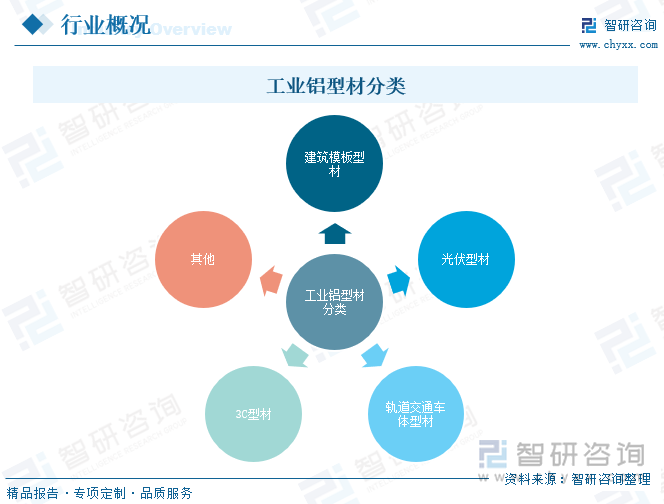
研判2025!中国工业铝型材行业政策汇总、产业链图谱、生产现状、竞争格局及发展趋势分析:光伏型材占工业铝型材总产量的33.7%[图]
Chan Ye Xin Xi Wang· 2025-07-01 01:16
Core Viewpoint - The industrial aluminum profile market in China is experiencing significant growth driven by the increasing demand for lightweight vehicles and the expansion of the new energy vehicle sector, alongside robust demand from the photovoltaic industry [1][9]. Market Overview - Industrial aluminum profiles are primarily alloy materials made from aluminum, produced through processes like melting and extrusion, resulting in various shapes for different applications [2]. - The market is witnessing a production capacity expansion among Chinese manufacturers to meet the rising demand, with a projected production volume of 11.705 million tons in 2024, marking a year-on-year increase of 23.21% [1][9]. Market Policies - A series of supportive policies have been introduced to encourage technological innovation and green manufacturing in the industrial aluminum profile sector, including guidelines for recycling and promoting green finance [4][6]. Industry Chain - The upstream of the industrial aluminum profile industry includes bauxite, recycled aluminum, and production equipment, while the downstream encompasses applications in photovoltaic, new energy vehicles, and construction [7]. Competitive Landscape - The industrial aluminum profile market is highly competitive, with numerous players entering the field. The top twenty companies include prominent names such as Conglin Aluminum Technology and Dingmei New Materials [11][13]. - Conglin Aluminum Technology specializes in high-end industrial aluminum profiles and lightweight equipment, serving major clients like China CRRC and Maersk [14]. - Dingmei New Materials focuses on high-performance aluminum and magnesium alloys, achieving a revenue of 1.491 billion yuan in 2024, with 44.01% from industrial aluminum materials [16]. Development Trends - The industry is expected to adopt smart production lines and technologies such as IoT and AI to enhance efficiency and reduce costs. The use of recycled aluminum is anticipated to increase, promoting resource circularity [18].