减税

Search documents
【环时深度】米莱上台两周年,阿根廷民众怎么看
Huan Qiu Shi Bao· 2025-12-04 22:51
Core Points - The recent midterm elections in Argentina resulted in a surprising victory for Javier Milei's right-wing coalition, the "La Libertad Avanza" party, which is seen as a public endorsement of his austerity measures and neoliberal policies [2][4] - Milei's government has implemented strict austerity measures, leading to a significant reduction in monthly inflation rates from 25% in December 2023 to around 2% recently, and a decrease in poverty rates from 52.9% to 31.6% [3][8] - Despite the economic improvements, there are concerns about the social costs of these reforms, with many citizens feeling the burden of austerity measures and expressing dissatisfaction with the growing inequality [3][5] Political Landscape - The "La Libertad Avanza" party secured over one-third of the seats in Congress, allowing Milei to block opposition attempts to overturn presidential decrees, thus strengthening his political foundation [2][4] - Public sentiment is mixed, with some citizens preferring the uncertainty of Milei's reforms over a return to previous governance, reflecting a broader disillusionment with traditional political parties [4][6] Economic Implications - Milei's victory has created new opportunities for debt issuance, potentially attracting much-needed foreign investment, particularly in sectors like oil and gas [2][3] - The government has made significant cuts to federal spending, reducing it by approximately 30% and cutting the number of public employees by about 15% [3][8] - Argentina's debt stands at approximately $56.944 billion, and the country is seeking to attract investment in infrastructure to support economic growth [3][7] Social Reactions - Many citizens express a sense of stability but also highlight the increasing financial strain, with reports of rising debt among working individuals [3][5] - There is a growing concern that the benefits of Milei's policies are disproportionately favoring the wealthy, leading to a perception of increased inequality [3][6] International Relations - The relationship between Argentina and the United States has become complex, with recent support from the U.S. government for Milei's administration, including a $20 billion currency swap agreement [7][8] - However, there are fears that U.S. support may come with strings attached, potentially undermining Argentina's economic sovereignty [7][8] Future Outlook - Analysts suggest that while Milei's reforms have shown some success, the sustainability of these policies remains in question, particularly regarding social equity and long-term economic stability [8][9] - The upcoming elections in 2027 could pose significant challenges for Milei if social discontent continues to grow due to ongoing austerity measures [9]
奇怪的一幕发生了
Sou Hu Cai Jing· 2025-12-03 06:45
Group 1 - The article discusses the potential selection of a new Federal Reserve Chair by Trump, indicating that he may have already made a decision [2][4]. - The original process for selecting candidates involved Vice President Pence conducting interviews, followed by a review from the advisory team before Trump made the final decision [3]. - Trump's abrupt announcement of having already chosen a candidate led to the cancellation of scheduled interviews with other candidates [4][5]. Group 2 - During a cabinet meeting, Trump publicly stated that they had reviewed ten candidates and had settled on one, hinting at Hassett as a potential choice [6]. - Hassett, a long-time economic advisor to Trump, is known for his pro-rate cut and pro-tax cut stance, making him a favorable candidate for Trump [6]. - Other candidates mentioned include former Federal Reserve Governor Kevin Warsh and current Fed Governor Christopher Waller, but Hassett appears to align more closely with Trump's preferences [6]. Group 3 - Market reactions to the potential appointment of Hassett were muted, with gold prices experiencing a slight increase before retreating, and the S&P 500 futures showing only minor gains [6]. - The closing of the market on the same day is expected to provide significant insights, as the market is currently at an emotional tipping point [6].


特朗普:已确定美联储主席继任者,很快就会宣布
Sou Hu Cai Jing· 2025-12-01 02:01
Core Viewpoint - President Trump has confirmed that he has selected a candidate for the next Federal Reserve Chair, with strong indications pointing towards Kevin Hassett, the current Director of the White House Council of Economic Advisers [1][2]. Group 1: Candidate Profile - Kevin Hassett, aged 63, holds a Ph.D. in economics from the University of Pennsylvania and has a background that includes working at the Federal Reserve and serving as an economic advisor to several Republican leaders [2]. - Hassett is known for advocating tax cuts and loose monetary policy, and he has publicly supported faster and more frequent interest rate cuts [2]. Group 2: Market Reactions - Market data indicates a significant increase in the probability of Hassett's nomination, rising to 64% from less than 40% in the previous week, while other candidates have much lower probabilities [1]. - The market reacted positively to the news of Trump's impending nomination announcement, with improved performance in Treasury auctions and a decrease in interest rates [3]. Group 3: Current Federal Reserve Context - Under Jerome Powell's leadership, the Federal Reserve has recently cut interest rates, bringing the benchmark rate to its lowest level in three years [5]. - Trump has been critical of Powell, suggesting that he would like to dismiss him and has made various accusations regarding the Federal Reserve's management [6][7].

华尔街“最乐观多头”摩根大通:AI超级周期驱动,标普500指数2026年有望冲破8000点
美股IPO· 2025-11-27 00:21
Group 1: Market Predictions - Morgan Stanley predicts the S&P 500 index could reach a base target of 7500 points by the end of 2026, with potential to exceed 8000 points under further Federal Reserve easing conditions, driven by an AI supercycle and a resilient U.S. economy [1] - The Nifty 50 index in India is expected to rise to 30,000 points by the end of 2026, approximately a 15% increase from current levels, supported by tax cuts and interest rate reductions [5] Group 2: Economic Drivers - Recent tax cuts and anticipated interest rate cuts by the Reserve Bank of India are expected to boost domestic demand, with a 25 basis point rate cut likely in December [7] - The Indian stock market's valuation has fallen below long-term averages after a period of underperformance, providing a supportive backdrop for recovery [7] Group 3: Trade Relations - The likelihood of a U.S.-India trade agreement is high, which could lead to a short-term revaluation of the stock market, particularly benefiting sectors like IT and pharmaceuticals [8][9] - The potential removal of a 25% punitive tariff on imports from India could enhance investor confidence and attract foreign capital inflows [8] Group 4: Sector Preferences - Morgan Stanley maintains an "overweight" rating on sectors such as materials, financials, consumer goods, healthcare, real estate, defense, and power, while holding a "underweight" stance on IT and pharmaceuticals [10] - Industries benefiting from domestic consumption growth and infrastructure development are expected to perform better, with financials poised to gain from the interest rate cycle and increased corporate debt demand [10]


英国秋季预算案出炉
Guo Ji Jin Rong Bao· 2025-11-26 16:16
Core Viewpoint - The UK government, led by Chancellor Rachel Reeves, has announced a second fiscal budget that includes a significant measure of extending the freeze on the personal income tax threshold for an additional three years, which is expected to generate £8 billion in revenue for the government [1]. Tax Policy Changes - The personal income tax threshold, which was previously adjusted annually based on the Consumer Price Index, has been frozen since 2021, leading to more individuals being pushed into higher tax brackets as wages rise [1]. - The government plans to cancel the cap on subsidies for families with two children starting in April, which is expected to cost over £2.3 billion [2]. - A new mansion tax will be imposed on properties valued over £2 million, projected to raise £4 billion [2]. - The gambling tax rate will be increased, including the introduction of a new comprehensive gambling tax, expected to generate £1.1 billion [2]. Economic Context - The UK economy has faced stagnation since the 2008 financial crisis, with local government funding increasingly strained despite rising allocations to healthcare and welfare [3]. - The government debt stands at £2.9 trillion, with annual interest payments exceeding £100 billion, raising concerns about the sustainability of the current fiscal model [3]. - The rising costs associated with an aging population and geopolitical tensions, such as the Russia-Ukraine conflict, have exacerbated the fiscal challenges [3]. Public Sentiment and Political Pressure - Public sentiment shows a significant portion of the population (42%) believes fiscal issues can be resolved without increasing taxes on ordinary citizens, while 63% feel that current tax levels are already high [6]. - The Labour Party, under Reeves, faces scrutiny for potentially breaking campaign promises not to raise taxes on the working population, with 69% of the public believing the party has deviated from its commitments [6]. - The relationship between Reeves and Prime Minister Keir Starmer has become strained, with internal party pressures mounting as Starmer's approval ratings decline [7]. Market Reactions - Following the announcement of the budget, the yield on the UK benchmark 10-year government bonds rose by 4 basis points to 4.535% [1]. - The retail sector has shown significant declines in confidence, with a recent survey indicating the largest drop in 17 years, reflecting concerns about future economic conditions [8]. - Analysts predict that the uncertainty surrounding fiscal policies may lead to increased borrowing costs, with the bond market showing little tolerance for unpredictability [9].
摩根大通:降息、减税若落地,印度股市有望在2026年底冲上30000点
Hua Er Jie Jian Wen· 2025-11-26 13:07
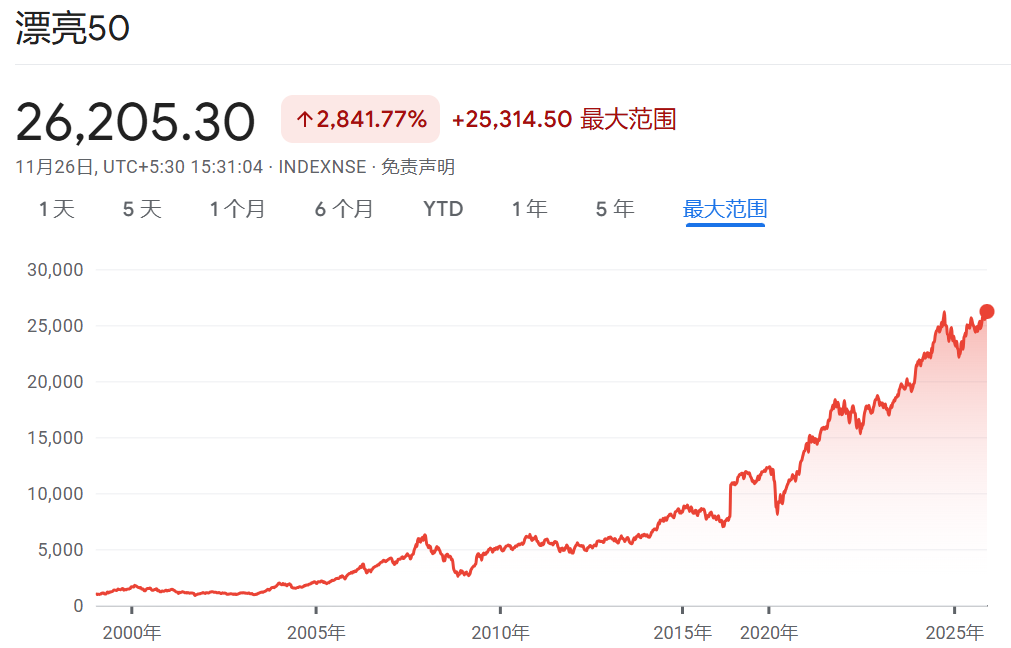
Core Viewpoint - Morgan Stanley predicts that the Indian benchmark Nifty 50 index is expected to rise to 30,000 points by the end of 2026, an increase of approximately 15% from current levels, driven by tax cuts and interest rate reductions [1] Market Performance - The Indian stock market experienced its strongest rebound in five months, with the Nifty 50 index surging 1.24% to 26,205.3 points, marking the highest closing level in 14 months [1] - The BSE Sensex index also rose 1.21% to 86,609.51 points, ending a three-day decline, with both indices recording their best single-day performance in five months [2] Economic Drivers - Morgan Stanley's report indicates that the Reserve Bank of India is expected to cut interest rates by 25 basis points in December, alongside recent tax cuts that have begun to boost consumption, corporate debt growth, and automobile sales, collectively driving domestic demand [3][4] - The report highlights that while the current valuation of the Indian stock market is at a premium compared to other emerging markets, it has fallen below long-term averages after 14 months of underperformance [4] Trade Relations - Analysts believe that the likelihood of a US-India trade agreement is high, which could lead to a short-term revaluation of the stock market. Increased oil imports from the US and reduced purchases from Russia may eliminate the possibility of punitive tariffs from the US [5] - The potential removal of the additional 25% tariff is expected to boost investor confidence, attract foreign capital, support the rupee, and benefit the IT and pharmaceutical sectors [5] Sector Preferences - Morgan Stanley maintains an "overweight" rating on sectors such as materials, financials, consumer goods, hospitals, real estate, defense, and power, while holding a "underweight" stance on IT and pharmaceutical sectors [7] - The analysis suggests that industries benefiting from domestic consumption growth and infrastructure development will perform better, with the financial sector poised to gain from the interest rate cycle and increased corporate debt demand [7]
当91%基金经理喊美股太贵 花旗投来看涨研报:牛市继续上演 标普冲击6900点
Zhi Tong Cai Jing· 2025-08-11 13:05
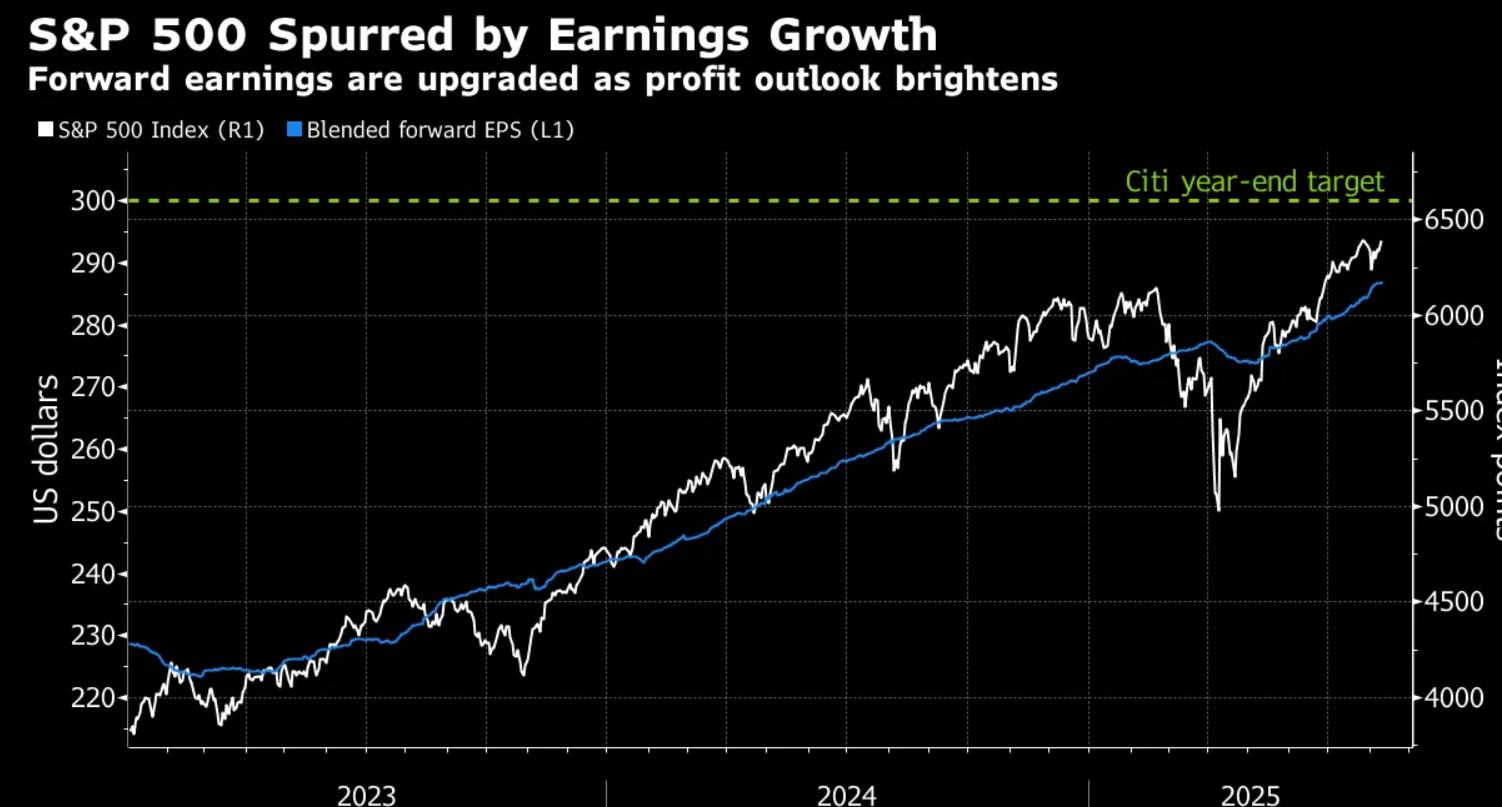
Core Viewpoint - Citigroup's stock strategists have raised the S&P 500 index target, citing the recent "Big and Beautiful" bill's tax cuts as a counterbalance to the negative impact of tariffs on U.S. corporate earnings [1] Group 1: Market Predictions - Citigroup's strategy team increased the S&P 500 year-end target from 6,300 to 6,600 points, indicating a potential 3% rise from last week's historical closing high, with a mid-2026 target of 6,900 points [1] - Morgan Stanley's chief equity strategist has also turned more optimistic, raising the S&P 500 target to 7,200 points for mid-2026 [5] - Oppenheimer's chief strategist has set the highest S&P 500 target among tracked strategists at 7,100 points for year-end [8] Group 2: Earnings Performance - Over 81% of S&P 500 companies have reported earnings above expectations, marking the highest rate in the past seven quarters [4] - Citigroup has revised its earnings per share (EPS) forecasts upward, projecting 2025 EPS to rise from $261 to $272 and 2026 EPS from $295 to $308 [4] Group 3: Technology Sector Influence - The "Magnificent Seven" tech giants, which include Apple, Microsoft, Google, Tesla, Nvidia, Amazon, and Meta Platforms, account for about 35% of the S&P 500 and are key drivers of the index's performance [2] - These tech giants have shown strong revenue growth driven by AI, solid fundamentals, and robust free cash flow, attracting significant global investment [2] - Despite their strong performance, six of the seven giants have expected price-to-earnings ratios significantly above 25x, raising caution among Wall Street analysts [2] Group 4: Investor Sentiment - A record 91% of surveyed institutional investors believe U.S. stocks are overvalued, the highest level since 2001 [8] - Investors are betting on tax cuts and anticipated Federal Reserve rate cuts to boost the market, primarily through large-cap tech stocks [9] - The concentration of returns in the S&P 500 has reached extreme levels, with just five large tech stocks contributing 68% of the index's gains this year [9]


日本首相石破茂:销售税是用于养老金等社会福利的收入。需要建立一个能在公众视野下公开讨论税收问题的框架。选举期间并未讨论减税的利弊权衡问题。
news flash· 2025-07-21 05:39
Core Viewpoint - Japanese Prime Minister Shigeru Ishiba emphasizes that sales tax is a revenue source for social welfare programs such as pensions [1] Group 1 - There is a need to establish a framework for publicly discussing tax issues [1] - The pros and cons of tax reduction were not discussed during the election period [1]
策略周评 | 预期好转,市场趋势向好
Sou Hu Cai Jing· 2025-07-21 03:42
Market Overview - Global stock markets experienced a broad recovery, with domestic equities outperforming overseas markets, particularly in the Hong Kong and ChiNext indices, as the Shanghai Composite Index stabilized above 3500 points [1][16] - The market sentiment improved due to easing tensions between China and the U.S., leading to positive expectations for negotiations and a rise in incremental capital inflows driven by enhanced profitability from mid-year earnings reports [1][16] - The overall pre-announcement profit rate for companies reporting mid-year results reached 44%, indicating structural improvements in earnings, particularly in the TMT, utilities, and transportation sectors [1][16] Economic Data Insights - In June, new social financing increased by 4.2 trillion yuan, showing a year-on-year increase of 0.9 trillion yuan, with a balance growth rate of 8.9% [5] - The GDP growth rate for Q2 was 5.2%, slightly below the previous quarter's 5.4%, while industrial output in June rose by 6.8%, exceeding expectations [7][8] - Retail sales in June totaled 42.287 billion yuan, growing by 4.8% year-on-year, indicating a slight decline in domestic demand compared to previous months [9][10] Sector Performance and Strategy - The technology sector is expected to benefit from improved market sentiment and structural reforms, with the "new quality productivity" becoming a long-term focus, particularly in the context of AI advancements [2][17] - Financial sectors are likely to attract new capital due to increased long-term assessments by insurance companies, while consumer leaders are positioned for recovery amid low valuations and supportive domestic policies [2][17] - The Hong Kong market is anticipated to perform better than A-shares in the second half of the year, driven by strong earnings from technology leaders and high dividend yields attracting institutional investments [18] International Market Dynamics - U.S. stock markets showed resilience with the S&P 500 and Nasdaq reaching new highs, supported by strong earnings in the financial and technology sectors, despite some volatility due to speculation around Federal Reserve policies [19] - The U.S. inflation data indicated a moderate rise, with the core CPI at 2.9%, suggesting that tariff impacts on inflation have yet to be fully realized [11][12] - The bond market remains stable, with short-term yields outperforming long-term ones, as the market anticipates a potential rate cut by the Federal Reserve in September [21]
日本!突发黑天鹅
中国基金报· 2025-07-20 16:02
Core Viewpoint - The ruling coalition in Japan is likely to lose its majority in the upper house elections, which could further weaken Prime Minister Shigeru Ishiba's leadership and disrupt financial markets [3][5]. Political Impact - Exit polls indicate that the ruling coalition may secure only 32 to 51 seats out of 125 contested, falling short of the 50 seats needed to maintain a majority in the 248-seat upper house [5]. - Ishiba has stated he will continue as Prime Minister, believing the Liberal Democratic Party (LDP) can still be the largest party in both houses [5]. - If the ruling coalition loses control of the upper house, it would mark the first time since the LDP's establishment in the 1950s that the government is in a minority in both houses [5][7]. Financial Market Implications - The election results could complicate Ishiba's policy agenda and U.S. trade negotiations, potentially leading to his resignation [7]. - Investor uncertainty may increase due to the ruling party's loss of majority, raising concerns about the ability of lawmakers to control fiscal spending, which has contributed to rising bond yields [8]. - The upcoming market reactions will be observed on the foreign exchange market, with the yen trading starting early on Monday [9]. Public Sentiment and Policy Challenges - Public dissatisfaction with rising prices has shifted votes towards opposition parties advocating for tax cuts and increased social welfare spending [9]. - The LDP's stance against lowering consumption tax contrasts with public demand, which may further weaken its position [9]. - The need for a trade agreement with the U.S. by August 1 adds pressure, as failure to do so could lead to increased tariffs on Japanese exports, negatively impacting GDP [10].