
大盘蓝筹

Search documents
早盘直击|今日行情关注
申万宏源证券上海北京西路营业部· 2025-10-20 02:03
Group 1 - Domestic macroeconomic data and the third-quarter reports of listed companies are being disclosed, leading to a decrease in market risk appetite [1] - The National Bureau of Statistics is gradually releasing September macroeconomic data, indicating that the economy remains stable overall [1] - The third-quarter reports will provide more information about the real economy, causing investors to adopt a wait-and-see approach during this period [1] Group 2 - The market experienced fluctuations last week, with the Shanghai Composite Index falling below the 30-day moving average [1] - The Shenzhen Component Index saw a larger decline, indicating a phase of catch-up decline [1] - Market volume shrank compared to the previous week, with the main focus on high-dividend sectors such as banking and coal [1] Group 3 - Large-cap blue-chip stocks showed relative resilience, while small-cap and technology stocks experienced larger declines [1] - The Shanghai Composite Index has entered a horizontal consolidation phase since the end of August, facing resistance above and support below [1] - The previous adjustment low remains above the market high of 2021, indicating that the original resistance level has become an important support level [1] Group 4 - After the holiday, the market attempted to break upward but fell back into consolidation due to negative information, suggesting that more time is needed for digestion and consolidation [1]


鸿星科技撤回IPO材料:主板上市新规下专精特新“小巨人”企业审慎校准再出发
Di Yi Cai Jing· 2025-09-30 04:36
Core Viewpoint - The "827 New Policy" implemented by the China Securities Regulatory Commission has led to significant changes in the A-share IPO market, marking the end of the rapid growth era and transitioning to a more precise selection and clearer sector positioning phase [1] Company Summary - Hongxing Technology voluntarily withdrew its IPO application due to changes in the main board listing rules, which increased the requirements for large-cap blue-chip companies, making it a strategic decision rather than a response to operational or compliance issues [2][3] - The company had previously met the listing requirements when it submitted its IPO application in December 2022, but subsequent policy adjustments created a mismatch between its profile and the new main board positioning [3] - Despite withdrawing from the IPO process, Hongxing Technology remains committed to high-quality development and plans to increase investment in core technology and product research to strengthen its competitive edge in the quartz crystal component sector [1][4] Industry Context - The quartz crystal component industry has faced challenges due to a global economic downturn, leading to a decline in demand for consumer electronics, with a 3.2% year-on-year drop in global smartphone shipments in 2023 [5] - The industry is expected to recover starting in Q1 2024, driven by the completion of inventory destocking and the introduction of new technologies in AI and optical communications [6] - Hongxing Technology's revenue is projected to grow by 4.8% to 567 million yuan in 2024, with improvements in profit quality and cash flow [6] Financial and Legal Considerations - Concerns regarding the company's historical high dividend payouts and ongoing equity litigation have been addressed, with the company clarifying that the litigation has been resolved and that its dividend practices are compliant with regulations [7][8] - The company has maintained a dividend payout ratio of 51.88% from 2021 to 2023, which is below the 80% threshold considered excessive [7][8] Strategic Direction - Hongxing Technology aims to focus on independent development, enhancing its core quartz crystal business while adapting its capital strategy to align with its growth stage [9][10] - The company plans to invest in R&D, expand its market presence, and increase production capacity in response to market demand [9][10] - The withdrawal from the IPO process is viewed as an opportunity to refine its listing quality and align with the evolving capital market landscape [11]
大类资产周报:资产配置与金融工程美元弱势,降息在即,全球风险资产上行-20250915
Guoyuan Securities· 2025-09-15 15:17
Group 1 - The macro growth factor continues to rise, while inflation indicators show a weakening rebound, with domestic CPI turning negative at -0.4% and PPI's decline narrowing to -2.9%, indicating persistent internal demand issues [4] - The Federal Reserve's interest rate cut expectations are driving upward global liquidity expectations, benefiting Asian equity markets, with the Korean Composite Index rising by 5.94% and the Hang Seng Tech Index by 5.31% [4][9] - The A-share market shows a preference for growth styles, with the Sci-Tech 50 Index increasing by 5.48%, while small-cap indices outperform large-cap blue chips [4] Group 2 - Recommendations for asset allocation include favoring high-grade credit bonds in the bond market, adjusting duration flexibly, and focusing on bank and insurance sector movements [5] - In the overseas equity market, the report suggests monitoring interest rate-sensitive sectors due to limited short-term rebound potential for the dollar and significantly raised interest rate cut expectations [5] - For gold, it is recommended to increase allocations to gold and silver as they are core assets during the interest rate cut cycle, with expectations for Shanghai gold to break previous highs [5] Group 3 - The report indicates that the overall liquidity environment remains supportive for market valuation recovery and structural trends, with a significant decrease in average daily trading volume in the A-share market [56] - The A-share valuation levels have increased, with the price-to-earnings ratio rising to 50.38 times and the price-to-book ratio reaching 5.60 times, suggesting that market expectations for future corporate earnings may be overly optimistic [60] - The report highlights that the earnings expectations for A-shares are weaker than historical averages, with a projected rolling one-year earnings growth rate of 10.3% and revenue growth rate of 5.9% [61]
四季度展望:风格切换,逢低布局大盘蓝筹
Haitong Securities International· 2025-09-07 12:03
The provided content does not contain any specific quantitative models or factors, nor does it include detailed construction processes, formulas, or backtesting results related to quantitative analysis. The document primarily discusses macroeconomic trends, sectoral outlooks, and investment strategies without delving into quantitative methodologies. If you have another document or specific section that includes quantitative models or factors, please provide it for analysis.
坚持价值投资,险资私募钟情高股息大市值公司
Zheng Quan Shi Bao· 2025-09-03 00:10
Core Insights - The Honghu Fund, the largest and earliest established insurance private equity fund, has become a major shareholder in at least six listed companies, indicating a strategic investment approach focused on stable, high-dividend blue-chip companies [1][2] Group 1: Fund Overview - The Honghu Fund has established four funds with a total scale of 110 billion yuan, managed by Guofeng Xinghua, a joint venture of Guoshou Asset and Xinhua Asset [1] - The first phase of the Honghu Fund has a scale of 50 billion yuan, with investments fully deployed by March 2023 [2] - The second phase has nearly completed its investment allocation by the end of Q2 2023, while the third phase commenced in early July 2023 [2] Group 2: Investment Characteristics - The investment criteria for the Honghu Fund include companies with good governance, stable operations, relatively stable dividends, good liquidity, and strong returns [1] - The selected companies exhibit characteristics of high dividend yields and large market capitalizations, with companies like Shaanxi Coal and China Shenhua yielding over 5% [1] Group 3: Performance and Impact - The pilot fund's risk indicators are below the benchmark, while its return indicators exceed the benchmark, achieving both functional and profitability success [2] - The pilot fund aims to enhance equity investment and long-term investment capabilities for insurance companies, contributing to market stability and fostering a positive interaction between insurance funds and capital markets [2]
坚持价值投资 险资私募钟情高股息大市值公司
Zheng Quan Shi Bao· 2025-09-02 18:00
Core Insights - The Honghu Fund, the largest and earliest established insurance private equity fund, has become a significant shareholder in at least six listed companies, indicating a strategic investment approach focused on stable and high-dividend blue-chip companies [1][2] Group 1: Fund Overview - The Honghu Fund has established four funds with a total scale of 110 billion yuan, managed by Guofeng Xinghua, a joint venture of Guoshou Asset and Xinhua Asset [1] - The first phase of the Honghu Fund has a scale of 50 billion yuan and began investing in March 2024, with all investments completed by March of this year [2] - The second phase of the fund has nearly completed its investment allocation as of the end of the second quarter, while the third phase commenced in early July and is progressing smoothly [2] Group 2: Investment Characteristics - The investment strategy of the Honghu Fund focuses on large listed companies that are well-governed, operate steadily, offer stable dividends, and have good liquidity [1] - The selected companies exhibit characteristics of high dividend yields and large market capitalizations, with companies like Shaanxi Coal and China Shenhua having dividend yields exceeding 5% [1] - The smallest company in the portfolio, Yili Group, has a market capitalization exceeding 100 billion yuan, while China Petroleum's market cap exceeds 1.6 trillion yuan [1] Group 3: Performance and Impact - The pilot fund's risk indicators are below the benchmark, while its return indicators are above the benchmark, achieving both functional and profitability success [2] - The pilot fund aims to enhance equity investment and long-term investment capabilities for insurance companies, contributing to market stability and fostering a positive interaction between insurance funds and the capital market [2] - The total amount of the long-term investment reform pilot for insurance funds has reached 222 billion yuan across three batches, with the first two batches having established private equity fund companies [2]







建信期货股指日评-20250901
Jian Xin Qi Huo· 2025-09-01 02:17
Report Information - Report Type: Stock Index Daily Review [1] - Date: September 1, 2025 [2] - Researchers: Nie Jiayi, He Zhuoqiao, Huang Wenxin [3] Market Performance Market Review - On August 29, the Wind All A index opened with an upward trend, then reversed and declined, and rebounded again at the end of the session, closing up 0.37% with over 60% of stocks falling. The CSI 300, SSE 50, and CSI 500 closed up 0.74%, 0.53%, and 0.47% respectively, while the CSI 1000 closed down 0.11%. The performance of index futures was generally stronger than that of the spot market, with the main contracts of IF, IH, IC, and IM closing up 1.03%, 0.68%, 0.43%, and 0.05% respectively [6]. Market Outlook - External markets: On August 25, Trump stated that China must ensure the supply of rare - earth magnets to the US, or face a 200% tariff, which increased market risk - aversion sentiment. - Domestic situation: The domestic economy is in a weak recovery stage. In July, economic data showed a decline in both supply and demand. From January to July, the total profit of industrial enterprises above the designated size was 4,020.35 billion yuan, a year - on - year decrease of 1.7% with a narrowing decline of 0.1 percentage points. The overall fundamentals are still under pressure, but market expectations for future economic recovery are positive due to policy support. - Regulatory aspect: Many banks announced strict control of illegal credit funds entering the market, and Guojin Securities raised the margin ratio for margin trading of underlying securities (excluding those on the Beijing Stock Exchange) to 100% on August 26, which cooled market sentiment. - Capital flow: The balance of margin trading has continuously reached new highs, and it is only about 30 billion yuan away from the historical high. There are signs of household deposits flowing into the market, and its sustainability needs to be observed. - Overall view: The US tariff statement and increased regulatory efforts have increased the pressure for the Shanghai Composite Index to break through 3,900. However, the market sentiment remains high, and there is still room for further capital inflow. Long positions can be held, and the trading volume and corporate semi - annual reports need to be monitored. In terms of market style, during market fluctuations, large - cap blue - chip stocks may be more favored by funds, and the CSI 300 and SSE 50 may be more dominant in the short term [7][8]. Industry News - On August 29, the Ministry of Finance released the economic operation of state - owned and state - holding enterprises from January to July 2025. From January to July, the total operating income of state - owned enterprises was 4,731.109 trillion yuan, the same as the previous year. The total profit was 2,478.64 billion yuan, a year - on - year decrease of 3.3%. The tax payable was 3,469.46 billion yuan, a year - on - year decrease of 0.4%. At the end of July, the asset - liability ratio of state - owned enterprises was 65.1%, a year - on - year increase of 0.3 percentage points [29].
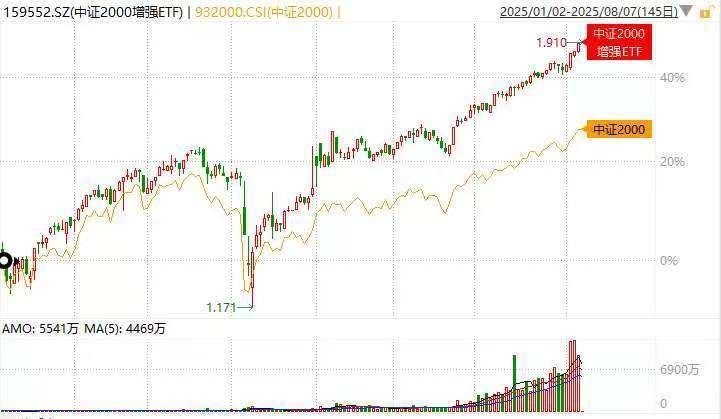
规模激增近40倍!“小盘之王”中证2000增强ETF(159552)量价齐爆再创新高
Sou Hu Cai Jing· 2025-08-07 01:47
Group 1 - The core viewpoint of the article highlights the strong performance of the small-cap index, specifically the CSI 2000 Enhanced ETF (159552), which has seen a year-to-date increase of over 45%, leading the market among broad-based ETFs [1] - As of August 6, the fund has experienced a net inflow of over 180 million, with a total size exceeding 600 million, making it the largest in its category [1] - The fund's size has grown by 3944.79% year-to-date, reaching a historical high [1] Group 2 - Market analysis suggests that the high elasticity of small-cap stocks has been fully activated due to low interest rates and policy support for specialized and innovative enterprises, contributing to their leading role in the current market rally [1] - The rolling price-to-earnings ratio of the CSI 2000 index is approaching 140 times, which is at the 97th percentile over the past decade, indicating potential volatility risks due to tightening liquidity or shifts in market style [1] - Institutions recommend that investors adopt a strategy of gradually accumulating positions on dips to avoid chasing high prices, while also paying attention to the rebound opportunities of relatively reasonably valued large-cap blue-chip stocks to balance portfolio risks [1]
利好暂缺叠加基本面走弱,回调蓄势以待政策发力
Haitong Securities International· 2025-08-03 12:33
Group 1 - The report indicates that the Hong Kong market is experiencing a correction phase due to weak economic fundamentals and a lack of positive catalysts, with the Hang Seng Index falling by 3.5% and the Hang Seng Tech Index dropping by 4.9% [1][7]. - China's economic data has shifted from structural divergence to overall weakness, with the July manufacturing PMI declining to 49.3 from 49.7 in June, reflecting weakening demand [1][7]. - The construction PMI has also weakened, influenced by subdued real estate demand and a slowdown in infrastructure investment, with notable declines in property sales in July [1][7]. Group 2 - The report highlights that the rebound in anti-involution sectors was primarily a technical recovery from oversold levels, and structural capacity cuts require sustained policy support [3][9]. - It is expected that targeted measures to stimulate domestic demand and real estate will be introduced, particularly around the time of the Fourth Plenary Session, as the core challenge for China's economy remains deflation [3][9]. - The report suggests that large-cap blue chips may gain greater upside potential once supply and demand policies work in tandem [3][9]. Group 3 - The report notes that the recent rally in Hong Kong and A-share markets was linked to a weaker dollar, with the dollar index's rebound in early July corresponding to a choppy phase for the Hang Seng Index [10][15]. - Following a new trade agreement between the U.S. and Europe, the dollar surged, but the potential for sustained dollar weakness is limited due to the U.S. implementing tariffs and gaining economic benefits from trading partners [10][15]. - Overall market risk appetite is trending lower as global markets enter a correction phase [10][15]. Group 4 - In terms of liquidity, the short selling ratio in Hong Kong rose to 16%, aligning with the two-year average, while southbound capital inflows significantly increased to HKD 59 billion [11][12]. - Major Chinese tech stocks, including Alibaba, Tencent, Xiaomi, and SMIC, saw significant net inflows, with each attracting HKD 2–3 billion [11][12]. - However, as the market declined midweek, leveraged inflows slowed, and equity ETFs shifted from net subscriptions to net redemptions, indicating a more cautious investor sentiment [12][15].
二季度主动权益基金披露四个看点
2 1 Shi Ji Jing Ji Bao Dao· 2025-07-29 10:12
Core Viewpoint - The active equity funds, considered as "smart money" in the market, have shown a shift in manager sentiment towards a more optimistic outlook, despite experiencing a decline in both share and scale due to ongoing redemption pressures [1][6]. Performance Summary - In Q2, active equity funds outperformed passive equity funds, with the mixed equity fund index rising by 3.06%, surpassing the CSI 300 index by approximately 1.81 percentage points [3]. - The average return for various active equity fund types exceeded 2%, with the best-performing fund, Changcheng Pharmaceutical Industry Select A, achieving a return of 35.86% [4][3]. - Despite good performance, over 60% of active equity funds still recorded positive returns, but the average return decreased compared to Q1 [3][6]. Scale and Redemption - The total scale of active equity funds decreased to 3.27 trillion yuan, a reduction of 366.62 billion yuan from the previous quarter [8]. - The number of active equity funds increased slightly to 4,190, but the overall market share continued to decline, reflecting a cautious investor sentiment [9][8]. - The gap between active and passive fund scales widened, with passive index funds reaching 3.60 trillion yuan [9]. Stock Positioning - Active equity funds increased their stock positions, with an overall weighted position of 88.08%, marking a continuous rise over four quarters [12]. - The allocation to small-cap stocks increased, while the allocation to large-cap stocks decreased, with the proportion of holdings in the CSI 500 reaching its highest point since 2018 [13][12]. Sector Allocation - The main sectors for active equity fund investments included electronics (19.01%), pharmaceuticals (11.01%), and power equipment & new energy (8.89%), with notable increases in communication and banking sectors [14]. - The allocation to communication increased by 2.60%, while the allocation to food and beverage decreased by 2.14% [14]. Individual Stock Holdings - The top ten holdings in active equity funds included Ningde Times, Kweichow Moutai, and Midea Group, with significant increases in holdings for stocks like Zhongji Xuchuang and Xinyi Semiconductor [15]. - The funds reduced their positions in major consumer stocks such as BYD and Kweichow Moutai, indicating a shift towards technology and growth-oriented stocks [15][16].