
宏观风险

Search documents
分析人士:铂钯高波动率成为新常态
Qi Huo Ri Bao· 2026-01-28 00:46
1月27日,受隔夜外盘市场剧烈波动影响,广期所铂、钯期价盘初大幅下挫,其中铂期货主力2606合约 一度跌超8%。随后市场情绪有所修复,铂、钯期价跌幅收窄。截至当日下午收盘,广期所铂期货主力 2606合约下跌4.6%,报705.7元/克;钯期货主力2606合约下跌2.08%,报523元/克。 业内人士认为,铂、钯价格走势主要受金属板块情绪带动,价格波动较大,表明市场分歧较大。 值得注意的是,1月26日,针对部分品种价格近期波动较大的情况,广期所发布风险提示称,期货公司 应切实履行风险管理职责,强化客户交易行为合规监管和风险防范,提醒投资者依规、谨慎、理性参与 交易,确保市场平稳运行。同时,广期所将坚持严监严管主基调,持续强化市场监管,严肃查处各类违 规行为,加强实际控制关系账户调查、认定,发挥"五位一体"监管协作合力,依法严厉打击市场操纵行 为,维护市场秩序。 顾冯达认为,在宏观风险上升的背景下,贵金属市场维持强势格局。铂族金属继续扮演跟涨角色,其走 势大概率取决于贵金属市场的情绪风向。在贵金属板块外溢效应下,铂族金属价格或呈现宽幅震荡走 势。 华联期货分析师曾可认为,短期铂、钯价格或仍受金属板块情绪及地缘政治 ...
GTC泽汇资本:关税触发避险 加密市场波动
Xin Lang Cai Jing· 2026-01-19 12:46
Core Insights - The global macro environment has shifted dramatically, impacting the digital asset market, with a notable decline in major cryptocurrencies due to rising "risk-off" sentiment triggered by new U.S. tariffs on European goods [1][3] - Approximately $600 million in cryptocurrency long positions were liquidated as traders reduced leverage and reassessed risk exposure amid uncertainty [1][3] - Altcoins experienced the most significant sell-off, with Solana (SOL) dropping over 6%, and XRP and Dogecoin (DOGE) declining between 4% and 7% [1][3] Market Trends - The rise of safe-haven assets contrasts sharply with the underperformance of risk assets, as gold and silver prices surged to historical highs while U.S. stock futures, particularly the Nasdaq 100 index, showed weakness [2][3] - The majority of the $600 million in liquidated positions were bullish, indicating a market shift from "aggressive expansion" to "defensive positioning" [2][4] - Despite Bitcoin showing some resilience, it fell below $93,000 after failing to reach $98,000, while Ethereum (ETH) hovered around $3,200, reflecting investor caution towards high-volatility assets during uncertain trade policy periods [1][2][3] Future Outlook - GTC Zhehui Capital suggests that while the cryptocurrency market initially performed well due to spot ETF inflows, the current deep correction highlights the need for investors to be aware of returning macro risks [2][4] - The ability of Bitcoin to hold above the $90,000 mark will be crucial in determining whether the market is experiencing a short-term pullback or a trend reversal [2][4] - The correlation between cryptocurrencies and global risk sentiment has reached new heights, with price movements likely to be influenced by trade policies and geopolitical situations [2][4]


表面对委内瑞拉变局波澜不惊 华尔街却已嗅到2026年的风险气息
Xin Lang Cai Jing· 2026-01-06 11:57
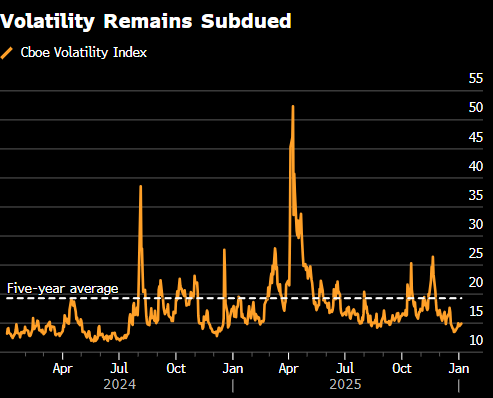
Core Viewpoint - Wall Street bulls need several favorable factors to achieve double-digit returns for the fourth consecutive year in 2026, amid ongoing trade tensions, economic fatigue, and geopolitical risks [1][6]. Economic Conditions - The U.S. economy shows signs of fatigue despite three interest rate cuts, with rates remaining high [1][9]. - Investors may be overly optimistic about the Federal Reserve's potential for two more rate cuts this year, given persistent inflation [9][10]. Market Reactions - The S&P 500 index rose by 0.6% following the U.S. military action in Venezuela, while oil prices increased slightly [6][11]. - Despite the geopolitical event, the Chicago Board Options Exchange volatility index remains low, below 16, indicating a lack of immediate market concern [6][11]. Investor Sentiment - After an approximately 80% increase in the stock market over three years, investors have become numb to risks, viewing market pullbacks as buying opportunities [8][9]. - A Bloomberg survey of 21 forecasters predicts an average increase of about 9% for the stock market in 2026, with no predictions of a decline [9]. Geopolitical Risks - Ongoing geopolitical tensions, including the Russia-Ukraine war and instability in Iran and Southeast Asia, contribute to market uncertainty [4][9]. - The recent military action in Venezuela serves as a reminder that unforeseen risks can emerge, potentially leading to a "sharp risk aversion phase" in the market [10][11]. Strategic Recommendations - Analysts suggest that investors should prepare for market volatility by favoring high-quality assets [10].
2026年牛市面临多重考验 华尔街在安逸中警惕宏观风险“黑天鹅”
Ge Long Hui A P P· 2026-01-06 10:52
Core Viewpoint - Christopher Harvey, head of equity and portfolio strategy at Canadian Imperial Bank of Commerce, suggests that investor expectations for two rate cuts by the Federal Reserve this year may be overly optimistic due to persistent inflation [1] Group 1: Market Outlook - Harvey indicates that U.S. corporations may lower their profit growth expectations after recent stock price surges, potentially undermining a key pillar of the bull market [1] - He warns that the coming months may be characterized by a "period of severe risk aversion," especially in light of recent events that could quickly reintroduce unknown factors by 2026 [1] Group 2: Investment Strategy - Harvey advises clients to prepare their portfolios for volatility by shifting towards high-quality assets [1] - His insights are noteworthy as he was among the few strategists who accurately predicted a significant rebound in the stock market following the tariff turmoil in April of the previous year [1] Group 3: Investor Caution - Other Wall Street analysts also emphasize the need for vigilance among investors, despite the limited nature of the Venezuelan incident [1]
VO: Too Defensive For AI Upside, Not Defensive Enough For Macro Risk
Seeking Alpha· 2025-12-26 10:38
Core Viewpoint - The Vanguard Mid-Cap Index Fund ETF (VO) currently lacks a compelling Buy thesis due to the absence of a positive macroeconomic backdrop necessary for investment [1] Group 1: Company Analysis - The Vanguard Mid-Cap Index Fund ETF (VO) is not positioned favorably for investment at this time [1] Group 2: Analyst Background - The analysis is conducted by a stock analyst with over 20 years of experience in quantitative research, financial modeling, and risk management [1] - The analyst has a strong focus on equity valuation, market trends, and portfolio optimization to identify high-growth investment opportunities [1] - The analyst previously held a Vice President position at Barclays, leading teams in model validation, stress testing, and regulatory finance [1] Group 3: Research Approach - The research approach combines rigorous risk management with a long-term perspective on value creation [1] - There is a particular interest in macroeconomic trends, corporate earnings, and financial statement analysis to provide actionable investment ideas [1]

有色金属日报 2025-12-22-20251222
Wu Kuang Qi Huo· 2025-12-22 02:08
1. Report Industry Investment Rating - No information provided regarding the industry investment rating in the report. 2. Core Viewpoints of the Report - The overall sentiment in the有色金属 market is influenced by factors such as the Fed's monetary policy, US economic data, and overseas supply disruptions. Different metals have varying price trends and influencing factors, and short - term price movements are expected to be affected by a combination of macro - factors and industry - specific fundamentals [4][7][10][12]. 3. Summary by Metal Copper - **Market Information**: On Friday, the LME 3M copper contract rose 1.22% to $11,870/ton, and the SHFE copper main contract reached 93,560 yuan/ton. LME copper inventory decreased by 3,875 tons to 160,400 tons. The domestic SHFE daily warehouse receipts increased by 0.1 to 46,000 tons. The domestic copper spot import loss was about 1,200 yuan/ton, and the refined - scrap copper price difference widened [3]. - **Strategy Viewpoint**: The Fed's loose monetary policy and the easing of concerns about the US stock AI bubble have a positive impact on sentiment. The copper ore supply remains tight, and the annual long - term contract benchmark is slightly higher than expected. The apparent consumption of refined copper in November was lower than expected, increasing the resistance to upward price movement. However, with less scrap copper substitution, the supply surplus pressure is not large. The short - term price is expected to remain high and volatile. The operating range of the SHFE copper main contract is 92,000 - 94,600 yuan/ton, and the LME 3M copper is 11,600 - 12,200 dollars/ton [4]. Aluminum - **Market Information**: Overseas supply disruptions pushed LME aluminum up, with the Friday closing price rising 1.32% to $2,955/ton, and the SHFE aluminum main contract reaching 22,245 yuan/ton. The SHFE aluminum weighted contract positions increased by 29,000 to 654,000 lots, and the futures warehouse receipts slightly decreased to 76,000 tons. Domestic aluminum ingot inventories increased slightly, and aluminum rod inventories decreased [6]. - **Strategy Viewpoint**: Global aluminum inventories continue to decline and are at relatively low levels compared to the same period in previous years. Coupled with overseas supply disruptions and a positive commodity atmosphere, aluminum prices are strongly supported. However, Mexico's increase in some aluminum tariffs and the off - season in the aluminum downstream industry pose pressure. The aluminum price is expected to fluctuate and accumulate momentum, with a rising center. The operating range of the SHFE aluminum main contract is 22,000 - 22,400 yuan/ton, and the LME 3M aluminum is 2,900 - 2,980 dollars/ton [7]. Lead - **Market Information**: Last Friday, the SHFE lead index rose 0.55% to 16,879 yuan/ton, and the LME 3S lead rose $16.5 to $1,973.5/ton. The domestic social lead inventories decreased by 420 tons to 1,950 tons [9]. - **Strategy Viewpoint**: The visible inventory of lead ore has increased, and the lead concentrate processing fee has remained flat. The operating rate of primary lead smelters has increased, while the operating rate of secondary lead has decreased marginally, and the operating rate of battery enterprises has remained stable. The domestic lead ingot supply has tightened marginally, and the visible inventory has remained relatively low. After the release of short - term macro - risks, the sentiment in the non - ferrous market is positive. The current lead price is at the lower end of the oscillation range, and it is expected to be strong in the wide - range in the short term [10]. Zinc - **Market Information**: Last Friday, the SHFE zinc index rose 0.19% to 23,081 yuan/ton, and the LME 3S zinc rose $8.5 to $3,073/ton. The domestic social zinc inventories decreased by 350 tons to 12,220 tons [11]. - **Strategy Viewpoint**: The visible inventory of zinc concentrate has increased, and zinc concentrate TC has stopped falling and stabilized. The shortage of domestic zinc ore is expected to ease marginally. The LME zinc ingot inventory has increased, and the LME zinc monthly spread has returned to a Contango structure. The domestic zinc ingot social inventory has continued to decline, and the spot basis has increased. After the release of short - term macro - risks, the sentiment in the non - ferrous market is positive. The zinc price is expected to be weak in the medium term but may have an upward impulse in the short term due to macro - sentiment [12][13]. Tin - **Market Information**: On December 19, 2025, the SHFE tin main contract closed at 343,040 yuan/ton, up 2.59%. The operating rate of tin smelters in Yunnan and Jiangxi is high and stable but lacks upward momentum. The demand for tin solder enterprises is stable, but the high tin price has suppressed downstream purchasing willingness, and the spot trading atmosphere is dull [14]. - **Strategy Viewpoint**: Although the short - term tin market demand is weak and the supply is expected to improve, the downstream inventory is low, and the bargaining power is limited. The short - term price is expected to fluctuate with market risk preference. It is recommended to wait and see. The operating range of the domestic main contract is 300,000 - 350,000 yuan/ton, and the overseas LME tin is 39,000 - 43,000 dollars/ton [15]. Nickel - **Market Information**: On Friday, the nickel price rebounded significantly, with the SHFE nickel main contract closing at 117,180 yuan/ton, up 2.84%. The nickel ore price remained stable, and the nickel iron price weakened again [16]. - **Strategy Viewpoint**: The nickel surplus pressure is still large. The nickel iron price has slightly declined, while the refined nickel price has dropped significantly. The refined nickel premium has reached the support level. It is necessary to wait for the nickel iron price to further decline to test the cash cost of the pyrometallurgical production line. It is recommended to wait and see in the short term. The short - term operating range of the SHFE nickel price is 110,000 - 125,000 yuan/ton, and the LME 3M nickel contract is 13,000 - 15,500 dollars/ton [17][18]. Lithium Carbonate - **Market Information**: Last Friday, the MMLC lithium carbonate spot index closed at 105,069 yuan, up 2.74% from the previous working day and 11.10% for the week [20]. - **Strategy Viewpoint**: The short - term supply recovery expectation has been falsified, and the bears are under pressure. The mid - term fundamentals are controversial, but the optimistic expectation is stronger. The long - position trend on the futures market has not ended. The lithium carbonate position is still high, and the intraday price fluctuates greatly. It is recommended to wait and see. The operating range of the GZCE lithium carbonate main contract is 108,600 - 117,200 yuan/ton [21]. Alumina - **Market Information**: On December 19, 2025, the alumina index fell 2.51% to 2,568 yuan/ton. The Shandong spot price fell 5 yuan/ton to 2,655 yuan/ton [23]. - **Strategy Viewpoint**: After the rainy season, the shipping from Guinea is gradually recovering, and the AXIS mine is resuming production. The ore price is expected to decline. The alumina smelting capacity surplus pattern is difficult to change in the short term, and the inventory accumulation trend continues. However, the current price is close to the cost line of most manufacturers, and the subsequent production reduction expectation is increasing. The overall non - ferrous sector is strong, and the cost - performance of short - selling is not high. It is recommended to wait and see in the short term. The operating range of the domestic main contract AO2601 is 2,400 - 2,700 yuan/ton [24]. Stainless Steel - **Market Information**: On Friday, the stainless - steel main contract closed at 12,720 yuan/ton, up 2.42%. The social inventory decreased to 1.0421 million tons, a 2.01% decrease from the previous period [26]. - **Strategy Viewpoint**: The overall trading atmosphere in the stainless - steel spot market is light, and the low - price warehouse receipt resources are actively traded, driving the continuous decline in social inventory. The market demand is mainly for rigid - demand purchases at low prices, and the acceptance of high - price resources is generally low. In the short term, the stainless - steel price is expected to continue to oscillate and bottom out, with limited upward space [27]. Cast Aluminum Alloy - **Market Information**: On Friday, the cast aluminum alloy price continued to rise, with the main AD2602 contract closing at 21,235 yuan/ton, up 0.59%. The trading volume decreased, and the warehouse receipts slightly decreased [29]. - **Strategy Viewpoint**: The cost of the cast aluminum alloy is relatively firm, and the supply - side disruptions continue, providing strong support for the price. However, the demand is volatile, and the delivery pressure forms an upper - limit suppression. The short - term price of the cast aluminum alloy is expected to fluctuate within a range [30].
资金狂撤、恐慌上头,比特币的最悲观情景是跌破7万美元?
Hua Er Jie Jian Wen· 2025-11-17 12:42
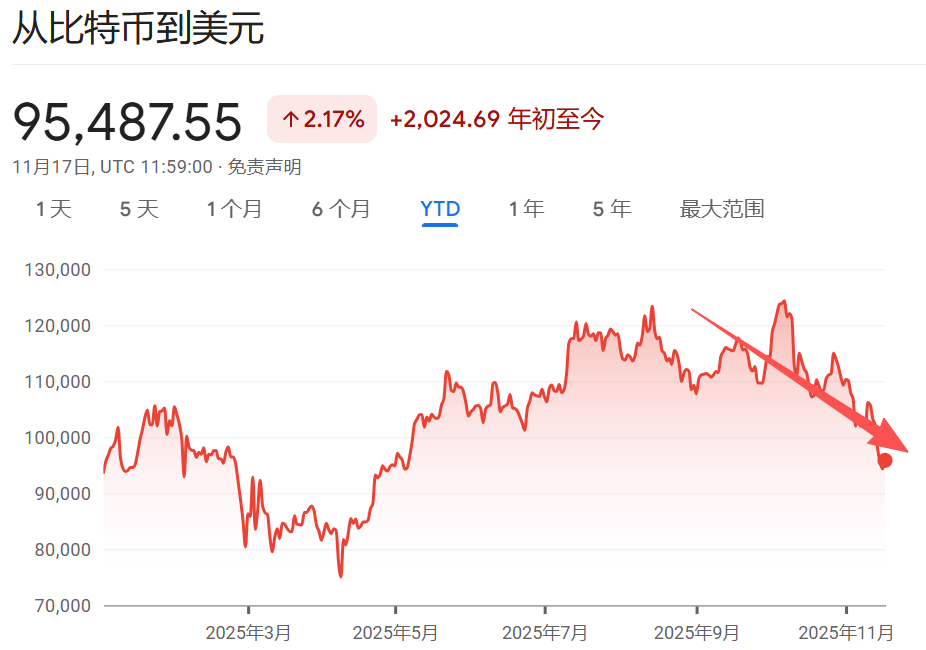
Core Viewpoint - Bitcoin has fallen below the $100,000 mark, raising concerns about its stability and potential further declines, with analysts warning of a possible retest of the $70,000 support level if the U.S. stock market continues to decline [1][4]. Market Dynamics - Bitcoin experienced a significant drop, erasing 30% of its gains for the year, with a peak of $126,000 on October 6, 2023, now down approximately 25% [1]. - Ethereum has also faced challenges, with a decline exceeding 35% from its August highs [1]. Liquidity Crisis - The recent downturn is characterized as a "two-phase decline," starting with macroeconomic risks and followed by a liquidity crisis that has led to increased volatility in the Bitcoin market [3]. - Following the October 10 crash, liquidity in the Bitcoin market has sharply decreased, causing even small trades to result in significant price movements [3]. Economic Environment - The macroeconomic environment is worsening, with reduced expectations for a Federal Reserve rate cut in December and a government shutdown impacting economic data releases, further dampening market sentiment [3]. - The tightening of liquidity is particularly affecting Bitcoin ETFs, which previously attracted over $100 billion but are now facing capital outflows [3]. Technical and Fundamental Pressures - Concerns persist that if the stock market experiences further profit-taking, cryptocurrencies may face a second wave of concentrated selling [4]. - Analysts warn that Bitcoin is still exhibiting characteristics of a risk asset, and further price declines are likely as uncertainties around AI valuations and interest rate cuts loom [4]. Historical Context and Investor Sentiment - There is apprehension among investors about a potential repeat of historical cycles, leading to preemptive market withdrawals to avoid significant downturns [5]. - However, some analysts believe the current sell-off is different from past crises, lacking systemic failures or credit contagion, and expect Bitcoin to reach new highs within 12 to 18 months once conditions stabilize [6]. Investment Strategies - Long-term investors are encouraged to view current price levels as attractive entry points, with some firms reporting record client investments in cryptocurrencies [6]. - Retail investors are advised to adopt dollar-cost averaging strategies and focus on understanding the fundamentals of Bitcoin and Ethereum rather than reacting to market headlines [6].
接盘侠越来越少 比特币坠入熊市! ETF撤资近9亿美元 创有史以来第二大流出规模
Zhi Tong Cai Jing· 2025-11-14 13:45
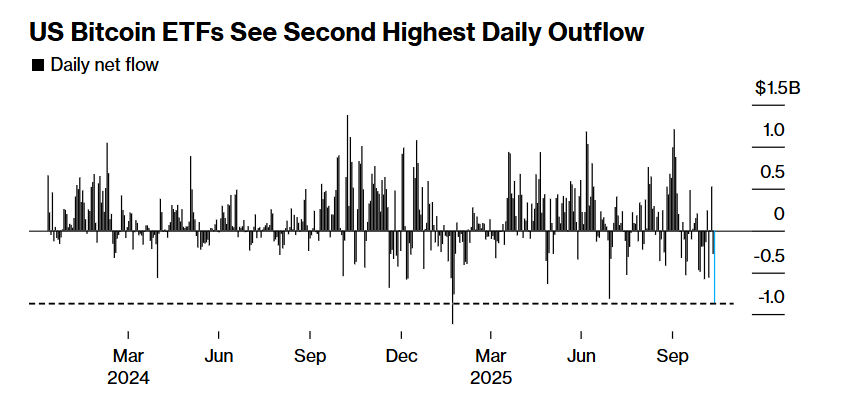
Core Insights - The recent wave of risk aversion in global financial markets has led to a significant decline in high-valued U.S. tech stocks and risk assets like Bitcoin, with nearly $900 million withdrawn from Bitcoin ETFs [1] - The absence of "blind speculators" in the Bitcoin market has contributed to the ongoing downward trend, as there are fewer short-term traders willing to buy Bitcoin, leading to a collapse in demand [1] - Bitcoin has dropped below the $100,000 mark, with a decline of over 20% from its all-time high earlier in October, entering what is referred to as a "bear market" [1] Market Dynamics - CoinGecko reported a forced liquidation of $19 billion in the cryptocurrency market on October 10, erasing over $1 trillion from the total market capitalization [2] - Bitcoin ETFs experienced a net outflow of approximately $870 million, marking the second-largest single-day redemption since their inception in January 2024 [2][5] - The tightening liquidity in the cryptocurrency market is evident, with market depth decreasing by about 30% from its peak earlier this year [5] Investor Sentiment - The recent sell-off in Bitcoin and other cryptocurrencies is synchronized with other risk assets, but the inherent volatility of cryptocurrencies results in larger declines [5] - There is growing concern among traders regarding upcoming economic data releases, which could further exacerbate the sell-off in risk assets, including cryptocurrencies [5] - The demand for neutral hedging options strategies, such as strangles and straddles, is increasing among cryptocurrency traders, indicating a shift towards managing volatility [8]
加密货币清算潮未止!美国比特币ETF单日资金流出创史上次高
Jin Shi Shu Ju· 2025-11-14 10:11
Core Insights - The cryptocurrency market is experiencing significant sell-offs, with nearly $900 million withdrawn from Bitcoin funds, causing Bitcoin prices to drop below $100,000 [1][3] - The total market capitalization of cryptocurrencies has decreased by over $1 trillion due to a liquidation event that saw $19 billion in liquidations on October 10 [3][6] - Bitcoin exchange-traded funds (ETFs) recorded approximately $870 million in net outflows, marking the second-largest single-day redemption since their inception [3][6] Group 1 - Investor sentiment is heavily influenced by risk aversion, leading to substantial withdrawals from Bitcoin funds [1] - Bitcoin's price fell by 2.8% to below $96,000, representing a decline of over 20% from its record high earlier in October [1][6] - The cryptocurrency market's liquidity has significantly decreased, with market depth down approximately 30% from its peak this year [6] Group 2 - The sell-off in cryptocurrencies is correlated with broader market risks, particularly as traders reassess the Federal Reserve's potential for short-term interest rate cuts [6] - There is an increasing demand for neutral strategies in the options market, indicating that traders are betting more on volatility [7]

2026年债市展望:蛰伏反击
HTSC· 2025-11-03 05:50
Group 1: Macroeconomic Outlook - The report highlights that both the US and China are entering critical years, with global investment driven by three and a half engines: AI investment, defense spending, and industrial restructuring [1][14] - The nominal GDP growth rate is expected to recover, with a focus on domestic demand and technology as key policy areas [1][2] - The transition from old to new economic drivers in China is anticipated to gain momentum, leading to a rebalancing of supply and demand [2][11] Group 2: Policy Environment - The "15th Five-Year Plan" sets a supportive policy tone, with monetary policy expected to remain accommodative, albeit with less room than in the current year [3][15] - Fiscal policy is projected to maintain a certain level of expansion, with total tools estimated at 15.7 trillion yuan, an increase of approximately 1.2 trillion yuan from this year [3][15] - The report emphasizes the importance of structural tools and the coordination between monetary and fiscal policies to support various sectors [3][15] Group 3: Supply and Demand Dynamics - The narrative of "asset scarcity" in the bond market is expected to weaken, with a focus on the verification of corporate profits and capacity utilization [4][18] - The report notes that government bond supply is likely to increase, but market pressure will be manageable due to central bank support [4][18] - Institutional behavior is identified as a major source of market volatility, with a reduction in stable funding leading to increased market fluctuations [4][18] Group 4: Bond Market Strategy - The bond market is expected to maintain a "low interest rate + high volatility" characteristic, with the central rate likely remaining stable or slightly increasing [5][18] - The report suggests a strategy of segment trading, coupon strategies, and equity exposure as priorities over duration adjustment and credit downgrading [5][18] - The ten-year government bond yield is projected to fluctuate between 1.6% and 2.1%, with a widening of term spreads anticipated [5][18]