实际利率下行

Search documents
通胀爆冷但可信度受限,贵?属维持偏强运
Zhong Xin Qi Huo· 2025-12-19 00:11
Report Summary 1. Report Industry Investment Rating No information provided. 2. Core View of the Report The pricing environment for precious metals remains favorable. The significant slowdown in core inflation in the US in November, continued dovish signals from the Fed, and escalating geopolitical tensions support precious metals. Gold is in a high - level consolidation, and silver has set new records. The deviation between the macro and risk assets drives the demand for hedging and allocation, which supports precious metals [2]. 3. Summary by Relevant Content Key Information - US November CPI rose 2.7% year - on - year, lower than the expected 3.1%. Core CPI rose 2.6% year - on - year, lower than the 3% two months ago, indicating further easing of inflation pressure [3]. - The European Central Bank maintained interest rates unchanged for the fourth consecutive time, with the deposit rate at 2%. The market started to cut rate - cut bets and priced in the possibility of a rate hike in 2026, leading to a slight strengthening of the euro [3]. - The Bank of England cut interest rates by 25 basis points to 3.75%, the lowest since February 2023, which was in line with expectations [3]. Price Logic - **Gold**: Although inflation data quality is limited, the downward trend of real interest rates remains intact. The decline of US November core CPI to 2.6% strengthens the market's pricing of Fed's continued easing before 2026. Despite the limited credibility of inflation data, the forward - looking pricing of the rate - cut path in the interest rate market has not reversed. Gold's demand as an asset allocation and risk - hedging tool remains stable due to geopolitical tensions and year - end liquidity tightening [4]. - **Silver**: In the context of stable gold prices, silver shows relative elasticity. In the short - term, it reflects changes in capital structure and volatility rather than a shift in macro - logic. In the medium - term, real interest rate decline and overall precious metal allocation demand support silver, but at high price levels, the risk of increased volatility and partial retracement rises [4]. Outlook - In the short - term, London gold is expected to trade in the range of [4150, 4500] dollars per ounce, and London silver in the range of [60, 67] dollars per ounce [7]. Index Performance - **Commodity Index**: The commodity index was 2272.81, up 0.44%; the commodity 20 index was 2604.10, up 0.53%; the industrial products index was 2207.25, up 0.79%; the PPI commodity index was 1367.53, up 0.65% [49]. - **Precious Metals Index**: On December 18, 2025, it was 3717.12, up 0.07% for the day, 2.01% in the past 5 days, 11.68% in the past month, and 68.01% year - to - date [50].
资金涌入,持续加仓!
Zhong Guo Zheng Quan Bao· 2025-12-16 14:08
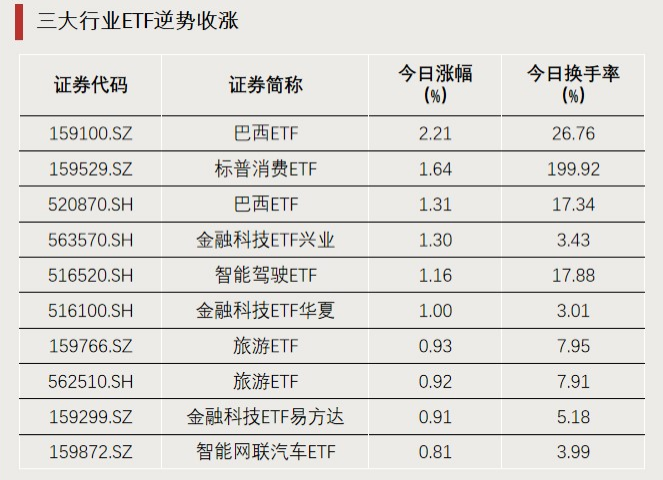
Market Overview - On December 16, A-shares and Hong Kong stocks experienced a pullback, with only about 50 out of over 1300 ETFs closing higher, and 6 of these ETFs rising by 1% or more. Financial technology, tourism, and automotive sector ETFs showed relative resilience [1] - In the cross-border ETF segment, two Brazilian ETFs and one S&P Consumer ETF led the market in terms of gains [1] ETF Performance - Notably, several ETFs that rose against the market trend saw significant increases in trading volume. The S&P Consumer ETF (159529) had a turnover rate of 199.92%, with a trading volume nearing 2 billion yuan, four times that of the previous day. The Smart Driving ETF (516520) also saw its trading volume increase to approximately seven times that of the previous day [2] - On December 16, financial technology, tourism, and automotive sector ETFs performed well, with multiple products ranking among the top gainers. The financial technology ETFs linked to the CSI Financial Technology Index saw over half of their constituent stocks close in the green, with notable gains from companies like Chuangshi Technology (300941) and Cuiwei Co. (603123) [4] Fund Flows - On December 15, despite the market pullback, ETFs experienced a net inflow of approximately 6.7 billion yuan, with broad-based ETFs attracting significant capital. Several ETFs linked to the CSI A500 Index ranked among the top for net inflows, with three A500 ETFs collectively receiving over 13.5 billion yuan in net inflows over the past five trading days [3][9] - The A500 ETF from Southern Fund (159352) led with a net inflow of 3.915 billion yuan on December 15, significantly outpacing other products [11] Sector-Specific Insights - The gold stock ETFs faced a sharp decline on December 16, with the largest drop exceeding 4%. Six out of the top ten ETFs with the largest declines were gold-related, reflecting a cautious market sentiment ahead of key economic data releases [7] - The CSI A500 Index has over 280 public funds linked to it, with more than 80 asset management firms involved, totaling over 240 billion yuan in assets. Over 80% of this is held in ETF products, with 40 ETFs exceeding 210 billion yuan in total assets [10] Upcoming Products - On December 19, Huatai-PB Fund will launch the Sci-Tech Entrepreneurship Artificial Intelligence ETF, adding to the growing list of innovative ETF products in the market [13]

黄金ETF华夏(518850)回调或为布局机会
Sou Hu Cai Jing· 2025-12-16 07:04
专业分析指出,当前金价上涨的核心动力仍来自美联储降息预期与实际利率下行。在美国关键经济数据 公布前,市场情绪偏向谨慎乐观。短期需警惕高位波动加剧,但在政策宽松逻辑未被证伪之前,黄金仍 具备逢回调配置价值。中期走势将取决于美国就业与消费数据是否真正指向经济放缓。(张韵) 中证网讯 12月16日,贵金属板块表现相对弱势,黄金相关ETF产品跌幅扩大,截至14:20,黄金ETF华 夏(518850)跌1.28%,有色金属ETF基金(516650)跌2.31%,黄金股ETF(159562)跌3.61%。值得 注意的是,截至12月15日,黄金ETF华夏(518850)已连续9个交易日获资金净流入,累计"吸金"超7.4 亿元,最新份额达11.59亿份,基金规模达108.98亿元。 ...
白银年内已涨近110% 机构:白银补涨弹性或优于黄金
Ge Long Hui· 2025-12-10 03:35
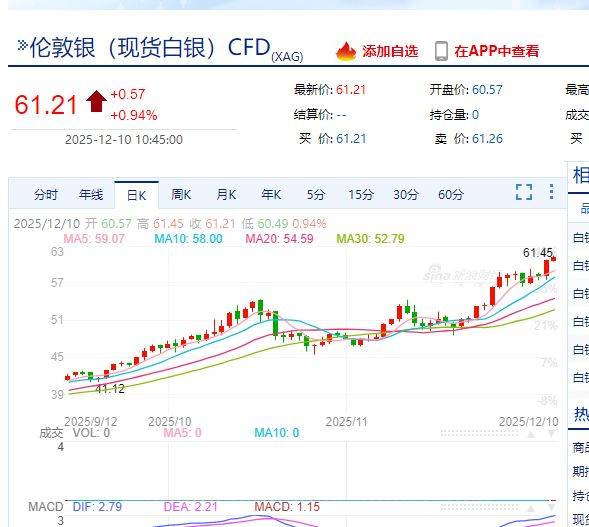
格隆汇12月10日|据每经,受美联储降息预期升温、全球供应紧张加剧以及被列入美国"关键矿产"清单 等多重因素推动,白银价格12月9日强势突破每盎司60美元关口,创下历史新高。今年以来,白银涨幅 已接近110%,表现远超黄金和铂金。截至发稿,现货白银报61.21美元/盎司,涨幅0.94%。作为对比, 尽管黄金今年也上涨了60%并突破4200美元大关,但在涨幅力度上仍逊色于白银,导致金银比价降至70 倍以下,为2021年7月以来首次。 中银证券认为,白银补涨弹性或优于黄金。黄金仍处于上升通道,但 当前处于加速上行后的高位震荡阶段,后续行情的催化关键在于"实际利率下行"与"美元走弱"能否形成 共振。相比之下,白银的短期确定性更强。当前处于历史高位的"金银比"蕴含着较大的修复空间,而光 伏等工业领域需求增长为银价提供了支撑,较低的库存水平使其价格短期弹性或优于黄金。 ...
涨势远超黄金!白银年内已涨近110%!发生了什么?
Sou Hu Cai Jing· 2025-12-10 03:21
Group 1 - Silver prices surged past $60 per ounce on December 9, reaching a historical high, driven by multiple factors including rising expectations of interest rate cuts by the Federal Reserve, global supply tightness, and inclusion in the U.S. "critical minerals" list [1] - Year-to-date, silver has increased nearly 110%, outperforming both gold and platinum [1] - As of the report, spot silver was priced at $61.21 per ounce, with a daily increase of 0.94% [1] Group 2 - In comparison, gold has also risen by 60% this year, surpassing $4,200, but its growth rate is still less than that of silver, resulting in the gold-silver ratio dropping below 70 for the first time since July 2021 [3] - The core catalyst for the current silver price increase is the repricing of interest rates and policy expectations, with the Federal Reserve initiating a new round of easing since September and reducing the federal funds rate to a range of 3.75% to 4.00% [5] - Market expectations indicate an 85% probability of further rate cuts in December, influenced by statements from key Federal Reserve officials and weak economic data [5] Group 3 - Analysts note that silver possesses both financial and commodity attributes, benefiting from a macro environment of liquidity easing, which supports its strong performance [7] - A global decline in silver inventories has led to noticeable supply tightness in the spot market, with recent trends showing a premium for physical silver in Europe and tightness in the domestic silver market [7] - The current high gold-silver ratio suggests significant potential for correction, while increasing demand from industrial sectors like photovoltaics supports silver prices [7]
港股概念追踪 国外白银极度缺货 国际银价创历史新高逼近60美元大关(附概念股)
Jin Rong Jie· 2025-12-08 00:56
智通财经获悉,当地时间12月5日,受投资者对美联储降息前景持乐观态度、白银ETF持仓增量等因素 推动,国际白银价格显著上涨。伦敦现货白银价格盘中一度突破每盎司59.33美元,刷新历史纪录。纽 商所白银期货价格主力合约价格当天一度逼近每盎司60美元大关,收盘报每盎司59.053美元,创历史新 高。 有分析认为,目前黄金与白银价格比约为75∶1,显著高于过去二十年约60∶1的平均水平,这表明白银在 贵金属板块中相对被低估。据悉,美国银行已将2026年白银目标价上调至每盎司65美元,美国花旗与渣 打则预测2025年第四季度至2026年第一季度,白银价格将稳定在55美元/盎司以上。 随着白银价格的走高,实物银条受到消费者热捧。12月4日,深圳水贝的白银首饰、银锭批发店铺生意 火爆。水贝白银首饰销售价格已达16.52元/克,而银锭批发价格涨至13.378元/克,创水贝银价历史新 高。水贝一家银饰批发店主表示:"近期买银饰和银锭的顾客明显增多了,特别是银锭,因为没有工 费,很多顾客买了用于投资。" 紫金矿业(02899):紫金矿业作为银、铜、锌等全球综合性矿业巨头,受益于金、铜等金属价格上涨及 锂电产业布局,长期成长性较 ...
新高下的贵金属行情展望
2025-12-04 02:21
新高下的贵金属行情展望 20251203 摘要 美国实际利率是全球利率的锚,2023 年 10 月见底后,黄金价格大幅上 涨,与美联储降息预期密切相关,即使暂停降息,市场仍担忧特朗普第 二个任期政策的不确定性。 全球央行购金是重要驱动因素,自 2022 年以来,每年购金量超 1,000 吨,主要由新兴市场和发展中经济体推动,反映出对地缘政治及去美元 化的担忧,中国央行三年购金 330 吨。 美联储处于降息周期,即使 12 月不降息,明年(2026 年)预计仍有 3-4 次降息,宽松货币政策导致实际利率下行,提升黄金吸引力,劳动 力市场疲软支持宽松政策。 白银作为黄金上涨的伴生品,金银比开始回落,白银弹性显现。美国实 际利率下行预期强烈,联邦基金利率可能降至 3%~3.25%,甚至更低, 实际利率下行超预期。 美元指数已跌破 100,未来可能跌至 95,受美国例外叙事减弱、非美经 济强劲、美联储降息、资金转向非美和亚太地区等因素影响,美元疲软 支撑贵金属市场。 Q&A 近期黄金和白银价格波动较大,未来贵金属市场的走势如何? 素。在美联储 10 月降息后,尽管 12 月降息预期曾有所减弱,但目前回升至 80%以上 ...
碾压黄金!银价狂飙续创新高,年内涨幅超100%
2 1 Shi Ji Jing Ji Bao Dao· 2025-12-03 08:54
Core Viewpoint - Silver prices have surged to a historic high, significantly outperforming gold, with a year-to-date increase of approximately 105% [1] Group 1: Price Movement - On December 3, international spot silver rose by 0.8%, reaching a record high of $58.94 per ounce [1] - The domestic futures market also showed strong performance, with the main Shanghai silver contract rising over 2%, achieving eight consecutive days of gains and continuously breaking historical highs [1] Group 2: Supply and Demand Dynamics - Following a silver shortage in London in October, silver inventories from China and the U.S. have flowed into London, alleviating the tight situation, but inventories continue to decline [1] - Shanghai silver inventory has dropped to a near ten-year low, with near-month contract prices exceeding those of far-month contracts, indicating a "backwardation" structure that reflects short-term supply pressure [1] - A global decline in inventories has led to significant signs of warehouse congestion in the spot market, with tight physical delivery conditions triggering a chain reaction of short squeezes that may further drive up silver prices [1] Group 3: Market Analysis - China International Futures believes that silver's rebound potential may be greater than that of gold [1] - While gold remains in an upward channel, it is currently experiencing high-level fluctuations after rapid gains, with future catalysts dependent on the interplay of "declining real interest rates" and "weaker dollar" [1] - In contrast, silver shows stronger short-term certainty, with the historically high "gold-silver ratio" indicating substantial room for correction, and increasing demand from industrial sectors like photovoltaics providing support for silver prices [1]
降息预期强化,?银震荡偏强
Zhong Xin Qi Huo· 2025-11-27 01:52
Group 1: Report's Core View - The weakening of the US dollar, the increasing probability of a December interest rate cut, and the enhanced expectation of a more dovish "Hassett Fed" policy have led to a continued strong - oscillating pattern for gold and silver. Geopolitical conflicts and energy - chain risks have added additional support. The mid - term upward logic remains unchanged [1]. - The weakening US economic data, including retail sales, consumer confidence, employment, and PPI, has increased the market's bet on a December interest rate cut. The probability of a 25bp cut in December is over 80% according to swap contracts [3]. - Gold's structural support is solid. Central bank gold purchases remain high, physical demand is resilient, and there is a potential marginal inflow in the ETF segment. Since the beginning of the year, gold and silver have risen by over 55% and nearly 80% respectively, driven by the decline in global real interest rates, the weakening of the dollar cycle, and central bank purchases [3]. - If the December interest rate cut is realized and the expectation of Hassett becoming the Fed chair is further strengthened, gold and silver prices may hit the upper limit of the range again, with silver having higher elasticity [3]. Group 2: Key Information - US economic data is weak. Retail sales in September only slightly rebounded, consumer confidence had the largest decline this year, and employment and PPI were also mild. The probability of a December interest rate cut continues to rise [2]. - Tensions in the Middle East have escalated, with multiple night attacks between Israel and Gaza. There is a risk of the local war spreading, and the global risk appetite is suppressed [2]. - The European energy chain faces winter uncertainties. Ukraine's drone attacks on Russian oil and power facilities have made European countries re - evaluate winter gas and power security and discuss additional reserves and supply alternatives [2]. Group 3: Price Outlook - The weekly price ranges are maintained at [4030 - 4200] for London gold and [50 - 55] for London silver [4]. Group 4: Index Information Special Index - The commodity index is 2241.06, up 0.12%; the commodity 20 index is 2543.53, up 0.04%; the industrial products index is 2200.67, up 0.03%; the PPI commodity index is 1336.40, down 0.13% [44]. Sector Index - The precious metals index on November 26, 2025, is up 0.25% today, up 1.28% in the past 5 days, up 4.87% in the past month, and up 52.36% year - to - date [45].
华安期货:11月12日黄金白银震荡盘整
Sou Hu Cai Jing· 2025-11-12 06:27
Core Viewpoint - The U.S. Senate's passage of the funding and extension bill paves the way to end the government shutdown, while poor employment data suggests the Federal Reserve may continue its rate cuts, supporting gold prices amid rising geopolitical risks and a weakening dollar [1][3]. Market Summary - COMEX gold futures rose by 0.27% to $4,133.20 per ounce, and COMEX silver futures increased by 1.52% to $51.08 per ounce [1]. - The U.S. announced a suspension of export control penetration rules from November 10, 2025, to November 9, 2026 [1]. - The ADP reported a decline of 11,250 jobs in the private sector every two weeks, totaling a loss of 45,000 jobs for the month, excluding government employees [1][3]. - The market outlook indicates a period of consolidation [3].