
房地产市场

Search documents
2025年 8.4万亿元!
Nan Fang Du Shi Bao· 2026-01-19 14:59
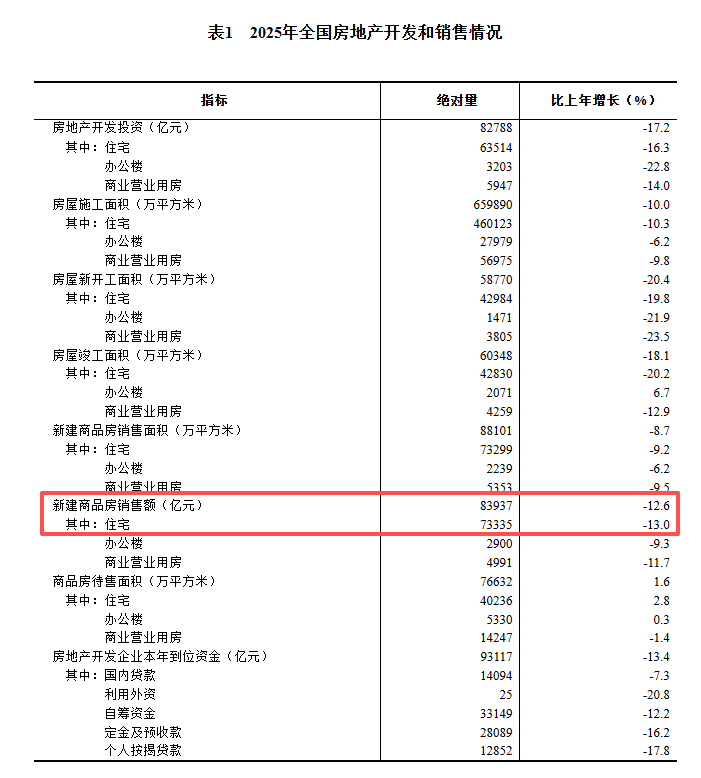
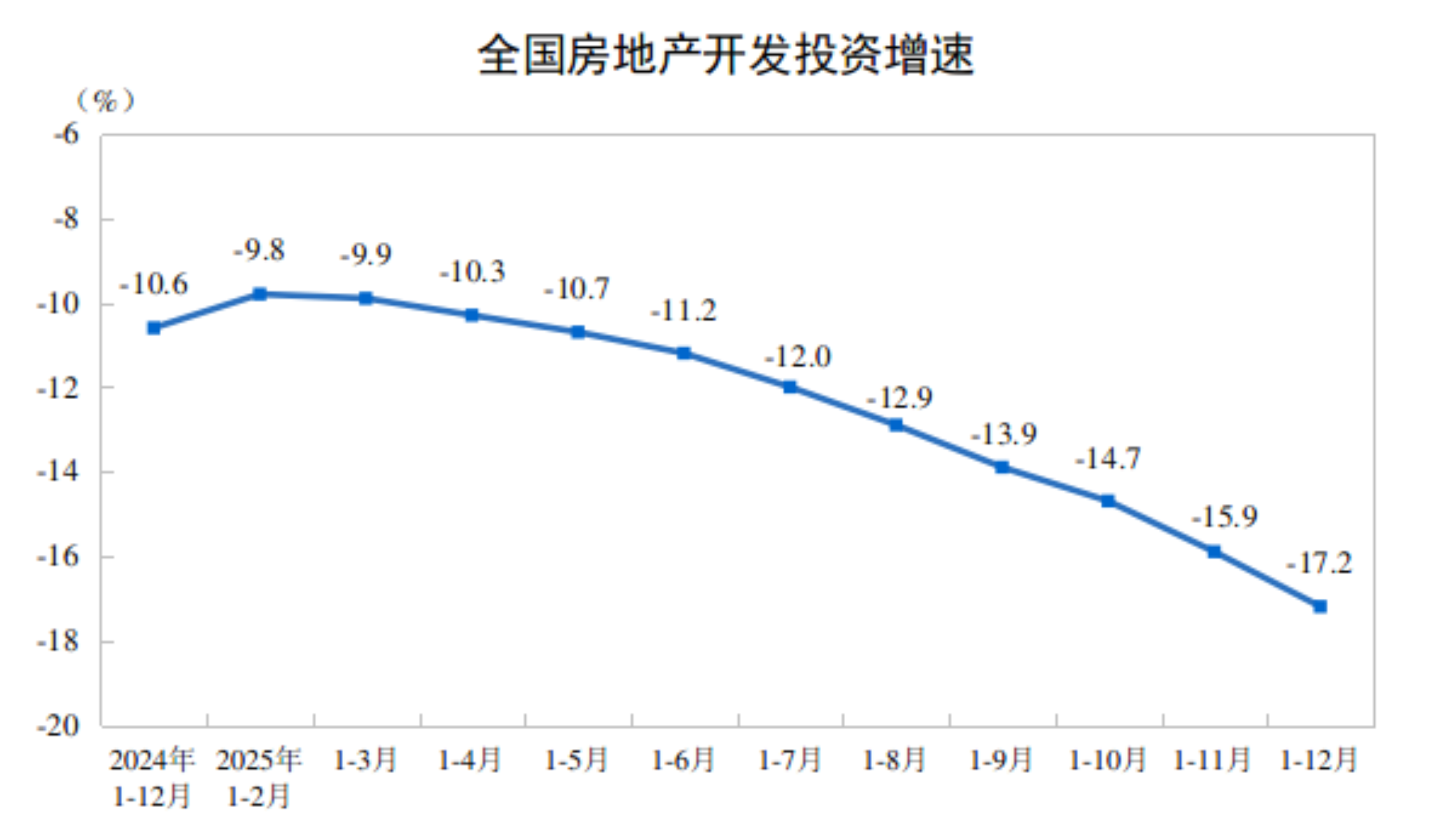
2025年,全国房地产开发投资82788亿元,比上年下降17.2%(按可比口径计算);其中,住宅投资 63514亿元,下降16.3%。 告别10万亿市场两年之后,中国房地产市场仍有83937亿元的底盘。 1月19日,国家统计局发布2025年全国房地产市场基本情况。在2025年,全国新建商品房销售额83937亿 元,下降12.6%;其中住宅销售额73335亿元,下降13.0%。 2025年12月份,房地产开发景气指数为91.45。 房地产开发企业房屋施工面积659890万平方米,比上年下降10.0%。其中,住宅施工面积460123万平方 米,下降10.3%。房屋新开工面积58770万平方米,下降20.4%。其中,住宅新开工面积42984万平方 米,下降19.8%。房屋竣工面积60348万平方米,下降18.1%。其中,住宅竣工面积42830万平方米,下 降20.2%。 广东省城乡规划院住房政策研究中心首席研究员李宇嘉分析指出,近期,一线城市房价跌幅开始收窄, 二手房挂牌量增幅开始减少,低价位二手房消化较快,小户型、总价低的房源占比明显提升,上海、深 圳、广州、东莞等重点城市二手房交易创近年来新高。这意味着在价格调 ...

2025年经济数据点评:外需强、消费稳、投资跌、地产降
Western Securities· 2026-01-19 13:32
Economic Growth - The economy is projected to grow by 5% in 2025, with significant contributions from external demand[1] - In Q4 2025, GDP is expected to grow by 4.5% year-on-year, marking a decline for three consecutive quarters[1] - Net exports are expected to contribute 1.6 percentage points to GDP growth, an increase of 0.1 percentage points from 2024[1] Nominal GDP and Price Index - The nominal GDP growth rate is expected to slow down, with a year-on-year increase of 4% in 2025, down from 2024[1] - The GDP deflator is projected to decrease by 1% year-on-year, indicating deflationary pressures[1] - In Q4 2025, nominal GDP is expected to grow by 3.8% year-on-year, a slight recovery from Q3's 3.7%[1] Industrial and Service Sector Performance - Industrial output is expected to grow by 5.2% year-on-year in December, up from 4.8% in November[2] - The service sector production index is projected to increase by 5% year-on-year in December, compared to 4.2% in November[2] Retail and Consumer Confidence - Retail sales are expected to grow by 3.7% year-on-year in 2025, a slight increase from 3.5% in 2024[2] - The consumer confidence index is anticipated to rise to 90.3 in November, indicating improved consumer sentiment[2] Investment Trends - Fixed asset investment is projected to decline by 3.8% in 2025, with a significant drop of 15.1% year-on-year in December[3] - Infrastructure investment is expected to decrease by 16%, manufacturing investment by 10.6%, and real estate investment by 35.8%[3] Real Estate Market - The sales area of commercial housing is expected to decline by 8.7% year-on-year in 2025, with sales revenue down by 12.6%[3] - Real estate prices in 70 major cities are expected to continue their downward trend, with no signs of stabilization by year-end[3]
地产月月报-20260119
Guo Tou Qi Huo· 2026-01-19 12:01
Group 1: Report Industry Investment Rating - No information provided Group 2: Core Viewpoints - The real - estate market remained weak overall in December 2025, with major indicators continuing to decline significantly and the decline in investment continuing to expand. Attention should be paid to subsequent policy changes and the restoration of the market's internal driving force [1] Group 3: Summary by Key Indicators Development Investment Completion Amount (in billion yuan) - The estimated value in 2025 was 827.88 billion. The estimated year - on - year change in November was - 30.3%, in December was - 17.2%, from January to November was - 35.8%, in 2025 was - 15.9%, and in 2024 was - 10.6% [1] New Housing Starts Area (in million square meters) - The estimated value in 2025 was 587.7 million square meters. The estimated year - on - year change in November was - 20.4%, in December was - 19.4%, from January to November was - 27.6%, in 2025 was - 20.5%, and in 2024 was - 23.0% [1] Commercial Housing Sales Area (in million square meters) - The estimated value in 2025 was 881.01 million square meters. The estimated year - on - year change in November was - 8.7%, in December was - 15.6%, from January to November was - 12.9%, in 2025 was - 17.3%, and in 2024 was - 7.8% [1] Housing Construction Area (in million square meters) - The estimated value in 2025 was 6,598.9 million square meters. The estimated year - on - year change in November was - 10.0%, in December was - 9.6%, and from January to November was - 12.7% [1] Housing Completion Area (in million square meters) - The estimated value in 2025 was 603.48 million square meters. The estimated year - on - year change in November was - 18.1%, in December was - 18.3%, from January to November was - 25.5%, in 2025 was - 18.0%, and in 2024 was - 27.7% [1]
国家统计局:2025年全年新建商品房销售额83937亿元
Guo Jia Tong Ji Ju· 2026-01-19 02:22
2025年,房地产开发企业房屋施工面积659890万平方米,比上年下降10.0%。其中,住宅施工面积460123万平方米,下降10.3%。房屋新开工面积58770万平 方米,下降20.4%。其中,住宅新开工面积42984万平方米,下降19.8%。房屋竣工面积60348万平方米,下降18.1%。其中,住宅竣工面积42830万平方米, 下降20.2%。 国家统计局数据显示,2025年全年全国固定资产投资(不含农户)485186亿元,比上年下降3.8%;扣除房地产开发投资,全国固定资产投资下降0.5%。分 领域看,基础设施投资下降2.2%,制造业投资增长0.6%,房地产开发投资下降17.2%。全国新建商品房销售面积88101万平方米,下降8.7%;新建商品房销 售额83937亿元,下降12.6%。分产业看,第一产业投资增长2.3%,第二产业投资增长2.5%,第三产业投资下降7.4%。民间投资下降6.4%;扣除房地产开发 投资,民间投资下降1.9%。高技术产业中,信息服务业,航空、航天器及设备制造业投资分别增长28.4%、16.9%。12月份,固定资产投资(不含农户)环 比下降1.13%。 2025年全国房地产市场基 ...
股指周报:大盘短期或宽幅震荡,但中期股指上涨逻辑不变-20260118
Hua Lian Qi Huo· 2026-01-18 14:37
Report Industry Investment Rating No information provided on the report industry investment rating. Core View of the Report The short - term market may experience wide - range fluctuations, but the medium - term upward logic of stock index remains unchanged. After a sharp rise, the short - term market may have large - scale fluctuations. Heavy - position profit - takers are advised to reduce positions on last Tuesday and Wednesday, then cover positions on dips or conduct intraday short - term trading. The spring market long - position window has opened, and the market will maintain an oscillating upward pattern. The mid - term view of being bullish on the stock index remains unchanged under the continuous increase of margin trading funds and the stabilization of the third - quarter report performance [16]. Summary by Directory 1. Weekly View and Strategy - **Fundamental View**: Last week, the market rose first and then fell. The performance of the four major indexes was different, with small and medium - cap indexes rising and large - cap indexes falling. The growth and cyclical style indexes continued to rise, while the financial, consumer, and stable style indexes declined. In the Shenwan industry, TMT and cyclical sectors such as computer, electronics, non - ferrous metals, and media led the rise, while sectors such as military industry, real estate, agriculture, and coal led the decline. In December 2025, the manufacturing PMI was 50.1%, up 0.9 percentage points from the previous month; the non - manufacturing PMI was 50.2%, up 0.7 percentage points from the previous month. The supply and demand sides of the manufacturing PMI continued to recover. The A - share performance showed signs of stabilization in the first quarter, declined in the second quarter, and continued to stabilize and recover in the third quarter [7][10]. - **Strategy View and Outlook**: The short - term market may experience wide - range fluctuations, but the medium - term upward logic of the stock index remains unchanged. It is recommended that heavy - position profit - takers reduce positions and then cover positions on dips or conduct intraday short - term trading. The spring market long - position window has opened, and the market will maintain an oscillating upward pattern. The mid - term view of being bullish on the stock index remains unchanged. In operation, long - term mid - line positions can be held, and short - term long positions should set stop - profit levels. Call options can be held with short - term stop - profit levels set [16]. 2. Index Industry Trend Review - Last week, the market rose first and then fell. The performance of the four major indexes was different, with small and medium - cap indexes rising and large - cap indexes falling. The growth and cyclical style indexes continued to rise, while the financial, consumer, and stable style indexes declined. In the Shenwan industry, TMT and cyclical sectors such as computer, electronics, non - ferrous metals, and media led the rise, while sectors such as military industry, real estate, agriculture, and coal led the decline [22][25]. 3. Main Contract and Basis Trend - Among the four major indexes, IC and IM continued to rise, while IH and IF adjusted. In terms of basis, the quarterly main contract basis of IM returned to a reasonable level. In terms of arbitrage among main contracts, IC/IF and IC/IH oscillated upwards, IH/IF oscillated, IM/IF and IM/IH oscillated upwards, and IM/IC continued to decline [32][36]. 4. Policy and Economy - **Economic Data**: In December 2025, the manufacturing PMI was 50.1%, up 0.9 percentage points from the previous month; the non - manufacturing PMI was 50.2%, up 0.7 percentage points from the previous month. The supply and demand sides of the manufacturing PMI continued to recover. PPI has shown different trends since 2023. In November 2025, industrial enterprise revenue continued to decline to 1.6%, and inventory continued to rise to 4.6%. The growth rate of medium - and long - term credit has been falling since May 2023, reaching 5.89% in November 2025 [42][45][53]. - **Policy**: The Politburo set the tone for the real estate market to stop falling and stabilize and boost the capital market. The State Council issued the New Nine - Point Plan to strengthen investor returns. The central bank created two new monetary policy tools. The implementation plan for promoting the entry of medium - and long - term funds into the market was officially released, which is expected to add 800 billion yuan of long - term funds to the A - share market annually [10]. 5. Revenue and Net Profit of Each Index - The performance of A - shares showed signs of stabilization in the first quarter, declined in the second quarter, and continued to stabilize and recover in the third quarter. In the third quarter of 2025, the performance of the four major indexes rebounded again [79][83]. 6. Valuation - The Shanghai Composite Index's valuation is 17.0155, with an upper - limit value of 15.68, at the 92.32 percentile since 2010, indicating a high valuation. The ChiNext's valuation is relatively low [94]. 7. Fed Interest Rate No information provided on the Fed interest rate. 8. Capital Flows - **Margin Trading**: In 2024, the net inflow was 274.8 billion yuan; in 2025, it was 670 billion yuan; as of January 15, 2026, the net inflow was 177.1 billion yuan, with a large net inflow of 98.1 billion yuan in the first five trading days. - **ETF**: From April 7, 2025, to January 16, 2026, the ETF scale increased by 71.8 billion yuan, 137.1 billion yuan less than the previous week. As of January 16, 2026, the ETF funds had a small net outflow of 138.3 billion yuan. - **Private Securities Investment Funds**: The scale increased by 1.8253 trillion yuan in the first 11 months of 2025, with a significant increase of 1.040028 trillion yuan in October, and the current total scale is 7.0076 trillion yuan. The newly registered scale in the first 11 months of 2025 was 433.7 billion yuan. - **Insurance Funds**: In the third quarter of 2025, the market value of A - shares held by insurance funds increased by 552.4 billion yuan, a month - on - month increase of 18.00%. In the first three quarters of 2025, the market value of A - shares held by insurance funds increased by 1.193 trillion yuan, and after deducting the scale increase, it increased by 758.4 billion yuan. - **Newly Established Funds**: As of September 30, 2025, the newly established stock - type fund shares were 323.3 billion, of which 137 billion were in the third quarter; the newly established hybrid - type fund shares were 103.6 billion, of which 53 billion were in the third quarter. In 2025, index - type funds had a net inflow of 104.9 billion yuan, while active equity - type funds had a net outflow of 444.9 billion yuan, and equity - type funds had a net outflow of 340 billion yuan [13][103][105]. 9. Technical Analysis No information provided on technical analysis other than the historical price charts of the four major indexes.
每日核心期货品种分析-20260116
Guan Tong Qi Huo· 2026-01-16 13:06
Report Summary 1. Report Industry Investment Rating No relevant information provided. 2. Core Viewpoints - As of the close on January 16, domestic futures main contracts mostly declined. Polysilicon and rapeseed oil rose over 2%, while lithium carbonate and container shipping to Europe routes dropped over 8%, and tin and nickel futures also fell significantly. Different futures varieties showed distinct trends due to various factors such as supply - demand fundamentals, geopolitical events, and policy changes [5][6]. 3. Summary by Directory 3.1 Commodity Performance - As of January 16, domestic futures main contracts showed a pattern of more declines than increases. Polysilicon and rapeseed oil rose over 2%, glass rose over 1%; lithium carbonate and container shipping to Europe routes dropped over 8%, tin dropped over 6%, nickel, butadiene rubber, fuel oil, caustic soda, and SC crude oil dropped over 3%, and apples, liquefied petroleum gas (LPG), and copper dropped over 2%. In the stock index futures, the CSI 300 futures (IF) main contract dropped 0.29%, the SSE 50 futures (IH) main contract dropped 0.64%, the CSI 500 futures (IC) main contract rose 0.40%, and the CSI 1000 futures (IM) main contract rose 0.25%. In the bond futures, the 2 - year Treasury bond futures (TS) main contract rose 0.03%, the 5 - year Treasury bond futures (TF) main contract rose 0.05%, the 10 - year Treasury bond futures (T) main contract rose 0.01%, and the 30 - year Treasury bond futures (TL) main contract dropped 0.09%. In terms of capital flow, hot - rolled coil 2605, rebar 2605, and rapeseed oil 2605 had capital inflows, while lithium carbonate 2605, silver 2604, and gold 2602 had capital outflows [5][6]. 3.2 Market Analysis - **Copper (Cu)**: Copper futures opened low and moved lower. Supply - side issues included difficulties for smelters to profit from long - term contracts, and by - products like sulfuric acid and gold becoming major profit sources. The refined copper output was expected to decline in January. The merger negotiation between Rio Tinto and Glencore might affect the global copper supply. Demand from end - users was strong, but the copper products sector was cautious. Copper inventory increased significantly. Although the market's expectation of copper being included in the tariff scope weakened, copper futures were still prone to rise due to tight supply [8]. - **Lithium Carbonate**: It opened high and hit the daily limit down. In December 2025, the output was 99,000 tons, a 3.0% month - on - month increase. The weekly inventory decreased slightly. The demand from energy - storage batteries remained strong, but the market was pressured by the expected increase in supply from the recycling end. The government's adjustment of the export tax - rebate policy for batteries might impact the market. The strong situation of lithium carbonate remained unchanged, but the market was volatile [10]. - **Crude Oil**: OPEC+ decided to maintain the production plan in February and March 2026. The EIA data showed an unexpected increase in US crude and gasoline inventories. US crude production decreased slightly but remained near the historical high. Geopolitical factors such as the situation in Iran and the US - India - Russia oil trade relationship affected the market. The market was worried about demand, and the supply was in an oversupply situation. The price was expected to fluctuate and consolidate [11][13]. - **Asphalt**: The asphalt production rate increased slightly this week, but the expected production in January 2026 decreased compared to the previous month and the same period last year. The downstream construction was restricted by funds and weather. The inventory rate of asphalt refineries continued to rise. The geopolitical situation in Venezuela affected the supply of raw materials for domestic asphalt production. The price was expected to fluctuate, and an inverse spread strategy was recommended [14][16]. - **PP**: After the New Year's Day holiday, the downstream PP operating rate decreased slightly. The PP enterprise operating rate remained stable at a relatively low level. The cost decreased due to the easing of the Iran situation. The supply increased with new capacity coming on - stream. The downstream demand was limited before the Spring Festival. The market was expected to fluctuate within a range, and the L - PP spread was expected to narrow [17]. - **Plastic**: The plastic operating rate decreased slightly. The downstream PE operating rate decreased, and the demand from the agricultural film sector continued to decline. The cost decreased with the easing of the Iran situation. The supply increased with new capacity coming on - stream. The market was expected to fluctuate within a range, and the L - PP spread was expected to narrow [18][19]. - **PVC**: The upstream calcium carbide price was stable. The PVC operating rate was basically stable, but the downstream operating rate decreased. The export orders decreased, and the social inventory continued to increase. The cancellation of the export tax - rebate policy might stimulate a rush - to - export phenomenon. The 03 - 05 contracts were expected to fluctuate strongly [20]. - **Coking Coal**: Coking coal opened low and moved higher but declined during the day. The coking coal options were listed on the Dalian Commodity Exchange. The supply from imported coal decreased, while domestic production increased. The inventory transferred from upstream to downstream. The demand from steel mills and coking enterprises was expected to increase during the winter storage period, but the upward momentum was limited due to weak macro - sentiment. The price was expected to fluctuate widely [22]. - **Urea**: Urea opened low and moved higher but declined during the day. The market trading was not active, and the downstream was resistant to high prices. The daily output was expected to remain above 200,000 tons. The agricultural demand increased, and the industrial demand from compound fertilizer and melamine factories also rose. The inventory decreased. The price was expected to adjust at a high level in the short term [23].
2025年哪个城市卖房最多?成都!
Sou Hu Cai Jing· 2026-01-15 06:14
Group 1 - The second-hand housing market has become the dominant force influencing the overall direction of the real estate market, with its liquidity and price trends deeply affecting the operational logic of the national real estate market [4][6]. - In 2025, Chengdu led the nation with a total transaction volume of 326,000 units (new and second-hand), followed closely by Shanghai with 324,000 units, and Wuhan (213,000 units) and Beijing (209,000 units) [2][6]. - The total transaction area for newly built housing in Chengdu reached 31.07 million square meters in 2025, ranking first nationally, while Shanghai and Beijing followed with 29.42 million and 20.22 million square meters, respectively [2]. Group 2 - In 2025, the cumulative transaction area of second-hand housing in 30 key cities reached 214 million square meters, 1.85 times that of new housing, marking a slight year-on-year increase of 0.2% and the highest scale since the industry adjustment in 2021 [3]. - The proportion of second-hand housing transactions in the total transaction volume of 30 cities reached 65%, an increase of 4 percentage points compared to 2024 [3]. Group 3 - In Chengdu, the second-hand housing transaction volume was 234,000 units in 2025, while new housing transactions decreased by 7,819 units compared to 2024, indicating a shift in market dynamics [6]. - The average price of second-hand housing in Chengdu was 12,200 yuan per square meter, down approximately 2,000 yuan from the beginning of 2025, reflecting ongoing adjustments in seller price expectations [6]. Group 4 - In Shanghai, the second-hand housing market saw a total transaction volume of 254,000 units in 2025, marking a near four-year high, while the average price of new housing rose by 6.93% to 81,337 yuan per square meter, the highest in nearly seven years [7][9]. - Beijing's total housing transactions reached 209,000 units, with second-hand housing accounting for 83% of the total, while new housing transactions decreased by 4.4% [9]. Group 5 - Some cities, such as Hefei, Yantai, Chongqing, and Kunming, experienced counter-cyclical growth in housing transactions, with Chongqing's second-hand housing transaction area reaching 1.247 million square meters, a year-on-year increase of 13% [12][13]. - The second-hand housing transaction area in cities like Chengdu, Chongqing, Tianjin, Xi'an, and Wuhan exceeded 1 million square meters, showcasing strong internal recovery capabilities and market capacity [13].

韩国央行行长罕见量化加息幅度 称稳汇率或需加息200–300基点
Xin Hua Cai Jing· 2026-01-15 05:04
新华财经北京1月15日电韩国央行行长李昌镛15日就货币政策与外汇市场形势发表系列讲话,明确指 出:若试图通过政策利率手段稳定外汇市场,"利率必须上调约200至300个基点",即从当前2.50%升至 4.5%–5.5%区间。 针对房地产市场,李昌镛重申:"不认为仅靠更高的利率就能平息房价上涨",暗示需依赖财政与监管等 非货币政策工具应对楼市风险。 在外汇干预方面,李昌镛透露,国民年金公团(NPS)近期已配合外汇当局开展对冲操作以稳定市场, 并感谢福利部协同合作。但他亦警告,散户投资者海外股票购买再度增加,叠加"韩国有很多人愿意借 出美元,但很少有人愿意出售"的结构性问题,加剧了本币贬值压力。 此外,李昌镛表示,若外汇市场持续不稳定,"韩国央行不会同意每年向美国流出200亿美元的投资资 金",并称政府将于当日稍晚就美韩贸易协议及外汇市场发布联合声明。他呼吁采取"临时措施与长期解 决方案并重"的策略应对汇率波动,并强调"有必要改变市场对韩元将进一步贬值的预期"。 (文章来源:新华财经) 李昌镛的此番表态凸显韩元持续贬值对货币政策构成的潜在压力。 李昌镛强调,近期韩元兑美元汇率一度跌至1470,虽"远未反映韩国经济基 ...
【环球财经】2025年11月澳大利亚家庭支出增长1%
Xin Hua Cai Jing· 2026-01-12 06:24
Group 1 - Australia's household income increased by 1% month-on-month and 6.3% year-on-year in November 2025, marking the first time since 2022 that this indicator has reached 1% or more for two consecutive months [1] - Household spending on food rose by 0.7%, while spending on tobacco and alcohol decreased by 1.8% in November 2025 [1] - Significant events in November contributed to a 1.2% increase in household spending on services, with "Black Friday" promotions driving a 0.9% increase in spending on goods [1] Group 2 - Despite strong household spending growth in late 2025, the real estate market appears to be slowing down, indicating a complex relationship between consumer and real estate data and monetary policy [2] - The recent cooling in the real estate market may suggest that the Reserve Bank of Australia could adopt a slightly tighter policy, while robust consumer spending indicates a solid private sector demand and genuine recovery in business activity [2] - Changes in consumer confidence data will be crucial in assessing whether the recovery in business activity will accelerate or slow down in 2026 [2]
中国宏观周报(2026年1月第2周)-20260112
Ping An Securities· 2026-01-12 02:40
Domestic Demand - In December 2025, retail sales of passenger vehicles in China were 2.296 million units, down 13% year-on-year, compared to a 7% decline in November[2] - Retail sales of major home appliances decreased by 28.5% year-on-year as of January 2, 2026, but improved by 8.4 percentage points from the previous value[2] - The volume of postal express deliveries decreased by 0.9% year-on-year as of January 4, 2026, a decline of 2 percentage points from the previous value[2] - Daily box office revenue for movies was 53.55 million yuan, down 26.3% year-on-year as of January 9, 2026[2] Industrial Sector - The Nanhua Industrial Index rose by 2.4% this week, with the black materials index up 2.7% and the non-ferrous metals index up 5.3%[4] - Daily average pig iron production and cement clinker capacity utilization rates increased, while the apparent demand for major steel products declined[4] - New home sales in 30 major cities fell by 38.4% year-on-year as of January 9, 2026, a decrease of 7.4 percentage points from the previous week[4] External Demand - Port cargo throughput increased by 1.1% year-on-year as of January 4, 2026, but this was a decline of 0.9 percentage points from the previous value[4] - Container throughput at ports rose by 7.7% year-on-year, an increase of 0.5 percentage points from the previous value[4] - South Korea's export value increased by 13.4% year-on-year in December, up 5 percentage points from November[4] Price Trends - The price of rebar futures increased by 0.7%, while spot prices rose by 0.6% this week[4] - Coking coal futures prices increased by 7.2%, with Shanxi coking coal spot prices remaining stable[4] - The agricultural product wholesale price index decreased slightly by 0.4% this week[4]