
税收政策调整

Search documents
避孕药具告别免税时代:13%增值税背后的经济账本
Sou Hu Cai Jing· 2025-12-03 04:14
Group 1 - The upcoming removal of the tax exemption for contraceptives in 2026 will significantly increase costs for manufacturers, potentially raising prices by over 15% due to a 13% VAT on production costs [1] - The change in tax policy reflects a shift in China's population strategy, moving from controlling birth rates to encouraging them, as evidenced by the introduction of a tax exemption for marriage introduction services [2] - The financial impact on companies with annual sales exceeding 100 million yuan could be substantial, leading to a potential re-evaluation of financial statements due to the sudden increase in tax burdens [1] Group 2 - The tax reform is part of a broader demographic strategy, linking the price fluctuations of contraceptives to macroeconomic policies, thus involving consumers in a larger societal change [2] - The historical context of the tax exemption for contraceptives illustrates the evolution of China's population policies, transitioning from quantity control to quality enhancement [2] - Companies may need to adjust their supply chain costs in response to consumer behavior shifting towards cheaper brands, which could lead to market segmentation [1]


今夜美股前瞻 | 芝商所交易暂停、黄金波动剧烈,特朗普欲调税收政策,三大股指期货齐涨
Jin Rong Jie· 2025-11-28 13:03
Market Overview - US stock index futures are all up, with Dow futures rising by 0.11%, S&P futures by 0.1%, and Nasdaq futures by 0.18% [1] - Major European stock indices are also up, with the Euro Stoxx 50 rising by 0.1%, FTSE 100 by 0.18%, CAC 40 by 0.23%, and DAX 30 by 0.19% [1] - WTI crude oil is up by 0.73%, priced at $59.08 per barrel, while Brent crude oil is down by 0.1%, priced at $62.81 per barrel [1] Market Events - CME suspended futures and options trading due to cooling issues at its data center, affecting multiple commodities, with analysts expecting significant price volatility upon resumption [1] - Spot gold prices experienced high volatility, with the bid-ask spread exceeding $20, dropping to $4154 per ounce before recovering to $4163.58 per ounce [1] - Trump proposed using tariff revenues to significantly reduce income taxes for low- and middle-income earners, indicating potential disruptive changes to US federal tax policy [1] - The China Smelters Purchase Team (CSPT) reached a consensus to reduce copper concentrate production capacity by over 10% for the 2026 fiscal year to combat unreasonable pricing and malicious competition [1] - Russia has received details of a peace plan agreed upon by the US and Ukraine, which will be discussed next week [1] Company News - The European Commission has received notification from Apple that its advertising and mapping services meet the thresholds of the Digital Markets Act (DMA), with a decision expected within 45 working days [1] - Nanwei Semiconductor (NVTS.US) signed a strategic distribution agreement with WT Microelectronics to integrate their distribution networks in Asia, accelerating the transition to high-power markets such as AI and energy [1] Economic Data - Germany's seasonally adjusted unemployment rate for November is 6.3%, in line with expectations and previous values, with a slight increase in seasonally adjusted unemployment by 0.1 thousand, lower than the expected 0.5 thousand [1] - France's GDP for Q3 grew by 0.9% year-on-year, matching expectations, and increased by 0.5% quarter-on-quarter [1]
再探深圳水贝市场:黄金税收新规下 金饰定价逐渐“清晰”
Zheng Quan Shi Bao· 2025-11-11 15:40
Core Viewpoint - The recent announcement of tax policies related to gold by the Ministry of Finance and the State Administration of Taxation has led to significant changes in the gold market, particularly in Shenzhen's Shui Bei market, where pricing has adjusted to reflect new tax implications [1][6]. Group 1: Market Reactions - Following the implementation of the new tax policy, gold jewelry prices in the Shui Bei market have increased, with prices reported at 1,099 yuan per gram, which includes tax, compared to the domestic gold price of approximately 966 yuan per gram [2][4]. - Initially, there was a period of pricing confusion in the Shui Bei market, but prices have since stabilized, with major trading centers reporting similar pricing around 1,097 to 1,098 yuan per gram [2][4]. - The increase in gold prices has led to a noticeable decline in customer transactions, as many consumers are adopting a wait-and-see approach [4]. Group 2: Industry Implications - The new tax policy is expected to have a significant impact on the gold jewelry industry, exacerbating existing challenges faced by jewelers, particularly in attracting younger consumers in a high gold price environment [6]. - The widening gap between the purchase price and the repurchase price of gold jewelry may reduce the incentive for consumers to sell back their gold, potentially affecting overall market liquidity [6]. - Industry experts suggest that to navigate the changes brought by the new tax policy, companies will need to enhance product value through creative design and improved craftsmanship [6].

黄金税收新政实施后,黄金消费股重挫、金条涨价,投资格局会怎样变化?
Xin Lang Cai Jing· 2025-11-03 13:49
Core Viewpoint - The recent decline in gold consumption stocks is significantly influenced by the new tax policy on gold, which is set to take effect from November 1, 2025, until December 31, 2027, leading to a sharp increase in gold prices in the market [2][3]. Group 1: Market Reaction - Gold consumption stocks experienced a sharp decline, with companies like Chao Hong Ji (潮宏基) hitting the daily limit down, and others like Chow Tai Fook (周大福) and Lao Pu Gold (老铺黄金) dropping over 6% [1]. - Following the announcement of the new tax policy, the actual price of gold bars in Shenzhen has surged to over 1,000 yuan per gram, with some brands exceeding 1,200 yuan per gram [2]. Group 2: New Tax Policy Details - The new tax policy differentiates between "member units" and "registered customers," implementing varied tax treatments based on the actual use of gold, which could impact the market dynamics significantly [3][4]. - Previously, both "member units" and "registered customers" could enjoy a 13% VAT deduction, but under the new policy, "registered customers" will only receive a 6% deduction, while "member units" will face further distinctions based on the investment nature of the gold [3]. Group 3: Implications for Investment Behavior - Analysts suggest that the new policy may lead to a structural shift in investment behavior, with funds that previously relied on tax arbitrage exiting the market, thus increasing the attractiveness of financial products like gold ETFs and futures [6]. - The long-term trend for gold remains positive, especially in a stagflation environment, as historical data indicates that gold tends to perform well compared to other asset classes during such periods [6].



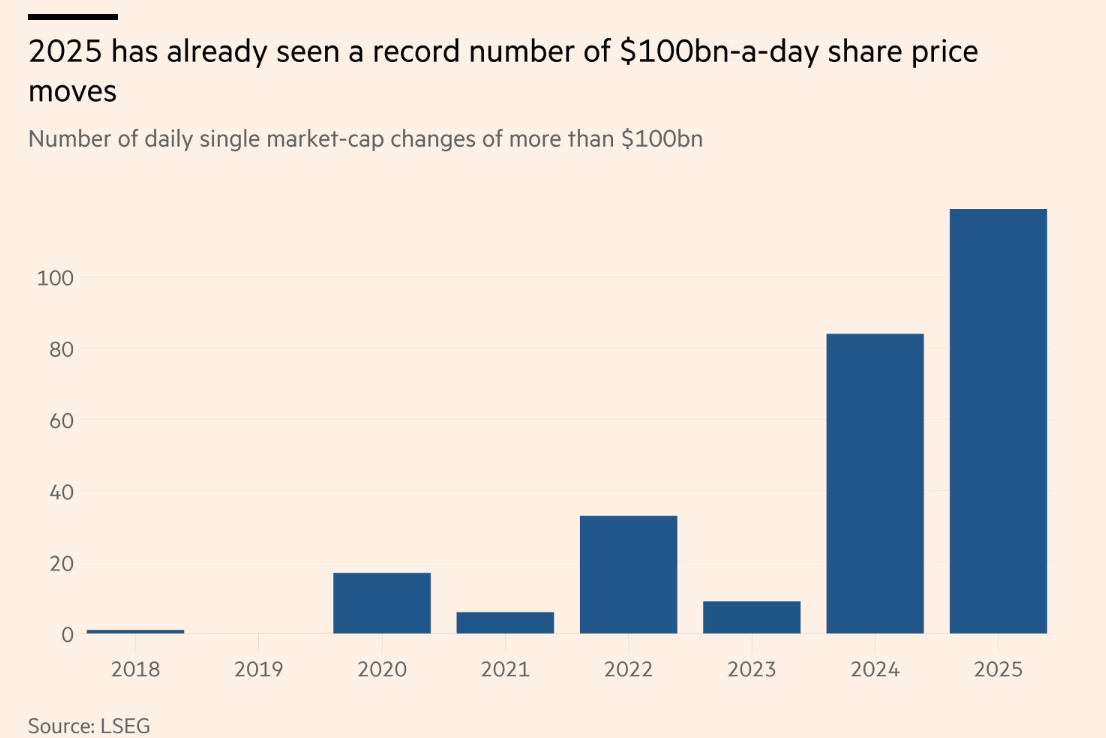
119次千亿级波动!美股“瀑布式下跌”风险在逼近?
Jin Shi Shu Ju· 2025-10-28 08:27
Core Insights - The volatility of stock prices exceeding $100 billion in a single day has become a norm on Wall Street, primarily driven by large tech companies, highlighting the risks faced by investors [1][2]. Group 1: Market Volatility - There have been 119 instances this year where individual stocks experienced a market cap fluctuation of over $100 billion, setting a historical record [2]. - Major tech companies like Nvidia, Microsoft, and Apple, each with market caps exceeding $3 trillion, are significant contributors to this volatility [2][4]. - The frequency of "vulnerable events" for large tech stocks, defined as price fluctuations far exceeding normal ranges, has surpassed the previous year's record [2][4]. Group 2: Impact of Earnings Reports - The upcoming earnings reports from major tech firms such as Meta, Alphabet, Microsoft, Apple, and Amazon are expected to heighten market risks due to their high volatility [4]. - Analysts warn that disappointing earnings could lead to severe declines in stock prices for these companies [4]. Group 3: Derivatives Market Influence - The derivatives market, particularly the trading of individual stock options, has intensified price fluctuations, with retail investors accounting for 60% of the trading volume this month [7][10]. - The rise of leveraged ETFs, which amplify stock price movements, has also contributed to increased market leverage and volatility [7][10]. Group 4: Correlation and Market Stability - Despite significant individual stock volatility, the overall market volatility remains moderate, as large-cap stocks do not typically move in sync [4][10]. - Analysts caution that if individual stock correlations rise, it could lead to synchronized sell-offs among large-cap stocks, posing greater risks to market stability [11].






个体工商户:取得收入后,我要缴哪些税(费)呢?
蓝色柳林财税室· 2025-10-15 01:18
Group 1 - The article discusses the addition of new reporting items related to employee compensation and export methods in tax declarations, requiring taxpayers to accurately report relevant information [8][9] - Adjustments to the prepayment tax calculation section include the addition of sales expenses and other income, as well as detailed reporting of export income types [9][10] - A new project for "tax credit" is introduced for enterprises eligible for special equipment tax credit policies, allowing them to report during prepayment declarations [12][13] Group 2 - The article outlines the adjustment of the tax allocation calculation method for total and branch institutions, promoting the method from the settlement phase to the prepayment phase [15][16] - Modifications to the form name and data items are specified, including the addition of actual tax allocation amounts and cumulative amounts for better clarity in tax reporting [16][17]

公募债基变革,市场的两大关切
HUAXI Securities· 2025-09-21 08:33
Group 1: Policy Changes and Market Concerns - The Ministry of Finance has reinstated value-added tax on interest income from government bonds, local bonds, and financial bonds since August 8, 2025, with a tax rate of 3%[11] - The China Securities Regulatory Commission has revised public fund sales fee management regulations, imposing punitive redemption fees of at least 1.5%, 1.0%, and 0.5% for different redemption periods[1] Group 2: Impact on Bond Market - As of June 2025, the total scale of bond funds is approximately CNY 11.15 trillion, with individual and institutional investors holding 17% and 81% respectively, translating to CNY 1.88 trillion and CNY 8.99 trillion[2] - If the new redemption fee regulations are implemented, there is a potential for significant capital outflow from public bond funds, which could amplify overall market volatility[1] Group 3: Institutional Responses - Bank wealth management products held CNY 1.38 trillion in public bond funds, accounting for 4.2% of their total holdings as of June 2025[3] - Insurance companies are estimated to hold around CNY 900 billion in public bond funds, maintaining a stable allocation of approximately 2.4%[4] Group 4: Historical Context and Future Projections - Historical cases show that bond fund outflows can be substantial; for instance, from September 2022 to January 2023, bond fund sizes dropped from CNY 5.19 trillion to CNY 4.01 trillion, a decrease of CNY 1.18 trillion[9] - Current market conditions suggest that if bond funds experience significant redemptions, the yield on 10-year government bonds could peak between 1.90% and 1.95%[10]
废铜行业税收政策调整对当前行情影响探讨
Hua Tai Qi Huo· 2025-09-18 02:14
Group 1: Report Summary - The 770th document of the National Development and Reform Commission in August 2025 included "tax rebates" in the list of illegal investment - promotion practices. Enterprises registered after May 2024 should cancel local retention rebates by the end of August, while those registered before can have a buffer until 2027. Some regions like Jiangxi and Anhui have already suspended rebates in September [2]. - The policy targets the "white - slip accounting" model in the recycled copper industry, and the practice of relying on local fiscal tax refunds of 4 - 6 percentage points is restricted, causing a sharp increase in enterprise costs [2]. - Referring to the experience of the lead industry, the recycled lead industry is in a "standardization pain period" with polarization. Leading enterprises adapt quickly, while small and medium - sized enterprises face challenges [3]. - When the scrap copper industry enters the "no - rebate era", enterprises should shift their competitiveness from "fiscal bonuses" to "real spreads", and investors should focus on local implementation rhythm and copper price rebound height [3]. Group 2: Background and Review - Since 2016, the policy orientation of the recycled metal industry has evolved from "environmental protection rectification" to "tax standardization". In the early stage, many small - scale scrap copper recycling workshops were shut down due to environmental non - compliance [10]. - Since 2019, policy focus has shifted to tax regulatory supervision. The "reverse invoicing" mechanism in 2024 marked the upgrade of the tax supervision system [10]. Group 3: Impact of Tax Policy on Domestic Scrap - related Enterprises Lead Industry Example - Before the "reverse invoicing" policy, the recycled lead industry had problems such as high tax costs, tax evasion, and environmental risks due to the lack of input tax deductions [11]. - After the implementation of the "reverse invoicing" policy, there were challenges such as data traceability difficulties, regional policy differences, and slow integration of individual recyclers [12][13]. - The recycled lead industry shows polarization. Leading enterprises' market share has reached over 50%, while small and medium - sized enterprises' capacity utilization has dropped from 75% to 45% [3][13]. Impact on Scrap Copper Enterprises - The 770th document affects the scrap copper industry. Enterprises relying on local fiscal tax refunds face cost - doubling pressure [20]. - In the worst - case scenario of full cancellation of rebates, the comprehensive tax rate of recycled copper enterprises will rise from 5.6% to 11.7% - 13.3%, and production capacity will shrink significantly. In the neutral scenario of partial cancellation, the impact is relatively mild [22]. - Enterprises should improve the proportion of taxable purchases at the raw material end, transfer taxes to downstream at the sales end, choose regions with long policy buffer periods, and use financial tools such as futures [3][24]. Group 4: Current Situation of Domestic Recycled Copper Rods - In the past 5 years, domestic recycled copper rod capacity has increased by nearly 400%, but there are many inefficient capacities. Since the second half of this year, enterprises have little profit [25]. - From January to July 2025, domestic scrap - produced blister copper output increased by 13.60% year - on - year, while scrap copper imports decreased by 0.5% year - on - year. The loss of the US as an import source may limit future import growth [26]. Group 5: Summary and Hedging Strategy Suggestions - The government's rectification of recycled resources and tax norms aims to ensure the stable supply of important resources and eliminate unfair competition. However, it may impact raw material supply in the short term [4][28]. - Considering various factors, copper prices may remain strong from September to October. Enterprises with buying hedging needs are advised to buy on dips, and those with selling hedging needs should increase hedging efforts in the price range of 84,000 - 84,500 yuan/ton [4][28].
国债不 “香” 了?利息税恢复的真相
和讯· 2025-08-08 10:49
Core Viewpoint - The adjustment of tax policies, particularly the restoration of VAT on newly issued bond interest, is a significant variable affecting market dynamics, aimed at guiding capital flows and alleviating fiscal pressure [2][3]. Group 1: Tax Policy Changes - Starting from August 8, 2025, newly issued government bonds, local government bonds, and financial bonds will be subject to VAT on interest income, while existing bonds will remain exempt until maturity [4][5]. - The gradual adjustment approach allows the market ample time to adapt and mitigates potential financial risks associated with sudden asset value fluctuations [5]. Group 2: Tax Rate and Impact - Financial institutions will pay a VAT of 6% on interest income, while asset management products will be taxed at a simplified rate of 3% due to their diverse investor base [7]. - Small-scale VAT taxpayers with monthly sales below 100,000 yuan will be exempt from VAT, indicating limited impact on individual investors, while institutional investors face significant pressure as they hold over 90% of the bond market [8]. Group 3: Rationale Behind Tax Restoration - The previous exemption from VAT was implemented to attract capital into the bond market during its early development phase, which has now achieved its goal with the bond market size reaching 183 trillion yuan, making it the second largest globally [9][10]. - The restoration of VAT is expected to enhance market pricing efficiency by addressing tax burden disparities among different bond types, potentially stabilizing yield curves [10]. Group 4: Effects on Investors - The new tax policy may lead to a temporary surge in demand for existing bonds due to their tax-exempt status, while newly issued bonds may see rising yields [11][12]. - Financial institutions may adjust their asset allocation strategies, favoring indirect holdings of government bonds through asset management products to minimize tax burdens [11][12]. Group 5: Broader Economic Implications - The tax policy aims to redirect funds from the bond market to the equity market, potentially revitalizing stock market activity, particularly in high-dividend and growth sectors [13][14]. - The restoration of VAT on bonds is projected to generate over 300 billion yuan in additional annual revenue for the government, aiding in fiscal sustainability and supporting public service functions [14].


投资端选项多元化 配置资金酝酿分流
Zhong Guo Zheng Quan Bao· 2025-08-05 21:07
Core Viewpoint - The Ministry of Finance and the State Taxation Administration announced the restoration of VAT on interest income from newly issued government bonds, local government bonds, and financial bonds starting from August 8, 2025, while existing bonds will remain exempt until maturity [1] Group 1: Market Reaction - The announcement led to an immediate spike in bond yields due to increased holding costs for new bonds, followed by a sharp decline in yields as institutional investors rushed to buy existing bonds benefiting from tax exemptions [1] - The market experienced a rapid shift in sentiment, with traders expressing concerns over the volatility and quick changes in market dynamics [1] Group 2: Investment Strategies - Institutions believe the tax adjustment will have a neutral impact on the bond market in the medium to long term, with a potential widening of the yield spread between new and existing bonds, prompting a buying spree for existing bonds [2][3] - The adjustment may lead to a shift in investment strategies, with a preference for existing bonds due to their tax advantages, while new bonds may require higher coupon rates to attract investors [2][3] Group 3: Fund Management Adjustments - Fund companies are adjusting redemption limits for bond funds in response to the new tax policy, preparing for potential market volatility [3] - The tax changes are expected to increase the appeal of existing bonds, leading to a strategy of "long existing bonds, short new bonds" among investors [3] Group 4: Asset Allocation Shifts - The restoration of VAT on interest income from newly issued bonds may lead to a reallocation of funds from the bond market to equity markets and other asset classes, as the attractiveness of new bonds diminishes [4][5] - Some funds may flow into credit bonds, particularly those with strong credit ratings, as investors seek to optimize returns in light of the new tax burdens [5] Group 5: Long-term Outlook - Despite short-term volatility, the overall impact of the tax adjustment on the bond market is expected to be limited, with bond funds and money market funds likely to maintain stable yields [3][4] - The long-term demand for government bonds from banks and insurance companies is anticipated to remain strong, as these institutions continue to prioritize asset-liability matching and stable returns [5]