经济刺激方案

Search documents
日本政府计划推出大规模经济刺激方案 引发金融市场担忧
Zhong Guo Xin Wen Wang· 2025-11-19 10:21
Core Viewpoint - The Japanese government plans to introduce a large-scale economic stimulus package exceeding 20 trillion yen to alleviate rising living costs, raising concerns in the financial markets about the impact on fiscal health [1]. Group 1: Economic Stimulus Plan - The proposed economic stimulus package is aimed at supporting an economy troubled by inflation [1]. - Prime Minister Sanna Takashi has committed to using active fiscal spending to address these economic challenges [1]. Group 2: Market Reactions - Investors are worried about the implications of the government's economic policies on Japan's fiscal health, leading to a recent sell-off of the yen and government bonds [1]. - As of 2023, Japan's debt-to-GDP ratio has reached 240%, highlighting the potential risks associated with increased fiscal spending [1].
日媒:日本计划推出超20万亿日元经济刺激方案
Sou Hu Cai Jing· 2025-11-19 06:48
Group 1 - The Japanese government plans to introduce an economic stimulus package exceeding 20 trillion yen to alleviate rising living costs [2] - Prime Minister Fumio Kishida has committed to supporting Japan's economy, which is struggling with inflation, through active fiscal spending [2] - Investor concerns regarding the impact of these economic policies on Japan's fiscal health have led to recent sell-offs of the yen and government bonds [2]

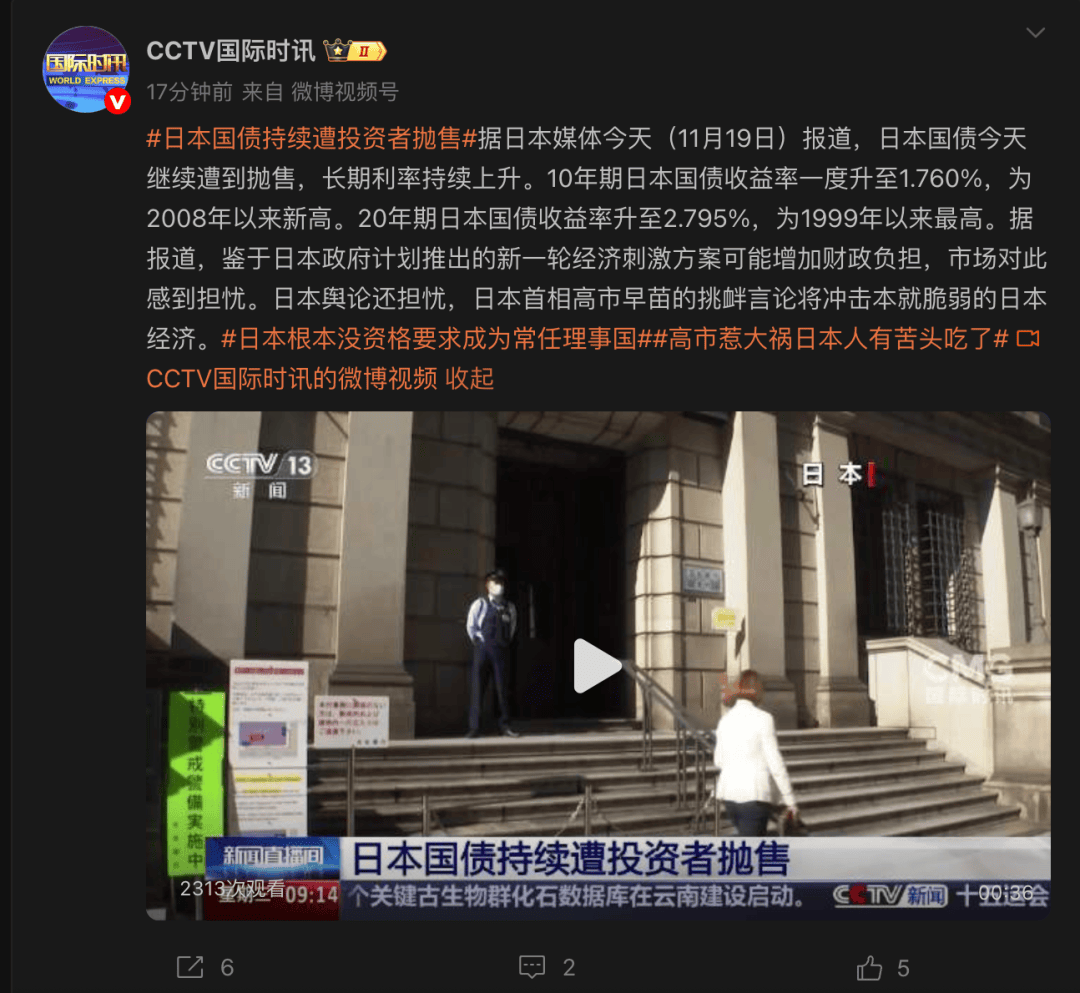
日本国债持续遭投资者抛售
Sou Hu Cai Jing· 2025-11-19 05:23
Core Viewpoint - Japanese government bonds are experiencing significant sell-offs, leading to rising long-term interest rates, with the 10-year yield reaching a new high since 2008 at 1.760% and the 20-year yield hitting its highest level since 1999 at 2.795% due to concerns over increased fiscal burdens from a new economic stimulus plan [1] Group 1 - The 10-year Japanese government bond yield rose to 1.760%, marking the highest level since 2008 [1] - The 20-year Japanese government bond yield increased to 2.795%, the highest since 1999 [1] - Market concerns are driven by the potential fiscal impact of a new economic stimulus plan proposed by the Japanese government [1] Group 2 - There are worries in Japanese public opinion regarding Prime Minister Sanna Takashi's provocative statements, which may negatively affect the already fragile Japanese economy [1]
日本消费股地震:资生堂暴跌11%,旅游零售股集体重挫
Sou Hu Cai Jing· 2025-11-17 17:07
Group 1 - The Japanese stock market experienced a significant decline, with the Nikkei 225 index dropping over 1% and falling below 50,000 points, primarily affecting tourism and retail stocks [1][3] - Notable declines included Shiseido's stock, which fell 11%, and Pacific International Holdings, which saw an 8.9% drop, marking their largest single-day declines since April 2024 [1][3] - Major retail and tourism-related companies, such as Isetan Mitsukoshi and Uniqlo's parent company Fast Retailing, also faced substantial stock price drops, with declines exceeding 5% [3] Group 2 - The downturn in the stock market is attributed to deteriorating Sino-Japanese relations, with Chinese authorities issuing travel warnings to their citizens regarding travel to Japan [5][11] - Chinese tourists are crucial for Japan's tourism sector, accounting for nearly 20% of international visitors in 2024, with their spending representing 27% of total inbound consumption, amounting to approximately 2.1 trillion yen [7] - A significant reduction in Chinese tourists could lead to a GDP decrease of 0.36% for Japan, equating to an economic loss of about 2.2 trillion yen [7] Group 3 - Japan's economy is facing multiple challenges, including a 1.8% decline in real GDP for the third quarter, marking the first negative growth in six quarters, largely due to decreased exports and a sharp drop in private residential investment [9] - Analysts suggest that the recent travel warnings from China threaten Japan's retail sales growth, particularly for companies like Shiseido and Uniqlo, which rely heavily on Chinese consumers [11] - The Japanese government has set an ambitious target to increase annual inbound tourist numbers to 60 million by 2030, but this goal is now uncertain due to escalating political tensions with China [15]

布米普特拉北京投资基金管理有限公司:日本经济一年半来首次出现负增长
Sou Hu Cai Jing· 2025-11-17 15:40
Core Viewpoint - Japan's economy experienced its first negative growth in six quarters during the third quarter of this year, with a year-on-year contraction of 1.8% [1] External Demand - The primary factor for Japan's economic contraction this quarter was weakened external demand, with its contribution to economic growth shifting from a positive 0.2 percentage points in the previous quarter to a negative 0.2 percentage points [4] - The increase in tariffs on certain imported goods by the U.S. significantly impacted Japan's export-driven economy, with a notable 24.2% year-on-year decline in automobile exports to the U.S. in September [4] - Despite an agreement between Japan and the U.S. to lower tariff levels to 15%, the overall export value still saw a quarter-on-quarter decline of 1.2% amid weak global demand [4] Domestic Demand - Domestic demand showed a mixed trend, with personal consumption expenditure, which accounts for over half of the economy, only slightly increasing by 0.1%, a slowdown from 0.4% in the previous quarter [6] - Persistently high food prices continue to suppress household consumption willingness [6] - Business equipment investment grew by 1.0%, outperforming market expectations and standing out as a bright spot in otherwise bleak data [6] - Residential investment saw a significant decline due to stricter environmental standards for new housing [6] - The GDP deflator index rose by 2.8% year-on-year, indicating ongoing inflationary pressures in Japan [6] Economic Policy Response - In response to economic downward pressure, Japan is expected to implement an economic stimulus plan exceeding 17 trillion yen this week [9] - The Bank of Japan maintained interest rates at 0.5% last month, with market expectations leaning towards avoiding interest rate hikes in December due to the potential economic contraction in the third quarter [9] - Current economic conditions are testing policymakers' ability to balance supporting economic growth while controlling inflation [9]

报道:日本经济方案考虑纳入芯片、矿产、国防三大领域
Hua Er Jie Jian Wen· 2025-11-10 13:34
Core Viewpoint - Japan's Prime Minister Sanna Takashi plans to initiate a new growth strategy through the first economic stimulus plan, focusing on investments in 17 key sectors including semiconductors, critical minerals, and defense industries [1] Group 1: Key Investment Areas - The economic plan emphasizes investments in sectors deemed crucial for Japan's economic growth, including semiconductors, artificial intelligence, shipbuilding, defense industries, and critical minerals [2] - Additional areas covered by the plan include supply chain strengthening, nurturing startups, financial growth promotion, and helping companies increase wages [3] Group 2: Fiscal and Monetary Policy Coordination - Takashi has indicated a shift towards more expansionary fiscal policies, aiming for wage growth that exceeds inflation rates to address high consumer prices [4] - The expert group suggests that the government should enhance the financial foundation of international cooperation banks and Japan Trade Insurance to ensure the implementation of investment plans related to the Japan-U.S. tariff agreement [3][4] - The scale and nature of the economic plan, along with the supplementary budget for funding, will serve as indicators of Takashi's commitment to fulfilling campaign promises without alarming investors [4] Group 3: Economic Outlook and Concerns - Economists expect the scale of the new economic plan to exceed last year's, but excessive spending may raise concerns in the bond market, potentially increasing long-term yields and triggering strong inflation [5]
报道:日本政府将敦促央行维持低利率,以进一步刺激经济
Hua Er Jie Jian Wen· 2025-11-10 02:17
Core Points - The Japanese government is preparing to emphasize the central bank's focus on achieving strong economic growth and price stability in its economic stimulus plan, highlighting Prime Minister Sanna Takashi's intention to maintain low interest rates to support the fragile economic recovery [1] - The draft framework of the stimulus plan indicates a focus on alleviating the impact of rising living costs on households, investing in crisis management and growth areas, and enhancing defense capabilities [1] - The draft emphasizes the importance of monetary policy aimed at achieving strong economic growth and price stability, with a commitment to closely coordinate with the Bank of Japan to avoid a return to deflation and ensure sustained economic growth based on price stability [1] - The Nikkei reported that the stimulus plan will include tax reduction measures aimed at stimulating investment in 17 key industries [1] Summary of the Stimulus Plan - The stimulus plan is expected to be finalized on November 21, marking the first significant economic initiative since Prime Minister Takashi took office last month [2] - The finalization of the stimulus plan will signify the formal establishment of the Takashi government's policy direction, providing important insights into Japan's economic policy trajectory [2]
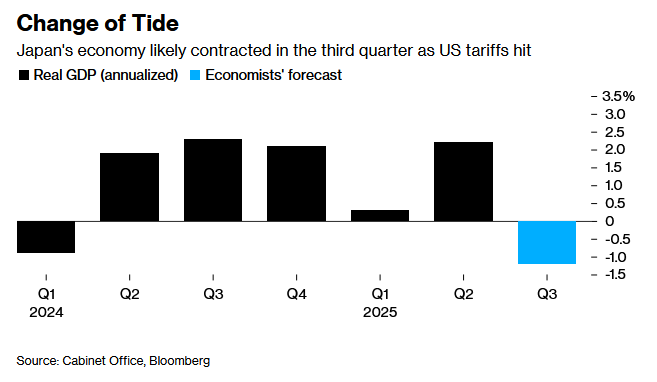
关税重压下出口受挫 日本第三季度经济或陷入萎缩
Zhi Tong Cai Jing· 2025-10-10 06:37
Group 1 - Japan's economy is expected to contract in the third quarter after five consecutive quarters of growth, primarily due to the impact of U.S. tariffs on exports [1][4] - Economists predict a year-on-year decline of 1.2% in Japan's GDP for the third quarter, a significant shift from previous expectations of a 0.1% increase [1][4] - The third quarter GDP data is scheduled to be released on November 17 [1] Group 2 - The potential economic downturn may provide support for the economic stimulus plan proposed by the new Liberal Democratic Party president, Sanae Takaichi [4] - Takaichi faces various economic challenges, including inflation pressures and trade tensions, with a focus on consolidating political support [4] - The Bank of Japan may slow down its interest rate hikes in response to the economic slowdown, with a monetary policy decision expected on October 30 [4] Group 3 - Economists forecast a 4% quarter-on-quarter decline in Japan's exports for the third quarter, worsening from a previous estimate of 3.1% [4] - Exports to the U.S. have seen significant declines, despite a trade agreement that fixed the tariff rate at 15%, which is still higher than before [4] - Many Japanese companies are reportedly lowering prices to absorb some of the tariff impacts and alleviate the burden on consumers [4] Group 4 - Private consumption in Japan is expected to grow by 0.5%, benefiting from wage increases resulting from spring labor negotiations [5] - However, core inflation remains significantly above the Bank of Japan's 2% target, continuing to erode household purchasing power [5]
每日债市速递 | 金融监管总局表示银行业保险业总资产超过500万亿元
Wind万得· 2025-09-22 22:26
Group 1: Open Market Operations - The central bank announced a 240.5 billion yuan 7-day reverse repurchase operation on September 22, with a fixed interest rate of 1.40% and a bid amount of 240.5 billion yuan, fully subscribed [1] - Additionally, a 300 billion yuan 14-day reverse repurchase operation was conducted using a fixed quantity and multi-price bidding method, marking the first such operation in nearly eight months [1] Group 2: Funding Conditions - The interbank market saw a continued improvement in funding conditions, with the overnight repo weighted average rate falling to around 1.42% [2] - The overnight funding quotes on the anonymous X-repo system also decreased to 1.43%, although supply remained at several hundred billion yuan [2] Group 3: Interest Rates and Debt Market - The latest one-year Loan Prime Rate (LPR) remained stable at 3.0%, while the five-year LPR also held steady at 3.5% [13] - The yield on major interbank bonds generally declined, with the 30-year futures contract rising by 0.22% and the 10-year contract increasing by 0.20% [12] Group 4: Financial Market Developments - The central bank successfully issued 60 billion yuan of 6-month central bank bills in Hong Kong at a winning rate of 1.72% [14] - The total scale of domestic bond ETFs surpassed 600 billion yuan, setting a new record [18]

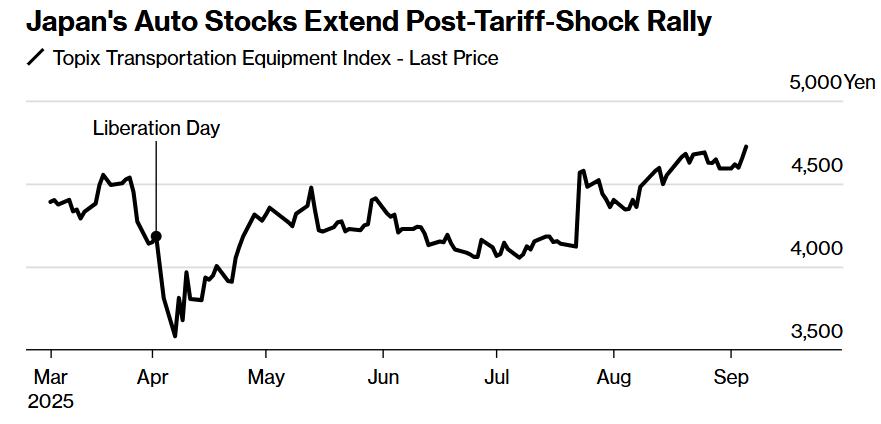
“15%封顶”的关税落地提振市场情绪 日本车企股价集体上扬
Zhi Tong Cai Jing· 2025-09-05 04:19
Core Viewpoint - The recent decision by the U.S. government to lower tariffs on Japanese automobiles from 27.5% to 15% has positively impacted investor sentiment towards Japanese automotive stocks, leading to a collective rise in their prices in the Tokyo stock market [1][4]. Group 1: Tariff Changes and Market Reactions - The U.S. government has set a maximum tariff of 15% on Japanese automobiles and parts, significantly lower than the previous 27.5%, which has boosted investor confidence in Japanese automotive stocks [1]. - The Topix automotive manufacturer sub-index in Japan saw a jump of 2.8%, marking its largest increase in a month, with Mazda and Nissan shares rising over 5% and Toyota shares increasing by 3.5% [1]. - Analysts view the new tariff as a favorable development for the Japanese automotive industry, suggesting that Japanese manufacturers may gain stronger market shares compared to international competitors [1]. Group 2: Industry Challenges and Analyst Perspectives - Despite the positive tariff news, some analysts remain cautious about the ability of Japanese automakers to mitigate the impacts of the 15% tariff, indicating that their capacity to respond to these tariffs is still uncertain [4]. - The Japanese automotive sector experienced a decline of over 6% in the two weeks following Trump's initial tariff announcement, highlighting the significant impact of the previous 25% tariffs [4]. - Toyota has warned that tariffs could result in a substantial profit hit of 1.4 trillion yen (approximately $9.4 billion), raising concerns about the future profitability of Japanese automakers under ongoing tariff pressures [5]. Group 3: Economic Indicators and Consumer Behavior - Positive economic indicators include a 1.4% year-on-year increase in Japanese household consumption in July, driven by spending on transportation and communication [5]. - Nominal wages in Japan grew by 4.1% year-on-year in July, the fastest pace in seven months, which could serve as a catalyst for consumer spending in the automotive sector [5]. - However, the outlook for Japanese exporters remains clouded due to ongoing global trade challenges, with export data showing a continuous decline for three months, including the largest drop in four years in July [6].