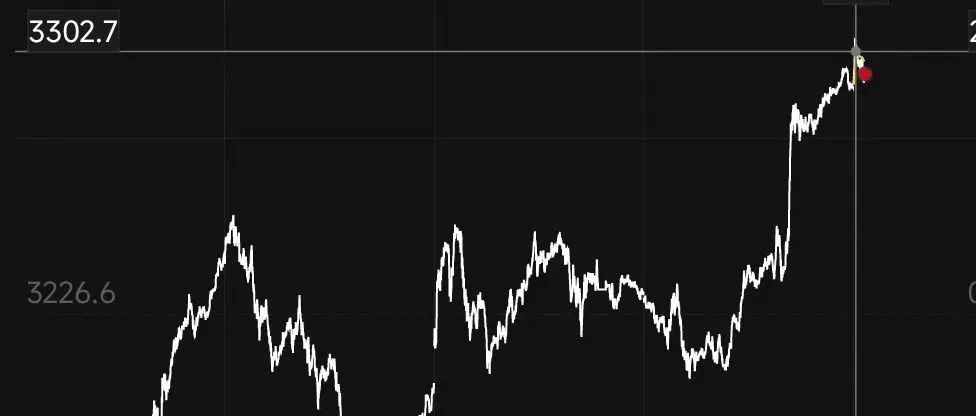
美股走势

Search documents
就市论市|纳指续创新高 美股能否延续强势?
Sou Hu Cai Jing· 2025-08-11 08:35
Core Insights - Recent data indicates signs of weakening in the US economy, with new tariff policies set to impact economic growth and inflation [1] - The probability of a rate cut by the Federal Reserve in September is observed at 94.4%, suggesting potential monetary easing in response to economic pressures [1] - The US stock market experienced a volatile rebound, with the Nasdaq reaching a new historical high, raising questions about future performance amid tariff implementation and earnings reports [1] Economic Indicators - The new tariff pressures are expected to moderately elevate inflation, which may suppress economic vitality in the US [1] - There is an increasing pressure for economic slowdown, leading to expectations that the Federal Reserve may implement further rate cuts within the year [1] Market Outlook - The earnings season for US stocks is anticipated to be characterized by high-level fluctuations, with three key scenarios to monitor as the market reacts to new economic data and tariff impacts [1]
【华尔街见闻·大师课】戴康:美国非农大调整,改变了什么预期?
戴康的策略世界· 2025-08-04 04:08
Group 1 - The adjustment of the U.S. non-farm payroll data has significantly impacted market expectations, indicating a shift in economic outlook [10] - Understanding the future trajectory of the U.S. economy is crucial, with discussions on whether a recession can be avoided [10] - Following a substantial correction in the U.S. stock market, there are considerations on whether this presents a good buying opportunity [10] Group 2 - Future trends in the U.S. dollar, U.S. Treasury yields, and gold prices are essential for investment strategies [10]


国泰海通:美联储降息预期或进一步收窄 美股仍有上行空间
Zhi Tong Cai Jing· 2025-07-31 22:47
Group 1 - The core viewpoint is that the US GDP growth in Q2 exceeded expectations, supported by a decline in imports, resilient consumption, and private non-residential investment [1][2] - The annualized quarter-on-quarter GDP growth rate for Q2 2025 reached 3.0%, higher than the market expectation of 2.6% and significantly above the previous value of -0.5% [2] - The main drag on GDP came from changes in private inventories, residential investment, and exports of goods and services [2] Group 2 - The Federal Reserve maintained its interest rates during the July 2025 meeting, but internal divisions have increased, with two members advocating for a 25 basis point cut [3] - The Fed expressed greater uncertainty regarding economic and inflation outlooks, changing its statement from reduced uncertainty to acknowledging that uncertainty remains [3] - Powell reiterated the Fed's independence and provided ambiguous forward guidance, indicating a hawkish stance, which has led to a decrease in market expectations for rate cuts throughout the year [3][4] Group 3 - The expectation for rate cuts throughout the year has narrowed, with the market reflecting only one potential cut in October, aligning with previous forecasts [4] - The anticipated impact of tariffs on inflation is expected to constrain rate cuts, with the 10-year Treasury yield projected to oscillate between 4.5% and 5.0% in the second half of the year [4] - The stock market is expected to experience some volatility in the second half, but the overall upward trend remains intact, particularly in sectors supported by capital expenditures and performance, such as AI and semiconductors [4]

美股再创新高后何去何从?中信建投:8月需警惕季节性回撤
贝塔投资智库· 2025-06-30 03:45
Core Viewpoint - The report indicates that after reaching a new high, the short-term adjustment risk for the US stock market is not significantly increased, and historical data suggests that the likelihood of a major decline decreases following new highs [2]. Group 1: Market Performance Analysis - Historical experience shows that after reaching a new high, the upward space and probability of significant gains decrease, especially within the first month [2]. - The probability of a decline exceeding 5% is lower after a new high, and the onset of such declines occurs later compared to other periods [2]. - Major declines of 20% or more after a new high tend to lead to short-term consolidations, but the variance in actual outcomes is significant, with both continued gains and declines possible [2]. - At the time of new highs, the net long positions in derivatives are not necessarily at extreme high levels, indicating that the current net long positions are relatively low [2]. Group 2: Seasonal Trends and Economic Factors - Historically, the US stock market tends to experience adjustments in Q3, with various uncertainties such as mid-year earnings, economic weakness, and fiscal monetary factors contributing to potential declines [3]. - Potential catalysts for market threats this summer include weak economic data impacting earnings expectations, with forward valuations only 1.9% away from early-year highs [3]. - The market's current immunity to fiscal debt issues may reverse if deficits rise or inflation increases in Q3, altering market narratives [3]. - External market volatility, such as issues with UK pensions, yen carry trades, and dollar depreciation, could also pose risks [3]. Group 3: Investment Strategy Outlook - The report suggests an N-shaped market trajectory, indicating limited short-term value for investments, with potential adjustments in Q3 presenting better entry opportunities [4]. - Earnings downgrades are expected to be a major concern in the second half of the year, coinciding with seasonal declines and the impact of tariffs, tax cuts, and earnings season [5]. - The optimal time for re-entering the US stock market may be after uncertainties clear up in the summer, with earnings expectations gradually shifting from 2025 to 2026 [5].

【环球财经】美股上半年上演“深V”反转,下半年走势如何?
Sou Hu Cai Jing· 2025-06-27 09:10
Group 1 - The core viewpoint of the articles indicates that the U.S. stock market has experienced significant volatility in 2025, with the S&P 500 index and Nasdaq index showing substantial declines from their peaks, but rebounding strongly since mid-April due to reduced policy uncertainty and expectations of a shift towards looser monetary policy by the Federal Reserve [1][2][4] - The rebound in the U.S. stock market is primarily driven by retail investors and liquidity, with a noted increase in risk appetite as the most pessimistic phase appears to have passed [1][4] - Analysts suggest that the volatility in the U.S. stock market is influenced by the performance of technology stocks, ongoing fiscal and trade deficits, and fluctuating tariff policies, which have all contributed to increased market uncertainty [2][3] Group 2 - The U.S. fiscal deficit for the fiscal year 2025 has reached $1.05 trillion, a year-on-year increase of 13%, raising concerns about the sustainability of U.S. government debt and challenging the high valuations of U.S. stocks [2][3] - The earnings growth of S&P 500 companies has shown resilience, with an expected earnings per share (EPS) growth of 7.5% for 2025, despite downward revisions in profit forecasts [5][6] - Current valuations of U.S. stocks are considered high, with the price-to-earnings (PE) ratio returning to levels seen in early March, indicating limited potential for further valuation increases [6]
如何看待美国通胀不及预期?
2025-06-12 15:07
Summary of Conference Call Notes Industry Overview - The notes primarily discuss the **U.S. economy** and its inflation dynamics, particularly focusing on the **Consumer Price Index (CPI)** and the impact of tariffs and trade relations with China. Key Points and Arguments 1. **CPI Trends**: In May, the core goods CPI experienced a month-on-month decline of -0.04%, indicating reduced upward pressure on prices, potentially due to prior inventory replenishment and recent easing of tariffs [1][4] 2. **Price Performance**: Prices for clothing and communication goods were notably weak, while wholesale prices continued to rise sharply, suggesting that wholesalers absorbed some tariff costs [4][5] 3. **Inflation in China-Dependent Products**: Prices for entertainment products, sports goods, and toys, which are heavily reliant on China, continued to rise, with toys showing a month-on-month inflation rate of 1.35% [6] 4. **Core Services and Rent**: Rent growth has slowed, but forward-looking indicators suggest limited downward space for future rent increases, indicating resilience in core service inflation [7] 5. **Trade War Implications**: The escalation of the trade war could lead to increased goods prices, potentially harming consumer purchasing power in services and discretionary spending [7] 6. **Market Reactions**: Current CPI data is stable, with no further escalation in the U.S.-China trade war, leading to a slight increase in interest rate cut expectations and a decline in U.S. Treasury yields [8] 7. **Future Inflation Risks**: Energy prices have been a significant drag on inflation, with global manufacturing PMI showing weakness and OPEC+ discussions on production cuts affecting oil prices [3] 8. **Consumer Spending Concerns**: There are risks of weakened demand in consumer services related to travel and leisure, as prices in these sectors have been soft over the past two months [7] Additional Important Insights - **Tariff Impact on Prices**: The transmission of tariff costs to consumers is expected to take about 2 to 4 months, indicating a lag in the impact of tariffs on retail prices [5] - **Economic Resilience**: Despite the potential for rate cuts, the U.S. economy shows resilience, and the uncertainty surrounding tariffs and tax cuts continues to pose risks for interest rate volatility [2][8] - **Long-term Outlook**: The long-term outlook for U.S. Treasury yields will become clearer once the effects of tariffs and tax cuts are fully absorbed by the economy [2][8]
【财经分析】标普再度逼近历史高位,美股还能走多远?
Xin Hua Cai Jing· 2025-06-12 12:12
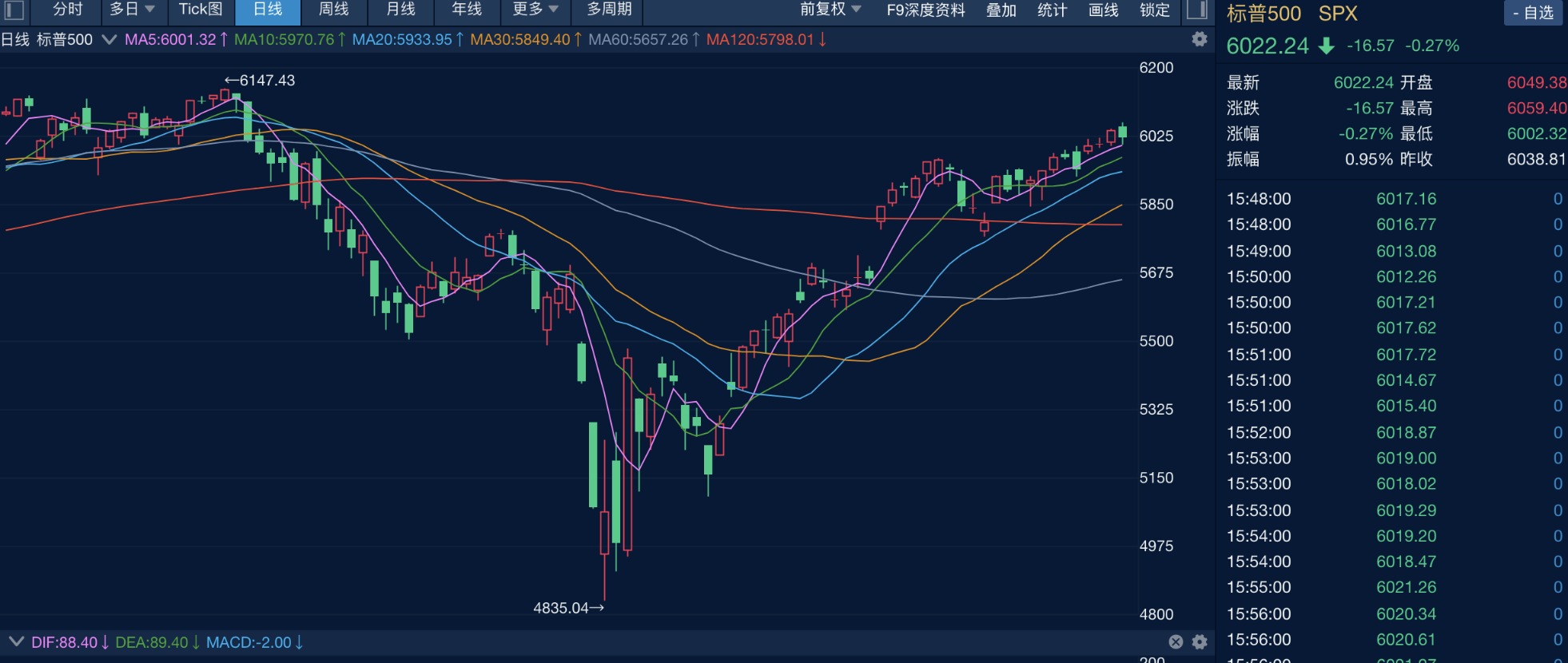
Market Overview - After experiencing policy fluctuations, market risk appetite has rebounded, with US stocks showing a strong recovery over the past month, bringing the S&P 500 index close to historical highs [1] - As of June 11, the S&P 500 index closed at 6022.24 points, reflecting an 18% rebound from early April, while the Nasdaq Composite index saw a 26% increase during the same period [1] Analyst Predictions - Several Wall Street investment banks have expressed optimistic expectations for the US stock market, with Goldman Sachs projecting a 10% increase in the S&P 500 index by the end of 2025, raising its target to 6500 points [4] - Citigroup has also raised its target for the S&P 500 index to 6300 points, anticipating a further 5% increase [4] - Analysts indicate that after the recent rise, valuations have reached historical highs, leading some investors to exit the market, suggesting limited upward potential for US stocks moving forward [4] Economic Factors - The Chief Investment Officer of Wells Fargo, Darrell Cronk, believes that the US stock market will experience more dramatic volatility this year compared to the previous two years, with significant fluctuations expected in the second half of 2025 [5] - Despite the lower-than-expected Consumer Price Index (CPI) data for May, core inflation is showing signs of recovery, and there are risks of inflation rising due to potential tariff costs being passed on to consumers [5] - The impact of the Trump tax cuts may also play a significant role in the US stock market, presenting both opportunities and risks for economic growth and valuations [5] Valuation Insights - The current price-to-earnings (P/E) ratio for the S&P 500 has risen to 27.82, indicating that US stocks are still relatively high in terms of valuation [6] - The expectation for S&P 500 earnings per share (EPS) growth is 7% for the second half of 2025 and 14% for 2026, although some analysts believe these projections may be overly optimistic given the potential impact of tariff policies [5][6] Asset Allocation Trends - There is a noticeable shift in global investment strategies from "dollar asset allocation" to "non-dollar asset reallocation," emphasizing the importance of diversified asset allocation [8] - The trend of "de-dollarization" is prompting countries to adjust their balance sheets, which may increase demand for Chinese assets, particularly in sectors like consumption, smart devices, robotics, and automation [8] Hong Kong Market Outlook - The Hong Kong market is expected to experience significant development opportunities, with relative valuations likely to rise and expansion opportunities on the horizon [9] - The Hang Seng Index's dynamic P/E ratio is currently at 10.37, while the Hang Seng Tech Index stands at 19.96, indicating that both indices have room for valuation recovery compared to major overseas indices [9]
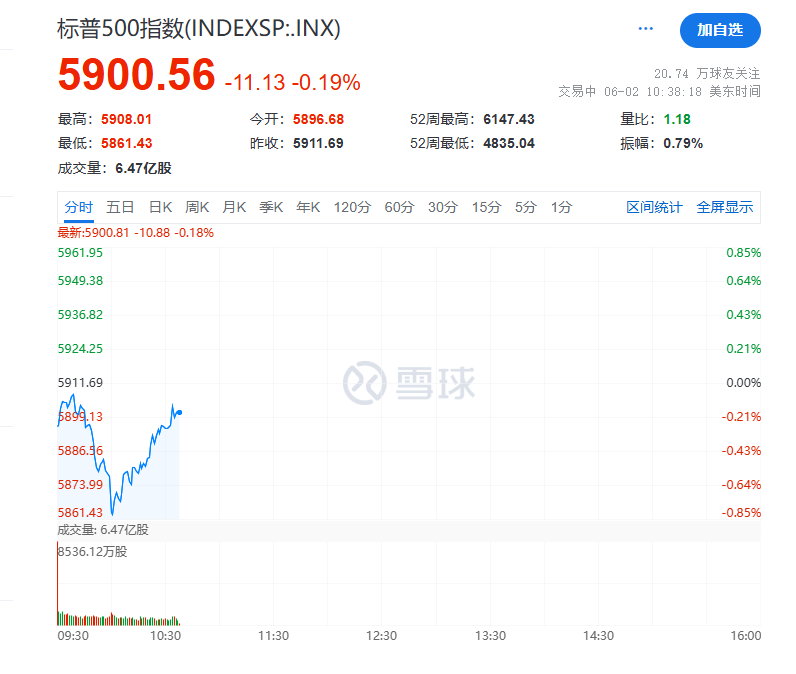
美股跌幅显著收窄,澳元涨1%
news flash· 2025-06-02 14:48
Group 1 - The U.S. stock market exhibited a V-shaped recovery in early trading, with the S&P 500 index narrowing its decline to less than 0.2% [1] - The Nasdaq index turned positive, while the Dow Jones Industrial Average's decline was reduced to less than 200 points at one point [1] - The semiconductor index showed a gain of 0.8% [1] Group 2 - The Australian dollar against the U.S. dollar experienced an increase of 1.0%, reaching a value of 0.6496 [1]
黄金突然狂飙!突破3300美元
21世纪经济报道· 2025-05-20 23:37
作 者丨李依农 杨雨莱 孙迟悦 编 辑丨和佳 江佩佩 深夜,金价再度狂飙! | | | | COMEXT .. | | | | | | --- | --- | --- | --- | --- | --- | --- | --- | | | | | GC.CMX | | | | | | 3295.6 | | 昨结 | | 3284.6 | 1 - 2 | | 3293.0 | | +11.0 | +0.33% | 总手 | | 1.01万 | 现手 | | 1 | | 最高价 | 3307.9 | 寺 එ | | 0 | | | 4438.0 | | 最低价 | 3291.9 | 仓 | | -18.1万 | | | 5625.0 | | 分时 | הת | | 信く | | EK | | | | 3328.3 | | | | | | 18:16 | 3.15% | | 3302.7 | | | | | | | 2.36% | | 3226.6 | | | | | | | 0.00% | | 3124 | | | | | | | -3.15% | | 05-15 | 05-16 | | 05-19 | | 05 ...