货币秩序重构

Search documents
中金2026年展望:维持超配中国股票与黄金
Guan Cha Zhe Wang· 2025-11-17 04:29
Core Viewpoint - The current gold bull market is likely not over, as its price increase and duration are still below historical comparisons from the 1970s and 2000s [1] Gold Market Insights - The continuation of the gold bull market is contingent on the Federal Reserve's monetary policy and the U.S. economy not entering a strong recovery phase characterized by "declining inflation and rising growth" [1] - There is a possibility that gold prices could exceed $5,000 per ounce next year if current trends persist [1] - Despite a clear bull market logic, gold is currently considered overvalued, suggesting a strategy of increasing allocation during dips rather than chasing prices [1] Stock Market Insights - Chinese stocks are expected to benefit from the AI technology wave and ample liquidity, with reasonable valuations [1] - Although year-end volatility may increase, there are no signals indicating a market top, thus maintaining an overweight position is recommended [1] - The U.S. stock market also has a bullish outlook, but concerns about high valuations and low elasticity during the dollar depreciation cycle suggest a neutral allocation [2] Fixed Income Insights - Chinese interest rates have room to decline, but the current valuation of Chinese bonds is high, limiting upside potential, leading to a recommendation for underweighting [2] - U.S. Treasuries benefit from the Fed's easing cycle but face mid-term inflation and debt risks, resulting in a neutral allocation recommendation [2] Market Top Indicators - The analysis of market tops for Chinese stocks and gold highlights the importance of economic and policy signals, with economic slowdowns or tightening policies often indicating market tops [4][5] - The difficulty in accurately timing market tops is noted, particularly due to the close timing of economic and market turning points [4] 2026 Market Outlook Factors - Four key factors that could alter the bullish trends for stocks and gold in 2026 include unexpected growth shifts, tightening policies, high valuations, and geopolitical shocks [6][7][8] - Current data does not support a significant improvement in economic growth for China and the U.S., suggesting that the bullish trends for stocks and gold are likely to continue [8] Asset Allocation Recommendations - The recommendation is to overweight Chinese stocks and gold, maintain a neutral position in U.S. stocks and bonds, and adjust commodity allocations to neutral [9] - The strategy emphasizes the importance of being prepared for potential market trend changes by increasing commodity allocations [9]
中金2026年大类资产展望:超配中国股票与黄金 标配美股与美债
智通财经网· 2025-11-17 00:40
Group 1 - The article discusses the importance of identifying market tops for Chinese stocks and gold, emphasizing that economic and policy signals are crucial for making accurate predictions [1][10][40] - It highlights that the U.S. stock market has a long bull market duration, while Chinese stocks experience more frequent bull-bear switches, making timing more critical for Chinese stocks [5][10] - The analysis indicates that gold's bull and bear markets are lengthy with low switching frequency, suggesting that identifying tops is also significant for gold [1][5] Group 2 - Four key factors are identified that could potentially alter the bull market trends for stocks and gold in 2026: growth direction, tightening policies, high valuations, and geopolitical shocks [2][39] - The current economic conditions in China are characterized as a "weak recovery," while the U.S. is moving towards "stagflation," which could impact the performance of stocks and gold differently [2][41] - The article suggests that while there are no immediate signals indicating a top for the current bull markets, high valuations for gold may lead to increased volatility in the future [26][36][40] Group 3 - The asset allocation recommendation includes overweighting Chinese stocks and gold, while maintaining a neutral position in U.S. stocks and bonds, and adjusting commodity exposure to neutral [3][4] - The rationale for these recommendations is based on the ongoing AI technology wave and liquidity conditions benefiting Chinese stocks, while gold is supported by the current monetary policy environment [3][4] - The article notes that despite potential volatility, there are no clear signals indicating a market top for Chinese stocks or gold at this time [25][36]

中金公司:建议乘势而上,继续超配中国股票与黄金
Sou Hu Cai Jing· 2025-11-17 00:40
Core Insights - The report from CICC highlights four key factors that could potentially alter the bullish trends of stocks and gold by 2026, including economic growth shifts, tightening policies, high valuations, and geopolitical shocks [1][2]. Group 1: Key Factors - **Economic Growth Shift**: Current weak recovery in China and a potential stagflation in the U.S. could change if policies lead to better-than-expected economic recovery, which may extend the stock bull market but negatively impact gold [1]. - **Tightening Policies**: Both China and the U.S. are currently in a loose policy environment. However, if the Federal Reserve slows down interest rate cuts due to inflation concerns, or if China's incremental policy pace slows, it could negatively affect both stock and gold bull markets [1]. - **High Valuations**: Chinese stocks are reasonably valued, but both gold and U.S. stocks are facing high valuation pressures, which could pose risks [1]. - **Geopolitical Shocks**: Unexpected geopolitical events could prolong the gold bull market but may adversely affect the stock bull market [1]. Group 2: Investment Recommendations - **Asset Allocation**: The company recommends an overweight position in Chinese stocks and gold, a standard allocation in U.S. stocks and bonds, and an adjustment of commodities to standard allocation while reducing Chinese bonds to underweight [2][3]. - **Chinese Stocks**: Benefiting from the AI technology wave and ample liquidity, Chinese stocks are seen as having reasonable valuations. Despite potential year-end volatility, there are no signals indicating a market peak, thus maintaining an overweight position is advised [3]. - **U.S. Stocks**: While the bullish logic applies to U.S. stocks, concerns over high valuations and low elasticity during a dollar depreciation cycle suggest a standard allocation is more prudent [3]. - **Commodities**: Commodities are recommended to be adjusted to standard allocation as they can hedge against changes in gold and stock trends while benefiting from post-liquidity recovery [3]. - **Gold**: Gold is expected to benefit from the Federal Reserve's easing cycle and monetary order reconstruction, but due to high valuations, an overweight position is suggested with a focus on buying on dips rather than chasing prices [3].

中金2026年展望 | 大类资产:乘势而上
中金点睛· 2025-11-17 00:08
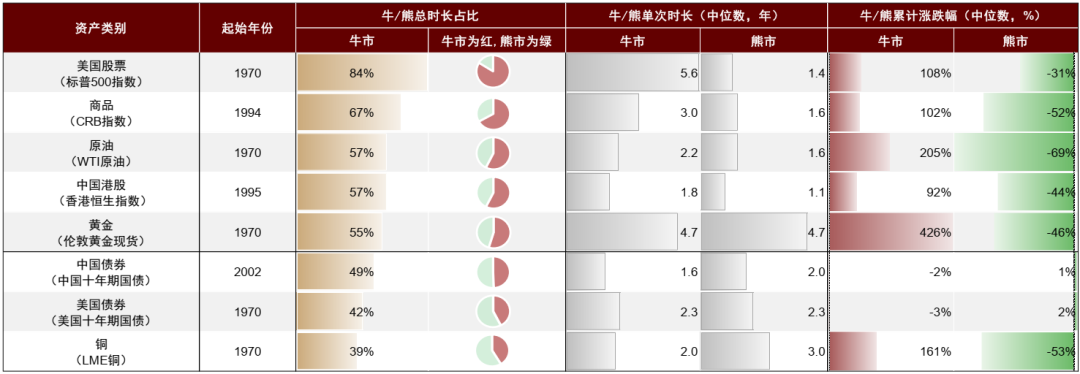
Group 1 - The core viewpoint of the article emphasizes the need to maintain an overweight position in gold and Chinese technology stocks while reducing exposure to commodities and dollar assets as the market trends evolve in 2026 [2][8] - The article identifies four key factors that could potentially alter the bullish trends of stocks and gold in 2026: economic growth turning, tightening policies, high valuations, and geopolitical shocks [4][42] - Historical analysis shows that the U.S. stock market has a long bullish phase, while Chinese stocks experience more frequent bull-bear switches, making the timing of market tops more critical for Chinese stocks [3][10] Group 2 - The article outlines the importance of accurately interpreting economic and policy signals to predict market tops, noting that signals from economic and policy dimensions are generally more reliable than those from liquidity, earnings, and valuation [14][28] - For gold, the article highlights that the key determinant for its market top is the Federal Reserve's policy, with historical data showing that four out of five gold bull markets peaked when the Fed began tightening [31][32] - The current economic environment is characterized by a weak recovery in China and a potential stagflation scenario in the U.S., which could support the continuation of the stock bull market while posing risks to the gold bull market [44]

中金研究 | 本周精选:宏观、策略、大类资产
中金点睛· 2025-11-08 01:07
Group 1 - The article discusses the new dynamics of the dual circulation model in the context of changing geopolitical conditions, emphasizing the importance of innovation and domestic demand to leverage China's scale economy advantages [5][7] - It highlights the recent trends in the macroeconomic environment, including the tightening of dollar liquidity and the Federal Reserve's plans to end quantitative tightening by December 2025, which may lead to a reintroduction of balance sheet expansion [7][9] - The article analyzes the movement of foreign capital, noting a divergence in investment patterns between Asia-Pacific and Europe-America, with a projected inflow of approximately 4500-6000 million HKD from public funds and insurance into the Hong Kong stock market [9][11] Group 2 - It points out the divergence between stock market performance and macroeconomic fundamentals, suggesting that increased risk appetite among investors may be a key driver of stock market support despite weak economic indicators [12][14] - The article outlines the long-term trends affecting global markets, including the restructuring of monetary order and the AI technology revolution, which are expected to influence asset performance in 2026 [14][16] - It concludes with a strategy recommendation to maintain an overweight position in Chinese stocks and gold while standardizing investments in U.S. stocks and bonds, anticipating potential shifts in economic indicators [14][16]

中金2026年展望 | 大类资产:乘势而上(要点版)
中金点睛· 2025-11-04 00:07
Core Viewpoint - The article discusses the significant fluctuations in global asset prices in 2025, attributing these changes to two long-term trends: the reconstruction of monetary order leading to a depreciation of the US dollar, and the AI technology revolution driving stock market growth. It suggests maintaining an overweight position in gold and technology stocks while underweighting dollar assets and commodities [3][4]. Summary by Sections Factors Changing Market Trends - Four main factors that could alter market trends are identified: high valuations, tightening policies, geopolitical shocks, and growth shifts. High valuations alone are not expected to trigger market adjustments without other driving factors [5][6][12]. - The article notes that Chinese stocks are currently at median valuation levels, suggesting potential for further upside if supported by fundamentals. In contrast, gold and US stocks are viewed as relatively expensive but still have strong long-term bullish narratives [6][12]. - Policy tightening is highlighted as a critical factor, with historical evidence showing that bull markets in stocks and gold often end during periods of tightening. The US inflation cycle is expected to peak around mid-2026, which could impact market dynamics [12][13]. - Geopolitical tensions are seen as beneficial for gold but detrimental to stocks, with historical data indicating that geopolitical events typically have short-lived impacts on asset prices [12][15]. - The article discusses the potential for economic growth shifts, emphasizing that if both the US and China experience stronger growth, it could favor stocks while challenging gold prices [12][16]. Asset Allocation Recommendations for 2026 H1 - Chinese Stocks: Maintain an overweight position, with a balanced style favoring technology growth stocks and cyclical value sectors as economic expectations improve [18]. - US Stocks: Maintain a neutral position, benefiting from macro liquidity and technology trends, while favoring Chinese stocks due to expected dollar depreciation [19]. - Chinese Bonds: Downgrade from neutral to underweight, as the bond market may face pressure from economic shifts and rising risk appetite [19]. - US Bonds: Maintain a neutral stance, with potential for yields to drop below 4%, but caution is advised due to rising inflation and fiscal expansion risks [19]. - Commodities: Upgrade from underweight to neutral, as they may benefit from improved economic conditions and serve as a hedge against geopolitical risks [19]. - Gold: Maintain an overweight position, supported by strong fundamentals such as monetary order reconstruction and rising geopolitical risks, with potential for prices to reach $5,000 per ounce [20].

王胜:明年行情更“灿烂”,中国资产最后全部都会被重估
申万宏源证券上海北京西路营业部· 2025-10-21 02:52
Core Viewpoint - The capital market in China is expected to experience a more optimistic outlook in 2026, with investor confidence translating into action despite external uncertainties [5][34]. Group 1: Market Outlook - The market outlook for the fourth quarter of 2025 is optimistic, suggesting that the performance will not be poor [7]. - The yield on equities is slightly higher than that of bonds, but this increase is still considered insufficient [8]. - A deep understanding of the long-term global competitive landscape will bolster investor confidence [10]. Group 2: Global Financial Dynamics - A downward trend in the US dollar is anticipated, which will likely lead to a systematic rise in global risk assets [13][15]. - The restructuring of the global monetary order highlights gold as a crucial asset allocation choice, even after significant price increases [18]. Group 3: Domestic Market Dynamics - The pricing power of leading domestic companies is increasing, reflecting a broader global restructuring of order [19]. - The focus should shift from quantity (GDP) to price factors, as improved pricing power among leading companies can enhance profitability [20][22]. Group 4: Investment Trends - High dividend yields remain attractive, with the current yield on the CSI 300 index still at the 90th percentile historically [31]. - The potential for revaluation exists for high ROE Chinese consumer brands, indicating long-term growth opportunities [32]. Group 5: Sector-Specific Insights - The artificial intelligence sector is expected to see significant developments in 2026, with many traditional industries likely to benefit from AI integration [29]. - The Hong Kong market is gaining attention due to its increased depth and inclusivity, making it a vital area for investment [28].

中金:A股资金面的五大变化和市场含义
中金点睛· 2025-07-20 23:21
Core Viewpoint - The A-share market is experiencing significant changes in its funding landscape, which are crucial for understanding market dynamics and future prospects [2][66]. Group 1: Changes in Funding Landscape - Change 1: The restructuring of the monetary order is leading to a shift in asset allocation, with Chinese assets benefiting relatively [5][11]. - Change 2: The proportion of individual investors in the A-share market has increased, indicating a shift in investor structure [23][24]. - Change 3: The growth in household savings, combined with an "asset shortage," is enhancing the relative attractiveness of the stock market [32][33]. Group 2: Market Dynamics and Investor Behavior - Change 4: The improvement in the funding structure and profitability effects is leading to a positive feedback loop in the market [51][56]. - Change 5: Many institutional investors have low positions in A-shares, which may present potential bullish opportunities [6][59]. Group 3: Market Valuation and Attractiveness - The current valuation of A-shares, in terms of equity risk premium and dividend yield, remains attractive compared to historical levels [37][40]. - The total market capitalization of A-shares relative to money supply and household savings is still at historically low levels, suggesting room for growth [44][45]. Group 4: Future Market Outlook - The mid-term market performance will be determined by fundamentals, but the influence of funding flows should not be underestimated, especially in the context of the current favorable funding changes [66]. - If the market continues to attract incremental capital, it may lead to an increase in risk appetite, benefiting various sectors, particularly those with high growth potential [67].