逆周期调节

Search documents
管涛:从兼顾内外均衡角度理解人民币汇率政策 | 马年大咖谈
Di Yi Cai Jing· 2026-02-18 00:23
Core Viewpoint - The appreciation of the RMB has significant tightening effects on the macro economy, especially in the context of a large trade surplus and net external debt position of the private sector in China [1][5]. Group 1: Economic Policy and Macro Environment - The Central Economic Work Conference emphasizes the continuation of proactive macro policies to stabilize employment, enterprises, markets, and expectations, aiming for qualitative and effective economic growth [1]. - The meeting highlights the need to maintain the RMB exchange rate at a reasonable and balanced level for the fourth consecutive year, indicating the importance of external and internal economic balance [1][2]. Group 2: Trade Surplus and External Balance - China's current account surplus reached a record $734.9 billion last year, a 73.4% increase year-on-year, with a surplus-to-GDP ratio of 3.5%, up 1.3 percentage points from the previous year [1]. - The trade surplus is driven by strong export competitiveness and a stable position in global supply chains, despite a significant drop in exports to the U.S. by 20% [2][3]. Group 3: Market Dynamics and Exchange Rate Management - The decline in China's export market share to 14.36% and a drop in global import market share to 9.69% indicate challenges in maintaining external competitiveness [3]. - The shift from net external debt to net external assets in the private sector means that RMB appreciation could lead to a reduction in private sector foreign exchange income and assets, complicating exchange rate management [4][5]. Group 4: Policy Recommendations - The report suggests a multi-faceted approach to manage exchange rates, including deepening market-oriented reforms and enhancing monitoring of cross-border capital flows to prevent excessive appreciation of the RMB [5]. - It advocates for targeted fiscal and monetary policies to stimulate domestic demand and promote a consumption-driven economic model, aiming to balance savings and investments [5].
中央财办分管日常工作的副主任、中央农办主任韩文秀,发表署名文章
Zhong Guo Ji Jin Bao· 2026-02-16 05:31
Core Viewpoint - The article emphasizes the importance of maintaining stability while seeking progress and improving quality in economic work, aiming for a good start to the "15th Five-Year Plan" [3][4]. Group 1: International and Domestic Situations - In 2025, the economic work will be reviewed, highlighting achievements during the "14th Five-Year Plan" and analyzing both international and domestic challenges [3][4]. - Internationally, geopolitical tensions and economic instability are increasing, with predictions of a decline in global trade growth from 2.4% in 2025 to 0.5% in 2026 [5]. - Domestically, there are significant challenges such as weak consumer demand and investment growth, with per capita consumer spending growth lagging behind disposable income growth [6]. Group 2: Economic Support and Reform - The article outlines five essential principles for economic work, including fully tapping economic potential and combining policy support with reform innovation [8][9]. - It stresses the need for a balanced approach between market freedom and government regulation to foster a healthy economic environment [10]. Group 3: Investment and Human Capital - There is a call for a dual focus on investing in physical assets and human capital, emphasizing the importance of improving living standards and developing human resources [11][12]. - The need for investment in education, healthcare, and skills training is highlighted to enhance overall productivity and economic resilience [12]. Group 4: Key Economic Tasks for 2026 - The article outlines key tasks for 2026, including expanding domestic demand, promoting technological and industrial innovation, and deepening reforms to stimulate high-quality development [13][14][15]. - It emphasizes the importance of improving the business environment and enhancing cooperation in international trade [16]. Group 5: Social Welfare and Risk Management - There is a strong focus on improving people's livelihoods, with policies aimed at stabilizing employment and enhancing social services [17]. - The article also addresses the need for effective risk management in key sectors, particularly in real estate and local government debt [18].
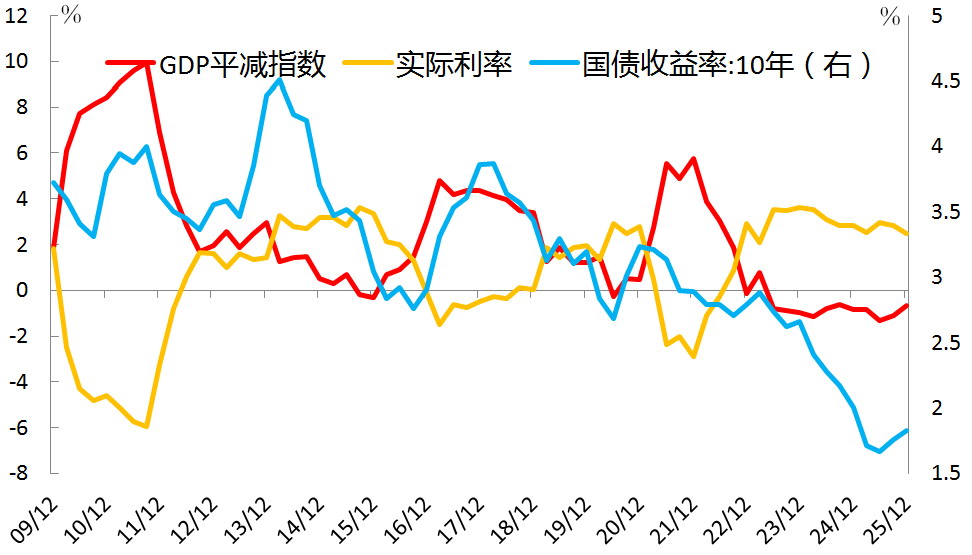
建信期货国债日报-20260213
Jian Xin Qi Huo· 2026-02-13 01:30
1. Report Information - Report Name: Treasury Bond Daily Report [1] - Date: February 13, 2026 [2] - Researchers: He Zhuoqiao, Huang Wenxin, Nie Jiayi [3] 2. Core Viewpoints - The current fundamental situation is weak, with the January PMI falling more than seasonally. In February, affected by the Spring Festival, the economic indicators are expected to decline further. However, structural interest rate cuts have been implemented, and the central bank's bond - buying scale is low, so the market's expectation of monetary easing is not strong. The planned issuance of local bonds in the first quarter is high, causing concerns about supply pressure [11]. - The current yield level of 10 - year treasury bonds around 1.8% does not fully price in the potential easing space. There is support from allocation demand at the beginning of the year, and the central bank is actively maintaining the money market, so the upside space of interest rates is limited. In February, the bond market is in a situation of mixed long - and short - term factors and may continue to fluctuate within a range [11][12]. - Before the Spring Festival, the central bank will actively maintain the cross - festival money market, and the supply pressure of government bonds is controllable, so the market environment is relatively warm. After the Spring Festival, the supply pressure will increase. Although the return of cash will supplement liquidity, the central bank usually withdraws funds, which may be unfavorable for short - term bonds. The market is more likely to bet on holiday economic data and important meetings and policies in March, and long - term bonds may be more advantageous. This week is the last trading week before the Spring Festival, trading is expected to be light, and short - term bonds should have stronger support [12] 3. Summary by Directory 3.1 Market Review and Operation Suggestions - **Market Conditions on the Day**: The money market improved slightly but remained in a tight balance. Treasury bond futures fluctuated within a narrow range [8]. - **Interest Rate Bonds**: The yields of major interest rate bonds in the inter - bank market declined across the board, with a larger decline in long - term interest rates. By 16:30, the yield of the 10 - year treasury bond active bond 250016 was reported at 1.774%, a decrease of 1.2bp [9]. - **Money Market**: The inter - bank money market improved marginally but remained in a tight balance. The net reverse repurchase injection in the open market was 448 billion yuan. The inter - bank money sentiment index was high in the morning and slightly declined in the afternoon. The overnight DR in the inter - bank deposit market fluctuated narrowly around 1.37%, the 7 - day funds rate fell about 1.3bp to around 1.53%, and the medium - and long - term funds were stable. The 1 - year AAA certificate of deposit rate fluctuated narrowly around 1.6% [10] 3.2 Industry News - The People's Bank of China released the "Fourth - Quarter 2025 China Monetary Policy Implementation Report" on February 10. The report proposed that the central bank will conduct counter - cyclical and cross - cyclical adjustments, support the good start of the "15th Five - Year Plan", and continue to implement a moderately loose monetary policy. It also introduced three ways of coordination between monetary policy and fiscal policy [13]. - Japanese Prime Minister Takamachi Sanae said she is open to dialogue with China. The Chinese Foreign Ministry Spokesperson Lin Jian responded that such "dialogue" is unacceptable [13]. - US President Trump said he is considering sending another aircraft carrier strike group to the Middle East in case the negotiation with Iran fails. The US and Iran restarted negotiations in Oman last Friday, and the second - round negotiation is expected to be held next week [14]. - Before the Spring Festival, the competition among banks for deposits has heated up again. Small and medium - sized banks mainly attract customers by raising the interest rates of specific deposit products, while large banks use methods such as giving points and reward vouchers. Multiple institutions and industry insiders believe that the matured time - deposit funds in 2026 are likely to circulate within the banking system and flow more to low - risk assets such as bank wealth management, money market funds, and insurance [14] 3.3 Data Overview - **Treasury Bond Futures Market**: The report provides trading data of treasury bond futures on February 12, including the previous settlement price, opening price, closing price, settlement price, change, change percentage, trading volume, open interest, and change in open interest of various contracts [6] - **Money Market**: The report includes information such as the SHIBOR term structure change, SHIBOR trend, change in the weighted average interest rate of inter - bank pledged repurchase, and change in the pledged repurchase rate of inter - bank deposits [29][33] - **Derivatives Market**: The report shows the Shibor3M interest rate swap fixing curve (mean) and the FR007 interest rate swap fixing curve (mean) [35]
中国宏观经济月度分析报告202601:烽火科技纠缠,时间藏一陬-20260212
中采咨询· 2026-02-12 05:56
Economic Indicators - The manufacturing PMI for January 2026 is 49.3%, a decrease of 0.8 percentage points from the previous month, indicating a slowdown in manufacturing activity[4] - The CPI growth rate for January 2026 is 0.2%, primarily due to the high base effect from the previous year's Spring Festival[6] - The PPI for January 2026 is -1.4%, with a narrowing decline of 0.5 percentage points, reflecting improved internal structure and demand driven by technology[6] Trade and Investment - In December 2025, China's total imports and exports amounted to $601.42 billion, with exports increasing by 6.6% and imports rising by 5.7% year-on-year[20] - The M1 growth rate in December 2025 fell to 3.8%, while M2 grew by 8.5%, leading to an expanding M1-M2 gap of -4.7%[34] - The real estate market shows signs of recovery, with new home prices averaging 17,114 RMB per square meter, a month-on-month increase of 0.18%[48] Sector Performance - The service sector's business activity index has stabilized around 49.5% for three consecutive months, supported by financial activities and holiday-related consumption[4] - The consumer goods sector experienced a decline of 2.2 percentage points, primarily due to a drop in clothing orders[27] - The equipment sector shows resilience, with significant demand for computers and automation equipment, indicating a positive trend in industrial investment[28]
建信期货国债日报-20260212
Jian Xin Qi Huo· 2026-02-12 01:21
1. Report Information - Report Name: Treasury Bond Daily - Date: February 12, 2026 - Research Team: Macro - Financial Team - Researchers: He Zhuoqiao, Huang Wenxin, Nie Jiayi [3] 2. Investment Rating - No investment rating information is provided in the report. 3. Core Viewpoints - The current situation of the bond market is a mix of long and short factors, and it is expected to continue to fluctuate within a range in February. Before the Spring Festival, the market environment is relatively warm, and after the festival, the supply pressure will increase. Long - term bonds may be more favorable. In the last trading week before the festival, trading is expected to decline, and short - term bonds should have stronger support [11][12] 4. Summary by Directory 4.1 Market Review and Operation Suggestions - **Market Performance**: The money market remained in a tight balance, but institutional allocation demand continued to improve. Coupled with the increasing risk - aversion sentiment approaching the long holiday, treasury bond futures closed slightly higher across the board. The yields of major term interest - bearing bonds in the inter - bank market showed a pattern of short - term increase and long - term decrease, with the decline of long - term active bonds around 1bp. The inter - bank money market tightened, with a net reverse - repurchase injection of 403.5 billion yuan in the open market. The overnight DR rate in the inter - bank deposit market fluctuated narrowly around 1.37%, the 7 - day fund rate dropped about 1.9bp to around 1.54%, and the 1 - year AAA certificate of deposit rate fluctuated narrowly around 1.6% [8][9][10] - **Conclusion**: Although the current fundamentals are weak, the expected market easing is not strong. The large supply pressure of local bonds in the first quarter is a concern, but the current yield level of 10 - year treasury bonds around 1.8% does not price in the possible future easing. With the support of allocation demand at the beginning of the year and the central bank's positive attitude towards protecting the money market, the upward space of interest rates should be limited [11][12] 4.2 Industry News - The People's Bank of China released the "China Monetary Policy Implementation Report for the Fourth Quarter of 2025" on February 10, stating that it will continue to implement a moderately loose monetary policy and introduce three ways of coordination between monetary and fiscal policies [13] - Japanese Prime Minister Takamachi Sanae expressed her willingness to have dialogue with China, but the Chinese Foreign Ministry spokesman responded that such a "dialogue" with confrontation actions was unacceptable [13] - US President Trump said he was considering sending another aircraft carrier strike group to the Middle East in case the negotiation with Iran fails. The second round of US - Iran talks is expected to be held next week [14] - During the "good start" deposit - attracting competition of banks before the Spring Festival, small and medium - sized banks mainly attract customers by raising the interest rates of specific deposit products, and large banks use methods such as giving points and reward rebates. The due deposit funds are likely to circulate within the banking system and flow more into low - risk assets [14] 4.3 Data Overview - **Treasury Bond Futures Market**: The report provides data on the trading of various treasury bond futures contracts on February 11, including pre - settlement price, opening price, closing price, settlement price, price change, price change rate, trading volume, open interest, and change in open interest. It also mentions the inter - period spread and inter - variety spread of the main treasury bond futures contracts [6] - **Money Market**: Relevant data on the money market are presented, such as the SHIBOR term structure change, SHIBOR trend, inter - bank pledged repurchase weighted interest rate change, and inter - bank deposit pledged repurchase interest rate change [29][33] - **Derivatives Market**: The Shibor3M interest rate swap fixing curve (mean) and FR007 interest rate swap fixing curve (mean) are provided [35]
央行Q4货政报告点评:灵活高效运用降准降息等多种政策工具
KAIYUAN SECURITIES· 2026-02-11 03:14
Economic Outlook - The report indicates that the economy is expected to stabilize and improve, supported by strong economic fundamentals and new growth drivers, with R&D investment intensity reaching 2.8%, surpassing the OECD average[3] - The CPI for 2025 is projected to remain flat year-on-year, while the PPI has increased for three consecutive months, indicating positive changes in price dynamics[4] Monetary Policy - The central bank is prepared to implement interest rate cuts and reserve requirement ratio reductions, emphasizing the need to manage the timing and intensity of these policies[5] - Structural monetary policies will focus on supporting key areas such as technology, green finance, and elderly care finance, with a continued emphasis on expanding domestic demand and supporting small and micro enterprises[5] Financial Market Dynamics - The report highlights the importance of deepening interest rate marketization reforms to enhance the transmission channels of monetary policy, with a focus on maintaining low financing costs for society[6] - The central bank remains vigilant against potential exchange rate risks, emphasizing a comprehensive approach to stabilize market expectations[6] Liquidity and Financial Stability - The report discusses the limited impact of deposit outflows from households and enterprises on overall financial liquidity, as the total liquidity indicators have shown steady growth[6] - The asset management product growth rate reached its highest level since the implementation of new regulations, driven by a rapid decline in deposit rates post-2024[6] Risk Considerations - Potential risks include economic downturns exceeding expectations and policy execution falling short of anticipated outcomes[7]
央行最新报告定调 适度宽松货币“不换挡”!
Bei Jing Shang Bao· 2026-02-10 14:58
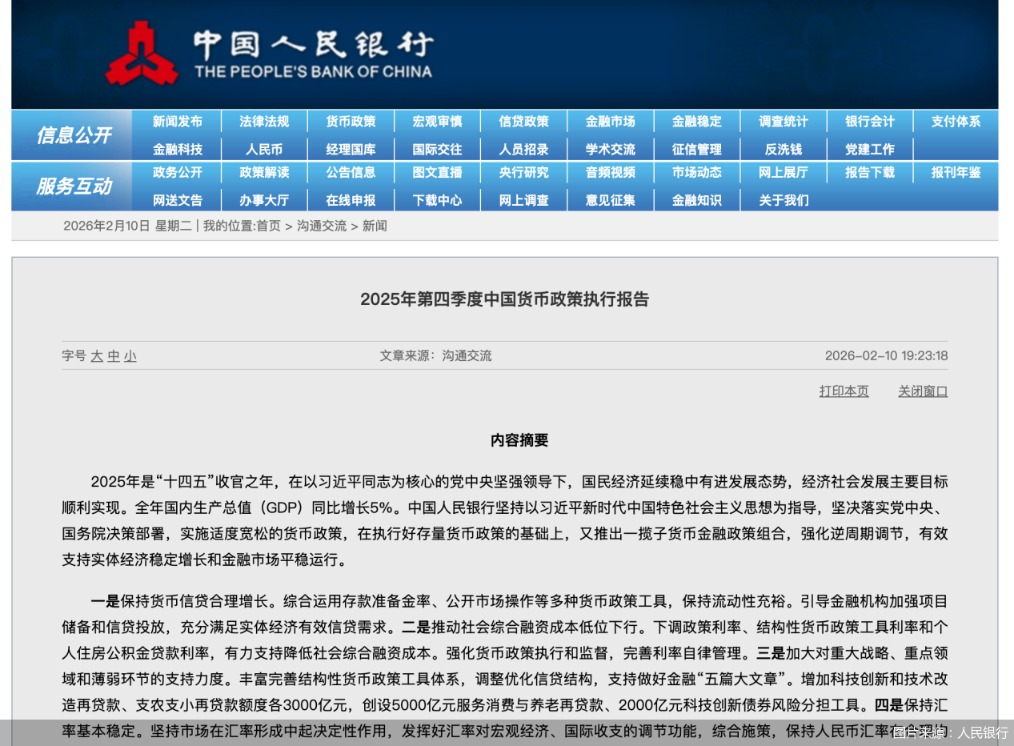
Core Viewpoint - The People's Bank of China (PBOC) is committed to implementing a moderately loose monetary policy to support stable economic growth and financial market stability in 2025, with a GDP growth target of 5% for the year [1]. Monetary Policy Implementation - In 2025, the PBOC employed various monetary policy tools, including reserve requirement ratios and open market operations, to maintain ample liquidity and support effective credit demand from the real economy [3]. - The PBOC aims to lower the overall financing costs in society by reducing policy interest rates and specific loan rates, thereby enhancing support for key sectors and strategic areas [3]. Financial Indicators - By the end of 2025, the total social financing scale and broad money supply (M2) grew by 8.3% and 8.5% year-on-year, respectively, significantly outpacing the nominal GDP growth rate [4]. - The new corporate loan and personal housing loan rates were approximately 3.1% in December 2025, indicating a decline in financing costs [4]. - Key loan categories such as technology loans, green loans, and loans for the elderly industry saw significant year-on-year growth rates, with technology loans increasing by 11.5% and loans for the elderly industry by 50.5% [4]. Future Policy Directions - The PBOC plans to continue its moderately loose monetary policy, focusing on promoting stable economic growth and reasonable price recovery while adjusting the implementation of policies based on domestic and international economic conditions [5]. - There will be an emphasis on improving the interest rate adjustment framework and enhancing the transmission mechanism of market interest rates to lower financing costs further [6]. - The PBOC aims to maintain the stability of the RMB exchange rate while expanding financial support for key areas such as domestic demand, technological innovation, and small and micro enterprises [6].

中国人民银行报告:继续实施好适度宽松的货币政策
Xin Hua Wang· 2026-02-10 13:25
Core Viewpoint - The People's Bank of China (PBOC) will continue to implement a moderately accommodative monetary policy, focusing on promoting stable economic growth and reasonable price recovery, while adjusting the policy's intensity, rhythm, and timing based on domestic and international economic conditions [1][2]. Group 1: Monetary Policy Implementation - The PBOC's report for the fourth quarter of 2025 indicates that it will introduce a comprehensive monetary and financial policy package to strengthen counter-cyclical adjustments, effectively supporting stable growth in the real economy and smooth operation of financial markets [1]. - By the end of 2025, the total financial volume is expected to maintain rapid growth, with the social financing scale and broad money supply (M2) increasing by 8.3% and 8.5% year-on-year, respectively, significantly outpacing nominal GDP growth [1]. Group 2: Credit Structure and Support - After adjusting for local government debt impacts, RMB loans are projected to grow by around 7%, indicating sustained strong credit support [1]. - The credit structure continues to optimize, with technology loans, green loans, inclusive loans, elderly care industry loans, and digital economy industry loans growing by 11.5%, 20.2%, 10.9%, 50.5%, and 14.1% year-on-year, respectively, all exceeding the overall loan growth rate [1]. Group 3: Future Monetary Tools and Support - In 2025, the PBOC increased the quotas for re-loans for technological innovation and agricultural support by 300 billion yuan each, established 500 billion yuan for consumer services and elderly care re-loans, and created a 200 billion yuan risk-sharing tool for technology innovation bonds [2]. - The PBOC aims to effectively implement various structural monetary policy tools, enhance financial support for key areas such as domestic demand expansion, technological innovation, and small and micro enterprises, while also improving macro-prudential and financial stability management tools [2].
央行:继续实施好适度宽松的货币政策
21世纪经济报道· 2026-02-10 12:00
Core Viewpoint - The article emphasizes the implementation of a moderately loose monetary policy in China, aimed at supporting stable economic growth and addressing challenges in the current external environment while ensuring financial stability [1][4]. Group 1: Monetary Policy Implementation - The People's Bank of China (PBOC) has adopted a series of monetary policies to maintain reasonable growth in money and credit, ensuring liquidity is abundant to meet the effective credit demand of the real economy [1][6]. - The PBOC has reduced policy interest rates and housing provident fund loan rates to lower the overall financing costs in society, thereby supporting economic stability [2][6]. - The total social financing scale and broad money supply (M2) grew by 8.3% and 8.5% year-on-year, respectively, significantly outpacing the nominal GDP growth rate [3]. Group 2: Support for Key Areas - The PBOC has increased the quotas for re-loans to support technological innovation and agricultural financing by 300 billion yuan each, and created 500 billion yuan for consumer services and elderly care loans [2]. - Financial support for key sectors has been enhanced, with significant year-on-year growth in loans for technology (11.5%), green projects (20.2%), and the elderly care industry (50.5%) [3]. Group 3: Financial Stability and Risk Management - The PBOC has established a macro-prudential and financial stability committee to improve the management and stability of the financial system, focusing on risk resolution in key institutions and regions [2][5]. - The Chinese yuan has maintained basic stability against the US dollar, with a closing exchange rate of 6.9890 yuan at the end of 2025, appreciating by 4.4% compared to the end of 2024 [3]. Group 4: Future Outlook - The PBOC will continue to implement a moderately loose monetary policy, focusing on stabilizing economic growth and ensuring reasonable price recovery, while adjusting policies based on domestic and international economic conditions [6]. - The emphasis will be on balancing short-term and long-term goals, supporting the real economy, and maintaining the health of the banking system [5][6].
节后市场波动加大
Qi Huo Ri Bao· 2026-02-10 06:06
Group 1 - The core viewpoint of the articles indicates that the bond market is stabilizing, driven by monetary policy adjustments and market conditions, while the real estate sector continues to face challenges [1][4][5] Group 2 - In early 2025, fixed asset investment decreased by 3.8% year-on-year, primarily due to declines in real estate development and infrastructure investment, with manufacturing investment showing a slight increase of 0.6% [2] - Real estate development investment fell by 17.2% year-on-year, and the sales of commercial housing dropped by 12.6%, indicating ongoing instability in the real estate market [2] - The consumer price index (CPI) rose by 0.8% year-on-year in December 2025, marking a 34-month high, while the producer price index (PPI) decreased by 1.9%, suggesting gradual improvement in domestic demand [2] Group 3 - As of the end of January, the bond market's outstanding scale exceeded 197.71 trillion yuan, with net financing in January amounting to 14,189 billion yuan, showing a slight year-on-year decline [4] - The central bank indicated that there is still room for further interest rate cuts and reserve requirement ratio reductions in 2026, aiming for a moderately loose monetary policy [4][5] - The central bank's net bond purchases in January amounted to 1,000 billion yuan, contributing to a generally loose market liquidity ahead of the Spring Festival [4][5] Group 4 - Looking ahead, the bond market is expected to stabilize before the holiday, with potential fluctuations and increased volatility in the long-end bond market after the holiday [6]