风格再平衡

Search documents
风格再平衡引发热议公募再拾“哑铃型配置”
Zhong Guo Zheng Quan Bao· 2025-11-05 20:08
Core Viewpoint - The A-share market is experiencing increased volatility, with a focus on style rebalancing as several well-known balanced fund managers have proactively adjusted their holdings in anticipation of market changes [1] Group 1: Investment Opportunities - Fund managers are identifying investment opportunities in sectors such as engineering machinery, chemicals, and non-ferrous metals, with some products in these sectors at the bottom of their price ranges [1][4] - Notable companies like China Ping An, Wanhua Chemical, XCMG, Sany Heavy Industry, and Luoyang Molybdenum have been added to the heavy stock lists or continuously increased in holdings by various fund managers [1][2] - The resource sector, particularly non-ferrous metals, has attracted significant attention, with funds increasing their positions in companies like Zijin Mining and Huaxi Nonferrous [3] Group 2: Fund Manager Actions - China Ping An has gained favor among several balanced and growth fund managers, with total holdings in various funds reaching significant values, such as 794 million yuan and 358 million yuan [2] - Fund managers like Zhou Weiwen have increased allocations to non-ferrous metals, engineering machinery, and chemicals, anticipating revenue growth as overseas demand recovers [4] - The mechanical sector has also seen increased interest, with funds like Morgan Emerging Power adding XCMG to their top holdings [2] Group 3: Market Trends and Strategies - The recent shift towards value and cyclical stocks is seen as a response to the high valuation of technology growth stocks, leading to a balanced investment strategy to mitigate risks [1][7] - ETFs tracking various indices have seen significant net inflows, indicating a market trend towards lower valuation and dividend-paying assets [6] - The market is expected to undergo a style switch, with institutions likely to adjust their portfolios in November to prepare for the upcoming spring market [6][7]





财信证券宏观策略周报(11.3-11.7):风格再平衡,关注低估且滞涨方向-20251102
Caixin Securities· 2025-11-02 10:57
Group 1 - The report emphasizes a style rebalancing in the market, focusing on undervalued and stagnant sectors as institutional funds tend to take profits from high-valuation stocks and shift towards low-valuation sectors during the fourth quarter [4][7][16] - The report highlights that the manufacturing PMI for October decreased by 0.8 percentage points to 49.0, indicating a contraction in the manufacturing sector, with both production and new orders indices showing declines [8][9] - The report notes that profits of industrial enterprises above designated size increased by 3.2% year-on-year from January to September, with September alone seeing a profit growth of 21.6%, driven by high-tech manufacturing and equipment manufacturing sectors [9][10][11] Group 2 - The report identifies key investment areas, including high-dividend large-cap blue chips such as banks and utilities, new consumption sectors like health and cultural tourism, and sectors benefiting from the "anti-involution" policy such as steel and photovoltaic [4][16] - The report discusses the ongoing reforms in the capital market, particularly the deepening of the ChiNext reform and the enhancement of the Beijing Stock Exchange's role as a capital market hub [12] - The report mentions the positive developments in US-China trade negotiations, which may enhance market resilience and provide a favorable environment for A-share performance [13][14]
独家调研|公募把脉A股 热门板块机遇与风险研判
天天基金网· 2025-10-30 10:23
Core Viewpoint - The overall sentiment among fund companies regarding the A-share market is optimistic or moderately optimistic, driven by policy support, ample liquidity, a clear technology theme, and a phase of external environment improvement, suggesting a potential for a fluctuating upward trend in the market [2][10]. Market Outlook - Most fund companies expect the market to maintain a fluctuating upward trend, with a short-term neutral outlook and a long-term bullish perspective, predicting a breakthrough of 4200 points next year, with a fluctuation lower limit of 3500-3600 points [2][10]. - There is a structural bull market, with traditional sectors having a reduced impact on the index, necessitating a focus on industrial trends for investment [2][10]. Cautious Sentiment - Some public funds hold a neutral view on the short-term market, expressing concerns about weak economic fundamentals and the difficulty of improving risk appetite, which may lead to increased market volatility [3][10]. - The core driving force for the A-share market in Q4 is expected to be liquidity easing, but the difficulty in enhancing risk appetite is noted [3][10]. Sector Analysis - The semiconductor sector is widely favored by public funds, with expectations of a cyclical recovery driven by self-sufficiency policies. However, a few funds express caution regarding short-term performance due to valuation concerns and geopolitical risks [4][10][11]. - The computing power sector, driven by the AI wave, is highlighted as a key investment area, with sustained high demand for global computing power. Some funds maintain a neutral or cautious stance on short-term performance, warning of potential overheating risks [6][10]. - Gold is viewed as having long-term allocation value, although some institutions are cautious about short-term trends due to concerns over crowded trades and technical overbought conditions [6][10]. - In the non-ferrous metals sector, there is optimism about continued industry prosperity, particularly for copper and aluminum, but some institutions caution against short-term risks such as rapid price increases and macroeconomic uncertainties [7][11]. Conclusion - Overall, while public funds maintain a strategic optimism as the Shanghai Composite Index surpasses 4000 points, they remain vigilant about structural risks, advising investors to consider valuation, industry prosperity, and policy rhythms when engaging with popular sectors [11].


红利资产年末“日历效应”有望浮现,大盘成长ETF(159203)今日涨幅超2%,机构:不是风格切换而是风格再平衡
Sou Hu Cai Jing· 2025-10-21 03:20
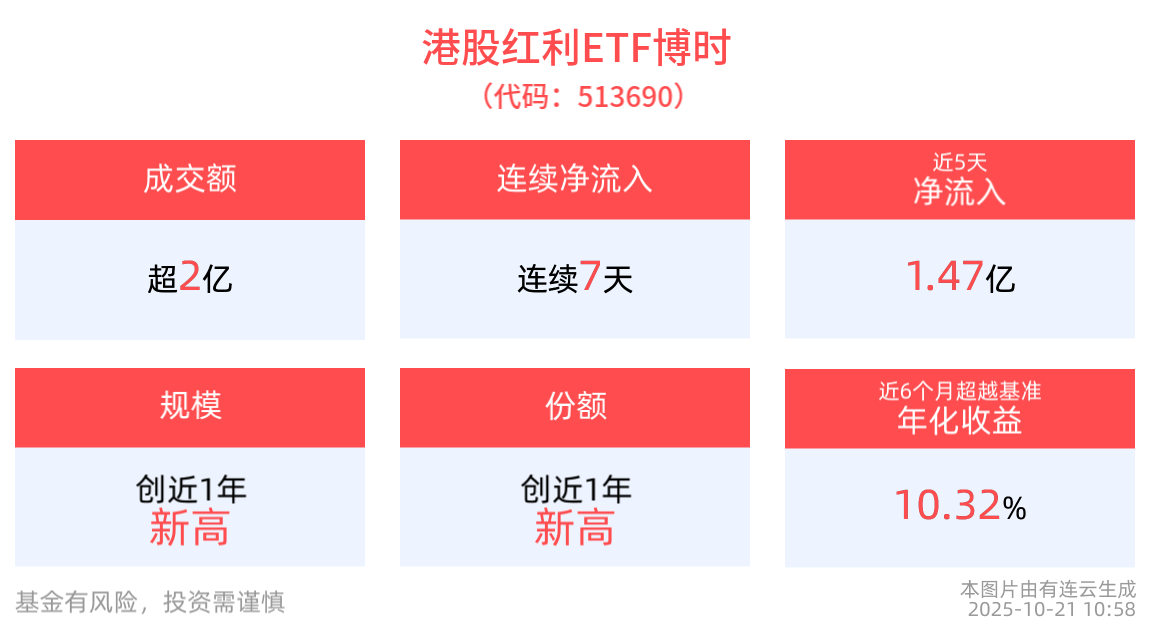
Core Insights - The Hang Seng High Dividend Yield Index increased by 0.22% as of October 21, 2025, with notable gains from stocks like Bosideng (up 6.22%) and China Pacific Insurance (up 3.15%) [3] - The CSI Dividend Index fell by 0.38%, with Wujin Stainless Steel leading gains at 5.51% while Yanzhou Coal Mining led losses at 4.45% [6] - The A-share market opened slightly higher but faced a pullback, with major indices closing up but showing a bearish candlestick pattern [7] Market Performance - The Hang Seng High Dividend ETF (513690) rose by 0.45%, reaching a latest price of 1.11 CNY, with a 1-week cumulative increase of 3.09% [3] - The Dividend ETF (515890) decreased by 0.47%, with a latest price of 1.48 CNY and a 1-week cumulative increase of 1.78% [6] - The Large Cap Growth ETF (159203) surged by 1.94%, with a latest price of 1.31 CNY and a 3-month cumulative increase of 22.32% [6] Economic Data - The actual GDP growth for Q3 2025 was 4.8%, down from 5.2% in the previous quarter, indicating increased internal economic pressure [7] - Retail sales in September grew by 3%, a decrease from 3.4% previously, while fixed asset investment saw a decline of 0.5% year-on-year [9] Investment Trends - There is a noted calendar effect for dividend assets entering Q4, with significant excess returns observed in December, January, and April [8] - The market is currently experiencing a style shift, with a focus on "countermeasures + hedging" themes due to external uncertainties [8] Fund Performance - The latest scale of the Hang Seng High Dividend ETF reached 5.628 billion CNY, marking a one-year high, with a total of 5.134 billion shares outstanding [10] - The fund has seen continuous net inflows over the past week, with a peak single-day net inflow of 49.21 million CNY, totaling 180 million CNY in net inflows [10]
永赢基金王乾:执行价值逆向策略 挖掘长周期资产
Zhong Guo Zheng Quan Bao· 2025-10-17 00:01
Core Viewpoint - The article emphasizes the importance of value investing and the need for a stable investment style amidst market fluctuations, highlighting the perspective of Wang Qian, a fund manager at Yongying Fund [1][3]. Group 1: Investment Philosophy - Wang Qian advocates for a long-term value investment approach, focusing on buying high-quality assets at reasonable prices to ensure sufficient safety margins for fund holders [1][2]. - The evaluation of high-quality assets involves multiple dimensions, with strong competitiveness being a key criterion, varying by industry [2]. - Wang Qian prioritizes safety margins over blindly following "good companies," emphasizing the importance of valuation discipline [2]. Group 2: Market Strategy - Wang Qian combines a contrarian strategy with long-term holding, suggesting that this approach can be effective despite potential short-term sacrifices in relative returns [2]. - He acknowledges the current dominance of technology growth styles but maintains a rational outlook, emphasizing the need for patience and adherence to established strategies [3]. - The rise of index investing has led to increased investor demand for clarity and stability in fund strategies, which Wang Qian recognizes as essential for building long-term trust with clients [3]. Group 3: Market Outlook - Following the "9.24" market rally in 2024, liquidity in the market has improved, leading to a positive wealth effect and potential opportunities in cyclical and domestic demand assets [3][4]. - The "anti-involution" policies have positively impacted midstream industries like photovoltaics and lithium batteries, promoting price recovery and improving corporate profits and household incomes [4]. - Wang Qian's portfolio is balanced across various sectors, including chemicals, food and beverages, non-bank financials, and agriculture, indicating a strategic positioning for economic recovery [4]. Group 4: Fund Development - The Yongying Value Return Mixed Fund, led by Wang Qian, was officially launched on October 13, with the firm committing 10 million yuan to subscribe to Class A shares during the fundraising period [5].
永赢基金王乾: 执行价值逆向策略 挖掘长周期资产
Zhong Guo Zheng Quan Bao· 2025-10-16 20:12
Core Viewpoint - The article discusses the investment philosophy of Wang Qian, a fund manager at Yongying Fund, who emphasizes value investing and maintaining a stable investment style despite market fluctuations [1][3]. Group 1: Investment Philosophy - Wang Qian adheres to a long-term value investment perspective, focusing on buying high-quality assets at reasonable prices to provide sufficient safety margins for the portfolio [1][2]. - The evaluation of high-quality assets includes multiple dimensions, with a strong competitive edge being a key criterion. Different industries may have varying sources of competitiveness [2]. - Wang Qian prioritizes safety margins when purchasing assets, indicating a disciplined approach to valuation and a willingness to wait for better entry points when assets are overvalued [2]. Group 2: Market Conditions and Strategies - Despite the current dominance of technology growth styles in the market, Wang Qian maintains a rational and objective mindset, believing that style rotation is a natural market phenomenon [3]. - The rise of domestic index investing has led to increased investor demand for clarity and stability in fund strategies, which Wang Qian recognizes as essential for building long-term trust with clients [3]. - Wang Qian's portfolio is balanced across various sectors, including chemicals, food and beverages, non-bank financials, and agriculture, reflecting a strategy that anticipates a shift from cyclical to domestic demand-driven industries as the economy recovers [4]. Group 3: Future Outlook - The recent "anti-involution" policies have positively impacted midstream industries such as photovoltaics, lithium batteries, and chemicals, promoting price recovery and improving corporate profits and household income [4]. - Wang Qian suggests that the market may experience a style rebalancing process rather than an immediate shift, with macroeconomic indicators showing signs of improvement [4]. - The Yongying Value Return Mixed Fund, led by Wang Qian, was officially launched on October 13, with the firm committing 10 million yuan to subscribe to its Class A shares, reflecting confidence in the long-term stability of the Chinese capital market [5].
执行价值逆向策略挖掘长周期资产
Zhong Guo Zheng Quan Bao· 2025-10-16 20:12
Core Viewpoint - The article discusses the investment philosophy of Wang Qian, a fund manager at Yongying Fund, who emphasizes value investing and maintaining a stable investment style despite market fluctuations [1][2][3] Investment Philosophy - Wang Qian advocates for long-term value investing, focusing on buying high-quality assets at reasonable prices to provide sufficient safety margins for fund holders [1] - The primary criterion for purchasing assets is the safety margin, with a disciplined approach to valuation, avoiding overpaying for "good companies" [2] - A combination of contrarian strategies and long-term holding is seen as an effective approach, even if it may lead to short-term relative underperformance [2] Market Perspective - Despite the current dominance of technology growth styles, Wang remains optimistic about value investing, recognizing that market style rotations are a natural occurrence [3] - The recent improvement in market liquidity and the positive impact of policies aimed at reducing competition in certain sectors are expected to benefit cyclical and domestic demand assets [3][4] Asset Allocation - Wang's portfolio is diversified across various sectors, including chemicals, food and beverage, non-bank financials, and agriculture, reflecting a balanced approach to investment [4] - The article notes that the hidden return rates of cyclical stocks are attractive, but further improvement in the fundamental economic environment is necessary for these assets to perform well [5] Fund Launch - The Yongying Value Return Mixed Fund, led by Wang Qian, was officially launched on October 13, with the firm committing 10 million yuan to subscribe to the fund's Class A shares, indicating confidence in the long-term stability of the Chinese capital market [5]
策略解读:贸易摩擦升级对A股有何影响
Guoxin Securities· 2025-10-11 11:58
Core Insights - The report indicates that despite the recent escalation in trade tensions, the medium-term outlook for the A-share market remains positive, with a focus on a style rebalancing towards traditional value sectors in Q4, such as real estate, brokerage, and consumer stocks [3][4][6]. Impact of Trade Tensions - The report highlights that the recent threats of tariffs from the U.S. have led to significant declines in major U.S. stock indices, with the Dow Jones falling by 878.82 points (1.90%), the S&P 500 down by 182.60 points (2.71%), and the Nasdaq dropping by 820.20 points (3.56%) on October 10 [3][4]. - The report notes that Trump's statements regarding potential tariffs, including a proposed 10% baseline tariff on all imports and up to 60% on goods from China, have heightened concerns about global trade tensions and inflation [4]. A-share Market Resilience - The report references past instances where A-shares experienced significant declines due to trade tensions, such as a 7.34% drop in the Shanghai Composite Index in April 2025, but subsequently rebounded due to supportive domestic monetary policies [5][6]. - It emphasizes that the current policy environment remains conducive to a bullish outlook for A-shares, with expectations for policy measures to counteract price declines [5]. Style Rebalancing in Q4 - The report observes a notable shift from technology stocks to value stocks in the A-share market, with the ChiNext and STAR 50 indices falling by 5.61% and 4.55%, respectively, while real estate and brokerage indices saw slight increases [6]. - Historical comparisons are made to previous market phases, indicating that increased volatility often accompanies a shift back to value stocks, as seen in the second phase of the 1999 bull market and during periods of heightened volatility in 2020 [6].

A股后续资金面怎么看?
2025-09-07 16:19
Summary of Key Points from Conference Call Records Industry Overview - The A-share market is currently driven by liquidity rather than economic fundamentals, similar to the early stages of the 2019 bull market [1][3] - The adjustment in the market is attributed to profit-taking and micro-structural deterioration, not a signal of the end of the bull market [1][3] Core Insights and Arguments - **Liquidity and Market Performance**: The recent rise in the stock market is primarily influenced by liquidity and leverage, with a significant shift of household savings into the equity market [2][4] - **Foreign Capital Inflow**: There is a notable increase in foreign capital entering the A-share market, with data indicating a rapid inflow of active foreign investments [4][22] - **Long-term Market Outlook**: The likelihood of the bull market ending due to liquidity tightening is low, as expectations of a Federal Reserve rate cut have been largely priced in [5][23] - **Sector Focus**: Long-term themes include AI and economic inflation rebalancing, while short-term opportunities may arise from style rebalancing in sectors like consumer goods and innovative pharmaceuticals [7][24] Important but Overlooked Content - **Policy Impact**: Recent domestic policies focus on anti-involution and consumer spending, with supply-side measures in the polysilicon industry and demand-side policies promoting consumer spending [8][9] - **Consumer Support Measures**: Specific government initiatives include subsidies for cultural and sports events, and plans for free preschool education, which are expected to stimulate consumption [9][10] - **Price Governance Innovations**: The new pricing law, which includes cost investigations, is expected to have a significant long-term impact on market dynamics [11] - **Technological Policy Developments**: New regulations aimed at attracting foreign tech talent and promoting AI development indicate a strategic focus on innovation [12] Investment Directions - **Investment Opportunities**: Recommended investment directions include hard currencies, gold, and resource assets, particularly industrial metals, as well as sectors with defensive attributes and low short-term valuations [24][30] - **Real Estate Market Dynamics**: The influx of capital into the stock market may initially lead to a decline in real estate investments, but could eventually result in a rebound in property prices as the stock market stabilizes [28] Financial Sector Insights - **Brokerage Sector Performance**: The brokerage sector is expected to benefit significantly from increased market liquidity and the influx of household funds, with historical data suggesting potential for substantial gains [25][27] - **Market Activity Indicators**: Recent data shows a significant increase in trading volumes and new account openings, indicating heightened retail investor interest [25][27] Conclusion - The A-share market is poised for potential upward movement due to strong liquidity and foreign capital inflows, despite short-term volatility. Key sectors and investment themes are emerging, driven by both domestic policy support and global economic trends.
西部证券晨会纪要-20250904
Western Securities· 2025-09-04 01:22
Macro Insights - The report suggests that the stock and bond markets are likely to gradually "decouple," with the market pricing in profit recovery and capital inflow expectations [1][7] - There is a reallocation logic in assets due to anticipated Fed rate cuts, leading to a weaker dollar cycle and global capital reallocation [1][7] - Short-term sentiment has not reached extreme levels, but there is a focus on style rebalancing driven by micro trading congestion, with narratives shifting towards consumption, non-ferrous metals, and innovative industries [1][8] Defense and Aerospace - The report on Xirui (2507.HK) indicates that the company is gradually expanding its production capacity and service network, with expected net profits of $170 million, $210 million, and $260 million for 2025, 2026, and 2027 respectively, corresponding to PE ratios of 14.0, 11.2, and 9.2 [2][10] - The demand for private jets is increasing, driven by a growing high-net-worth population and improved flight infrastructure, benefiting leading companies like Xirui [9] Electronics - Shengke Communication (688702.SZ) is expected to achieve revenues of 1.353 billion, 1.776 billion, and 2.195 billion yuan from 2025 to 2027, with year-on-year growth rates of 25.1%, 31.3%, and 23.6% respectively, maintaining a "buy" rating [3][13] - The company is focusing on high-end switch chip products to meet the demands of large-scale data centers and cloud services [12] Computer Industry - Ruijun Power (301236.SZ) is projected to achieve revenues of 365 billion, 424 billion, and 493 billion yuan from 2025 to 2027, with net profits of 3.84 billion, 5.18 billion, and 7.81 billion yuan respectively, maintaining a "buy" rating [4][16] - The company is deepening its soft-hard integration strategy, with significant growth in revenue from computing products and smart electronics [15][17] Power Equipment - Guoxuan High-Tech (002074.SZ) reported a revenue of 19.394 billion yuan for the first half of 2025, a year-on-year increase of 15.48%, with net profits of 367 million yuan, up 35.22% [22][24] - The company is expanding its international presence and has successfully launched its first experimental line for solid-state batteries, enhancing its competitive edge [24] Automotive - Li Auto (02015.HK) achieved a revenue of 30.25 billion yuan in Q2 2025, with a net profit of 1.1 billion yuan, maintaining a stable gross margin of 20.1% [30][32] - The company is expanding its sales and service network, with plans to increase the number of supercharging stations significantly [31][32] - The report on Seris (601127.SH) indicates a revenue of 62.402 billion yuan for the first half of 2025, with a net profit growth of 81.03%, driven by strong sales of its high-end models [38][39] Tire Manufacturing - Linglong Tire (601966.SH) reported a revenue of 11.812 billion yuan for the first half of 2025, a year-on-year increase of 13.80%, despite a decline in net profit [41][42] - The company is expanding its global footprint with a new production base in Brazil, aiming to enhance its international competitiveness [42][43]