
春季行情

Search documents
股指结束17连阳
Hua Tai Qi Huo· 2026-01-14 03:12
1. Report Industry Investment Rating - No information provided 2. Core Viewpoints of the Report - The continued increase in trading volume but decline in the equity market on the day reflects certain selling pressure in the market. The short - term adjustment is normal, and the spring market is not over. Attention should be paid to the possibility of a counter - rally [3] 3. Summary by Relevant Catalogs Market Analysis - **Macro - economic situation**: The Ministry of Industry and Information Technology held the 18th symposium for manufacturing enterprises, emphasizing active participation in industry rule - making and self - regulatory mechanism construction and resisting "involution". The World Bank raised the 2026 global economic growth forecast to 2.6%, 0.2 percentage points higher than the previous forecast. It is predicted that the US GDP growth rate will reach 2.2% in 2026, the eurozone economic growth will slow down to 0.9%, and Japan's economic growth will slow down to 0.8%. The US CPI in December 2025 rose 2.7% year - on - year, and the core CPI rose 2.6%, both remaining the same as the previous value [1] - **Stock index adjustment**: In the spot market, the three major A - share indexes adjusted. The Shanghai Composite Index ended its 17 - day winning streak, falling 0.64% to close at 4138.76 points, and the ChiNext Index fell 1.96%. Most sector indexes declined. The petroleum and petrochemical, pharmaceutical, and non - ferrous metal industries led the gains, while the national defense and military industry, electronics, communications, and computer industries led the losses. The trading volume of the Shanghai and Shenzhen stock markets reached 3.65 trillion yuan, setting a new record. Overseas, the three major US stock indexes all closed down, with the Dow Jones Industrial Average falling 0.8% to 49191.99 points [1] Futures Market - **IC position increase**: In the futures market, on the basis of the basis, this Friday is the delivery day of the current - month contracts, and the current - month contracts of the four major stock index futures are at a premium. In terms of trading volume and open interest, the trading volume and open interest of IF, IH, and IC increased simultaneously [2] Strategy - The continued increase in trading volume but decline in the equity market on the day reflects certain selling pressure in the market. The short - term adjustment is normal, and the spring market is not over. Attention should be paid to the possibility of a counter - rally [3] Chart Summary - **Macro - economic charts**: Include the relationship between the US dollar index and A - share trends, the US Treasury yield and A - share trends, the RMB exchange rate and A - share trends, and the US Treasury yield and A - share style trends [6][10][9] - **Spot market tracking charts**: The daily performance of major domestic stock indexes on January 13, 2026 shows that all indexes declined to varying degrees. The Shanghai Composite Index fell 0.64% to 4138.76 points, the Shenzhen Component Index fell 1.37% to 14169.40 points, and the ChiNext Index fell 1.96% to 3321.89 points. Also includes the trading volume of the Shanghai and Shenzhen stock markets and the margin trading balance [12][13] - **Stock index futures tracking charts**: - **Trading volume and open interest**: The trading volume and open interest of IF, IH, and IC increased, while the open interest of IM decreased. The trading volume of IF was 172,729 (an increase of 16,637), the open interest was 307,410 (an increase of 5,440); the trading volume of IH was 67,378 (an increase of 13,333), the open interest was 94,858 (an increase of 3,136); the trading volume of IC was 212,314 (an increase of 8,960), the open interest was 317,086 (an increase of 6,136); the trading volume of IM was 305,102 (an increase of 6,539), the open interest was 401,618 (a decrease of 1,419) [14] - **Basis**: The basis of each contract of the four major stock index futures has different fluctuations. For example, the current - month contract basis of IF is 5.17 (an increase of 5.69) [34] - **Inter - period spreads**: The inter - period spreads of different contracts of the four major stock index futures have different changes. For example, the spread between the next - month and current - month contracts of IF is - 3.20 (an increase of 5.60) [39]
有色狂奔,不见降速!有色ETF华宝(159876)大涨2.5%再刷历史新高
Sou Hu Cai Jing· 2026-01-14 02:39
Core Viewpoint - The non-ferrous metal sector is experiencing significant growth, with the popular ETF, Huabao Non-Ferrous ETF (159876), reaching a historical high and attracting substantial capital inflow, indicating strong investor interest in this asset class [1][2]. Group 1: Market Performance - On January 14, the non-ferrous metal sector continued to rise, with Huabao Non-Ferrous ETF (159876) increasing by over 2.5% [1]. - The ETF has seen a real-time net subscription of over 44 million units, with a total capital inflow of 387 million yuan in the past 10 days [1]. - As of January 13, the latest scale of Huabao Non-Ferrous ETF (159876) is 1.294 billion yuan, making it the largest ETF tracking the same index in the market [2]. Group 2: Economic Outlook - According to Dongfang Securities, during the Federal Reserve's interest rate cut cycle, physical assets with tight supply and demand can exhibit significant price elasticity, suggesting a potential super cycle for industrial metals like copper and aluminum [1]. - The duration of the non-ferrous metal super cycle is expected to depend on three conditions: the recovery of U.S. dollar credit, the progress of strategic reserves, and the effectiveness of "anti-involution" policies [1]. - Based on these conditions, the non-ferrous metal super cycle is likely to continue until 2026, supported by a weak dollar cycle, policy backing, and industrial upgrades [1].
7亿基金突遭“资金洪流”
Di Yi Cai Jing Zi Xun· 2026-01-13 11:16
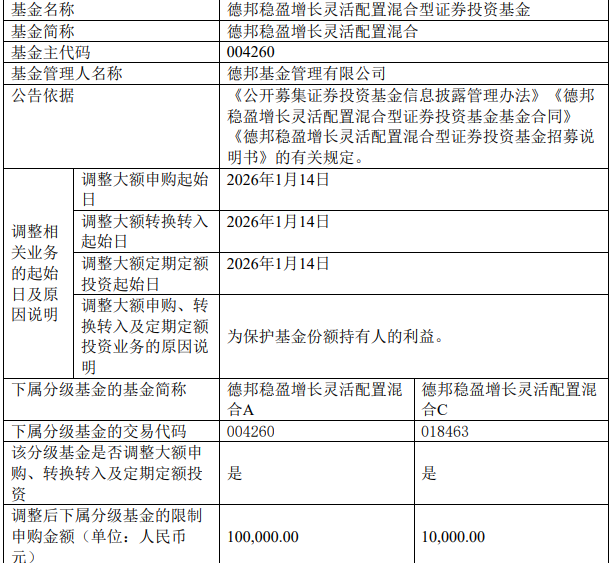
Group 1 - The core point of the article highlights the recent surge in interest and investment in the Debon Fund's "Debon Stable Growth" product, leading to significant purchase limits being imposed to protect existing investors [2][4][11] - On January 13, the A-share market reached a record trading volume of nearly 3.7 trillion yuan, with many equity funds hitting new net asset value highs, prompting over 80 equity funds to announce purchase limits since the beginning of the year [2][11][12] - The Debon Stable Growth fund saw a single-day inflow of 12 billion yuan, although the fund company denied disclosing real-time fund size data, emphasizing that such information is not publicly available until the end of the trading day [4][9] Group 2 - The fund's risk rating was raised to "high risk" on the Ant Financial platform due to increased trading activity and market volatility, while another platform still categorized it as "medium to high risk" [6][8] - The fund's A-class share reported a year-to-date return of 29.42% as of January 12, with significant performance from its top holdings in the technology sector [8][9] - The recent market dynamics are attributed to institutional and absolute return funds driving a notable rally, with expectations for continued upward movement in the spring market [3][13]


7亿基金突遭“资金洪流”
第一财经· 2026-01-13 10:52
Core Viewpoint - The article discusses the recent surge in interest and investment in the Debon Wealth Growth Fund, highlighting the implications of its rapid growth and the subsequent restrictions imposed by the fund to protect existing investors [3][4][6]. Group 1: Fund Performance and Market Activity - On January 12, the Debon Wealth Growth Fund reportedly attracted 12 billion RMB in a single day, leading to heightened market attention and subsequent announcements of purchase limits [3][6]. - The fund's A-class shares recorded a year-to-date return of 29.42% as of January 12, with significant performance from its top holdings in the technology sector [10]. - The A-share market has seen a record trading volume, reaching nearly 3.7 trillion RMB on January 13, with almost half of equity funds hitting new net asset value highs [3][14]. Group 2: Purchase Restrictions and Risk Assessment - Debon Fund announced a significant tightening of purchase limits for its Wealth Growth Fund, reducing the maximum purchase amount to 10,000 RMB for A shares and 1,000 RMB for C shares starting January 14 [6][8]. - The fund's risk rating was raised to "high risk" on the Ant Financial platform due to increased trading activity and market volatility, while another platform maintained a "medium-high risk" designation [8][10]. - The imposition of purchase limits is aimed at protecting existing investors and managing the fund's operational stability amid rapid inflows [6][15]. Group 3: Market Sentiment and Future Outlook - Market sentiment remains optimistic, with expectations for continued upward movement in the A-share market, driven by institutional investments and a favorable liquidity environment [4][16]. - Analysts suggest that the current market rally may transition from valuation recovery to profit growth as companies begin to disclose annual performance forecasts [16][17]. - Despite the overall positive outlook, some fund managers express caution regarding high-volatility sectors, indicating a need for careful investment strategy and risk management [17].

金鹰基金:天量遭遇主线暂歇 春躁行情踏浪前行
Xin Lang Cai Jing· 2026-01-13 09:38
Market Overview - All three major indices closed lower, with the ChiNext index experiencing a significant decline of 1.96%, while the Shanghai Composite Index fell by 0.64% to 4138 points. The Hong Kong Hang Seng Index opened high but closed lower. Trading volume in both markets increased, approaching 3.7 trillion yuan [1][8]. Sector Performance - The commercial aerospace sector saw a substantial drop, leading to a decline in market sentiment. According to WIND data, most of the 31 primary industries tracked by Shenwan experienced declines, with notable gains in oil and petrochemicals (1.62%), pharmaceuticals (1.21%), non-ferrous metals (0.91%), and media (0.67%). In contrast, sectors such as defense, electronics, communications, and computers lagged behind. Out of over 5300 stocks in the market, 3726 saw declines, indicating poor profitability [1][9]. Reasons for Market Correction - The primary reason for the market correction was the cooling off of previously popular speculative themes, particularly in commercial aerospace and controllable nuclear fusion sectors. The commercial aerospace concept stocks notably weakened after several companies issued risk warnings on January 12. This decline raised concerns among investors regarding high-volatility sectors, prompting some to quickly realize profits, which led to concentrated selling pressure [2][9]. Short-term Outlook - The current short-term fluctuations may present a good opportunity for allocation. Historical data from the past two decades indicates that spring market rallies typically occur, although the timing and magnitude can vary. Compared to historical trends, the current bull market has not yet reached its peak, and market sentiment remains subdued. The influx of absolute return funds from insurance, private equity, and retail investors suggests that the spring rally in A-shares has already begun [2][10]. Future Market Dynamics - As the annual performance forecast disclosure window opens for listed companies, the market logic is expected to shift from valuation recovery to profit growth. The current spring market is anticipated to be characterized by a more tradable and significant upward trend after digesting market sentiment [3][10]. Sector Allocation Recommendations - The importance of performance realization is expected to increase, focusing on core technology and manufacturing sectors. Key areas to prioritize include overseas computing power, storage, consumer electronics, and wind energy storage, which currently have low trading congestion and still present buying opportunities. Additionally, sectors like innovative pharmaceuticals and gaming, which may see fundamental improvements in Q1, are also expected to rotate into focus [4][11]. Commercial Aerospace Sector Outlook - Despite the recent adjustments and the need to digest short-term overheating sentiment, the commercial aerospace sector may still hold strong investment appeal. The ongoing developments with SpaceX and robust policy support, along with significant industry catalysts, suggest that the sector could remain active with participation opportunities [5][12].
7亿基金突遭“资金洪流”, 春季行情与限购潮同步上演
Di Yi Cai Jing· 2026-01-13 09:11
Core Viewpoint - The recent surge in interest and investment in the Debon Stable Growth Fund has led to significant market activity, prompting the fund to implement purchase limits to protect existing investors and manage fund operations effectively [1][3][10]. Group 1: Fund Activity and Market Response - On January 13, the Debon Stable Growth Fund announced limits on large purchases, reducing A-class share limits to 1 million yuan and C-class share limits to 100,000 yuan, with further restrictions to 100,000 yuan and 10,000 yuan respectively starting January 14 [3][4]. - The fund experienced a notable increase in attention, with over 210 million views on the Ant Fund platform and a significant rise in risk classification to "high risk" due to heightened trading activity [5][7]. - The fund's A-class shares reported a year-to-date return of 29.42% as of January 12, with significant performance from its top holdings in the technology sector [7][10]. Group 2: Market Trends and Fund Limitations - The A-share market has seen a record trading volume, reaching nearly 3.7 trillion yuan on January 13, with many equity funds hitting new net asset value highs, leading to over 80 equity funds announcing purchase limits since the beginning of the year [1][10][11]. - The trend of imposing purchase limits is a response to the rapid increase in fund inflows, with at least 160 funds implementing similar measures since the start of 2026, indicating a broader strategy to manage investor behavior and market volatility [11][12]. - Analysts suggest that the current market rally is driven by institutional and absolute return funds, with expectations for continued upward movement, although caution is advised regarding high-volatility sectors [2][12][13].
早盘直击|今日行情关注
申万宏源证券上海北京西路营业部· 2026-01-13 03:33
首先,春季行情继续演绎。 2026年一开局,市场便连续放量上行,原因在于市场对扩大内需的战略方针抱有期待,对"十五五"的开门红有所企盼。 从实际情况看,股票市场的成交金额出现连续放大的趋势,显示增量资金正在集中入场。成长性行业继续表现领先,体现投资者风险偏好提升,资金进攻 欲望较强的市场特征。以上各种信号与传统的春季行情的特征较为相符,并且已经处于快速上行阶段,热点或有进一步的扩散。 其次,周一两市再次上涨,量能放大。 沪指高开后,一路震荡反弹,收盘于全天高点附近,与5天均线的乖离率有所加大。深圳成指表现更强,延5 天均线不断上移重心。两市成交金额超过3.6 万亿元,较上个交易日有所增加。当天市场热点主要集中在TMT和军工行业。投资风格方面,中小盘和科技 股领涨。从运行节奏看,沪指完成小双底形态,正在向前期高点挑战。沪指分别于2025年11月下旬和12月中旬向下调整,止跌的位置基本相。随后进入了 持续反弹的进程,目前已经越过了小"双底"形态的目标位,正在挑战更高的点位。未来需要关同,形态类似于"双底"注量价配合的状况。 风险提示: 国际贸易、地缘冲突超出预期;上市公司业绩增速回落超预期;全球经济衰退超预期。 ...

红利风向标 | 关注红利资产与景气成长搭配的“哑铃策略”
Xin Lang Cai Jing· 2026-01-13 01:09
Core Viewpoint - The market is showing signs of recovery, potentially entering a "spring market" phase, suggesting a strategic allocation of assets between high-dividend and quality cash flow assets, and high-growth assets to capture market opportunities [3][7]. Fund Performance Summary - The Hwabao A-Share Dividend ETF (562060) has a latest dividend yield of 4.76% with a one-year return of 23.89% and a one-year annualized volatility of 10.79% [1]. - The Hwabao Hong Kong Stock Connect Low Volatility Dividend ETF (159220) shows a one-year return of 26.9% and an annualized volatility of 11.77% [2][6]. - The Hwabao A500 Low Volatility Dividend ETF (159296) has a one-year return of 1.06% and an annualized volatility of 8.40% [2][6]. - The Hwabao 800 Low Volatility Dividend ETF (159355) reports a one-year return of 0.49% with an annualized volatility of 8.30% [2][6]. - The Hwabao Cash Flow ETF (562080) tracks the CSI 300 Free Cash Flow Index, showing a one-year return of 15.57% [3][7]. Market Strategy - Investors are advised to adopt a "barbell strategy," balancing high-dividend and quality cash flow assets with high-growth assets aligned with industry trends and policy directions to mitigate volatility during market corrections [3][7].

中泰证券:春季行情启动 板块优先配置小盘成长与双创方向
智通财经网· 2026-01-12 23:41
Group 1 - The current market spring rally characteristics are gradually emerging, with leveraged funds becoming active again since mid-December, and the proportion of financing purchases in the A-share market is rising [1][5] - The trading volume of small-cap growth stocks has been increasing since late December, indicating a shift in funds towards this sector [1][5] - The previously net outflowing thematic/industry index ETFs have turned positive this week, showing a significant net inflow trend [1][6] Group 2 - The current market rally is supported by long-term funds, with significant inflows into the A500 ETF nearing 100 billion RMB, boosting market confidence [2] - The "spring rally" is characterized by seasonal trends, typically occurring from late December to the first quarter, with an average increase of about 15% during this period [3] Group 3 - Investment recommendations prioritize small-cap growth and innovation-driven sectors, suggesting a focus on small-cap innovation stocks [7] - The strategy emphasizes short-term trend tracking, participating in thematic sectors with recent fund accumulation, such as pharmaceuticals, robotics, and gaming [7] - The securities and financial technology sectors are expected to benefit from increased trading volumes and active leveraged funds, with financial technology companies being more sensitive to market fluctuations [7]

A股放量走高,热点轮动逐步加快|市场观察
Di Yi Cai Jing Zi Xun· 2026-01-12 15:07
Core Viewpoint - The A-share market has reached a historical high in trading volume, indicating increased market activity and investor optimism, driven by expectations of long-term capital inflow [1][2][3] Group 1: Market Performance - On January 12, the Shanghai Composite Index rose by 1.09% to close at 4165 points, with a total trading volume of 3.64 trillion yuan, surpassing the previous record of 3.48 trillion yuan set on October 8, 2024 [1][4] - The current market rally is characterized by structural and thematic trading rather than a broad-based increase, with significant capital flowing into sectors like AI applications and commercial aerospace [4][6] Group 2: Investor Sentiment - Investors are optimistic about the entry of long-term capital into the market, which is expected to drive further growth, although some sectors may experience overheating [2][3] - Institutional investors, including social security funds and insurance capital, are showing confidence in the Chinese economy and capital market, contributing to stable incremental funding [3][4] Group 3: Market Dynamics - The market is experiencing a rapid rotation of capital between high and low-performing sectors, with notable adjustments in previously strong sectors like optical modules and insurance [3][5] - Analysts suggest that the current spring rally is likely to continue, with a focus on structural rebalancing as certain sectors become overheated [5][6] Group 4: Future Outlook - The market is expected to maintain an upward trend, supported by favorable macroeconomic conditions and ongoing policy reforms aimed at enhancing market quality and stability [4][6] - Analysts highlight that the current market environment is distinct from previous bull markets, with complexities in the global economic landscape and a shift towards quality-focused domestic policies [4][7]