量化宽松

Search documents
徽商期货:美联储2026年或放缓降息步伐 黄金、铜等品种仍具备多头配置价值
Qi Huo Ri Bao· 2025-12-16 01:40
Core Viewpoint - The Federal Reserve announced a 25 basis point cut in the benchmark interest rate, aligning with market expectations, bringing the total cuts for the year to 75 basis points, indicating a potential slowdown in rate cuts for the following year [1][2][3] Group 1: Federal Reserve's Rate Decision - The Federal Reserve's decision to lower the benchmark interest rate to a range of 3.50% to 3.75% marks the third consecutive cut this year, totaling 75 basis points for 2023 and 175 basis points since September of the previous year [2][3] - There was a notable internal dissent within the Federal Reserve, with three officials voting against the rate cut, indicating a higher level of disagreement regarding the extent of the cuts than previously anticipated [2][3] Group 2: Economic Outlook and Inflation - The Federal Reserve's economic outlook has become more optimistic, with GDP growth forecasts for 2025 and 2026 raised to 1.7% and 2.3% respectively, while inflation expectations have been slightly adjusted downward [4] - The core service inflation rate has decreased from 4.3% to 3.5% from January to September, suggesting a trend of easing inflation pressures, particularly influenced by the housing market [8] Group 3: Labor Market Conditions - The U.S. labor market is showing signs of weakness, with the unemployment rate rising to 4.4%, the highest in four years, and a decline in private sector jobs reported [7] - The labor market's deterioration is raising the necessity for further rate cuts by the Federal Reserve, as the overall employment situation remains fragile [7] Group 4: Future Policy Directions - Federal Reserve Chairman Powell indicated a pause in rate cuts but left the possibility of a cut in January open, emphasizing the importance of upcoming economic data [5] - The market anticipates that the Federal Reserve may continue to lower rates in the first half of 2026, contingent on the labor market's recovery and inflation trends [9] Group 5: Global Monetary Policy Context - The global monetary policy landscape is diverging, with the Federal Reserve in a rate-cutting cycle while other major central banks are in a holding pattern, reflecting varying economic conditions and inflation outlooks [10][12] - The potential appointment of a new Federal Reserve chair could influence future monetary policy directions, with current expectations leaning towards continued easing [10]
美联储理事米兰:美联储续作国库券购买并非量化宽松,并将继续将部分风险转移至私人市场。
Sou Hu Cai Jing· 2025-12-15 15:15
美联储理事米兰:美联储续作国库券购买并非量化宽松,并将继续将部分风险转移至私人市场。 来源:金融界AI电报 ...
国债破38万亿!美联储“隐形印钞机”,数字“无中生有”收割全球
Sou Hu Cai Jing· 2025-12-15 14:16
大家好,今天犀哥这篇财经评论,主要来聊聊美联储。美国如今的国债超过了37万亿直逼40万亿大关, 那么美联储这台"隐形印钞机",它到底是怎么悄咪咪造出几万亿美元,最后让全世界跟着掏钱的? 美元都是怎么么诞生的? 首先得明确一点,美联储印钱根本不用纸和油墨,不是咱们想的那样,一堆工人围着印钞机忙,它玩的 是纯数字操作。 简单说,只要它想,就能直接在购买国债或者住房抵押贷款支持证券(MBS)的机构账户上,凭空敲 出一串数字,这钱就这么"无中生有"了。 这些新造出来的数字,会变成商业银行的准备金,银行手里有了钱,自然要往外放贷赚利息。 无限量注钱是好事还是坏事 关键是碰到危机的时候,这套操作才真叫"开大招",2008年金融危机那会,还有2020年疫情刚爆发的时 候,市场上的钱都吓得不敢动了,银行不敢放贷,企业不敢投资,眼看整个金融系统就要崩,美联储直 接启动了量化宽松(QE)。 说白了就是无限量往市场里注钱,不管是国债还是其他资产,只要能稳定市场,它就买,表面上看是救 市,避免了金融系统崩盘,但说白了就是把美国的危机转嫁到了全世界。 因为美元是全球通用货币,各国贸易往来、外汇储备都得用它,美联储印多了美元贬值,全球都 ...

公募基金权益指数跟踪周报(2025.12.08-2025.12.12):政策预期兑现,把握结构机会-20251215
HWABAO SECURITIES· 2025-12-15 11:52
Report Industry Investment Rating - No information provided in the content Core Viewpoints of the Report - Last week (2025.12.08 - 2025.12.12), the market showed a high - opening and low - closing trend. There is still a lack of a strong main line in the market. Externally - oriented sectors are stronger than domestically - oriented sectors, but the former's stock prices are at a high level with intensified gaming, and the latter lacks continuous data improvement and reversal momentum. After multiple macro - events, the market may enter a volatile consolidation phase with limited index - level opportunities [3][12]. - Overseas, short - term macro - positive factors being exhausted may pressure high - valuation and crowded AI assets, especially considering the possible interest rate hike by the Bank of Japan next week. However, the Fed's restart of quantitative easing provides re - inflation guidance for the US economy, and the prospect of global manufacturing recovery is still worthy of attention [12]. Summary by Relevant Catalogs 1. Weekly Market Observation - Equity Market Review and Observation - Market Performance: Last week, among major broad - based indexes, the BeiZheng 50, ChiNext Index, and KeChuang 50 led the gains, while the Micro - cap Stock Index, Dividend Index, and Shanghai Composite 50 led the losses. Market liquidity showed a structural shortage, with technology sectors such as computing power being relatively dominant. At the end of the year, funds further concentrated on leading tech stocks. In terms of themes, commercial aerospace, cross - strait integration, and some newly - listed stocks were active. The average daily trading volume of the entire A - share market was 1938.5 billion yuan, showing a month - on - month increase [12]. - Market Structure: Externally - oriented sectors (e.g., AI, non - ferrous metals) are stronger than domestically - oriented sectors (e.g., real estate, consumption). The former's stock prices are at a high level with intensified gaming, and the latter lacks continuous data improvement and reversal momentum [3][12]. - Macro - events: - Central Economic Work Conference: Held from December 10th to 11th, it continued the general tone of "seeking progress while maintaining stability", focused more on quality improvement and efficiency enhancement as well as policy coordination. Fiscal policy is "more proactive", and monetary policy is "moderately loose" [5][13]. - Fed Rate Cut: The Fed cut interest rates by 25 basis points in the December FOMC meeting, the third cut this year. After the cut, the market focused on the uncertainty of the future interest rate cut path, which may lead to some funds taking profits and rotating from high - valuation tech stocks, intensifying market differentiation [5][13]. - Bank of Japan Rate Hike: The market's expectation of a rate hike by the Bank of Japan has significantly increased. Although last year's hawkish rate hike had an impact on the global market, this time the expectation has been well - communicated, and the market has priced it relatively fully, so the impact on the global market is expected to be relatively limited [5][14]. 2. Active Equity Fund Index Performance Tracking - Overall Performance: | Index Classification | Last Week | Last Month | Since the Beginning of This Year | Since Inception | | --- | --- | --- | --- | --- | | Strategy - Theme | Active Stock Fund Preferred | 0.65% | - 0.46% | 39.07% | 40.20% | | Investment Style | Value Stock Fund Preferred | - 1.14% | - 2.33% | 18.76% | 18.85% | | | Balanced Stock Fund Preferred | 0.28% | - 0.98% | 30.74% | 27.88% | | | Growth Stock Fund Preferred | 1.57% | 0.60% | 54.47% | 40.59% | | Industry - Theme | Pharmaceutical Stock Fund Preferred | - 0.83% | - 1.84% | 36.66% | 18.38% | | | Consumption Stock Fund Preferred | - 0.54% | - 2.37% | 11.10% | 3.95% | | | Technology Stock Fund Preferred | 2.40% | 0.57% | 48.07% | 50.39% | | | High - end Manufacturing Stock Fund Preferred | 3.10% | - 0.89% | 35.14% | 28.62% | | | Cyclical Stock Fund Preferred | - 0.09% | 0.53% | 27.27% | 18.28% | [15] - Index Positioning and Benchmarks: - Active Stock Fund Preferred: Selects active equity funds based on performance competitiveness and style stability in value, balanced, and growth styles, with the style distribution roughly balanced according to the CSI Active Stock - type Fund Index. The performance benchmark is the Active Stock Fund (930980.CSI) [16][17]. - Value Stock Fund Preferred: Includes deep - value and quality - value styles. Selects 10 funds of deep - value, quality - value, and balanced - value styles to form the index. The performance benchmark is the CSI 800 Value Index (H30356.CSI) [20]. - Balanced Stock Fund Preferred: Fund managers of this style balance stock valuation and growth. Selects 10 relatively balanced and value - growth style funds to form the index. The performance benchmark is the CSI 800 (000906.SH) [22]. - Growth Stock Fund Preferred: Aims to seize the opportunities of performance and valuation double - click during a company's high - growth stage. Selects 10 funds of active - growth, quality - growth, and balanced - growth styles to form the index. The performance benchmark is the 800 Growth (H30355.CSI) [24][25]. - Pharmaceutical Stock Fund Preferred: Selects funds based on the intersection market value ratio of fund equity holdings and the constituent stocks of the CITIC Pharmaceutical Index. Constructs an evaluation system in the sample that meets the industry theme, with 15 funds selected to form the index. The performance benchmark is the pharmaceutical - theme fund index (fitted by Huabao Fund Research and Investment Platform) [25][29]. - Consumption Stock Fund Preferred: Selects funds based on the intersection market value ratio of fund equity holdings and the constituent stocks of relevant CITIC consumption - related indexes. Constructs an evaluation system in the sample that meets the industry theme, with 10 funds selected to form the index. The performance benchmark is the consumption - theme fund index (fitted by Huabao Fund Research and Investment Platform) [29]. - Technology Stock Fund Preferred: Selects funds based on the intersection market value ratio of fund equity holdings and the constituent stocks of relevant CITIC technology - related indexes. Constructs an evaluation system in the sample that meets the industry theme, with 10 funds selected to form the index. The performance benchmark is the technology - theme fund index (fitted by Huabao Fund Research and Investment Platform) [35]. - High - end Manufacturing Stock Fund Preferred: Selects funds based on the intersection market value ratio of fund equity holdings and the constituent stocks of relevant CITIC high - end manufacturing - related indexes. Constructs an evaluation system in the sample that meets the industry theme, with 10 funds selected to form the index. The performance benchmark is the high - end manufacturing - theme fund index (fitted by Huabao Fund Research and Investment Platform) [37]. - Cyclical Stock Fund Preferred: Selects funds based on the intersection market value ratio of fund equity holdings and the constituent stocks of relevant CITIC cyclical - related indexes. Constructs an evaluation system in the sample that meets the industry theme, with 5 funds selected to form the index. The performance benchmark is the cyclical - theme fund index (fitted by Huabao Fund Research and Investment Platform) [37][38].
谁在为美联储买单?空手套白狼造万亿,新兴市场沦为“接盘侠”
Sou Hu Cai Jing· 2025-12-15 10:09
Group 1 - The core concept of the article revolves around the Federal Reserve's ability to "print money" without physical cash, using digital methods to inject liquidity into the economy by purchasing U.S. Treasury bonds and mortgage-backed securities [4][6] - The process involves the Federal Reserve crediting commercial banks' accounts with "reserves," which enhances their lending capacity, leading to increased money supply in the market [6][8] - Historical instances of this practice include the 2008 financial crisis and the 2020 pandemic, where the Federal Reserve implemented quantitative easing (QE) to stabilize the economy by purchasing significant amounts of securities [10][12] Group 2 - The article discusses the consequences of excessive money printing, particularly the rise of inflation, which prompted the Federal Reserve to shift from quantitative easing to a balance sheet reduction strategy starting in 2022 [15][17] - By 2025, the Federal Reserve's balance sheet is projected to decrease from a peak of $9 trillion to $6.59 trillion, indicating a tightening of monetary policy [17] - A recent Federal Open Market Committee (FOMC) meeting revealed internal divisions within the Federal Reserve regarding interest rate adjustments, highlighting the challenges faced in managing monetary policy [19][22] Group 3 - The short-term effects of the Federal Reserve's actions included lower corporate financing costs and rising stock market indices, but long-term inflationary pressures began to emerge, with the Consumer Price Index (CPI) increasing significantly from 2020 to 2023 [26][28] - The article notes that while wealthy individuals benefited from rising asset prices, ordinary Americans faced higher living costs, exacerbating wealth inequality [31] - Other countries, particularly emerging markets, experienced negative impacts from the Federal Reserve's policies, leading to increased commodity prices and forcing them to raise interest rates to stabilize their currencies [33][36] Group 4 - The article contrasts the Federal Reserve's approach with that of the People's Bank of China, which uses bond purchases as a tool for precise monetary policy rather than indiscriminate liquidity injection [41] - The potential for a shift away from the dollar as the world's primary reserve currency raises questions about the sustainability of the Federal Reserve's money printing practices [46]
美联储送上“圣诞大礼”:降息+储备管理购债
Sou Hu Cai Jing· 2025-12-15 09:52
来源:证券市场周刊 美联储如期宣布降息25个基点,但内部分歧加剧,"点阵图"预测明年降息一次。尽管如此,"扩表"依然提振了市场,即将通过储备管理购债计划重启扩表向 市场提供流动性支持。 美元指数显著回落或延续下行走势,白银继续创下历史新高,尽管没有像白银那样势如破竹,但黄金总体保持着8月以来的上升势头。道指狂飙1.05%,对 利率最为敏感的小盘股指数罗素2000的涨幅达到1.32%,交易员似乎在为年底的圣诞反弹作准备。 美联储鹰派降息 美联储宣布降息25个基点符合市场预期,利率区间降至3.50%-3.75%。内部分歧明显,12名票委中有三人投下反对票,为2019年以来最多。 但此次明显是一次"预防性降息",只是旨在防范就业放缓超出预期的更大幅度下降,但对通胀的担忧仍然较深。 美联储预计,失业率会在年底达到4.5%,目前为4.4%。当前,受过大学教育的劳动者就业市场的恶化尤为显著。20-24岁大学毕业生的失业率已攀升至 8.5%,比2022年的低点高出3.5个百分点。大学毕业生占美国劳动力的40%以上,约占美国劳动收入的55%-60%。 与此同时,通胀还远未回到2%的目标值。今年核心个人消费支出(PCE)同比通 ...
智昇黄金原油分析:短线快速跳水 长期依然看好
Sou Hu Cai Jing· 2025-12-15 09:46
Group 1: Gold Market - Last week, gold experienced a rapid decline near the close, dropping nearly $100, which significantly impacted short-term trends, but this may be attributed to profit-taking, with long-term prospects for gold remaining positive [1] - The Federal Reserve's recent interest rate cut was perceived as hawkish, yet the S&P 500 and Dow Jones indices reached all-time highs, indicating that the market does not view the Fed as overly hawkish, and further monetary easing is expected [1] - The Fed's announcement of a $40 billion monthly purchase of short-term government bonds is interpreted as a signal for a new quantitative easing phase, with potential purchases of about $500 billion next year, indicating aggressive liquidity injection [1] - Quantitative easing is expected to devalue purchasing power, potentially leading to high inflation in the U.S., which could benefit precious metals like gold [1] - Technically, gold's daily chart shows a small bullish candle, indicating an expanding upward structure and a long-term bullish outlook, with short-term support at $4,325 [1] Group 2: Oil Market - Last week, oil prices continued to decline, but signs of a slowdown in the downtrend suggest a potential short-term rebound, although the medium to long-term outlook remains constrained by oversupply [3] - If the Russia-Ukraine conflict is resolved, Russian oil could quickly return to the market, significantly impacting oil prices; however, recent talks have not yielded a compromise, and sanctions on Russian oil are expected to remain in place [3] - Even without Russian oil returning to the market, the supply-demand imbalance persists, with production gaps left by Russia likely filled by non-OPEC+ producers like the U.S. and Brazil, leading to a projected global surplus of 4.09 million barrels per day by 2026, equivalent to 4% of global demand [3] - Technically, oil's daily chart shows a small bullish candle, with clear support at previous lows, but the downtrend remains intact; short-term traders may focus on a potential rebound, with resistance at $58 [3] Group 3: Currency Market - Following the Fed's December meeting, the U.S. dollar index has weakened, reaching a new low since early October, and may continue to decline due to the Fed's monetary policy and the appreciation potential of non-U.S. currencies [3][4] - Market expectations for continued rate cuts in 2026 persist despite Powell's emphasis on higher thresholds for further cuts, with potential leadership changes at the Fed possibly leading to more accommodative policies [4] - The Bank of Japan's recent signals for potential interest rate hikes and the lack of further rate cuts in the Eurozone are significant factors contributing to the dollar's weakness [5] - Technically, the dollar index's daily chart shows a double top breakout and bearish divergence in moving averages, indicating a downtrend; short-term traders may look for resistance at 68.56 [5] Group 4: Economic Events - The U.S. National Economic Council Director Hassett indicated that if selected to lead the Fed, he would consider Trump's policy opinions, but the Fed's rate decisions would remain independent [6] - Japanese central bank officials may begin selling ETF holdings as early as next month, a process expected to take decades [6] - Ukrainian President Zelensky expressed a willingness to abandon Ukraine's NATO membership in negotiations regarding a potential peace agreement with the U.S. [6]
百利好晚盘分析:短线快速跳水 长期依然看好
Sou Hu Cai Jing· 2025-12-15 09:12
Gold - Last week, gold experienced a rapid decline near the close, dropping nearly $100, which significantly impacted the short-term trend structure, but this may just be a result of profit-taking leading to increased short-term selling; long-term outlook for gold remains positive [1] - The Federal Reserve's recent interest rate cut was perceived as hawkish, yet the S&P 500 and Dow Jones indices both reached historical highs post-announcement, indicating that the market does not view the Fed as overly hawkish; the Fed's monetary policy is expected to continue easing [1] - The Fed's announcement of a $40 billion monthly purchase of short-term government bonds is interpreted as a signal for a new quantitative easing phase, with potential purchases of about $500 billion in short-term bonds next year, indicating aggressive liquidity injection [1] - Quantitative easing is expected to devalue purchasing power, potentially leading to high inflation in the U.S., which would benefit precious metals like gold [1] - Technically, gold's daily chart shows a small bullish candle, indicating an expanding upward structure and a long-term bullish outlook; short-term support is noted at $4,325 [1] Oil - Last week, oil continued its downward trend, but signs of a slowdown in the decline suggest a potential short-term rebound; however, the medium to long-term outlook remains constrained by oversupply [2] - If the Russia-Ukraine conflict is resolved, Russian oil could quickly return to the market, significantly impacting oil prices; however, recent talks between U.S. and Russian officials did not yield a compromise, and sanctions on Russian oil exports are expected to remain in place [2] - Even if Russian oil does not return to the international market soon, the supply-demand imbalance persists, with production gaps left by Russia likely to be filled by non-OPEC+ producers like the U.S. and Brazil; by 2026, the global daily surplus of oil is projected to reach 4.09 million barrels, equivalent to 4% of global demand [2] - Technically, oil's daily chart shows a small bullish candle, with significant support at previous low points, but the downward trend remains unchanged; short-term focus should be on resistance around $58 [2] Dollar Index - Following the Federal Reserve's December meeting, the dollar index has continued to weaken, reaching a new low since early October; this trend may persist due to the Fed's monetary policy and the appreciation potential of non-U.S. currencies [3] - Despite Powell's emphasis on a higher threshold for further rate cuts, market expectations for continued rate cuts in 2026 have not dissipated; potential leadership changes at the Fed could lead to a more accommodative policy direction, further weakening the dollar [3] Non-U.S. Currencies - The appreciation of non-U.S. currencies is a significant factor in the dollar's weakness; the Bank of Japan's governor has indicated a clear signal for potential interest rate hikes, suggesting a possible increase from 0.50% to 0.75% [4] - The Eurozone also has limited room for further rate cuts, contributing to the dynamic where non-U.S. currencies rise as the dollar falls, potentially expanding the dollar index's decline [4] - Technically, the dollar index's daily chart shows a double top breakout with bearish divergence in moving averages, indicating a downward trend; short-term focus may be on resistance around 68.56 [4] Nikkei 225 - The Nikkei 225 index has shown a series of small bearish and bullish candles, indicating weak rebound strength, and may be entering a medium-term C-wave decline [5] - The 4-hour chart suggests the completion of an upward structure, with short-term resistance to be monitored around 50,410 [5] Copper - Copper's daily chart shows a large bearish candle, forming an engulfing pattern, indicating a potential medium-term peak [6] - The 1-hour chart suggests the completion of an upward structure, likely leading to a descending ABC pattern; short-term resistance is noted at $5.36 [6] Market Overview - The U.S. White House National Economic Council Director Hassett indicated that if selected to lead the Fed, he would consider Trump's policy opinions, but the Fed's rate decisions will remain independent [7] - Japanese central bank officials may begin selling ETF holdings as early as next month, a process expected to take decades [7] - Ukrainian President Zelensky proposed abandoning Ukraine's NATO membership aspirations during negotiations with U.S. envoys regarding a potential peace agreement for the Russia-Ukraine conflict [7] Upcoming Events - On December 15, at 23:30, FOMC permanent voter and New York Fed President Williams will speak on economic outlook [8]

华安基金:美联储延续降息并重启扩表,流动性宽松或利好黄金
Xin Lang Cai Jing· 2025-12-15 06:04
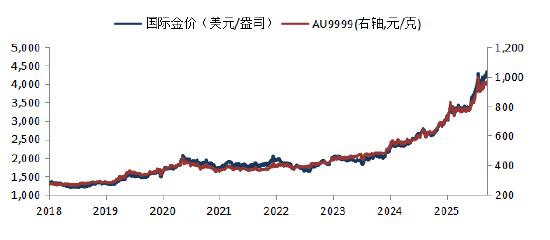
Group 1: Gold Market Overview - Gold prices experienced a steady increase last week, with London spot gold closing at $4,299 per ounce (up 2.4% week-on-week) and domestic AU9999 gold at 964 yuan per gram (up 1.0% week-on-week) [1][4] - The Federal Reserve's December meeting resulted in a 25 basis point rate cut, but there was significant internal disagreement regarding future rate cuts, with three dissenting votes [1][8] - The dot plot indicates one expected rate cut next year, with varying expectations among committee members regarding the number of cuts, reflecting a broader division within the Fed [8] Group 2: Economic Outlook and Federal Reserve Actions - The Federal Reserve revised upward its economic growth forecast while lowering unemployment and PCE inflation expectations, suggesting a favorable economic outlook for the U.S. next year [2][8] - Following the cessation of balance sheet reduction on December 1, the Fed announced plans to begin expanding its balance sheet on December 11 to address potential liquidity risks, emphasizing that this is not a quantitative easing measure [2][9] - The Fed will initiate reserve management purchases (RMPs) at a rate of $40 billion per month to mitigate pressures from Treasury issuance, which is expected to lead to a more accommodative liquidity environment, potentially benefiting gold [9] Group 3: Market Sentiment and Future Expectations - Current interest rate futures indicate market expectations for two rate cuts next year, slightly higher than the Fed's dot plot median, reflecting optimism about future rate cuts [2][9] - The ongoing dovish stance of the Fed, particularly if a more dovish chair is selected, could lead to a more aggressive rate-cutting cycle, which is likely to support gold prices [2][9] - The combination of loose monetary and fiscal policies, along with ongoing credit risks related to U.S. debt servicing, continues to drive global central banks to purchase gold as a means of diversifying foreign exchange reserves [2][9] Group 4: Upcoming Indicators - Key signals to watch for the upcoming week regarding gold ETFs include the U.S. November CPI, unemployment rate, and non-farm payrolls, as well as interest rate decisions from the European Central Bank and the Bank of Japan [3][9]
张尧浠:金价牛市前景良好 短线调整仍是多头机会
Xin Lang Cai Jing· 2025-12-15 05:15
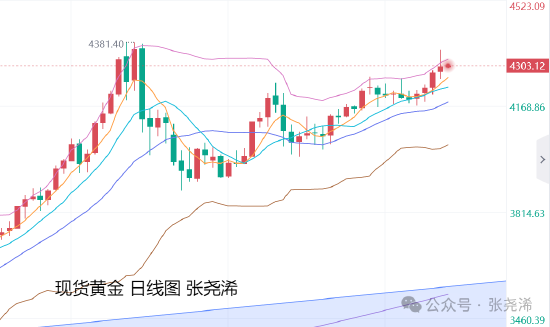
12月15日:黄金市场上周:国际黄金如期在持稳5-10周均线上方,强势反弹收阳,并再度触及趋势线压 力,虽仍有再度遇阻回落调整的风险,但整体前景仍看好上行,故此,如有回落,也是入场看涨的机 会。 具体走势上,金价自周初开于4196.40美元/盎司,先行筑底震荡,于周二录得当周低点4170.19美元后, 连续震荡回升,周四多头动力加大突破之前震荡阻力,周五进一步攀升录得当周高点4353.49美元,但 尾盘明显回撤跳水,最终收于4301.15美元,周振幅183.3美元,收涨104.75美元,涨幅2.5%。 影响上,周初走势先行延续近期震荡格局波动,之后受到支撑买盘,以及美联储在降息落地后表示会在 未来30天内购买400亿美元短债(变相放水),以及鲍威尔虽未就近期是否再次降息提供明确指引,但 表示不包含未来加息情景,被市场解读为存在明年1月进一步降息的可能; 再加上特朗普批评鲍威尔:降息幅度太小,可以翻倍,应降至全球最低。还有美国周初请失业金人数创 下疫情后最大单周增幅。进一步提升了市场对于未来降息前景的预期,而助力金价多头延续到周五触及 当周高点,但由于周五的众多美联储官员偏鹰讲话和获利了结而回撤收线。 展望本周 ...