
供应过剩

Search documents
国际油价集体收跌,库存大幅增加引发供应过剩担忧
Mei Ri Jing Ji Xin Wen· 2025-11-04 22:17
Core Insights - International oil prices collectively declined, with WTI crude oil falling by 1.02% to $60.43 per barrel and Brent crude oil decreasing by 0.85% to $64.34 per barrel [1] Supply and Inventory - The U.S. API crude oil inventory increased by 6.521 million barrels last week, compared to a previous decrease of 4 million barrels, raising concerns about oversupply in the market [1]
OPEC+2026年?季度暂停增产,国内液体化?库存压?较
Zhong Xin Qi Huo· 2025-11-04 05:25
1. Report Industry Investment Rating The report does not provide an overall industry investment rating. 2. Core Views of the Report - Crude oil is in a volatile pattern due to the co - existence of supply pressure and geopolitical risks. OPEC+ decided to continue increasing production in December 2025 but pause in Q1 2026. The high inventory and surplus supply are bearish factors, while strong refined - product crack spreads, geopolitical attacks on refineries are bullish factors [1]. - Liquid chemical products faced a significant decline on Monday. Ethylene glycol has a supply - surplus expectation, and the styrene - pure benzene market may continue to decline without major supply cuts or demand surges [2]. - Overall, crude oil will continue to fluctuate in the short term, and the chemical supply side still faces significant pressure [3]. 3. Summary by Variety Crude Oil - **View**: Supply pressure persists, and geopolitical risks remain. Overseas crack spreads are strong, but domestic refinery profits are under pressure. OPEC+ is more cautious about increasing production, and oil prices may move from the bottom - seeking to the bottom - grinding stage. It is expected to fluctuate in the short term [8]. Asphalt - **View**: With the weakening of crude oil and rebar, asphalt futures prices lack support. The absolute price of asphalt is over - estimated, and the monthly spread is expected to decline with the increase of warehouse receipts [8]. High - Sulfur Fuel Oil - **View**: As crude oil weakens, fuel oil futures prices are on the weak side. Although the supply in the Asia - Pacific region may decline in November, the demand is still weak, and attention should be paid to the development of the Russia - Ukraine conflict [8]. Low - Sulfur Fuel Oil - **View**: It fluctuates with crude oil. It is supported by the rebound of gasoline and diesel crack spreads but faces negative factors such as weak shipping demand. It is expected to follow crude oil fluctuations with a relatively low valuation [9][10]. Methanol - **View**: Suppressed by the high - inventory reality in the near term, methanol fluctuates downward. Although the port inventory has decreased slightly, the high inventory still has a suppressing effect, but there is still value in going long at low levels considering potential Iranian disturbances [24]. Urea - **View**: There is a co - existence of high - inventory suppression and cost support, and it is expected to fluctuate narrowly. The high inventory restricts the upward space of futures prices, while coal costs provide support [25]. Ethylene Glycol - **View**: The expectation of supply surplus suppresses the market, and there is no fundamental positive support. With the return of integrated refineries and concentrated imports, the price is expected to decline in the medium - and long - term under the expectation of inventory accumulation [15][16][17]. PX - **View**: Although some plants are under reform and maintenance, PX supply is not affected. With strong supply and demand, the profit supports the price. It is expected to return to the cost - and - fundamental pricing logic in the short term and maintain range - bound trading [11]. PTA - **View**: The supply - demand drive is limited, the market negotiation fades, and the basis weakens slightly. The price is affected by cost and macro - sentiment fluctuations, and there is a weakening expectation in the medium term [11]. Short - Fiber - **View**: There is an expectation of weakening supply and demand, and the processing fee is under pressure. The upstream cost support is weak, and the downstream demand fails to keep up, so the price is expected to fluctuate with the upstream [19][20]. Bottle Chip - **View**: The cost provides no obvious guidance, the volatility narrows, and the trading atmosphere fades. The price follows the cost fluctuations, and the processing fee has stronger support during the factory production - reduction period [21]. Propylene - **View**: The propane CP price is reduced again, and PL is weaker than PP in the short term [29]. PP - **View**: With the decline in maintenance and high inventory pressure, it is expected to trade within a range. The decrease in maintenance leads to an increase in production, and the high - level inventory in the middle reaches suppresses the price [28]. Plastic - **View**: With the short - term decline in maintenance, it is expected to trade within a range. The supply pressure and weak fundamental support limit the price upside, and the profit support is also limited [27]. Styrene - **View**: There is still a concern about inventory swelling, and it fluctuates weakly. Although there are some disturbances in the cost - side pure benzene supply, it cannot reverse the situation, and the subsequent trend depends on crude oil [13]. PVC - **View**: The market sentiment cools down, and it fluctuates weakly. After the end of maintenance in early November, the production will increase, while the downstream demand is weak, and the export is also under pressure [30]. Caustic Soda - **View**: The supply - demand is under pressure, and the cost rises. The inventory continues to accumulate, and the price is weak. Attention should be paid to whether low profits can drive upstream production cuts [30]. 4. Variety Data Monitoring Energy Chemical Daily Indicator Monitoring - **Inter - period Spread**: The inter - period spreads of various varieties such as Brent, Dubai, PX, PTA, etc. have different changes, which reflect the market's expectations for different contract periods of each variety [32]. - **Basis and Warehouse Receipts**: The basis and warehouse - receipt data of different varieties are presented, showing the relationship between spot and futures prices and the quantity of goods in storage [33]. - **Inter - variety Spread**: The spreads between different varieties such as PP - 3MA, TA - EG, etc. are provided, which can be used to analyze the relative price relationships between different chemical products [34]. Chemical Basis and Spread Monitoring The report mentions the basis and spread monitoring of multiple chemical varieties including methanol, urea, etc., but specific data and analysis are not fully presented in the provided content. 5. Index Information - **Comprehensive Index**: The commodity index is 2250.33 (+0.10%), the commodity 20 index is 2546.82 (+0.02%), and the industrial product index is 2237.50 (+0.09%) [273]. - **Energy Index**: On November 3, 2025, the energy index was 1178.10, with a daily increase of 1.69%, a 5 - day increase of 0.79%, a 1 - month decrease of 3.81%, and a year - to - date decrease of 4.06% [275].
农产品日报:糖价止跌反弹,棉价延续震荡-20251104
Hua Tai Qi Huo· 2025-11-04 03:29
Report Industry Investment Ratings - The investment ratings for cotton, sugar, and pulp are all neutral [2][5][7] Core Views - **Cotton**: In the short term, the upper limit of the cotton futures market is under significant hedging pressure, and there is a possibility of a callback to test previous lows after cost solidification. In the long - term, the beginning inventory of the new year is low, consumption is resilient, and the current cotton price is undervalued. After the seasonal pressure, the cotton price can be optimistically viewed [2] - **Sugar**: Before the end of the year, the sugar market is expected to fluctuate. Next year, the situation is not optimistic, and there is a possibility of new lows [5] - **Pulp**: The fundamental improvement of the pulp market is insufficient, and the pulp price is likely to remain in the bottom - range fluctuation. Attention should be paid to the actual implementation of demand during the peak season in the fourth quarter [7] Summary by Related Catalogs Cotton Market News and Important Data - Futures: The closing price of the cotton 2601 contract yesterday was 13,600 yuan/ton, up 5 yuan/ton (+0.04%) from the previous day [1] - Spot: The Xinjiang arrival price of 3128B cotton was 14,656 yuan/ton, down 18 yuan/ton; the national average price was 14,859 yuan/ton, down 1 yuan/ton [1] - US Cotton: From October 24 to 30, 2025, 202,500 tons of US 2025/26 cotton were graded and inspected, with 80.7% meeting the ICE cotton futures delivery requirements [1] Market Analysis - International: Sino - US negotiations have made progress, pushing up US cotton prices, but the amount of US cotton China will purchase is unclear. The US government shutdown has delayed key data release, and the short - term upside of the outer market is limited due to supply and demand pressure [2] - Domestic: The new cotton year starts with low inventory, but new cotton is being listed. The purchase price of seed cotton is rising, and the expected decline in production supports the post - holiday market. However, the short - term upside of cotton prices is limited due to hedging and weak demand [2] Strategy - Neutral. In the short term, there is a high hedging pressure on the market, and in the long - term, the cotton price can be optimistically viewed after seasonal pressure [2] Sugar Market News and Important Data - Futures: The closing price of the sugar 2601 contract yesterday was 5499 yuan/ton, up 16 yuan/ton (+0.29%) from the previous day [2] - Spot: The spot price of sugar in Nanning, Guangxi was 5750 yuan/ton, unchanged; in Kunming, Yunnan, it was 5695 yuan/ton, down 15 yuan/ton [2] - New Sugar: On October 30, 2025, Yingmao Sugar Industry's Mengpeng Sugar Mill started production, and the new sugar is priced at 5700 yuan/ton, 710 yuan lower than the same period last year [3] Market Analysis - International: The global sugar market is in a bearish cycle due to oversupply from Brazil and India. Although the sugar - making ratio in Brazil has decreased recently, the long - term rebound of raw sugar is limited [4] - Domestic: The new sugar season in China is expected to have increased production, but the price is near the production cost, and the tightening of syrup control policies supports the price, limiting the downside [4] Strategy - Neutral. The market will fluctuate before the end of the year, and there may be new lows next year [5] Pulp Market News and Important Data - Futures: The closing price of the pulp 2601 contract yesterday was 5306 yuan/ton, up 94 yuan/ton (+1.80%) from the previous day [5] - Spot: The spot price of Chilean Silver Star softwood pulp in Shandong was 5500 yuan/ton, up 25 yuan/ton; the price of Russian softwood pulp was 5045 yuan/ton, up 55 yuan/ton [5] - Market: The price of imported wood pulp in the spot market is rising moderately, with different price increases in various regions and pulp types [5] Market Analysis - Supply: Overseas pulp mills' price increases, production cuts, and conversion plans have limited impact on the overall supply. Domestic imports have increased, and port inventories remain high [6] - Demand: Weak consumption in Europe and the United States and insufficient domestic demand are suppressing pulp prices. Despite new production capacity, effective demand is lacking, and paper mills' raw material procurement is cautious [6] Strategy - Neutral. The pulp price is likely to fluctuate at a low level, and attention should be paid to the peak - season demand in the fourth quarter [7]
原油交易提醒:OPEC+暂停增产计划引发市场观望
Sou Hu Cai Jing· 2025-11-04 01:39
Core Viewpoint - OPEC and its partners have announced a pause in their production increase plans starting from Q1 2026, anticipating a seasonal slowdown in oil demand, which may lead to an oversupply in the market next year and further pressure on oil prices [1][5] Group 1: Market Dynamics - WTI crude oil prices have seen a cumulative decline of approximately 9% over the past three months, primarily due to OPEC+'s accelerated production recovery and increased output from the U.S. and other non-OPEC producers [1] - Analysts indicate that the pause in production quotas signals OPEC+'s dynamic adjustment to market conditions, despite not significantly altering production forecasts [3] - Current market conditions show WTI prices fluctuating between $59 and $63, with a potential breakout above $63 possibly leading to $65, while a drop below $59 could indicate a return to a bearish trend [3] Group 2: Supply Risks - The recent sanctions on two major Russian oil companies have added uncertainty to the supply outlook, with concerns raised by energy executives at the ADIPEC conference regarding supply risks [1][4] - BP's CEO highlighted that the latest sanctions have materially impacted supply capabilities, although some oil-producing countries are attempting to reassure the market [4] - Morgan Stanley's analysis suggests that while short-term price expectations for Brent have been raised, significant supply surplus pressures are still anticipated in the coming months [5] Group 3: Geopolitical Factors - Recent geopolitical tensions, such as drone attacks in Ukraine affecting oil infrastructure, have contributed to supply concerns and market volatility [3][4] - The divergence in institutional views indicates a lack of consensus in the market, with the real risk being a rapid recovery in supply that could suppress oil prices and weaken the fiscal revenues of member countries [7]


OPEC+宣布明年暂停增产后,大摩火速上调油价预期!
Hua Er Jie Jian Wen· 2025-11-03 07:09
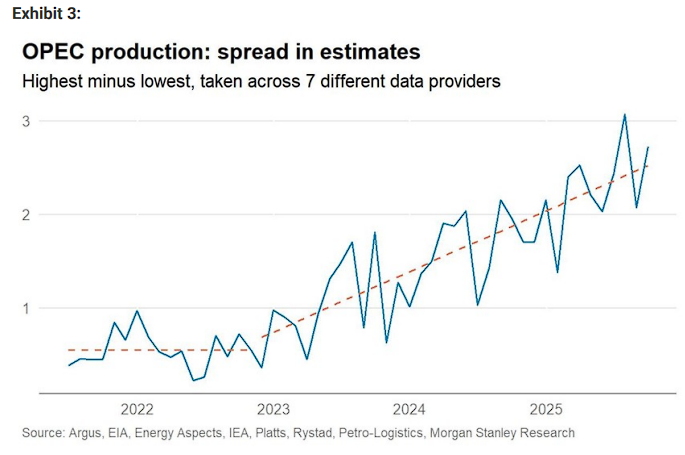
Core Insights - OPEC+ has announced a pause in production growth until Q1 2026, which has prompted Morgan Stanley to adjust its Brent crude oil price forecast from $57.50 to $60 per barrel, signaling a reduction in market volatility [1][2][4] - The pause in production growth is seen as a proactive measure by OPEC+ to stabilize the market, rather than a significant change in actual production levels [2][3] - Morgan Stanley believes that the combination of OPEC+'s intervention and new sanctions on Russian oil by the US and EU will support Brent oil prices in the near term [4][3] OPEC+ Production Strategy - OPEC+ plans to increase production by 137,000 barrels per day in December, consistent with previous months, but will pause growth from January to March due to seasonal demand factors [2] - The decision to pause is typical for the first quarter, which is usually a seasonally weak period for oil demand, reflecting a cautious approach by oil-producing countries [2] Market Dynamics and Price Forecast - Morgan Stanley's analysts assert that the perception of OPEC+ operating in an "autopilot" mode has been disrupted by this pause, indicating that the organization is still responsive to market conditions [3] - The firm anticipates a significant oversupply in the global oil market in 2026, particularly in the first half, but believes OPEC+'s intervention will mitigate downward price risks [3][4] - The forecast suggests that Brent oil prices could rise to $65 per barrel by the second half of 2027 as global demand begins to consume excess inventories [4] Discrepancies in Production Data - There is a notable gap between OPEC+'s production quotas and actual output, with discrepancies reported to exceed 2.5 million barrels per day, complicating the assessment of OPEC+'s effectiveness [6][9] - Morgan Stanley's analysis indicates that actual production growth has been minimal despite quota increases, suggesting that remaining production capacity may be limited [9][10]

油价创逾一月来最长连涨记录!应对需求淡季与过剩风险 欧佩克+决定明年首季暂停增产
智通财经网· 2025-11-03 00:43
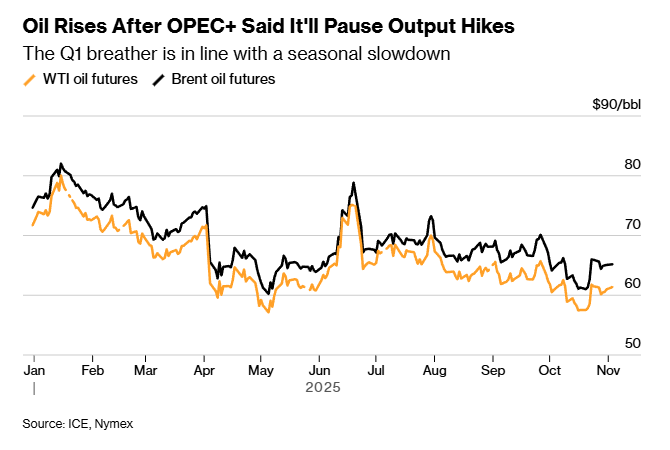
智通财经APP获悉,欧佩克+在平衡扩大市场份额的目标与日益显现的供应过剩信号后,决定在明年第 一季度暂停增产,但该联盟下个月仍将小幅提高产量。 以沙特阿拉伯为首的主要成员国在周日的视频会议上达成协议,决定12月日均增产13.7万桶,与10月和 11月计划的增产量持平,随后在明年1月至3月期间暂停增产。第一季度通常是石油需求淡季,与会代表 表示,从1月起暂停增产的决定,反映出对季节性需求放缓的预期。 消息公布后,布伦特原油价格周一突破每桶65美元,连续第四日走高,创下9月下旬以来最长连涨纪 录;WTI原油价格突破61美元关口。 然而,这一决定出台之际,石油交易商正面临一段充满不确定性的时期。作为欧佩克+联合主导国,俄 罗斯正遭受制裁,这使其石油供应前景存在变数。与此同时,交易商指出,当前供应过剩局面正不断加 剧,预计明年这一情况还将进一步恶化。 加拿大皇家银行资本市场大宗商品策略主管Helima Croft表示:"暂停增产无疑是局势的新变数,但考虑 到第一季度供应前景的不确定性,我认为这是审慎之举。" 尽管对俄制裁在油价跌至五个月低点后起到了支撑作用,但一名代表在会议当天早些时候透露,欧佩克 +目前尚无法评估这 ...
国泰君安期货·原油周度报告-20251102
Guo Tai Jun An Qi Huo· 2025-11-02 11:26
GuotaiJunanFuturesallrightsreserved,pleasedonotreprint 国泰君安期货·原油周度报告 国泰君安期货研究所 黄柳楠 投资咨询从业资格号:Z0015892 赵旭意 投资咨询从业资格号:Z0020751 日期:2025年11月2日 | 01 | CONTENTS 02 | 03 | 04 | 05 | 06 | | --- | --- | --- | --- | --- | --- | | 综述 | 宏观 | 供应 | 需求 | 库存 | 价格及价差 | | 原油:短期关注地缘风险, | 利率、贵金属与油价走势比较 | OPEC+核心成员国出口量一览 | 欧美炼厂开工率 | 美欧各类油品库存 | 基差 | | 不宜单边追多 | 海外服务业数据 | 非OPEC+核心成员国出口量一览 | 中国炼厂开工率 | 亚太各类油品库存 | 月差 | | | 中国信用数据 | 美国页岩油产量 | | | 内外盘原油价差 | | | | | | | 净持仓变化 | SpecialreportonGuotaiJunanFutures 2 观点综述 01 本周原油观点:短期关注地缘风险 ...
“聪明钱”嗅到油价反弹气息? 美国加码制裁俄油之后 对冲基金创纪录削减原油看跌仓位
智通财经网· 2025-11-01 03:59
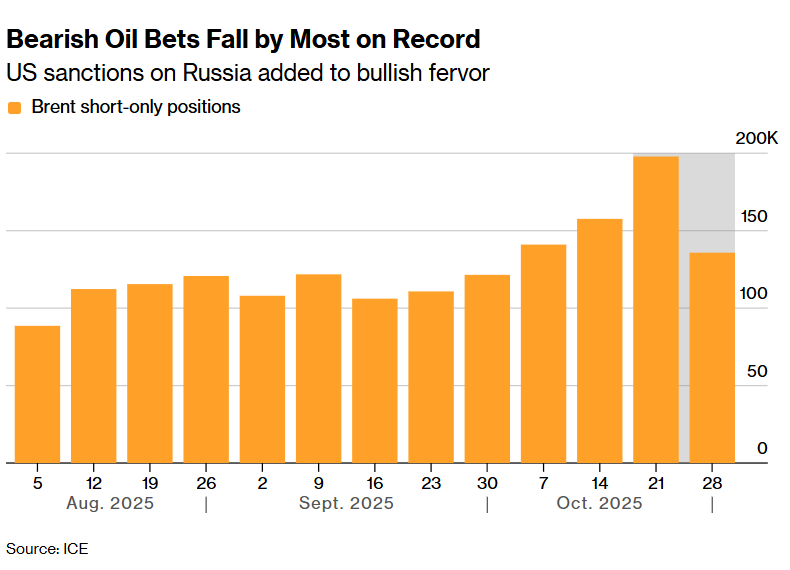
Core Viewpoint - The recent sanctions imposed by the U.S. government on major Russian oil companies have led to a record reduction in bearish positions by global hedge funds in Brent crude oil futures, coinciding with a market adjustment to the "supply surplus" pessimism [1][5]. Group 1: Hedge Fund Activity - Global hedge funds reduced their short positions in Brent crude oil futures by 62,078 contracts, reaching a total of 135,790 contracts, marking the largest recorded decline in short positions since data collection began by ICE Futures Europe [1]. - This significant reduction in bearish sentiment among hedge funds reflects a shift in market expectations regarding oil supply, particularly following the U.S. sanctions targeting Rosneft and Lukoil [1][6]. Group 2: Market Dynamics - The sanctions are expected to substantially cut the supply from Russia, which is the second-largest oil producer in the OPEC+ alliance, thereby altering the global oil supply landscape [2][6]. - Despite a cooling demand growth, OPEC+ members have been increasing oil production, contributing to a bearish outlook on Brent crude prices, which have fallen over 15% this year [5][6]. Group 3: Impact of Sanctions - The sanctions represent one of the most severe measures taken by the U.S. against Russian energy exports during the ongoing Russia-Ukraine conflict, affecting nearly half of Russia's oil production [6]. - The sanctions also extend to foreign financial institutions engaging in significant transactions with the sanctioned companies, potentially limiting their access to the U.S. financial system [6].
新能源及有色金属日报:金属板块集体下滑,沪镍不锈钢小幅下跌-20251031
Hua Tai Qi Huo· 2025-10-31 02:50
Report Summary 1. Industry Investment Rating No industry investment rating is provided in the report. 2. Core Viewpoints - The nickel market is facing a situation of high inventory and oversupply, and nickel prices are expected to remain in a low - level oscillation. The stainless - steel market is also under the dual pressure of high inventory and weak demand, and its price is expected to maintain a low - level oscillation [1][3]. 3. Summary by Related Catalogs Nickel Variety - **Market Analysis** - **Futures**: On October 30, 2025, the main contract 2512 of Shanghai nickel opened at 121,770 yuan/ton and closed at 120,980 yuan/ton, a change of - 0.03% from the previous trading day's close. The trading volume was 99,113 (- 10,149) lots, and the open interest was 107,897 (- 1,789) lots. The main contract showed a volatile downward trend. The Fed's 25 - basis - point interest rate cut and Powell's cautious statement on the December rate cut led to a short - term rebound of the US dollar, pressuring commodities, and Shanghai nickel closed slightly lower in the late session [1]. - **Nickel Ore**: The mine side still has a strong attitude of holding prices, and the overall nickel ore price remains firm. The CIF tender price of 1.4% nickel ore from Indonesia's purchases in the Philippines was 49.5 - 50.5, down 1 dollar month - on - month. The FOB tender price of 1.4% nickel ore from the northern Philippine mine LNL was 43.5, unchanged month - on - month. The Surigao mining area in the Philippines is about to enter the rainy season, and the shipping is coming to an end; the northern mines are in the tender and shipping stage. The price of downstream nickel iron is under pressure, and iron plants are not willing to accept the high price of raw material nickel ore. The domestic trade benchmark price in Indonesia in November (phase one) is expected to fall by 0.12 - 0.18 dollars, and the current mainstream premium is + 26, with the premium range mostly between + 25 - 27 [1]. - **Spot**: The sales price of Jinchuan Group in the Shanghai market was 123,700 yuan/ton, up 600 yuan/ton from the previous trading day. Spot trading was dull, and the spot premiums and discounts of each brand remained stable. Among them, the premium of Jinchuan nickel changed by 50 yuan/ton to 2,450 yuan/ton, the premium of imported nickel changed by 0 yuan/ton to 400 yuan/ton, and the premium of nickel beans was 2,450 yuan/ton. The previous trading day's Shanghai nickel warehouse receipt volume was 31,532 (99) tons, and the LME nickel inventory was 251,640 (- 66) tons [2]. - **Strategy** - The nickel market has high inventory and the oversupply pattern remains unchanged. It is expected that nickel prices will remain in a low - level oscillation. The recommended strategy is mainly range - bound operation for the single - side, and no operations are recommended for the inter - period, inter - variety, spot - futures, and options [3]. Stainless - Steel Variety - **Market Analysis** - **Futures**: On October 30, 2025, the main contract 2512 of stainless steel opened at 12,805 yuan/ton and closed at 12,725 yuan/ton. The trading volume was 105,051 (+ 11,210) lots, and the open interest was 89,093 (- 4,171) lots. Similar to the trend of Shanghai nickel, the main contract showed a volatile weakening trend. Overseas, the rebound of the US dollar pressured commodities; domestically, although the adjustment of real - estate policies released certain positive signals, the demand transmission of stainless steel in the real - estate field was lagging, and it was difficult to boost market confidence in the short term [3]. - **Spot**: The price was basically stable, and trading was still difficult. The price of stainless steel in the Wuxi market was 13,000 (+ 100) yuan/ton, and that in the Foshan market was 13,000 (+ 50) yuan/ton. The premium and discount of 304/2B were 250 to 550 yuan/ton. According to SMM data, the ex - factory tax - included average price of high - nickel pig iron remained unchanged at 924.5 yuan/nickel point [3]. - **Strategy** - In the short term, stainless steel will still face the dual pressure of high inventory and weak demand, and it is expected to maintain a low - level oscillation. The single - side strategy is neutral, and no operations are recommended for the inter - period, inter - variety, spot - futures, and options [5].
能源化策略报:聚酯终端需求依旧环?向好,芳烃供给端压?仍较
Zhong Xin Qi Huo· 2025-10-31 02:04
1. Report Industry Investment Rating No specific industry investment rating is provided in the report. 2. Core View of the Report The overall energy and chemical market is under pressure from supply and geopolitical factors. Crude oil faces supply pressure and geopolitical risks, and most chemical products are expected to continue to fluctuate and consolidate. The polyester terminal demand is improving, but the supply side of chemicals is a key negative factor. The market's response to the Sino - US summit is "buy on the rumor, sell on the news," and the OPEC+ is likely to continue to increase production at the upcoming meeting. [2][3][4] 3. Summary by Related Catalogs 3.1 Market Logic - The polyester chain's demand side is improving, with better terminal fabric shipments, inventory reduction, and improved nominal cash flow. However, the supply side of chemicals is a major negative factor. The meeting of the PTA and bottle - chip leading enterprises on the 30th had no substantial policies, which led to a decline in the day - trading session. [3] 3.2 Variety Analysis 3.2.1 Crude Oil - **View**: Supply pressure continues, and geopolitical risks still exist. - **Main Logic**: The Sino - US summit results are in line with expectations, but concerns about Russian oil remain. The macro and geopolitical drivers for oil prices are limited. Supply pressure suppresses prices, but geopolitical concerns still support prices to some extent. The price is expected to decline slowly and fluctuate weakly. [7] 3.2.2 Asphalt - **View**: With the weakening of crude oil and rebar, the asphalt futures price has no support. - **Main Logic**: OPEC+ may increase production in November, Saudi Arabia reduces the export discount of crude oil to Asia, and the end of the Palestine - Israel conflict and the realization of the positive news from the Sino - US summit lead to a decline in oil prices. The asphalt - fuel oil spread is expected to continue to decline, and the asphalt inventory pressure is large. [7] 3.2.3 High - Sulfur Fuel Oil - **View**: With the weakening of crude oil, the fuel oil futures price is weak. - **Main Logic**: OPEC+ supply increase and falling oil prices lead to a decline in high - sulfur fuel oil prices. Although the Palestine - Israel conflict has ended, the Russia - Ukraine conflict continues to escalate. The demand for fuel oil is still weak. [8] 3.2.4 Low - Sulfur Fuel Oil - **View**: Low - sulfur fuel oil fluctuates with crude oil. - **Main Logic**: It follows crude oil fluctuations, has low valuation, and faces supply increase and demand decline trends. [10] 3.2.5 Methanol - **View**: The port inventory pressure still exists, the olefins have declined, and methanol fluctuates lower. - **Main Logic**: The futures price fluctuates lower. The high port inventory suppresses prices, but there is still low - buying value considering the potential Iranian disturbances in winter. [26] 3.2.6 Urea - **View**: The market sentiment is pessimistic, and it is under continuous pressure. - **Main Logic**: The market sentiment is pessimistic due to the lack of export information updates from the nitrogen fertilizer association meeting. [26] 3.2.7 Ethylene Glycol (EG) - **View**: The coal - based production rate is continuously rising, and the supply - demand pattern deteriorates month - on - month. - **Main Logic**: The international oil price is weak, the coal - based production rate is high, the supply - demand pattern weakens, and the port inventory accumulates. [18][19] 3.2.8 PX - **View**: The meeting has no substantial measures, and PX returns to the fundamental pricing logic. - **Main Logic**: The crude oil price fluctuates and falls. Some PX factories have maintenance, and the supply is temporarily stable. The short - term supply and demand are both strong, and the market gives back the previous emotional premium. [11] 3.2.9 PTA - **View**: The meeting has no substantial resolution, and PTA processing fees are still under pressure. - **Main Logic**: The upstream cost fluctuates and falls, the meeting has no substantial production reduction, some devices may restart, and the downstream polyester demand provides some support. [12] 3.2.10 Short - Fiber - **View**: The meeting has no positive news, the market sentiment turns cold, and polyester staple fiber remains consolidated. - **Main Logic**: The upstream cost is poor, the meeting has no clear production reduction measures, the supply side has a device restart, and the downstream demand is for rigid replenishment. The inventory is at a healthy level, and the profit has some support. [22][23] 3.2.11 Bottle - Chip - **View**: The PTA anti - involution meeting has no positive news. - **Main Logic**: The meeting fails to support the price, the supply - demand is stable, and the absolute price follows the upstream fluctuation, while the processing fee has some support. [24] 3.2.12 Pure Benzene - **View**: Affected by macro - events, pure benzene fluctuates. - **Main Logic**: The naphtha price is strong, but the opening of the Shandong - East China arbitrage window and the rumored maintenance of styrene devices suppress the price. [14][15] 3.2.13 Styrene - **View**: After the macro - disturbance, styrene rises and then falls. - **Main Logic**: Styrene follows the oil price to rebound, but the rebound is weak due to new production capacity and weak downstream follow - up. [16] 3.2.14 LLDPE - **View**: Maintenance slightly increases, and LLDPE is viewed within a range. - **Main Logic**: The macro - situation, oil price, and its own fundamentals limit the upside space, and the short - term price fluctuates within a range. [28] 3.2.15 PP - **View**: Maintenance is stable, the propane CP price is reduced, and PP is viewed within a range. - **Main Logic**: The reduction of the propane CP price drags down PP, and its own fundamentals have limited support. [29] 3.2.16 PL - **View**: The propane CP price is reduced again, and PL is weaker than PP in the short term. - **Main Logic**: The reduction of the propane CP price and weak downstream demand lead to a decline in PL prices. [30] 3.2.17 PVC - **View**: Market sentiment cools down, and PVC weakens. - **Main Logic**: The macro - sentiment cools down, and the PVC fundamentals are under pressure due to increased production, limited downstream demand, and anti - dumping pressure on exports. [31] 3.2.18 Caustic Soda - **View**: Supply and demand are under pressure, and the futures price is weak. - **Main Logic**: The macro - sentiment cools down, and the supply is high while the demand is inelastic, leading to inventory accumulation. [32]