
AI投资

Search documents
港股速报 | 高开低走 港股反弹告吹 中兴通讯H股跌超13%
Sou Hu Cai Jing· 2025-12-11 08:51
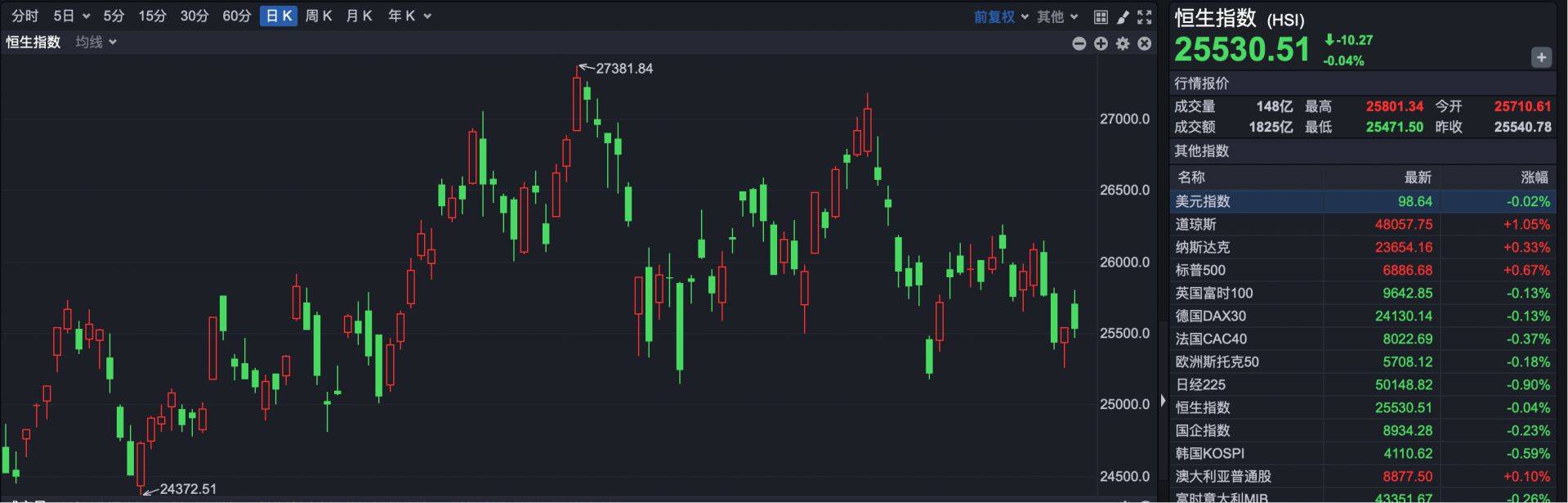
Market Overview - The Hong Kong stock market opened higher due to the Federal Reserve's interest rate cut but ultimately closed lower, with the Hang Seng Index finishing at 25,530.51 points, down 10.27 points or 0.04% [1] - The Hang Seng Tech Index closed at 5,534.59 points, down 46.51 points or 0.83% [3] - The total trading volume for the day was 1,825 million Hong Kong dollars, indicating a decrease in trading activity [1] Company Focus - ZTE Corporation (HK00763) experienced a significant drop, with its stock price falling over 13% by the end of the trading day, and its A-shares (SZ000063) also hit the daily limit down [4] - ZTE announced it is in communication with the U.S. Department of Justice regarding compliance investigations related to the U.S. Foreign Corrupt Practices Act, asserting its commitment to compliance and normal business operations [6] Sector Performance - Hong Kong banking stocks showed overall strength, with HSBC Holdings (HK00005) rising over 3% to reach a historical high of 115.3 Hong Kong dollars, ultimately closing up 2.06%. Other banks like Standard Chartered, Bank of East Asia, Bank of China Hong Kong, and Hang Seng Bank also saw gains [6] Capital Flows - Southbound capital recorded a net inflow of over 700 million Hong Kong dollars into Hong Kong stocks by the end of the trading day [8] Market Outlook - According to CMB International, the Hong Kong stock market is expected to transition from valuation-driven to earnings growth-driven, with a projected earnings growth rate of 6% to 10% for the Hang Seng Index, suggesting an upward potential of 10% to 15% for the index next year [10] - The outlook for the Hong Kong market is supported by favorable internal policies and external monetary easing from major economies, with expectations for significant revenue and profit growth in 2026 following a bottoming out in 2025 [10]



12月FOMC会议的三点超预期
Donghai Securities· 2025-12-11 07:48
Interest Rate Decisions - The Federal Reserve lowered the benchmark interest rate by 25 basis points to a range of 3.50%-3.75% as expected[2] - The median forecast for the federal funds rate in 2026 is a further reduction to 3.4% and to 3.1% by the end of 2027[2] Economic Projections - The SEP forecast for 2026 GDP growth was raised from 1.8% to 2.3%, reflecting optimism due to reduced inflation and increased technology investments[2] - Core PCE inflation estimates for 2025 and 2026 were revised down by 0.1 percentage points to 3.0% and 2.5%, respectively[2] Market Reactions - Following the FOMC meeting, U.S. Treasury yields fell, stock markets rose, and gold prices increased, indicating stronger expectations for future monetary easing[2] - The market is pricing in a 22.1% probability of a rate cut in January 2026[8] Key Points of Dovish Outlook - The announcement of a $40 billion purchase of Treasury securities over the next 30 days and the removal of the SRF operation limit were unexpected[2] - The voting split among FOMC members was 9:3, indicating less division than anticipated, which is crucial for effective policy management[2] Employment and Inflation Insights - Powell indicated that non-farm payrolls may see an average monthly decline of 20,000, suggesting a cautious outlook on employment[3] - The Fed's current policy prioritizes employment over inflation, with expectations of a stable economic growth trajectory into 2026[3]
宏观点评报告:12月FOMC:降息偏鸽但分裂,点阵图鹰派-20251211
Huaxin Securities· 2025-12-11 06:31
Monetary Policy Insights - The Federal Reserve announced a 25 basis point rate cut on December 11, 2025, marking the most divided vote since 2019, with three dissenters[4] - The dot plot indicates a hawkish stance, with only one expected rate cut in 2026 and a distribution showing three members predicting a rate hike[4] Economic Forecasts - The Fed upgraded its economic outlook while lowering inflation expectations, predicting a soft landing for the economy in 2026[4] - Unemployment rate forecasts were also revised downwards, indicating a more optimistic view on labor market conditions[4] Liquidity and Market Strategy - The end of quantitative tightening (QT) was confirmed, with the Fed initiating a reserve management program (RMP) to purchase $40 billion in short-term debt monthly[6] - The report suggests focusing on technology themes in U.S. equities, particularly in sectors like space, quantum, nuclear energy, and autonomous driving[6] Investment Recommendations - U.S. equities are expected to benefit from a stable economy and new liquidity points, while U.S. Treasury bonds are anticipated to remain volatile at high levels[6] - The dollar is projected to maintain a downward trend due to pressures from yen interventions and euro appreciation[7] Risk Factors - Potential risks include abrupt changes in overseas monetary policy, slower-than-expected AI investment progress, and economic downturns exceeding forecasts[8]
A股指数集体高开:沪指涨0.09%,贵金属、海南等板块涨幅居前
Feng Huang Wang Cai Jing· 2025-12-11 01:39
凤凰网财经讯 12月11日,三大指数集体高开,沪指高开0.09%,深成指高开0.13%,创业板指高开 0.05%,贵金属、海南、能源金属等板块指数涨幅居前。 | | | | | 沪深京重要指数 | | | | | | --- | --- | --- | --- | --- | --- | --- | --- | --- | | 名称 *● | 咸新 | 涨幅% | | 涨跌 涨跌家数 | 涨速% | 息手 | 现手 | 金额 | | 上证指数 | 3903.89 | 0.09 | 3.39 | 1107/740 | -0.02 | 5847 | 584万 | 69.36 亿 | | 深证成指 | 13333.29 | 0.13 | 16.87 | 1447/895 | 0.03 | 8247 | | 824万 106.35亿 | | 北证50 | 1393.32 | 0.25 | 3.52 | 151/74 | 0.24 | 6.62万 | 6.62万 | 8498万 | | 创业板指 | 3210.55 | 0.05 | 1.55 | 704/468 | 0.05 | 156 7 | 156万 | 39.9 ...

国金证券:AI投资确属泡沫 但对美国而言存在其合理性
Di Yi Cai Jing· 2025-12-10 23:59
Core Viewpoint - The AI investment sector is identified as a bubble, yet it holds a certain rationality for the United States [1] Group 1: Industry Vulnerabilities - The fragility of the AI industry chain is increasingly evident, highlighting issues such as insufficient information disclosure and weak capital expenditures [1] - High leverage and off-balance-sheet financing amplify risks, with particular attention needed on the opacity of private credit and implicit guarantees related to off-balance-sheet liabilities [1] Group 2: External Risks - The liquidity uncertainty stemming from the 2026 U.S. midterm elections is a key external risk contributing to the bubble [1]

特朗普批评降息幅度太小
Wind万得· 2025-12-10 22:44
Core Viewpoint - The Federal Reserve announced a 25 basis point rate cut, lowering the federal funds rate target range to 3.50%-3.75%, aligning with market expectations [1][5]. Group 1: Federal Reserve Actions - The Federal Reserve will begin expanding its balance sheet by purchasing $40 billion in short-term Treasury bonds, with the purchase scale expected to remain high for several months before significantly reducing [1]. - The decision to cut rates was passed with a 9-3 voting ratio, indicating increasing divisions among committee members [1]. - The median expectation from the "dot plot" suggests a further rate cut of 25 basis points in 2026, consistent with previous forecasts [2]. Group 2: Market Reactions - Following the Federal Reserve's announcement, the U.S. dollar weakened, while U.S. stocks and commodities strengthened, and U.S. Treasury yields declined [2]. - The Dow Jones, Nasdaq, and S&P 500 indices showed positive movements, with the Dow increasing by 497.46 points (+1.05%) and the S&P 500 rising by 46.17 points (+0.67%) [2]. Group 3: Future Rate Cut Predictions - Multiple international investment banks predict that the Federal Reserve will cut rates 2-3 times in 2026, with terminal rates expected around 3.00%-3.25% [9]. - Goldman Sachs, Bank of America, Morgan Stanley, and Deutsche Bank each forecast two rate cuts in 2026, while Nomura Securities anticipates three cuts [9]. - Analysts attribute the likelihood of further rate cuts to leadership changes rather than economic interpretations, suggesting a shift towards a more dovish Federal Reserve [11].

国际航协:航空公司盈利预期稳健 2026年净利润预计为410亿美元
Zhong Guo Min Hang Wang· 2025-12-10 05:40
Core Viewpoint - The International Air Transport Association (IATA) forecasts a stable profitability for the global airline industry, with a projected net profit of $41 billion by 2026, despite ongoing supply chain challenges [1][2] Financial Outlook - Global airline revenue is expected to reach $1.054 trillion in 2026, a 4.5% increase from $1.008 trillion in 2025 [1] - Operating profit is projected to be $72.8 billion in 2026, up from $67 billion in 2025, with an operating margin of 6.9% compared to 6.6% in 2025 [1] - The net profit forecast for 2026 is $41 billion, compared to $39.5 billion in 2025, maintaining a net profit margin of 3.9% [1] - Average net profit per passenger is estimated at $7.90, slightly lower than the historical high of $8.50 in 2023 [1] Regional Performance - European airlines are expected to outperform North American airlines, driven by effective capacity management and high load factors, particularly among low-cost carriers [1] - Middle Eastern airlines show strong performance with net profit margins nearing 10% and average profit per passenger at $29, benefiting from a favorable regulatory environment [1] - African airlines face the highest unit costs globally, with costs per available ton-kilometer close to 140 cents, nearly double the industry average [1] Asia-Pacific Insights - The Asia-Pacific region continues to show strong passenger demand, led by China and India, supported by increased tourism and a growing middle class [2] - The region's load factor is expected to reach a historic high of 84.4% by 2026 [2] Challenges and Opportunities - Despite the positive outlook, the airline industry struggles with profitability that does not cover capital costs, highlighting a significant imbalance in profit distribution within the aviation value chain [2] - Air cargo is performing well, with projected revenue of $158 billion in 2026, a 2.1% increase from $155 billion in 2025, driven by e-commerce and semiconductor transport demand [2] - Cargo yield is expected to remain stable, only slightly decreasing by 0.5%, maintaining a level approximately 30% higher than pre-pandemic figures [2]
航司运一位旅客赚不过苹果卖一个手机壳
Di Yi Cai Jing Zi Xun· 2025-12-10 03:33
Core Insights - The International Air Transport Association (IATA) forecasts that global airlines will achieve a net profit of $41 billion in 2026, up from $39.5 billion in 2025, marking a historical high [2] - Total industry revenue is expected to reach $1.054 trillion in 2026, a 4.5% increase from $1.008 trillion in 2025, with passenger traffic projected to hit 5.2 billion, reflecting a 4.4% growth [2] - The average net profit per passenger is estimated at $7.90, lower than the historical peak of $8.50 in 2023, remaining unchanged from 2025 [2] Financial Performance - The IATA highlights that the airline industry contributes nearly 4% to global GDP and supports 87 million jobs, yet profit margins are extremely thin [2] - Fuel costs are projected to slightly decrease to $252 billion in 2026, down 0.3% from $253 billion in 2025, while non-fuel costs are expected to rise to $729 billion, a 5.8% increase from $689 billion in 2025 [2] - The increase in non-fuel costs is attributed to aging fleets, supply chain disruptions, and rising maintenance and leasing costs [2] Regional Insights - In the Asia-Pacific region, net profit is estimated at $6.6 billion in 2026, driven by increased tourism and a growing middle class in China and India [3] - However, the average profit per passenger in the Asia-Pacific region is only $3.20, the lowest among all regions, compared to $28.60 in the Middle East, $10.90 in Europe, $9.80 in North America, and $5.70 in Latin America [3] - The region is expected to achieve a record passenger load factor of 84.4% in 2026, despite challenges in international passenger recovery and overcapacity [4] Cargo Insights - The IATA anticipates that air cargo volume will reach 7.16 million tons in 2026, a 2.4% increase from 2025, defying many pessimistic forecasts [4] - Despite a slowdown in global trade, cargo yield is expected to remain stable, only slightly decreasing by 0.5%, and maintaining a level approximately 30% higher than pre-pandemic [4] - The demand for air cargo is bolstered by strong e-commerce and semiconductor transportation needs, as global trade flows adjust due to U.S. tariff policies [4]

11月进出口点评:全球资本开支仍是出口主线
Orient Securities· 2025-12-10 03:16
Group 1: Export Performance - In November, exports saw a significant year-on-year increase of 5.9%, rebounding from a previous decline of -1.1%[6] - Exports to the US decreased by 28.6% year-on-year, indicating ongoing weakness in consumer goods exports[6] - Non-US regions showed resilience in import demand, particularly in capital goods, which outperformed consumer goods[6] Group 2: Market Dynamics - The demand for investment-related equipment remains a core driver of export recovery, especially in non-US markets[6] - The AI-related processing trade chain between China and other Asian regions continues to boost exports, with significant increases in integrated circuit exports[6] - The reduction of tariffs on fentanyl by the US has not diminished the confidence of Chinese manufacturers in expanding overseas[6] Group 3: EU Export Trends - Exports to the EU surged by 14.8% year-on-year in November, marking the highest growth rate for the year[6] - The sustainability of this growth is uncertain, as it may be driven by preemptive imports ahead of the upcoming carbon tax legislation in January 2026[6] - Overall, the export structure remains unchanged, with limited recovery expected in consumer goods exports until the end of Q1 next year[6]
港股科技30ETF(513160)近5日持续“吸金”累超3.1亿元,机构:估值处于低位的港股有望率先反弹
2 1 Shi Ji Jing Ji Bao Dao· 2025-12-10 02:17
Group 1 - The Hong Kong stock market experienced a decline on December 10, particularly in the technology sector, with the Hong Kong Technology 30 ETF (513160) dropping by 0.74% and trading volume exceeding 470 million yuan [1] - Despite the recent downturn, there has been a significant inflow of funds into the Hong Kong Technology 30 ETF, with a net inflow of over 310 million yuan in the past five days as of December 9 [1] - According to China Merchants Securities, the recent pullback in the Hong Kong market is seen as an overreaction influenced by the U.S. market, and it is expected that the market will rebound as interest rate expectations become clearer and concerns over AI bubbles are addressed [1] Group 2 - Alibaba has established a new consumer-facing business group called Qianwen, led by Vice President Wu Jia, which consolidates several existing business units and includes various applications and AI hardware [2] - Guolian Minsheng Securities remains optimistic about the revaluation of AI in China, recommending attention to platform-based internet companies and AI ecosystem enterprises with modeling or application capabilities [2] - The Hong Kong Technology 30 ETF closely tracks the Hang Seng Hong Kong Stock Connect China Technology Index, which includes major technology companies listed in Hong Kong, such as SMIC, Kuaishou, Tencent, Alibaba, and Xiaomi [2]
