
人民币升值

Search documents
离岸人民币升破7关口 离岸金融迈向“结构优化”的内涵式发展
Xin Lang Cai Jing· 2026-01-04 12:49
Core Viewpoint - The recent appreciation of the Renminbi (RMB) against the US dollar is attributed to multiple macroeconomic factors and market dynamics, with the offshore RMB breaking the 7 mark being a significant event that enhances its attractiveness in global markets [1][2]. Group 1: Factors Influencing RMB Appreciation - The weakening of the US dollar index, which fell below 100, is a primary driver of the RMB's strength, influenced by expectations of continued interest rate cuts by the Federal Reserve in 2026 [1][2]. - Increased demand for currency settlement by enterprises as the year-end approaches has contributed to the seasonal strengthening of the RMB [1]. - The sustained appreciation of the RMB has improved market sentiment, further pushing up its value [1]. Group 2: Implications for Offshore RMB Assets - The RMB's rise above 7 enhances the valuation attractiveness of offshore RMB assets, improving liquidity in offshore markets [2]. - The appreciation reduces the actual debt servicing costs for bonds issued in RMB, encouraging foreign institutions to issue "dim sum bonds" [2]. - A narrowing or even inversion of the interest rate differential between China and the US lowers the opportunity cost of holding RMB-denominated assets [2]. Group 3: Future Trends in Offshore Markets - If the RMB continues to appreciate moderately in 2026, the offshore market is expected to transition from a "liquidity market" to a "deep allocation market," with more diverse issuers seeking low-cost financing [3]. - The offshore RMB interest rate curve is anticipated to become smoother, and the range of derivative products will expand, indicating a shift towards quality improvement in RMB internationalization [3]. - Recent reports indicate a slight increase in China's offshore financial index, with growth in offshore bond issuance and cross-border RMB transactions, reflecting a structural upgrade in the offshore financial system [3]. Group 4: Strategic Development of Offshore Financial Markets - The demand for offshore RMB is driven by China's growing economic and political status globally, positioning it as a central player in international finance [4]. - Future developments in offshore finance will require institutional openness to attract relevant factors and enhance the internationalization of the RMB [4][5].
向上动能仍存,新年或有新气象
Datong Securities· 2026-01-04 11:25
Group 1 - The overall performance of major assets shows that the equity, bond, and commodity markets are stabilizing with narrow fluctuations [2][9] - The A-share market is experiencing a high-level narrow fluctuation, with the Shanghai Composite Index maintaining a continuous upward trend, although affected by pre-holiday risk aversion [3][11] - The domestic macroeconomic data continues to improve, with PMI rising and remaining in the expansion zone, while the RMB continues to appreciate against the USD, providing support for the market [3][12] Group 2 - The bond market is expected to remain in a state of fluctuation, with liquidity easing providing a support base while upward movement is capped by the equity market [6][36] - The bond market configuration suggests that it may continue to experience a period of oscillation, with short-term bonds likely to perform better due to their flexibility [6][36] Group 3 - The commodity market is stabilizing after a slight decline, with precious metals like gold and silver experiencing adjustments after significant gains [7][44] - The outlook for precious metals remains positive in the medium to long term, with expectations of upward movement due to ongoing geopolitical conflicts and a declining status of the US dollar [7][44] - The recommendation for commodity allocation suggests maintaining positions in gold [7][47] Group 4 - The report suggests an "barbell strategy" for A-share allocation, focusing on offensive sectors like telecommunications and commercial aviation while retaining cash for potential post-holiday volatility [5][13] - The focus on technology innovation sectors is emphasized as a key driver for market performance in the medium to long term, particularly in the context of national competition and industrial transformation [11][13]
中信证券:人心思涨环境下 开年后A股市场或震荡向上
智通财经网· 2026-01-04 09:41
Core Viewpoint - The report from CITIC Securities indicates that the biggest expected divergence in 2026 will stem from the balance between external and internal demand, with a trend towards imposing tariffs on external demand and subsidizing internal demand, marking an important beginning this year [1][7]. Market Overview - The market is expected to experience a higher probability of upward movement after the New Year, given the relatively low funding enthusiasm at the end of last year and the prevailing sentiment of wanting to see market growth [1][8]. - The overall market sentiment is currently restrained, with many investors waiting for the right entry point, suggesting limited potential for significant market corrections in the absence of major unexpected risks [8]. Investment Strategy - The company recommends adopting a mindset focused on "earning performance money rather than expecting valuation money" for mid-term investments, favoring sectors with lower heat and concentration but increasing attention and catalysts, such as chemicals, engineering machinery, electric power equipment, and new energy [1][10]. - There is a cautious approach towards high prosperity and high heat sectors that have seen stagnant stock prices, while new industry themes like commercial aerospace are expected to continue to evolve and warrant ongoing attention [1][10]. Performance Analysis - In 2025, the median return for actively managed public funds tracked by CITIC Securities was 28.2%, ranking third over the past decade, with a significant disparity in returns between the top and bottom deciles [2]. - The overall performance of the A-share and Hong Kong stock markets in 2025 can be divided into five phases, with notable fluctuations driven by external factors such as tariff impacts and AI application narratives [3][4]. Structural Market Dynamics - The significant money in the structural bull market in 2025 primarily came from the correction of expected divergences and performance growth, particularly in the context of external and internal demand dynamics [4]. - The report highlights that the market's perception of external demand has shifted from optimism to caution, with geopolitical factors influencing expectations throughout the year [7]. Future Outlook - The anticipated structural adjustments in trade policies, including increased tariffs and stricter export controls, indicate a shift in China's approach to external trade, aiming to balance external and internal demand [7]. - The report emphasizes that the market may struggle to quickly price in these significant structural changes, which could serve as both a source of expected divergence and potential performance growth [7].

——策略周报专题:若人民币汇率持续升值,风格行业如何选择-20260104
Guohai Securities· 2026-01-04 09:03
2026 年 01 月 04 日 策略周报 研究所: 证券分析师: 赵阳 S0350525100003 zhaoy05@ghzq.com.cn 证券分析师: 陈艺鑫 S0350525010003 chenyx03@ghzq.com.cn [Table_Title] 若人民币汇率持续升值,风格行业如何选择 ——策略周报专题 最近一年走势 相关报告 鹏》——2025-06-17 本篇报告解决了以下核心问题:1、人民币强升值或弱升值期间,配置什 么风格或行业胜率弹性较高?2、当下应该关注哪些性价比较高的行业? 核心要点: 国海证券研究所 请务必阅读正文后免责条款部分 《投资黄金如何增强收益——策略周报*陈艺鑫, 胡国鹏》——2025-09-28 《策略周报:反内卷行情有望进入第二阶段*陈艺 鑫,袁稻雨》——2025-08-24 《投资红利如何增强收益-——红利系列报告*陈艺 鑫,胡国鹏》——2025-07-25 《基于"三步走"的黄金交易策略*陈艺鑫,胡国 《我国财政货币双宽松下,大类资产如何配置*陈 艺鑫,胡国鹏》——2025-03-09 1、根据内需经济复苏强弱,将 2015 年 811 汇改后人民币升值阶段 ...
观点:USDT 负溢价,持有稳定币还亏钱,到底该怎么看和怎么办?
Xin Lang Cai Jing· 2026-01-03 17:12
Core Viewpoint - The article discusses the reasons behind the appreciation of the Chinese Yuan (RMB) and the negative premium of USDT, highlighting the economic factors influencing these trends. Group 1: Reasons for RMB Appreciation - The appreciation of the RMB is primarily driven by three factors: attracting foreign investment, boosting domestic consumption, and alleviating international trade tensions [5][6][7]. - Attracting foreign investment enhances investment expenditure, as a stronger RMB makes it easier for China to draw in capital, especially in light of debt issues faced by both the US and China [5]. - The appreciation of the RMB reduces costs for consumers and businesses when purchasing foreign goods, thereby increasing consumption expenditure and corporate profit margins [6]. - A stronger RMB can help mitigate political friction arising from trade surpluses, as it may reduce the trade deficit for other countries, leading to less governmental expenditure on trade disputes [7]. Group 2: Implications of RMB Appreciation - The article emphasizes that the appreciation of the RMB must be stable and orderly, as rapid appreciation could negatively impact net exports and economic growth targets for the following year [8][10]. - The current economic environment, with a GDP growth target of around 5%, allows for a controlled appreciation of the RMB to facilitate economic transition and opportunity exploration [8]. Group 3: USDT Negative Premium - The negative premium of USDT is attributed to three main factors: a sluggish cryptocurrency market, increased demand for RMB during year-end settlements, and tighter regulations on stablecoins by the Chinese government [12][13]. - The article suggests that the negative premium of USDT is likely a short-term phenomenon influenced by supply and demand dynamics rather than a structural risk [13]. Group 4: Currency Strategy Recommendations - The article advises that unless USDT constitutes a significant portion of an investment portfolio, it may be prudent to maintain a certain level of stablecoin assets due to the potential for short-term losses from currency exchange [14]. - The opportunity cost of holding stablecoins is highlighted, especially in the context of China's economic challenges and the potential for lower returns in the domestic market [14]. - The article discusses strategies for hedging against RMB appreciation, including investing in stablecoins from Hong Kong, Japan, and South Korea, as well as gold-backed assets and Euro stablecoins [18][19].

人民币兑美元破 6.97,汇率突破背后的多重支撑
Sou Hu Cai Jing· 2026-01-03 04:04
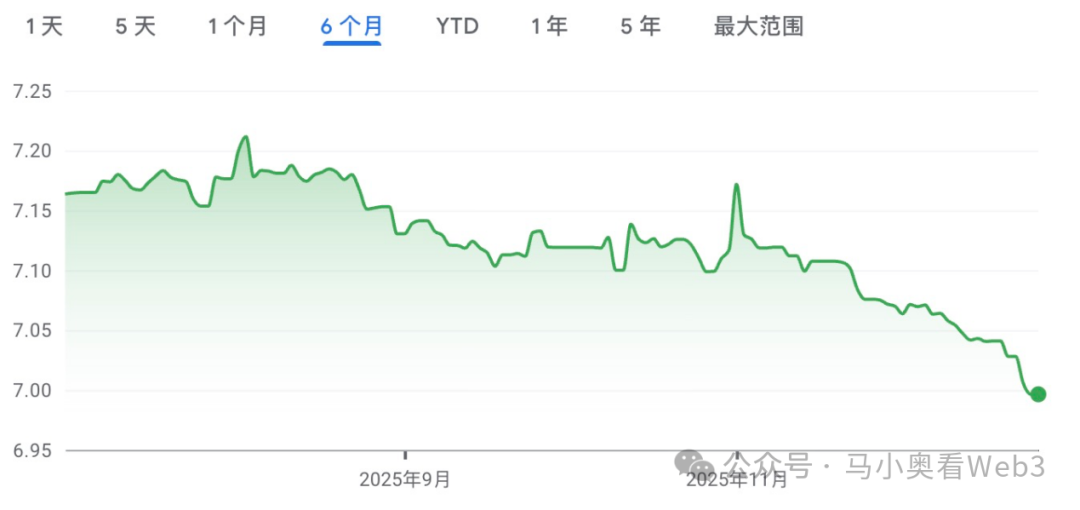
Core Insights - The offshore RMB/USD exchange rate has successfully broken the 6.97 mark, reaching a high of 6.9678, marking the highest level since May 2023, driven by both short-term market sentiment and long-term support from an improved RMB ecosystem and enhanced cross-border payment convenience [2] Group 1: Support Behind the Exchange Rate Breakthrough - The recent appreciation of the RMB is attributed to ongoing upgrades in internal financial infrastructure, including the launch of the digital RMB 2.0, which offers interest on wallet balances at a rate of 0.05%, making China the first economy to provide interest on central bank digital currency [3] - As of November 2025, the digital RMB has recorded 3.48 billion transactions totaling 16.7 trillion yuan, with 230 million personal wallets and 1.884 million corporate wallets, indicating a growing penetration in cross-border scenarios [3] - The upcoming implementation of new CIPS business rules on February 1, 2026, will ease access for foreign institutions, enhancing the efficiency of RMB cross-border circulation with 190 direct participants and 1,567 indirect participants globally [3] Group 2: Analysis and Outlook on Appreciation Trend - The breakthrough of the 6.97 exchange rate reflects increasing market confidence in the RMB, with the interest mechanism for digital RMB wallets enhancing their savings attributes and reducing holding risks, thereby attracting more users [4] - The global expansion of the CIPS system facilitates easier use of the RMB in cross-border trade and investment, steadily improving its international acceptance [4] - Long-term trends suggest that the RMB will continue to appreciate, supported by the ongoing development of the digital RMB ecosystem and the implementation of new CIPS regulations, although exchange rate fluctuations will still be influenced by global economic conditions and monetary policies of major economies [4]
港股开年大涨:人民币升值与科技驱动四大行业ETF表现亮眼
Xin Lang Cai Jing· 2026-01-02 16:52
Group 1 - The Hong Kong stock market showed a strong start in 2024, with the Hang Seng Index rising by 2.76% on January 2, breaking through the previous month's technical platform [1] - The appreciation of the Renminbi against the US dollar is a significant factor driving the rise in Hong Kong stocks, with predictions of further appreciation to around 6.8 by 2026, encouraging foreign capital to invest in Renminbi assets [1] - Strong expectations in the global technology sector, particularly in AI and semiconductors, are positively impacting Hong Kong stocks, with notable performance from Samsung due to high demand for AI-related storage chips [1] Group 2 - The Hang Seng Technology Index rose by 4% on January 2, supported by the strong performance of key technology stocks, including the anticipated listing of Baidu's Kunlun chip and the positive reception of Wall Street technology [2] - Collaborations between companies like Huahong Semiconductor and Huahong Group are expected to positively impact financial reports, further validating market optimism [2] - The financial sector, especially the insurance industry, has shown strong performance, with the appreciation of the Renminbi significantly enhancing the relative value of financial assets, attracting more investment attention [2] Group 3 - The rise of non-ferrous metal stocks, exemplified by Zijin Mining and Luoyang Molybdenum, reflects the active market for precious and minor metals, with optimistic market sentiment towards the sector [3] - In the consumer sector, ETFs related to home appliances and tourism have performed well, with over 208 million people expected to travel during the New Year period, a 21% increase year-on-year, boosting stocks related to travel [3] - Overall, the combination of Renminbi appreciation, global technology resonance, and strong performance across four key industries has set a positive foundation for the Hong Kong stock market at the beginning of the year [3]
【真灼港股名家】创5年来最大年度升幅 人民币升势未止
Sou Hu Cai Jing· 2026-01-02 13:55
自去年4月开始,人民币从7.35低位拾级而上,在2025年最后一个交易日,人民币更升穿7算心理关口,并触及6.9855,为两年半来首 次,主要因为年末出口商集中抛售美元的推动下,人民币走强。 管理人民币升值速度对央行而言颇具挑战。如果人民币升得太快,会对出口行业造成明显冲击;但人民币升值有助于推动经济向消 费驱动转型。央行需要在[短期阵痛与长期收益] 之间取得平衡。 回顾去年,人民币兑美元确实显著走强,尤其踏入11月下旬后升值速度加快。不过,若从单一美元转向整体货币篮子,便会发觉, 人民币对其他主要非美货币的表现仍然偏弱,反映今次升值更多是美元因素主导,而非人民币全面转强。 人民币2025全年累计升值约5%,终止连续三年贬值走势,并创五年来最大年度升幅。人行近期试图通过更偏弱的中间价指引以及官 媒口头警示来防止人民币升值过快,但未能扭转人民币持续走强的趋势。 周三是2025年最后一个交易日,主要中资国有银行进行年终结账,这令即期市场上的购汇需求阶段性减少,从而推升人民币。预计 这波"沽卖美元潮"可能延续至农历新年结束。 部分投行此前已普遍预期人民币将升破7关口。例如,美国银行全球研究预计,到2026年第四季度 ...
港股收评:新年开门红!恒科指大涨4%,科技股、芯片股大爆发
Ge Long Hui· 2026-01-02 08:57
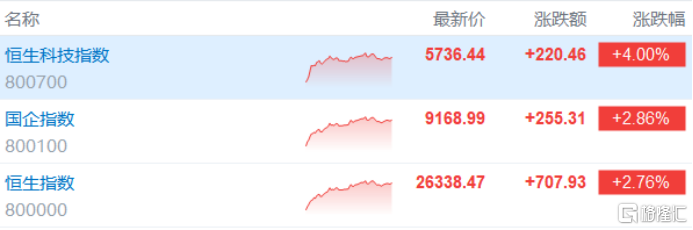
Market Overview - The Hong Kong stock market experienced a significant rally on January 2, with the Hang Seng Index rising by 2.76% to close at 26,338.47 points, the Hang Seng China Enterprises Index increasing by 2.86%, and the Hang Seng Tech Index surging by 4% [1] Sector Performance - Major technology stocks saw collective gains, with Baidu rising by 9.35%, Tencent and Alibaba increasing by over 4%, and Kuaishou and JD.com gaining over 3% [3][5] - Semiconductor stocks also performed well, with Hua Hong Semiconductor up by 9.4% and SMIC increasing by over 5% [3][10] - Wind power equipment stocks surged, with Goldwind Technology rising nearly 21% [3] - The gaming sector saw broad increases, with NetEase, Zhongyou Game, and Qingci Game all rising over 6% [3][14] - Some sectors, including film, lottery, and dairy products, showed weakness [3] Notable Stocks - Hua Hong Semiconductor's stock price reached 81.30 HKD, up by 9.42% [6][11] - Baidu's stock price closed at 143.80 HKD, up by 9.35% [6][16] - Goldwind Technology's stock price increased to 16.22 HKD, up by 20.95% [9] - The stock of the newly listed company, Birun Technology, surged by 75.8% on its debut, reaching a market capitalization of nearly 81.3 billion HKD [10] Industry Developments - The aerospace and defense sector saw gains, with Dalu Aerospace Technology Holdings rising over 13% [8] - The electric power equipment sector experienced widespread increases, with several companies, including Shanghai Electric and Harbin Electric, also showing positive performance [9] - The tourism and travel sector was active, with Hong Kong Travel and Ctrip Group both rising over 5% [12][13] - The gaming sector remained vibrant, with multiple companies, including Feiyu Technology and NetEase, showing significant gains [14] Future Outlook - According to industry analysts, the Hong Kong stock market is expected to continue its bullish trend in 2026, with a focus on growth and value reconstruction [20] - The net profit growth rate for Hong Kong Stock Connect constituent stocks is projected to reach 7.3% year-on-year, with sectors like information technology, discretionary consumption, and healthcare leading the growth [20]


今天,全线爆发!港股大涨700点,恒科涨超4%,壁仞科技一度涨近120%,百度大涨9%,A50拉升,人民币走强
Mei Ri Jing Ji Xin Wen· 2026-01-02 07:18
半导体指数暴涨8.3%。截至发稿,华虹半导体涨超10%、中芯国际(00981.HK)涨9.89%。消息方面,华虹半导体发布多份公告表示,公司拟通过发行股份 方式向华虹集团等4名交易对方购买其合计持有的华力微97.4988%股权,并拟向不超过35名符合条件的特定对象发行股票募集配套资金。 "港股GPU第一股"壁仞科技今日上市,盘中表现活跃。该股盘初一度大涨近120%,截至发稿,涨幅有所回落,但仍大涨80%,总市值突破800亿港元。 每经编辑|何小桃 1月2日,港股2026年首个交易日迎来开门红。 在科技股领涨下,港股市场走势强劲,截至发稿,恒生指数大涨近700点,涨幅为2.73%,恒生科技指数涨超4%。 | 恒生指数 | 恒生国企 | 恒生科技 | | --- | --- | --- | | 26329.53 | 9167.38 | 5746.31 | | +698.99 +2.73% | +253.70 +2.85% | +230.33 +4.18% | | 恒指期货 | 港股通50 | 恒生生物科技 | | 26395 | 3974.99 | 14442.02 | | +747 +2.91% | +96.5 ...

