
财政赤字

Search documents
阿根廷国会与总统米莱“斗法”
Xin Hua Wang· 2025-10-09 09:01
Group 1 - The Argentine Congress passed a bill allowing either chamber to overturn presidential decrees with a simple majority, escalating the conflict between Congress and President Milei [1] - The bill was approved with 140 votes in favor, 80 against, and 17 abstentions, and is expected to pass in the Senate soon [1] - Since taking office in December 2023, President Milei has issued over 70 decrees to address issues like high inflation, fiscal deficits, and external debt, but many have been overturned by Congress [2] Group 2 - The upcoming midterm elections on October 26 will see half of the Chamber of Deputies and one-third of the Senate seats contested, following Milei's coalition's losses in local elections [2] - President Milei is seeking to expand his party's minority seats in Congress to facilitate economic reforms and is negotiating a $20 billion aid package with the U.S. government [5] - To boost his popularity, Milei is attempting to revive his "rock star" image and has been involved in public events, including a music concert [5]


美国2025财年预算赤字达1.8万亿美元 关税收入飙升难掩财政压力
智通财经网· 2025-10-08 22:25
Core Insights - The U.S. federal government recorded a budget deficit of approximately $1.8 trillion for the fiscal year 2025, nearly unchanged from 2024, with a slight reduction of $80 billion [1][2] - Despite a significant increase in tariff revenue, government spending growth outpaced fiscal improvements, highlighting fiscal vulnerability amid economic expansion [1] Revenue Summary - Federal government revenue increased by 6% year-on-year, amounting to approximately $3.08 trillion [1] - Customs revenue reached $195 billion, more than doubling from the previous year's $77 billion, largely due to new tariffs imposed by the Trump administration [1][2] - Corporate income tax revenue decreased by about 15% compared to 2024, attributed to the Tax and Expenditure Act allowing greater investment deductions for corporations [1] Expenditure Summary - Government spending grew by 4%, totaling approximately $3.01 trillion, with interest on public debt surpassing $1 trillion for the first time [1] - Social Security expenditures increased by $121 billion due to cost-of-living adjustments and new eligibility criteria for public sector employees [2] - Education Department spending plummeted by $234 billion, primarily due to student loan accounting adjustments and significant cuts to the department's functions [2] Fiscal Outlook - The estimated budget deficit as a percentage of GDP for fiscal year 2025 is approximately 5.9%, a slight decrease from 6.4% in the previous fiscal year [2] - The Treasury Secretary aims to reduce the deficit ratio to 3% by 2028, the end of Trump's term, amidst concerns over maintaining a deficit close to 6% during non-crisis periods [2]
2025年10月流动性展望:流动性宽松或为当前债市最大的确定性
Xinda Securities· 2025-10-08 11:13
1. Report Industry Investment Rating No relevant content provided. 2. Core Viewpoints of the Report - Liquidity easing is the most certain factor in the current bond market. Although there are some disturbances in October, as long as the central bank's attitude remains unchanged, the impact of tool maturities is relatively limited, and the government bond supply may shrink significantly, which will ease the tax - period disturbances. The probability of monetary policy tightening is low, and the DR001 and DR007 central levels in October are expected to remain slightly below 1.4% and 1.5% [3][66]. 3. Summary According to the Directory 3.1 August: Government Deposits Leaked Heavily, and the Excess Reserve Ratio Dropped to a Low Level - The excess reserve ratio in August decreased by 0.1pct to 1.1% compared with July, lower than the expected 1.4%, mainly due to the 337 billion yuan increase in government deposits instead of the expected decline. This was caused by the slowdown in narrow - fiscal expenditure growth, low broad - fiscal deficit scale, treasury cash fixed - deposit withdrawal, and slow use of replacement bonds [6]. - The central bank's claims on other depository corporations in August were slightly higher than the net funds injected through reverse repurchase, MLF, PSL, SLF, and other structural monetary policy tools. The legal deposit reserve of the central bank was slightly lower than expected, while currency issuance and foreign exchange holdings were close to expectations [15]. 3.2 September: The Central Bank Offset Exogenous Disturbances with Medium - term Liquidity, and the Fundamentals Fluctuated but the Central Level Remained Stable - The broad - fiscal deficit scale in September may be at a relatively high level compared with the same period in previous years. The expenditure of replacement bonds will cause additional leakage of government deposits, and the net financing scale of government bonds will decline slightly compared with August. It is expected that government deposits will decrease by about 810 billion yuan month - on - month, which will supplement liquidity [16]. - In September, bank reserve payments and currency issuance increased seasonally, with the former expected to rise by 310 billion yuan and the latter by 250 billion yuan. Foreign exchange holdings may continue to withdraw about 70 billion yuan in funds [16]. - In the open market, the central bank's net injection of pledged reverse repurchase in September was 390.2 billion yuan, the net injection of outright reverse repurchase was 300 billion yuan, and the net injection of MLF was 300 billion yuan. Assuming that PSL and other structural monetary policy tools had a net withdrawal of about 200 billion yuan, the central bank's claims on other depository corporations may increase by about 790 billion yuan month - on - month. It is expected that the excess reserve ratio in September will be about 1.4%, an increase of about 0.3pct compared with August, similar to June [16][26]. - Although the central bank did not continuously increase the injection during the period of rising funds in September, the average values of DR001 and DR007 in September were roughly the same as those in July - August, indicating that the central bank maintained a relatively loose attitude within the existing framework, and the change in its operation mode may be related to exogenous disturbances and tool positioning adjustments [28]. - Since the beginning of this year, the central bank has increased the scale of policy tool injections to offset exogenous disturbances such as government deposits and bond maturity. Since Q3, the central bank has shifted its injections more towards medium - term outright reverse repurchase and MLF. After the increase in medium - and long - term liquidity injection scale, the central bank has relaxed the control of short - term fluctuations in funds [35]. - In September, the central bank adjusted the 14 - day reverse repurchase to a fixed - quantity, interest - rate tender, and multiple - price winning bid, which may lower the 14 - day reverse repurchase interest rate. After the adjustment, the 14 - day reverse repurchase became a supplement to the 7 - day reverse repurchase, focusing on providing cross - quarter funds [38]. - The lower net lending of banks in September compared with June may be related to the weak sentiment of non - bank institutions and the decline in leverage willingness, which released potential risks in the funds market. The early progress of cross - quarter operations in September was also an important reason for the loose funds at the end of the month [41]. 3.3 October: Disturbances Mainly Come from Maturities and Tax Payments, but the Certainty of Liquidity Easing under the Central Bank's Care Remains Strong - In October, the broad - fiscal revenue and expenditure may show an anti - seasonal deficit, and the supply pressure of government bonds will be significantly weakened. It is expected that government deposits will increase by about 570 billion yuan month - on - month, significantly lower than the same period in previous years. After the National Day holiday, cash reflux may release about 150 billion yuan in liquidity, and the reserve payment base may decrease seasonally by about 30 billion yuan [50]. - In the open market, it is assumed that the balance of pledged reverse repurchase will drop to 2 trillion yuan at the end of October, corresponding to a net withdrawal of about 660 billion yuan in reverse repurchase. MLF and outright reverse repurchase may continue to be over - renewed, with net injections of 100 billion yuan and 300 billion yuan respectively. Assuming that PSL and other structural monetary policy tools have a net withdrawal of about 200 billion yuan, the central bank's claims on other depository corporations will decrease by about 460 billion yuan month - on - month. It is also assumed that the central bank will restart bond purchases of 100 billion yuan. Overall, it is expected that the excess reserve ratio in October will be about 1.2%, a decrease of 0.2pct compared with September, at a neutral level for non - quarter - end months [50]. - The central bank's Q3 monetary policy meeting continued the tone of the Politburo meeting in July. Although the meeting's description of the economy was slightly weakened, it emphasized that monetary policy should promote growth and prices to be at a reasonable level. The probability of reserve requirement ratio cuts and interest rate cuts in Q4 cannot be ruled out, but the central bank may still need to observe, and potential policy changes need to be observed in important meetings in mid - to late October [64]. - The exogenous disturbances in the funds market in October mainly come from tax periods and the large - scale maturity of policy tools. As long as the central bank's attitude remains unchanged, the impact of tool maturities is relatively limited. The reduction in government bond supply in October will ease tax - period disturbances. The probability of monetary policy tightening is low. It is expected that the central levels of DR001 and DR007 in October will remain slightly below 1.4% and 1.5%, and whether they can become looser still needs to observe the central unified deployment [66].
美国政府停摆,美元为何回升?:——国庆中秋假期宏观综述
Huafu Securities· 2025-10-08 07:48
Group 1: US Economic Situation - The US government shutdown began on October 1, 2023, due to unresolved disagreements between the Republican and Democratic parties regarding healthcare subsidies, leading to uncertainty in economic data releases[3] - The ADP employment data for September indicated a decrease of 32,000 jobs, marking the lowest monthly performance since April 2023, which reflects significant impacts from tariff policies on the labor market[3][12] - Despite initial declines, the US dollar index rebounded by 0.8% from October 2 to October 7, reaching approximately 98.5, close to the previous high of 98.55 on September 25[3][12] Group 2: Eurozone and Japan Economic Challenges - The resignation of French Prime Minister Le Maire highlighted fiscal difficulties in the Eurozone, with France aiming to reduce its budget deficit to 4.7% of GDP by 2026 and further to about 3% by 2029[4][15] - The Eurozone's manufacturing PMI fell to 49.8 in September, indicating a contraction, while the US ISM manufacturing PMI showed a recovery, suggesting that the worst impacts of tariff shocks on US production confidence may have passed[4][16][17] - Japan's new Prime Minister, Kishi, is expected to pursue fiscal stimulus and monetary easing, causing the yen to depreciate significantly, with the USD/JPY exchange rate nearing 151, the lowest level since March 2023[5][20][21] Group 3: China's Manufacturing Sector - China's manufacturing PMI rose slightly to 49.8 in September, driven by a rebound in new export orders, although it remained below the expansion threshold of 50[6][23] - The new export orders index increased by 0.6 percentage points to 47.8, indicating a short-term "export rush" amid the ongoing tariff negotiations with the US[6][23] - The production index rose by 1.1 percentage points to 51.9, reflecting improved production expansion, although domestic demand remains weak[6][23][24]
刚刚 开盘大涨!又一次见证历史
Zhong Guo Ji Jin Bao· 2025-10-07 03:12
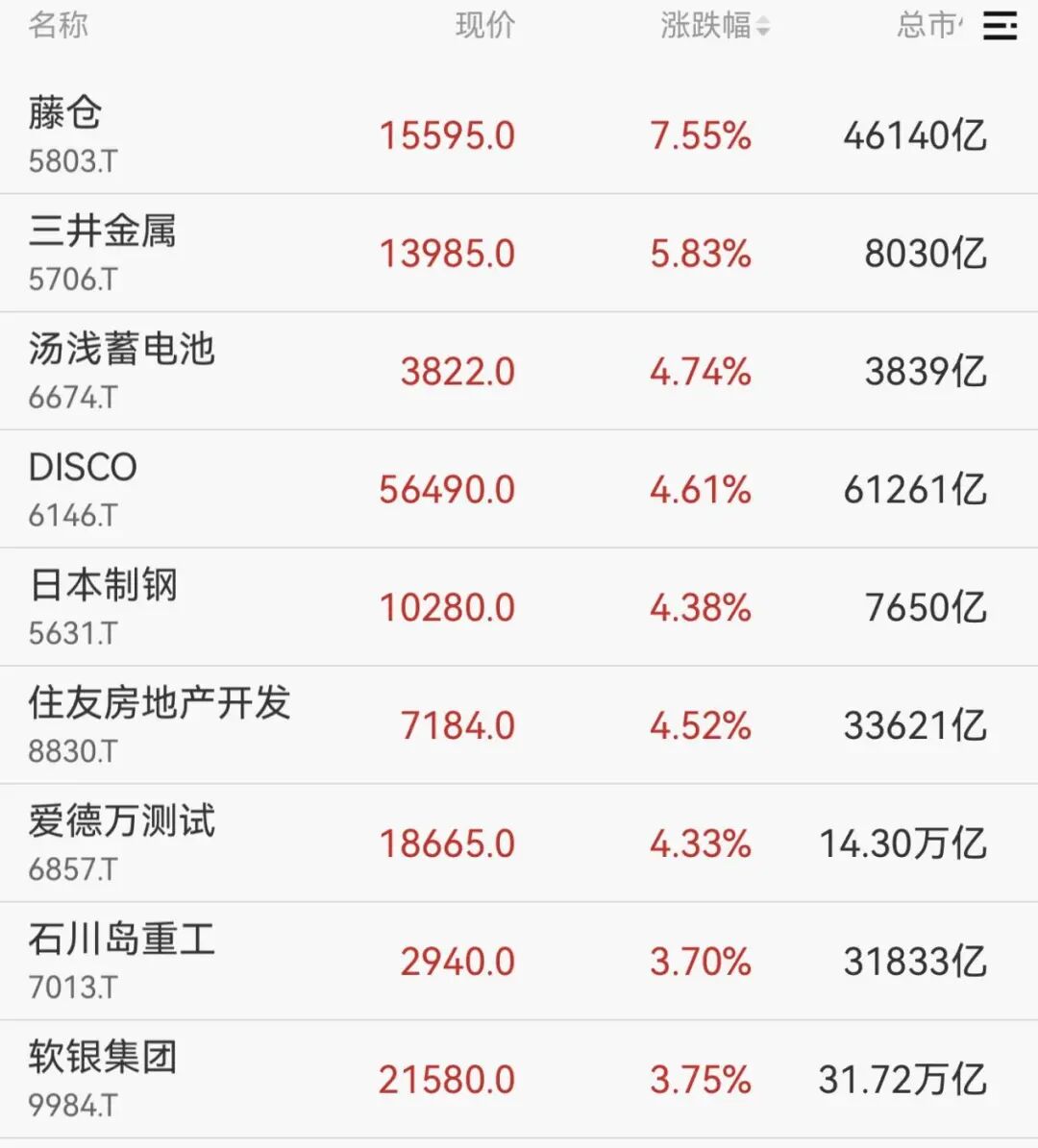
Market Overview - Japanese stock market opened significantly higher, with the Nikkei 225 index surpassing the 48,500 mark, closing at 48,449.85, up 1.05% for the day [3] - Notable individual stock performances include Fujikura, which surged over 7%, and other companies like Advantest, SoftBank Group, and DISCO also saw gains [3][4] Economic Indicators - Japan's foreign exchange reserves for September reached $1.3413 trillion, up from $1.3242 trillion previously [5] - Household spending in Japan for August increased by 2.3% year-on-year, exceeding the expected 1.2% growth, and showed a month-on-month increase of 0.6% against an expected 0.1% [5] - The Japanese Ministry of Finance plans to auction approximately 700 billion yen of 30-year government bonds, marking a market test for the new policies of the ruling party's president, Sanae Takaichi [5][6] Bond Market Dynamics - The Japanese long-term bond market is under pressure due to government debt reaching twice the GDP, with traditional buyers like life insurance companies showing reduced demand [6] - Goldman Sachs has warned that the election of Sanae Takaichi as the president of the ruling party may lead to increased volatility in Japan's long-term government bonds, potentially affecting bond markets in the US and UK as well [8] Gold Market Performance - Gold futures have reached a historic high, breaking the $4,000 per ounce mark for the first time, with a year-to-date increase of over 50% [9] - Spot gold also hit a record high at $3,973.56 per ounce amid ongoing concerns regarding the US government shutdown [9][10]
为什么市场对美国政府关门无动于衷?
伍治坚证据主义· 2025-10-06 08:45
Core Viewpoint - The recurring government shutdowns in the U.S. have become a normalized event, with the latest occurring on October 1, 2025, impacting over 800,000 federal employees and delaying crucial economic data, yet the financial markets remain largely unaffected [2][3][4]. Group 1: Impact on Economic Data - The shutdown has led to the postponement of key economic reports such as non-farm payroll and CPI data, creating challenges for analysts who must rely on private data sources to estimate employment rates [3][4]. - The Congressional Budget Office estimates that a one-month shutdown could reduce GDP by 0.3 percentage points, with unemployment potentially rising to between 4.8% and 5% [3]. Group 2: Market Reactions - Despite the shutdown, bond yields have shown minimal volatility, and the stock market continues to perform well, indicating a detachment from political events [3][4]. - Market participants appear to have developed a "selective blindness" towards political uncertainties, leading to a temporary reduction in market volatility [5]. Group 3: Long-term Implications - The ongoing political dysfunction and inability to pass budgets are eroding government credibility, which could have long-term consequences for economic stability and investor trust [4][6]. - The U.S. public debt has surpassed $35 trillion, over 130% of GDP, raising concerns about fiscal sustainability and the potential for a future financial crisis if political solutions remain ineffective [5][6]. Group 4: Global Trust and Currency Stability - The international standing of the U.S. dollar relies heavily on global trust in American institutions; frequent fiscal chaos may prompt other nations to diversify their reserves away from the dollar [6][8]. - Central banks worldwide have been increasing their holdings of gold and non-dollar assets, indicating a growing concern over the reliability of U.S. fiscal policy [6][8].

Federal Reserve's Miran says there is 'significant disinflation in the pipeline' despite rise in CPI
Youtube· 2025-10-03 23:15
Economic Context - The September jobs report is missing due to the government shutdown, leaving policymakers without crucial economic data as the Federal Reserve considers its next interest rate move [1][2] - The Federal Reserve relies on economic data to set monetary policy, making the absence of key reports like retail sales and inflation data problematic for decision-making [3][4] Fiscal Policy and Economic Indicators - The fiscal deficit has decreased by approximately $400 billion on an annualized basis from February to August compared to the previous fiscal year, indicating a significant policy shift [6] - Population growth has experienced substantial fluctuations, impacting the neutral interest rate and making current monetary policy more restrictive [7][8] Interest Rate Decisions - The neutral rate is estimated to be around 0.5% in real terms, suggesting that the Federal Reserve should move towards this rate more quickly due to recent tightening of policy [8][9] - Concerns are raised about the risks of an economic slowdown if interest rates remain too tight for an extended period [9] Inflation Dynamics - Current inflation data shows significant increases in food prices and other essentials, complicating the justification for cutting interest rates [19][20] - Shelter costs, which are a major component of inflation, are expected to see disinflation due to a lag in average rent adjustments compared to market rents [22][23] Policy Criticism and Responses - Criticism from economists like Larry Summers highlights concerns about the potential inflationary impact of current policies, with a call for more cautious approaches [26][28] - The Federal Reserve's recent rate cuts have not adversely affected the bond market, indicating a different economic landscape compared to previous years [17]

港府:本财年首五个月财政赤字676亿港元
智通财经网· 2025-09-30 12:26
Group 1 - The Hong Kong government reported a financial deficit of 67.6 billion HKD for the first five months of the fiscal year ending August 31, 2025 [1] - Total expenditure and revenue for the first five months were 311 billion HKD and 208.6 billion HKD, respectively [1] - The deficit was influenced by the timing of major income sources such as salaries tax and profits tax, which are primarily collected later in the fiscal year [1] Group 2 - The government issued bonds that generated 61.6 billion HKD in revenue and repaid 26.8 billion HKD in principal during the same period [1] - As of August 31, the fiscal reserves stood at 586.7 billion HKD [1]
新政权面临的经济挑战
Shang Wu Bu Wang Zhan· 2025-09-28 16:02
Group 1 - The core viewpoint is that Thailand's economy is showing signs of recovery but faces significant challenges that need to be addressed by the new government and its economic team [1] - InnovestX predicts a more severe economic slowdown in the fourth quarter, potentially lasting until mid-2026, with growth rates possibly falling below 1% over the next four quarters, leading to an annual GDP growth rate of only 1.8% this year and 1.4% next year [1] - The Thai government, led by Anutin, faces two major risks: the continued appreciation of the Thai Baht, which has risen 6.4% this year, and the potential fiscal crisis following Fitch's downgrade of Thailand's sovereign credit rating from "stable" to "negative" [1] Group 2 - InnovestX highlights that the key issue is fiscal problems, as government revenue growth is not keeping pace with expenditure growth, leading to an expanding fiscal deficit [2] - Two fiscal indicators show increasing risk: public debt has reached 65.4%, nearing the GDP threshold of 70%, and tax revenue growth has decreased from 3.2% last year to 1.2% [2] - The budget deficit as a percentage of GDP is stable at 4.3%, down from 4.6% last year, and the interest burden relative to fiscal revenue is at 8.6%, below the investment-grade standard of 10% [2] Group 3 - The Finance Minister has proposed a plan to stimulate the economy in the short term and enhance revenue-generating capacity in the long term through various measures [3] - The "Khon La Krueng Plus" co-payment scheme offers tax benefits and helps businesses enhance their e-commerce capabilities, while also reforming government revenue without legal changes and establishing a new medium-term fiscal framework [3] - InnovestX views this plan positively for its potential to provide short-term economic stimulus and long-term investment growth, but notes concerns about implementation challenges due to the government's limited four-month tenure and its minority status [3]
混沌天成期货: 贵金属动能按下“快进键” 波动率同步攀升
Jin Tou Wang· 2025-09-28 07:45
Market Performance - On September 26, the Shanghai gold futures contract reported a price of 862.50 CNY per gram, with an increase of 0.88% from the previous day [1][2] - The opening price for the day was 857.70 CNY per gram, with a high of 865.28 CNY and a low of 857.38 CNY [1][2] Macroeconomic Insights - The U.S. Federal Reserve officials expressed differing views on interest rate policies, indicating ongoing internal divisions regarding the need for further rate cuts [3] - Recent economic data showed an increase in U.S. personal consumption expenditures and GDP growth, leading to a reduced necessity for rate cuts by the Fed [4] - The U.S. manufacturing PMI for September was recorded at 50.2, remaining above the growth threshold, while the Eurozone's PMI showed a decline [4] Fiscal and Monetary Conditions - The U.S. banking system's reserves fell below $3 trillion for the first time since January 1, indicating tightening liquidity conditions [5] - The U.S. fiscal deficit for August was reported at $344.79 billion, driven by increased spending and weaker corporate tax revenues [5] - The rising fiscal deficit and national debt, now at $37 trillion, continue to support precious metals [5] Political Developments - Significant political events have heightened global sensitivity, with the U.S. imposing new tariffs on pharmaceutical products and other goods, potentially benefiting gold in the long term [6] Precious Metals Market Dynamics - Precious metals, particularly silver, have seen notable price increases, driven by rising leasing rates in the silver market [7] - Short-term fluctuations in precious metals are influenced by the U.S. dollar index and Treasury yields, with recent liquidity releases leading to recoveries in gold, silver, and equities [7] - Long-term support for precious metals remains strong due to global debt and geopolitical factors, although caution is advised for short-term trading volatility [7]