扩内需

Search documents
反内卷、新周期——能源周期2026投资策略
2025-12-15 01:55
Summary of Key Points from Conference Call Records Industry Overview Chemical Industry - The chemical industry is expected to experience both cyclical and growth opportunities in 2026 due to domestic supply-side reforms and demand-side expansion policies, alongside improved overseas demand. Oil prices are projected to stabilize around $60 per barrel, alleviating inventory pressure on chemicals. [4][12] - Key sectors to focus on include spandex, nylon, and rigid demand sectors like pesticides and fertilizers, particularly those with strong demand resilience. [4] Power Industry - The power industry is segmented into thermal, hydro, nuclear, and renewable energy, each presenting unique investment opportunities. [5][6] - Thermal power's capacity price has increased to over 50%, enhancing profitability, although its share of installed capacity is expected to decline. [5] - Hydro power is benefiting from improved water conditions, while nuclear power is set to experience a production peak between 2026 and 2027, indicating strong growth potential. [6][7][8] Non-Ferrous Metals Industry - The non-ferrous metals index has surged by 78% by the end of 2025, indicating a new upward cycle. Valuations remain within a safe range, with expectations of price increases driven by Fed rate cuts and improved US-China trade relations. [12] - Specific opportunities include increased demand for gold and silver, as well as investment prospects arising from copper supply shortages. [12] Building Materials Industry - The building materials sector is recovering confidence due to factors like the Western Development strategy and anti-involution policies. The fiberglass manufacturing sector has led the market with a 68% increase. [28][29] - Structural investment opportunities are anticipated in 2026, particularly in traditional materials like cement and glass, driven by urban renewal and new energy demands. [29][30] Key Investment Opportunities Lithium Battery Sector - The lithium battery sector is expected to maintain strong growth despite concerns over slowing demand for electric vehicle batteries. The sector is projected to grow at a rate of 10% to 15% in 2026, with significant demand from the energy storage market. [34][35] - Key materials such as electrolyte additives, particularly VC additives, are expected to see price increases due to their sensitivity and tight supply conditions. [37] Gold Market - The passage of the "Great Beauty Act" is anticipated to increase the US fiscal deficit, negatively impacting asset credit and accelerating global central bank gold purchases, supporting gold prices. A 10% increase in gold prices is expected by 2026. [3][14] - A-share gold companies are entering a growth phase in mining output, with performance expected to improve significantly. [14] Construction Sector - The construction industry should focus on urban renewal and major engineering projects, as well as opportunities arising from mergers and acquisitions. [18][27] - Key players in the construction of clean energy projects in the western regions, such as China Power Construction and China Energy Engineering, are recommended for tracking. [20][19] Additional Insights - The hydro power sector is expected to see strong support from improved water conditions, with significant growth potential in the long term. [7] - The nuclear power sector is projected to have a compound annual growth rate of around 10% due to a peak in new production. [8][9] - The building materials sector is expected to benefit from urban renewal policies and the demand for high-quality green materials as the real estate market evolves. [32][33]
十大券商一周策略:跨年行情蓄势待发,风格切换可能会越来越强,关注低位价值板块
Sou Hu Cai Jing· 2025-12-15 00:08
Group 1 - The central economic work conference has set the tone for 2026 economic work, with expectations for a "cross-year market" and "spring excitement" rising among broker reports [1] - The policy focus on "expanding domestic demand and countering involution" is expected to lead the market out of deflation, with technology sectors like AI computing power and commercial aerospace being key offensive directions [1][4] - There is a growing preference for low-volatility, high-dividend assets, indicating a potential market style switch [1][3] Group 2 - Citic Securities suggests seeking intersection in configurations, focusing on products with overseas exposure and positive changes in domestic demand as catalysts [2] - The report emphasizes that while external demand products have been validated, the potential for exceeding expectations is limited, and investors' low expectations could lead to valuation elasticity if domestic demand surprises positively [2] - The focus remains on industries where China has a global share advantage, such as non-ferrous metals, chemicals, and new energy, with an emphasis on companies that can enhance global pricing power [3] Group 3 - The market is expected to enter a new phase of recovery, with significant support from previous price levels and a shift in investor sentiment following recent adjustments [5] - Structural risks are emerging, which could hinder the sustained strength of advantageous themes, as indicated by high transaction concentration [5][6] - The focus on low-volatility and stable return assets is increasing, with potential interest in service consumption sectors like aviation, duty-free, and hotels [3][12] Group 4 - The central economic work conference has highlighted the importance of expanding domestic demand and addressing involution, clarifying the path out of deflation [7][19] - The emphasis on enhancing the income of middle and low-income groups and stimulating private investment indicates a shift towards endogenous growth drivers [7] - The conference also pointed out the need for a unified national market and the deepening of anti-involution measures, which are crucial for the recovery of corporate profits and subsequent improvements in resident income [8] Group 5 - The new policy deployment is expected to support the A-share market's cross-year performance, with a focus on TMT and advanced manufacturing sectors [9] - The historical performance of the A-share market during the start of the "13th Five-Year" and "14th Five-Year" plans suggests a positive outlook for 2026 [9] - The report indicates that the market may experience fluctuations due to various domestic and international events, but the overall economic policy is expected to remain supportive [9] Group 6 - The AI industry is characterized by a competition in full-stack capabilities and deep penetration into various application scenarios [10][11] - Domestic firms are focusing on building a full-stack system in the computing hardware sector, with significant advancements in AI solutions and infrastructure [11] - The demand for AI infrastructure is expected to drive growth in related sectors, including telecommunications and high-spec data centers [11][16] Group 7 - The commercial aerospace sector is entering a period of heightened activity, supported by new policies and government initiatives [17] - The establishment of a national commercial aerospace development fund aims to attract private investment and enhance the capabilities of commercial companies [17] - Recent advancements in satellite internet and frequent launches are expected to benefit the entire aerospace industry chain [17]
国家发展改革委明确2026年九大重点任务
Zheng Quan Ri Bao· 2025-12-14 16:18
12月12日至13日,全国发展和改革工作会议在北京召开。会议总结2025年发展改革工作,研究部署2026 年发展改革重点任务。 会议指出,今年是很不平凡的一年,我国经济顶压前行、向新向优发展,实现质的有效提升和量的合理 增长,年度和"十四五"规划目标任务即将顺利完成。会议强调,发展改革系统要深刻领会习近平总书记 在中央经济工作会议上提出"五个必须"的重要内涵,准确把握明年经济工作的总体要求,结合职能扎扎 实实做好明年发展改革重点工作。 从此次部署的2026年发展改革九项重点任务来看,编制实施好"十五五"规划被置于首位。会议强调,要 深入领会党中央战略意图,坚持因地制宜,提高规划质量,加强规划内容审核衔接,把《中共中央关于 制定国民经济和社会发展第十五个五年规划的建议》确定的各项决策部署和工作要求落到实处。同时, 加强经济监测预警分析,完善政策工具箱,加强预期管理,做好今明两年政策衔接、工作衔接,推动政 策靠前发力,实现良好开局。 在扩内需方面,会议提出,"多措并举促进投资止跌回稳""提振消费要出实招出新招"。 在投资方面,会议强调,明年发展改革系统要充分发挥"两重"建设、新增地方政府专项债券等各类政府 投资资 ...
管涛:明年经济工作要坚持政策支持与改革创新并重
Di Yi Cai Jing· 2025-12-14 12:25
本次会议将去年底提出的五个"必须统筹"改为新五个"必须"。 明年预算赤字率或继续维持在4%左右,但新增政府债务规模(包括赤字、专项债和特别国债)或超过 今年11.86万亿元的水平。 关于适度宽松的货币政策,会议强调把促进经济稳定增长、物价合理回升作为货币政策的重要考量,灵 活高效运用降准降息等多种政策工具。人民银行主要负责人在会后接受媒体采访时表示,央行将继续实 施好适度宽松的货币政策,把握好政策实施的力度、节奏和时机,为经济稳定增长和金融市场稳定运行 创造良好货币金融环境。由此可见,货币政策的支持性立场不会改变,但期待大幅宽松是不现实的。明 年重点是要在优化结构性货币政策工具运用、加强与财政政策协同的基础上,进一步畅通货币政策传 导,统筹做好五篇金融"大文章"。会议连续四年提出"保持人民币汇率在合理均衡水平上的基本稳定", 这表明防止汇率超调仍是当前宏观调控的重中之重。 日前召开的中央经济工作会议(下称"会议")对2026年经济工作做出了重大部署。2026年是"十五五"开 局之年,会议通稿内容与《中共中央关于制定国民经济和社会发展第十五个五年规划的建议》(下 称"'十五五'规划建议")一脉相承,是从"写意画 ...
国金策略:国内中央经济工作会议定定调扩内需、反内卷,走出通缩路径明晰
Sou Hu Cai Jing· 2025-12-14 10:10
Group 1 - The macro effects brought by AI investment will be more important than AI itself, as evidenced by the significant drop in AI tech stocks like Oracle and Broadcom, which reflects market concerns about future performance despite increased capital expenditure guidance [2][12][13] - The recent drop in AI stocks does not affect the upward adjustment of AI investment guidance, indicating a divergence between AI stock performance and the broader macroeconomic benefits of AI investment [2][12][33] Group 2 - The recent interest rate cuts and the Federal Reserve's announcement to purchase short-term government bonds are expected to strengthen the trend of investment exceeding consumption in the real economy [3][15][17] - The rising unemployment rate and declining average hourly wages in the U.S. are likely to catalyze further interest rate cuts, with a potential path from AI investment to monetary policy and then to real economic demand recovery [3][17] Group 3 - The Central Economic Work Conference in China has set the tone for expanding domestic demand and addressing "involution," clarifying the path out of deflation [4][20][22] - The focus on expanding domestic demand has shifted from government-led initiatives to endogenous drivers, emphasizing income growth for a broader population and activating private capital [4][22][23] - The conference's emphasis on "anti-involution" in the manufacturing sector is crucial for corporate profit recovery, which historically leads to improvements in employment and wages [4][23][26] Group 4 - Despite market volatility related to AI stock performance and interest rate expectations, the actual impacts on the fundamentals should be the focus, as AI investment continues to be adjusted upwards and will stimulate manufacturing demand [5][33] - Recommendations include focusing on industrial resource chains benefiting from AI investment and the recovery of global manufacturing, as well as opportunities in China's equipment exports and consumer sectors [5][33]

消费者服务行业周报(20251208-20251212):关注中央经济工作会议“扩内需”相关政策,看好服务消费空间-20251214
Huachuang Securities· 2025-12-14 09:43
Investment Rating - The report maintains a "Recommend" rating for the consumer services industry, highlighting optimism about service consumption potential [1]. Core Viewpoints - The Central Economic Work Conference emphasized the importance of domestic demand and plans to implement measures to boost consumption, including a focus on enhancing the supply of quality goods and services [4]. - The report suggests that service consumption is expected to be a key driver for domestic demand in 2026, with potential growth in holiday policy optimization and consumption voucher issuance [4]. - Key investment targets include hotels, human resources services, duty-free sectors, gaming companies, internet platforms, integrated tea dining, innovative tourism sites, and the sports sector [4]. Industry Basic Data - The consumer services industry comprises 55 listed companies with a total market capitalization of 498.804 billion yuan and a circulating market capitalization of 457.081 billion yuan [1]. Relative Index Performance - The consumer services sector experienced a decline of 0.76% this week, while the overall A-share market rose by 0.27% and the CSI 300 index fell by 0.08% [7]. - The sector's performance over the past month shows a relative underperformance compared to the CSI 300 index [2][7]. Weekly Industry Insights - The report notes that the social services sector's stock performance was mixed, with notable gains in companies like China High-Tech and China Oriental Education, while others like Haidilao and Wanda Hotel Development faced declines [4][19]. - The report also highlights significant announcements from various companies, including share buybacks and management changes [34]. Upcoming Shareholder Meetings - Several companies in the consumer services sector have scheduled shareholder meetings in the coming month, including Long White Mountain and Chongqing Department Store [35].
A股策略周报20251214:齿轮仍在转动-20251214
SINOLINK SECURITIES· 2025-12-14 08:26
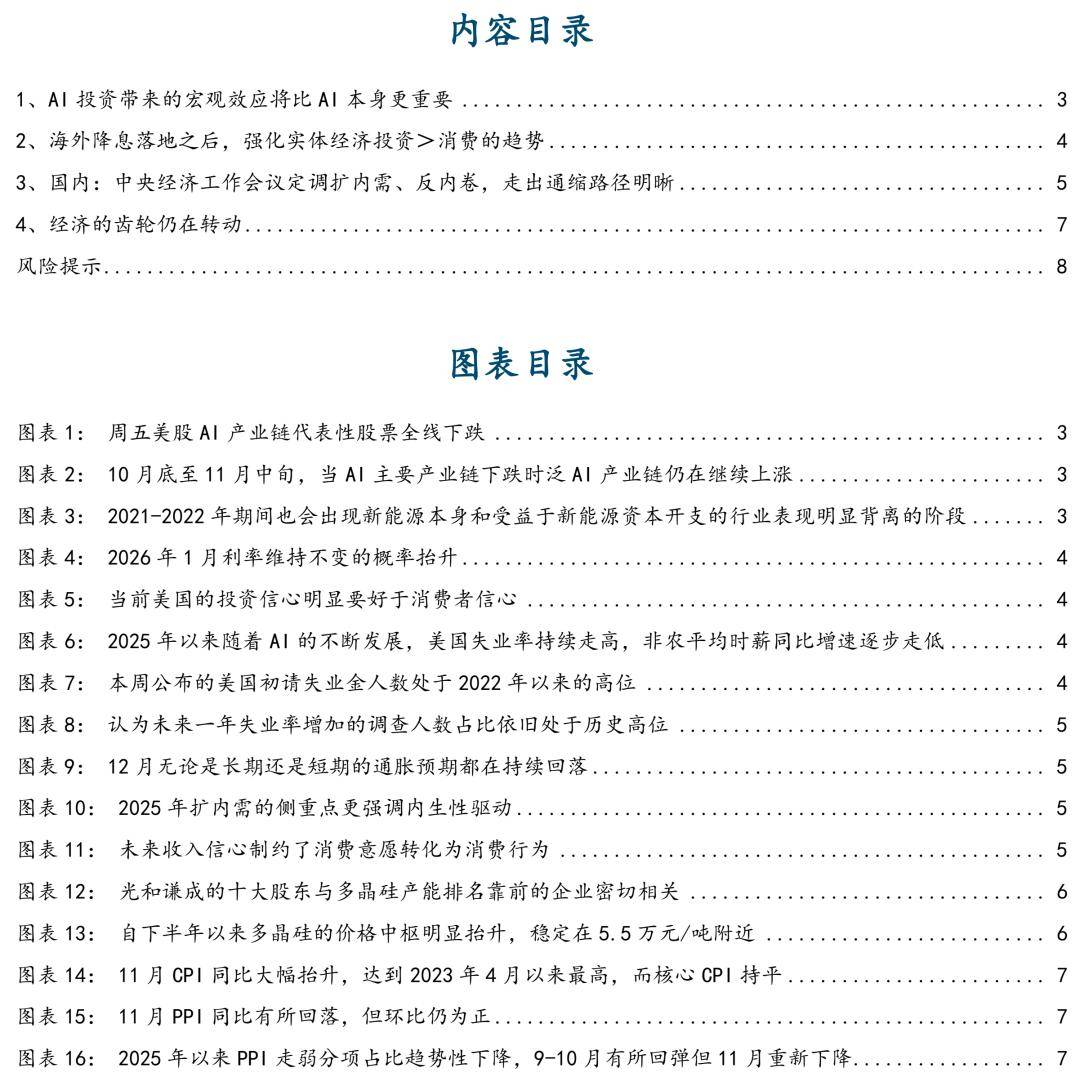
Group 1 - The core viewpoint of the report emphasizes that the macro effects of AI investment will be more significant than the performance of AI stocks themselves, as evidenced by the recent downturn in AI tech stocks despite an increase in capital expenditure guidance from companies like Oracle [10][11]. - The report highlights that the recent drop in AI stocks is linked to market concerns about future earnings realization, particularly regarding order completion, growth sustainability, and profit margins [10][11]. - It is noted that the investment in AI is expected to continue driving macroeconomic effects, with a shift in focus from AI stock performance to sectors benefiting from AI investment [10][11]. Group 2 - The report discusses the recent interest rate cuts in overseas markets, which are expected to reinforce the trend of investment exceeding consumption, particularly in the context of rising AI investment [16][19]. - It mentions that the Federal Reserve's focus may shift towards unemployment rates rather than inflation concerns, with a potential for multiple rate cuts if unemployment surpasses the 4.5% threshold [19]. - The anticipated pathway from AI investment to monetary policy and then to the real economy is outlined, suggesting that aggressive AI investment could lead to increased unemployment, prompting further rate cuts and stimulating global manufacturing investment [19]. Group 3 - The report summarizes the outcomes of the recent Central Economic Work Conference in China, which emphasizes expanding domestic demand and addressing "involution" in the manufacturing sector as key strategies to combat deflation [24][27]. - It indicates that the focus on expanding domestic demand will shift from government-led initiatives to enhancing residents' income and activating private capital [24][27]. - The report also highlights that the recovery of corporate profits is crucial for improving employment and wages, with signals of a profit bottom emerging in Q3 2025 [27][31]. Group 4 - The report asserts that despite market volatility related to AI stock performance and interest rate expectations, the fundamental impacts of ongoing AI investments and the stimulus from rate cuts on manufacturing demand remain strong [4][43]. - It recommends focusing on sectors that will benefit from increased AI investment and the anticipated recovery in global manufacturing, including industrial resource chains and non-bank financial services [4][45]. - The report also identifies opportunities in China's equipment exports and manufacturing sectors that are poised for a bottom reversal, alongside a recovery in consumer spending driven by increased capital inflows [4][45].


招商证券:2025年中央经济工作会议如何指引A股?
Xin Lang Cai Jing· 2025-12-14 07:04
Core Viewpoint - The Central Economic Work Conference held on December 10-11 in Beijing maintained a relatively positive stance, indicating a focus on stabilizing investment and addressing demand-side weaknesses in the economy [1][2][3] Group 1: Economic Assessment and Policy Directions - The conference highlighted the phrase "strong supply, weak demand," indicating increased attention to the current decline in demand, suggesting that policies targeting demand may be introduced soon [7] - The narrow fiscal deficit rate is expected to remain at 4% next year, with an emphasis on maintaining necessary fiscal deficits and total debt levels, while also addressing local fiscal difficulties [7][8] - Monetary policy will prioritize promoting stable economic growth and reasonable price recovery, indicating a higher focus on economic development and price stabilization among multiple monetary policy goals [2][7] Group 2: Investment and Consumption Strategies - The conference emphasized expanding domestic demand as a key task for next year, with specific measures to boost consumption through increasing residents' income, optimizing the "two new" policy, and releasing potential in service consumption [2][8] - The focus on major projects is expected to be a primary driver for investment recovery, particularly as next year marks the beginning of the 14th Five-Year Plan [3][9] - Historical data suggests that the market tends to favor large-cap stocks in the week following the conference, with sectors such as oil and petrochemicals, telecommunications, and electronics showing higher probabilities of price increases [3][9]

财米油盐丨定调2026经济工作:“扩内需”都出什么招?
Ren Min Wang· 2025-12-13 08:13
近日举行的2025年中央经济工作会议(以下简称"会议")为"十五五"开局锚定方向。在会议部署的明年 八项重点任务中,"坚持内需主导,建设强大国内市场"居首。这也是"扩内需"连续四年被摆在重要位 置。 "扩内需"绝不是让老百姓掏空钱包"买买买",而是通过一系列举措让大家"能消费、敢消费、愿消费"。 此次会议明确提出"推动投资止跌回稳"。一方面,要"适当增加中央预算内投资规模""优化地方政府专 项债券用途管理"等;另一方面,要调动民营企业、社会资本积极性。在资金方面,会议还提出要"引导 金融机构加力支持","继续发挥新型政策性金融工具作用"。 总而言之,扩内需绝不是让大家掏空钱包,而是要综合施策,让居民收入更稳、负担更轻、消费更值, 也让企业有生意做、有利润赚,最终让中国经济更加稳健、更有韧性。 "敢消费",得有底气。 会议明确提出要"多办实事",列举了"鼓励支持灵活就业人员、新就业形态人员参加职工保险""增加普 通高中学位供给和优质高校本科招生""深化医保支付方式改革""推行长期护理保险制度"等多个民生领 域的政策要求。另外还专门提到要"着力稳定房地产市场" 。通过加强大家在就业、教育、医疗、住 房、养老等"人 ...
魏建国:服务消费将成为“十五五”扩内需破局重要“法宝”
Sou Hu Cai Jing· 2025-12-12 14:20
Core Viewpoint - The service consumption sector is identified as a crucial driver for expanding domestic demand, emphasizing its role in enhancing quality of life and economic transformation [1][3]. Group 1: Importance of Service Consumption - Service consumption is increasingly recognized as the main force driving overall consumption, highlighting its growing significance in the market [1]. - The transformation of consumption is occurring across four dimensions: digitalization, personalization, refinement, and branding, which collectively enhance the quality of service consumption products [1]. - Rural consumption growth is outpacing urban areas, indicating a shift in consumption patterns [1]. Group 2: Characteristics of Service Consumption - Service consumption is characterized by its "new" nature, leveraging digital technologies to eliminate barriers in demand connection, exemplified by the shift from daily to minute-based cross-border payment settlements [3]. - The "effect" of service consumption is seen in its ability to activate deeper consumer demands through high-end technology, as demonstrated by a Shenzhen-based new energy vehicle company optimizing its battery management system with German engineering consulting [4]. - Service consumption is described as a comprehensive upgrade to the quality of life for the public, acting as a vital tool for improving living standards and fostering refined consumption scenarios [4].