
社会融资规模

Search documents
宁证期货今日早评-20251114
Ning Zheng Qi Huo· 2025-11-14 02:18
Key Points of the Report 1. Report Industry Investment Ratings No specific industry investment ratings are provided in the report. 2. Core Views of the Report - The Fed has internal differences regarding a potential December interest rate cut. The end of the US government shutdown has led to simultaneous declines in US stocks, bonds, and the exchange - rate, increasing market divergence. Gold is short - term bullish and may experience high - level oscillations in the medium term [1]. - The natural rubber market is currently in a state of mixed long and short factors. Prices are expected to continue range - bound oscillations due to factors such as supply disruptions and inventory pressure [2]. - The manganese silicon market is expected to fluctuate around the low - end of cost valuation in the short term, with attention on raw material cost adjustments [4]. - The coking coal market is in a stalemate between long and short forces. The main contract has seen a pullback at the upper edge of the previous oscillation range, and future supply conditions should be closely monitored [5]. - The steel market is currently experiencing weak supply and demand. Steel prices are expected to continue narrow - range oscillations in the short term, with limited upside and downside potential [6]. - The live hog market's LH2601 contract still faces downward pressure in the short term, with bottom - end oscillations and range - bound trading [6]. - The soybean meal 01 contract is expected to have a narrow - range oscillation between 3030 - 3090 in the short term [7]. - The palm oil market has limited short - term supply - demand contradictions and is mainly for range - bound trading [8]. - The long - term treasury bond market is expected to have a slightly bullish medium - term oscillation, with attention on the stock - bond seesaw effect [9]. - The silver market is short - term bearish but bullish in the medium term, with attention on the divergence between gold and silver [9]. - The crude oil market is expected to operate in a weak oscillation, with supply - surplus concerns being the core factor determining price direction [10]. - The PTA market is expected to be range - bound, and it is advisable to wait and see [12]. - The methanol 01 contract is expected to have a short - term weak oscillation, and it is recommended to wait for further stabilization [12]. - The soda ash 01 contract is expected to have a short - term oscillation, and it is recommended to wait and see or short - sell on rebounds [13]. - The L2601 contract of plastic is expected to have a short - term oscillation, and it is recommended to wait and see or short - sell on rebounds [14]. 3. Summaries by Commodity Gold - The Fed has internal differences on a December rate cut. The end of the government shutdown has increased market divergence. Gold is short - term bullish and medium - term high - level oscillating. Attention should be paid to the impact of the US dollar index [1]. Natural Rubber - Thai raw rubber prices are stable, and domestic inventories show different trends. The domestic production area is entering a reduction period, and overseas rainfall has affected supply. However, high inventory and a large price difference with synthetic rubber restrict price increases. Short - term price range - bound oscillations are expected [2]. Manganese Silicon - The national capacity utilization rate and daily output of manganese silicon have increased slightly. Cost is in a stalemate, demand support is weakening, and supply is expected to remain high. The short - term market is expected to fluctuate around the low - end of cost valuation [4]. Coking Coal - The capacity utilization rate and production of coking coal mines have increased. The market is in a long - short stalemate due to supply - side support and energy supply concerns. The main contract has pulled back, and actual supply should be monitored [5]. Rebar - This week, rebar production, inventory, and demand have all decreased. The steel market has weak supply and demand, with a larger inventory decline and cost support. Short - term narrow - range oscillations are expected [6]. Live Hogs - The national live hog price has continued to decline. Weak terminal demand, low slaughterhouse acquisition enthusiasm, and high breeding - end sales pressure have led to downward pressure on the LH2601 contract [6]. Soybean Meal - Imported soybean supply is sufficient, oil - mill开机率 is rising, and demand is stable. Inventory is increasing, restricting price increases. The 01 contract is expected to oscillate narrowly in the short term [7]. Palm Oil - Indian palm oil imports have decreased significantly in October due to high inventory. The domestic market is in an adjustment phase with limited supply - demand contradictions and is mainly for range - bound trading [8]. Long - term Treasury Bonds - The growth of social financing in October has slowed, and the marginal effect of monetary policy easing has weakened. Macro - control may shift to promoting consumption. The bond market is slightly bullish in the medium term, with attention on the stock - bond seesaw [9]. Silver - The end of the US government shutdown has reduced risk appetite. Silver is short - term bearish and medium - term bullish, with attention on the divergence between gold and silver [9]. Crude Oil - The IEA has further raised the supply - surplus pressure forecast. The market is concerned about supply surplus, and prices are expected to operate in a weak oscillation [10]. PTA - PTA production has decreased, polyester inventory has decreased, and demand is fair. With crude oil oscillating weakly, PTA is expected to be range - bound, and waiting and seeing is advisable [12]. Methanol - Domestic methanol production is at a high level, downstream demand is stable, and port inventory is accumulating. The 01 contract is expected to have a short - term weak oscillation, and waiting for further stabilization is recommended [12]. Soda Ash - The price of soda ash has risen slightly, production has decreased, and inventory has changed slightly. The glass market has weak demand. The 01 contract is expected to oscillate in the short term, and waiting and seeing or short - selling on rebounds is recommended [13]. Plastic - The price of LLDPE has increased slightly, production has increased, and inventory has risen. Downstream demand is weak. The L2601 contract is expected to oscillate in the short term, and waiting and seeing or short - selling on rebounds is recommended [14].
期指:震荡蓄势
Guo Tai Jun An Qi Huo· 2025-11-14 01:45
Report Summary 1) Industry Investment Rating No investment rating information is provided in the report. 2) Core View On November 13, 2025, all four major stock index futures contracts for the current month rose. However, the total trading volume of stock index futures declined on this trading day, indicating a cooling of investors' trading enthusiasm. Additionally, the total positions of all four major stock index futures decreased. [1][2] 3) Summary by Related Catalogs a) Stock Index Futures Data Tracking - **CSI 300 and Related Futures**: The CSI 300 index closed at 4702.07, up 1.21%. Among its futures contracts, IF2511 closed at 4693.6, up 1.07% with a basis of -8.47; IF2512 closed at 4677, up 1.06% with a basis of -25.07; IF2603 closed at 4645.8, up 1.00% with a basis of -56.27; IF2606 closed at 4601.4, up 1.01% with a basis of -100.67. [1] - **SSE 50 and Related Futures**: The SSE 50 index closed at 3073.67, up 0.96%. Among its futures contracts, IH2511 closed at 3072.6, up 0.81% with a basis of -1.07; IH2512 closed at 3068.8, up 0.81% with a basis of -4.87; IH2603 closed at 3064, up 0.83% with a basis of -9.67; IH2606 closed at 3059.6, up 0.99% with a basis of -14.07. [1] - **CSI 500 and Related Futures**: The CSI 500 index closed at 7355.29, up 1.55%. Among its futures contracts, IC2511 closed at 7335.4, up 1.63% with a basis of -19.89; IC2512 closed at 7269, up 1.71% with a basis of -86.29; IC2603 closed at 7087.4, up 1.64% with a basis of -267.89; IC2606 closed at 6885.4, up 1.61% with a basis of -469.89. [1] - **CSI 1000 and Related Futures**: The CSI 1000 index closed at 7590.58, up 1.39%. Among its futures contracts, IM2511 closed at 7566, up 1.60% with a basis of -24.58; IM2512 closed at 7478.4, up 1.67% with a basis of -112.18; IM2603 closed at 7246, up 1.60% with a basis of -344.58; IM2606 closed at 7012, up 1.57% with a basis of -578.58. [1] b) Trading Volume and Position Changes - **Trading Volume**: The total trading volume of IF decreased by 8821 lots, IH decreased by 1184 lots, IC decreased by 13405 lots, and IM decreased by 29092 lots. [2] - **Positions**: The total positions of IF decreased by 13919 lots, IH decreased by 1167 lots, IC decreased by 19353 lots, and IM decreased by 20677 lots. [2] c) Top 20 Member Position Changes - **IF Contracts**: For IF2511, long positions decreased by 3207 lots and short positions decreased by 2753 lots; for IF2512, long positions decreased by 4944 lots; for IF2603, long positions decreased by 1419 lots and short positions decreased by 1558 lots; for IF2606, long positions decreased by 8 lots and short positions increased by 70 lots. [5] - **IH Contracts**: For IH2511, long positions decreased by 194 lots and short positions increased by 64 lots; for IH2512, long positions decreased by 1093 lots and short positions decreased by 442 lots; for IH2603, long positions decreased by 14 lots and short positions decreased by 96 lots. [5] - **IC Contracts**: For IC2511, long positions decreased by 4850 lots and short positions decreased by 4795 lots; for IC2512, long positions decreased by 8355 lots; for IC2603, long positions decreased by 179 lots and short positions decreased by 568 lots; for IC2606, long positions decreased by 451 lots and short positions decreased by 673 lots. [5] - **IM Contracts**: For IM2511, long positions decreased by 5732 lots and short positions decreased by 5208 lots; for IM2512, long positions decreased by 5868 lots and short positions decreased by 6259 lots; for IM2603, long positions decreased by 1923 lots and short positions decreased by 2516 lots. [5] d) Trend Intensity and Important Drivers - **Trend Intensity**: The trend intensity of IF and IH is 1, and the trend intensity of IC and IM is also 1. [6] - **Important Drivers**: The Ministry of Commerce held a regular press conference, and the spokesperson mentioned the results of the China-US economic and trade consultations in Kuala Lumpur, including agricultural product trade. The US government ended its 43 - day shutdown after the President signed a temporary appropriation bill. China's new social financing in October was 810 billion yuan, new RMB loans were 220 billion yuan, and the M2 - M1 gap widened. China's CSRC Chairman Wu Qing visited financial regulatory authorities in France and Brazil and had discussions with international institutional investors. The A - share market opened lower and closed higher, with the Shanghai Composite Index rising 0.73% to 4029.5 points, a ten - year high. [6][7][8]
透过数据看“暖意” 多领域“枝繁叶茂”彰显中国经济新亮色
Yang Shi Wang· 2025-11-14 01:39
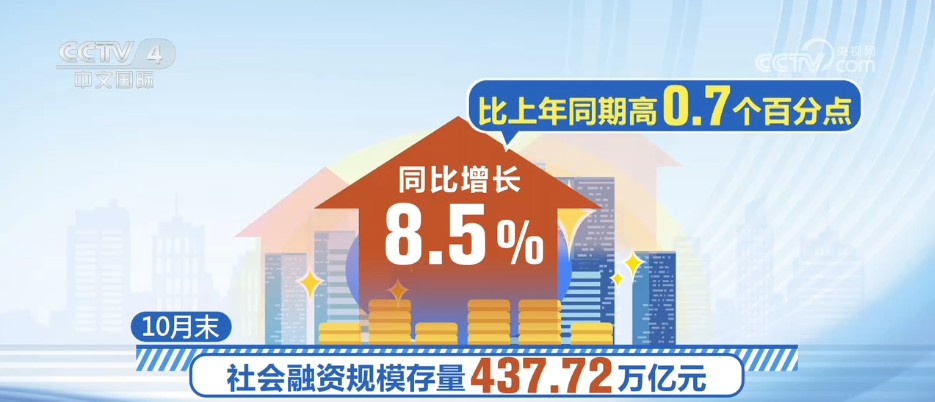
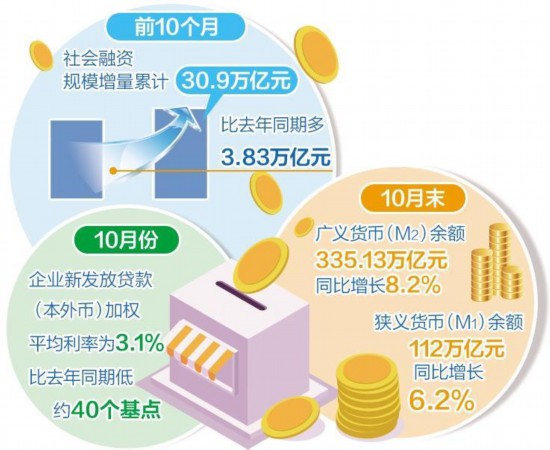
Group 1: Financial Data Overview - As of the end of October, the total social financing scale reached 437.72 trillion yuan, with a year-on-year growth of 8.5%, which is 0.7 percentage points higher than the same period last year [3] - The cumulative increase in social financing for the first ten months was 30.9 trillion yuan, exceeding the same period last year by 3.83 trillion yuan [3] - The broad money supply (M2) stood at 335.13 trillion yuan, growing by 8.2% year-on-year, while the narrow money supply (M1) was 112 trillion yuan, with a year-on-year increase of 6.2% [3] Group 2: Loan and Interest Rate Trends - The balance of RMB loans reached 270.61 trillion yuan, with a year-on-year growth of 6.5%, and an increase of 14.97 trillion yuan in loans during the first ten months [3] - The average interest rate for newly issued corporate loans in October was 3.1%, approximately 40 basis points lower than the same period last year, while the average interest rate for new personal housing loans was also 3.1%, about 8 basis points lower year-on-year [3] Group 3: Trade and Economic Development - In the first ten months of the year, Shanghai's import and export volume reached 3.7 trillion yuan, an increase of 5.2%, with exports amounting to 1.6 trillion yuan, up by 10.5% [7] - The Shanghai Free Trade Zone has implemented 80 reform measures for institutional openness, with 77 measures being replicated nationwide or in other free trade zones [9] - ASEAN has maintained its position as China's largest trading partner for agricultural and food products for eight consecutive years, with bilateral trade reaching 513 billion USD, a year-on-year increase of 8.9% [9] Group 4: Infrastructure and Technological Advancements - China completed water conservancy construction investments of 1,009.47 billion yuan in the first ten months, implementing 46,000 various water conservancy projects [10] - The first phase of 6G technology testing has been completed, with over 300 key technology reserves formed, and 57 tests conducted in five major technical directions [10]

存量社融保持较高增速,货币政策有望进一步加力
Sou Hu Cai Jing· 2025-11-14 01:24
11月13日,央行公布10月金融统计数据。广义货币(M2)和社会融资规模增速均保持在较高水平,持 续为经济回升向好创造适宜的货币金融环境。 具体看,2025年10月末,M2余额335.13万亿元,同比增长8.2%,比上年同期高0.8个百分点,在上年同 期基数提高的背景下,仍保持较高增速。 社会融资规模存量437.72万亿元,同比增长8.5%,比上年同期高0.7个百分点。1至10月,社会融资规模 增量为30.9万亿元,同比多增3.83万亿元。 "总体来看,M2和社会融资规模增速均保持在较高水平,持续为经济回升向好创造适宜的货币金融环 境。其中,广义货币(M2)余额335.13万亿元,同比增长8.2%,比上年同期高0.8个百分点,在上年同 期基数提高的背景下,仍保持较高增速。"业内专家表示。 图片来源:视觉中国 来源:北京日报客户端 记者:潘福达 该团队称,综合考虑近期外部环境及国内经济金融形势变化,着眼于稳定今年四季度及明年一季度宏观 经济运行,更大力度促进房地产市场止跌回稳,年底前货币政策将进一步加力。 数量型政策方面,在近期央行持续通过买断式逆回购、MLF(中期借贷便利)等政策工具向市场注入 中期流动性,并 ...

有效满足实体经济融资需求
Jing Ji Ri Bao· 2025-11-14 00:45
Monetary Policy and Financial Conditions - The broad money supply (M_2) and social financing growth rates remain high, indicating effective monetary policy support for high-quality economic development [2] - As of the end of October, M_2 stood at 335.13 trillion yuan, growing by 8.2% year-on-year, while narrow money (M_1) increased by 6.2% to 112 trillion yuan [4] - The weighted average interest rate for new corporate loans was 3.1%, down approximately 40 basis points year-on-year, reflecting a low-cost financing environment [6] Social Financing and Government Bonds - By the end of October, the total social financing stock reached 437.72 trillion yuan, with an annual growth of 8.5%, supported by increased government bond issuance [3] - Government bonds issued in the first ten months totaled about 22 trillion yuan, nearly 4 trillion yuan more than the previous year, aiding in major project financing and debt relief [3] - The issuance of special long-term government bonds increased from 1 trillion yuan last year to 1.3 trillion yuan this year, indicating proactive fiscal policy [3] Loan Growth and Structure - In the first ten months, RMB loans increased by 14.97 trillion yuan, with household loans rising by 739.6 billion yuan and corporate loans by 13.79 trillion yuan [6] - The structure of loans is shifting, with a notable increase in medium- and long-term loans, which supports sustainable economic growth [6] Consumer Financing and Economic Support - The implementation of consumer loan interest subsidies has reduced personal interest burdens, enhancing consumer capacity and demand [7] - The comprehensive financing cost for enterprises has decreased, providing more funds for production and development, which stimulates economic circulation [6][7] Macro Policy Adjustments - Recent macroeconomic policies have focused on counter-cyclical adjustments, with measures aimed at boosting consumption and supporting livelihoods [9] - The People's Bank of China aims to balance short-term and long-term economic goals while maintaining strong support for the real economy [9]
央行:社会融资已发生结构性变迁 贷款增速略低一些也合理
2 1 Shi Ji Jing Ji Bao Dao· 2025-11-14 00:23
Core Insights - The financing structure for enterprises in China is shifting from reliance on bank loans to a more diversified approach that includes bonds and stocks, reflecting changes in the economic and financial landscape [1][2] Financing Trends - In the first ten months of 2025, the total social financing scale increased by 30.9 trillion yuan, which is 3.83 trillion yuan more than the same period last year. The net financing from corporate bonds was 1.82 trillion yuan, and government bonds accounted for 11.95 trillion yuan [1] - Other financing methods, excluding loans, now account for over half of the total social financing growth, with government bond net financing nearing 40% [1] Monetary Policy and Economic Indicators - The M2 money supply reached 335.13 trillion yuan at the end of October, with a year-on-year growth of 8.2%, indicating a supportive monetary policy stance [3][5] - The M1 money supply also showed a year-on-year increase of 6.2%, reflecting improved business activity and consumer demand [4][5] Loan Dynamics - In the first ten months, RMB loans increased by 14.97 trillion yuan, which is a decrease of 1.55 trillion yuan compared to the previous year. Corporate loans are performing better than residential loans, which remain weak [7][8] - The demand for medium to long-term loans from enterprises is expected to improve due to recent policy measures aimed at supporting key industries and projects [7] Consumer Credit and Housing Market - Residential loans decreased by 3.604 trillion yuan, with both short-term and medium to long-term loans showing significant reductions. The overall credit demand from households remains fragile [8] - Recent adjustments in housing purchase policies in major cities have led to a slight increase in new home sales, but the market remains uneven, particularly in the second-hand housing sector [8] Future Outlook - The focus of future policies will be on boosting domestic demand and consumption, with an emphasis on improving living standards, stabilizing employment, and enhancing the consumer environment [9]
24小时环球政经要闻全览 | 11月14日
Sou Hu Cai Jing· 2025-11-14 00:16
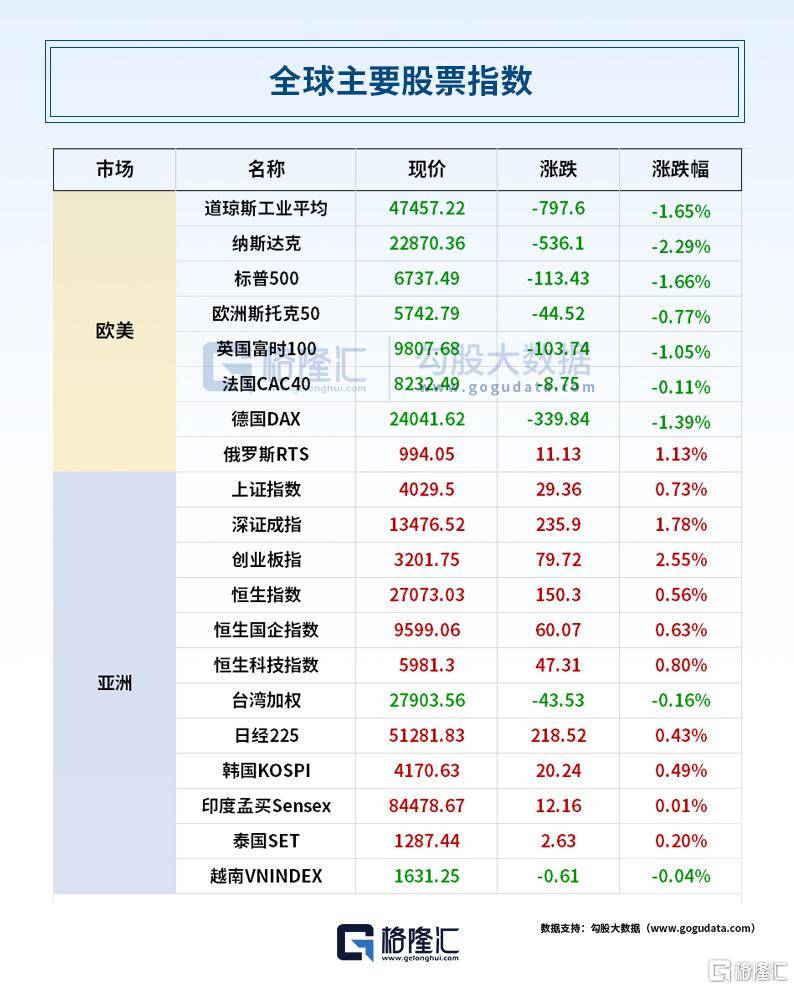
Market Performance - Major US indices experienced declines, with the Dow Jones Industrial Average down by 797.6 points (-1.65%) to 47,457.22, and the Nasdaq down by 536.1 points (-2.29%) to 22,870.36 [2] - European indices also saw losses, with the DAX down by 339.84 points (-1.39%) to 24,041.62, while the UK FTSE 100 fell by 103.74 points (-1.05%) to 9,807.68 [2] - In contrast, several Asian indices showed positive movement, with the Shanghai Composite Index up by 29.36 points (0.73%) to 4,029.5 and the Shenzhen Component Index up by 235.9 points (1.78%) to 13,476.52 [2] Regulatory Developments - The Chairman of the China Securities Regulatory Commission, Wu Qing, visited France and Brazil to discuss securities market regulation and deepen bilateral cooperation [3] - The European Union plans to impose fees on small packages from China starting next year, aimed at curbing the influx of inexpensive goods [6] Corporate Earnings - Tencent reported Q3 revenue of 192.87 billion yuan, a 15% year-on-year increase, with net profit rising 19% to 63.13 billion yuan [8] - JD.com posted Q3 revenue of 299.1 billion yuan, a 14.9% increase, but net profit fell to 5.3 billion yuan from 11.7 billion yuan year-on-year [8] - Semiconductor manufacturer SMIC reported Q3 revenue of 17.162 billion yuan, up 9.9%, with net profit increasing 43.1% to 1.51 billion yuan [8] - Bilibili's Q3 net revenue was 7.69 billion yuan, reflecting a 5% year-on-year growth [8] Investment Trends - BlackRock's Q3 13F report indicated significant increases in holdings of Microsoft, Amazon, and Nvidia, while reducing its stake in Apple by 2.5 million shares [7] - Michael Burry, known for his bearish stance, dissolved his asset management firm and warned of risks associated with major tech companies using AI-driven accounting methods [10] New Initiatives - Apple launched a Mini App Partner Program, reducing its revenue cut from 30% to 15% for developers selling qualifying in-app purchases [11][12]



前10个月人民币贷款增近15万亿元 有效满足实体经济融资需求
Jing Ji Ri Bao· 2025-11-13 23:53
广义货币(M2 )和社会融资规模增速保持较高水平、贷款规模合理增长、信贷结构持续优化、贷款利率保 持低位……中国人民银行11月13日公布的10月份金融统计数据报告显示,适度宽松的货币政策持续显 效,货币金融条件相对宽松,我国经济高质量发展有着坚实支撑。 融资渠道日益多元 综合融资成本下降是货币条件比较宽松的重要体现。招联首席研究员董希淼分析,近年来企业和居民融 资成本低位下行,说明货币条件比较宽松、资金供给比较充裕,实体经济有效融资需求得到了充分满 足。在适度宽松的货币政策带动下,社会综合融资成本持续下降,为经营主体纾困解难、注入信心,不 仅让企业有更多资金投入生产研发、稳步发展壮大,也有助于激发消费潜力、畅通经济循环。 随着明示企业贷款综合融资成本工作进一步推广,企业融资成本更加阳光透明,小微企业融资获得感持 续提升。山东烟台某物流公司因扩大业务规模,需要申请500万元贷款,企业通过填写《企业贷款综合 融资成本清单》后,评估费、抵押登记费、保险费等费用共计1420元均由银行承担,企业无需支付任何 附加费用,贷款综合融资成本较之前询价结果低0.4个百分点。 初步统计,今年10月末社会融资规模存量为437.72 ...
前10个月人民币贷款增加近15万亿元 金融总量合理增长
Zhong Guo Zheng Quan Bao· 2025-11-13 23:32
Core Viewpoint - The People's Bank of China (PBOC) has reported that the growth rates of broad money (M2) and social financing remain high, creating a favorable monetary environment for economic recovery. The central bank is expected to continue implementing a moderately accommodative monetary policy to support the real economy [1][5]. Group 1: Social Financing and Government Bonds - As of the end of October, the total social financing stock reached 437.72 trillion yuan, with a year-on-year growth of 8.5%. The cumulative increase in social financing for the first ten months was 30.9 trillion yuan, which is 3.83 trillion yuan more than the same period last year [2]. - The rapid issuance of government bonds, including special refinancing bonds, has significantly supported the growth of social financing. In the first ten months of this year, the cumulative issuance of government bonds was approximately 22 trillion yuan, nearly 4 trillion yuan more than the previous year [2]. - The M2 balance at the end of October was 335.13 trillion yuan, with a year-on-year increase of 8.2%, while the narrow money (M1) balance was 112 trillion yuan, growing by 6.2% year-on-year [2]. Group 2: Loan Structure and Interest Rates - The total RMB loan balance reached 270.61 trillion yuan at the end of October, with a year-on-year growth of 6.5%. In the first ten months, RMB loans increased by 14.97 trillion yuan [3]. - The structure of loans is improving, with inclusive small and micro loans reaching 35.77 trillion yuan, growing by 11.6% year-on-year, and medium to long-term loans for the manufacturing sector at 14.97 trillion yuan, increasing by 7.9% [3]. - The average interest rate for newly issued corporate loans was 3.1%, approximately 40 basis points lower than the same period last year, while the average interest rate for new personal housing loans was also 3.1%, about 8 basis points lower year-on-year [3]. Group 3: Monetary Policy and Price Stability - The financial data for October indicates reasonable growth, providing strong financial support for the real economy. The supportive monetary policy is expected to continue promoting a reasonable recovery in prices [4]. - The growth rates of social financing and M2 have consistently remained above 8%, exceeding the nominal GDP growth rate by about 4 percentage points, with financing costs remaining low [4].
前10个月人民币贷款增加近15万亿元:金融总量合理增长 货币政策保持力度
Zhong Guo Zheng Quan Bao· 2025-11-13 23:32
Core Insights - The People's Bank of China reported that in October, both the broad money supply (M2) and the social financing scale maintained a high year-on-year growth rate, creating a favorable monetary environment for economic recovery [1][4] - Experts indicate that the central bank will continue to implement a moderately accommodative monetary policy to support the real economy [1][4] Monetary Supply and Social Financing - As of the end of October, the total social financing scale was 437.72 trillion yuan, reflecting an 8.5% year-on-year increase; the cumulative increase for the first ten months was 30.9 trillion yuan, which is 3.83 trillion yuan more than the same period last year [2] - The issuance of government bonds, including special refinancing bonds, has significantly supported the growth of social financing, with approximately 22 trillion yuan of government bonds issued from January to October, nearly 4 trillion yuan more than the previous year [2] - The M2 balance reached 335.13 trillion yuan, with an 8.2% year-on-year growth, while the narrow money supply (M1) was 112 trillion yuan, growing by 6.2% year-on-year [2] Loan Structure and Interest Rates - The total RMB loan balance was 270.61 trillion yuan at the end of October, with a year-on-year growth of 6.5%; the increase in loans for the first ten months was 14.97 trillion yuan [3] - The structure of loans is improving, with inclusive small and micro loans at 35.77 trillion yuan, growing by 11.6%, and medium to long-term loans for the manufacturing sector at 14.97 trillion yuan, increasing by 7.9% [3] - The average interest rate for newly issued corporate loans was 3.1%, approximately 40 basis points lower than the same period last year, indicating a continued decline in financing costs [3] Price Stability and Economic Support - The financial data for October indicates reasonable growth, providing strong support for the real economy; supportive monetary policy is expected to continue promoting price recovery [4] - The growth rates of social financing and M2 have consistently remained above 8%, outpacing the nominal GDP growth by about 4 percentage points [4] - Experts emphasize the importance of maintaining a moderately accommodative monetary policy to ensure strong support for the real economy moving forward [4]