规模效应

Search documents
小米汽车,差点就盈利了
21世纪经济报道· 2025-08-20 10:37
Core Viewpoint - Xiaomi Group's Q2 2025 financial report shows significant growth in revenue and adjusted net profit, driven by its automotive business, IoT, and internet services, despite challenges in its smartphone segment [4][6]. Financial Performance - Xiaomi reported Q2 revenue of 116 billion yuan, a year-on-year increase of 30.5%, and an adjusted net profit of 10.8 billion yuan, up 75.4% [4]. - The automotive business generated 20.6 billion yuan in revenue from the delivery of 81,300 vehicles, with a gross margin of 26.4% [6][9]. - The operating loss in the automotive sector decreased from 500 million yuan in Q1 to 300 million yuan in Q2, marking a 40% improvement [9][12]. Business Segments Smartphone Business - Smartphone revenue was 45.5 billion yuan, accounting for 39.3% of total revenue, but showed a decline of 2.1% year-on-year and 10.1% quarter-on-quarter [14]. - The average selling price (ASP) of smartphones fell to 1,073 yuan, down 11.3% from the previous quarter [15]. - Despite challenges, Xiaomi maintained a 14.7% market share globally, ranking third, and regained the top position in Southeast Asia with an 18.9% market share [16]. IoT and Internet Services - IoT revenue reached 38.7 billion yuan, a 44.7% increase year-on-year, with a gross margin of 22.5% [17]. - Internet services generated 9.1 billion yuan, growing 10.1% year-on-year, with a high gross margin of 75.4% [20]. - The IoT segment is becoming a significant profit source, surpassing the smartphone business in gross margin contribution [20]. Cost Management - Xiaomi's overall expense ratio decreased to 13.9%, down 2.2 percentage points year-on-year, indicating effective cost control despite entering the automotive sector [22]. - R&D expenses were 7.8 billion yuan, with a slight decrease in the R&D expense ratio due to revenue growth outpacing absolute spending [24]. - The company leveraged shared R&D resources across its product lines, enhancing efficiency [24]. Automotive Business Outlook - Xiaomi's automotive business is close to profitability, with a theoretical net loss of approximately 6,000 yuan per vehicle, indicating that minor adjustments could lead to profitability [11][12]. - The company aims to deliver 350,000 vehicles by the end of the year, with production capacity increasing [12]. - The automotive sector's rapid growth and decreasing losses suggest a potential for achieving quarterly profitability by late 2025 or early 2026 [12].

小鹏汽车累亏427亿后“转正”在即,上半年账期缩短62天、三个月内应付款242亿
Sou Hu Cai Jing· 2025-08-20 10:32
Core Viewpoint - Xiaopeng Motors is approaching a profitability turning point, with significant revenue growth and reduced net losses in the first half of the year [3][4]. Financial Performance - Total revenue for the first half of the year reached 34.09 billion yuan, a year-on-year increase of 132% [3]. - Net loss for the first half was 1.14 billion yuan, down from a loss of 2.65 billion yuan in the same period last year [3][4]. - In Q2, net loss narrowed to 480 million yuan, a 62.8% year-on-year reduction and a 28% decrease from the previous quarter, marking the lowest loss since Q3 2020 [4][6]. Delivery and Growth Metrics - Vehicle deliveries in the first half totaled 197,189 units, a 279% year-on-year increase, surpassing the total deliveries for the previous year [5]. - In Q2 alone, Xiaopeng delivered 103,200 vehicles, a 241.6% year-on-year increase [6]. Profitability Indicators - Q2 revenue was 18.27 billion yuan, a 125% year-on-year increase, with a gross margin of 17.3%, up 3.3% year-on-year [7]. - Overall gross margin for the first half reached 16.5%, a 3% increase year-on-year, while automotive gross margin rose to 12.6%, a 6.6 percentage point increase [8]. Future Outlook - Xiaopeng expects Q3 deliveries to be between 113,000 and 118,000 units, representing a 9.5% to 14.4% increase quarter-on-quarter, with revenue projections of 19.6 billion to 21 billion yuan [9]. - The company aims for an overall profitability capability of 17% to 19% in Q4, maintaining its target [8]. Debt and Cash Flow Management - As of June 30, the asset-liability ratio was 67%, up from 62% at the end of 2024 [10]. - Current liabilities totaled 47.963 billion yuan, with cash reserves of 47.57 billion yuan, indicating a weak coverage ratio of 0.41 for operating cash flow against current liabilities [11]. - Xiaopeng's payment cycle has improved, with accounts payable turnover days reduced to 170 days, down from 232.79 days at the end of 2024 [14][16].
零跑汽车(09863):点评:规模效应持续带动盈利提升,二季度业绩再超预期
Changjiang Securities· 2025-08-20 10:11
Investment Rating - The investment rating for the company is "Buy" and is maintained [5]. Core Views - The company focuses on self-research to create cost advantages, resulting in an excellent price-performance ratio, with products covering a price range of 50,000 to 200,000 CNY. For Q2 2025, revenue reached 14.23 billion CNY, with a gross margin of 13.6% and a net profit attributable to shareholders of 160 million CNY. The domestic new car cycle is expected to drive continuous sales growth, while collaboration with Stellantis opens up global sales opportunities [2][4][6]. Summary by Sections Company Performance - In Q2 2025, the company achieved a sales volume of 134,000 units, representing a year-on-year increase of 151.7% and a quarter-on-quarter increase of 53.2%. Revenue for the same period was 14.23 billion CNY, up 165.5% year-on-year and 42.0% quarter-on-quarter. The average revenue per vehicle was 106,000 CNY, with a year-on-year increase of 6,000 CNY [6]. Profitability - The gross margin for Q2 2025 was 13.6%, an increase of 10.9 percentage points year-on-year, while it decreased by 1.2 percentage points quarter-on-quarter. The improvement in gross margin was attributed to scale effects, cost reduction, product structure optimization, and income from other businesses. The net profit attributable to shareholders was 160 million CNY, marking a turnaround from loss, with a profit margin of 1.1% [6]. Future Outlook - The company is expected to sell 620,000, 910,000, and 1,210,000 vehicles in 2025, 2026, and 2027, respectively. The company plans to launch 2-3 new products globally each year, with the B10 and B01 already launched in 2025. The company aims to achieve localized manufacturing in Europe by 2026 [4][6].

小米汽车,差点就盈利了
投中网· 2025-08-20 07:20
Core Viewpoint - Xiaomi Group's Q2 2025 financial report shows significant growth in revenue and adjusted net profit, driven by its automotive business and other segments, despite challenges in its smartphone division [6][8]. Financial Performance - Q2 revenue reached 116 billion yuan, a year-on-year increase of 30.5%, while adjusted net profit was 10.8 billion yuan, up 75.4% [6]. - The automotive business delivered 81,300 vehicles, generating 20.6 billion yuan in revenue with a gross margin of 26.4% [9][15]. Automotive Business Insights - The automotive division's operating loss decreased from 500 million yuan in Q1 to 300 million yuan in Q2, marking a 40% improvement [9][12]. - The gross margin for the automotive business improved from 23.2% in Q1 to 26.4% in Q2, indicating effective cost management and scale effects [13][14]. - Xiaomi's automotive business is close to profitability, needing to reduce costs or increase margins by approximately 6,000 yuan per vehicle to break even [16][20]. Smartphone Business Challenges - Smartphone revenue was 45.5 billion yuan, accounting for 39.3% of total revenue, but showed a decline of 2.1% year-on-year and 10.1% quarter-on-quarter [19]. - The average selling price (ASP) of smartphones fell to 1,073 yuan, down 11.3% quarter-on-quarter, reflecting increased competition and a shift to lower-priced models [21]. IoT and Internet Services Growth - IoT and lifestyle product revenue reached 38.7 billion yuan, a 44.7% increase year-on-year, with a gross margin of 22.5% [22]. - Internet services revenue was 9.1 billion yuan, growing 10.1% year-on-year, with a high gross margin of 75.4% [23][24]. Cost Management and Efficiency - Xiaomi's overall expense ratio decreased to 13.9%, down 2.2 percentage points year-on-year, showcasing effective cost control despite entering the automotive sector [28]. - The company achieved cost efficiency through scale effects and shared R&D investments across its product lines [29][30]. Future Outlook - With a backlog of over 200,000 orders for the YU7 model, Xiaomi is well-positioned to meet its annual target of 350,000 vehicle deliveries [17]. - The automotive business is expected to achieve quarterly profitability by late 2025 or early 2026, potentially ahead of competitors like Xpeng and NIO [17].

小米小鹏零跑:新势力“增长三杰”的秘密
Hu Xiu· 2025-08-20 03:04
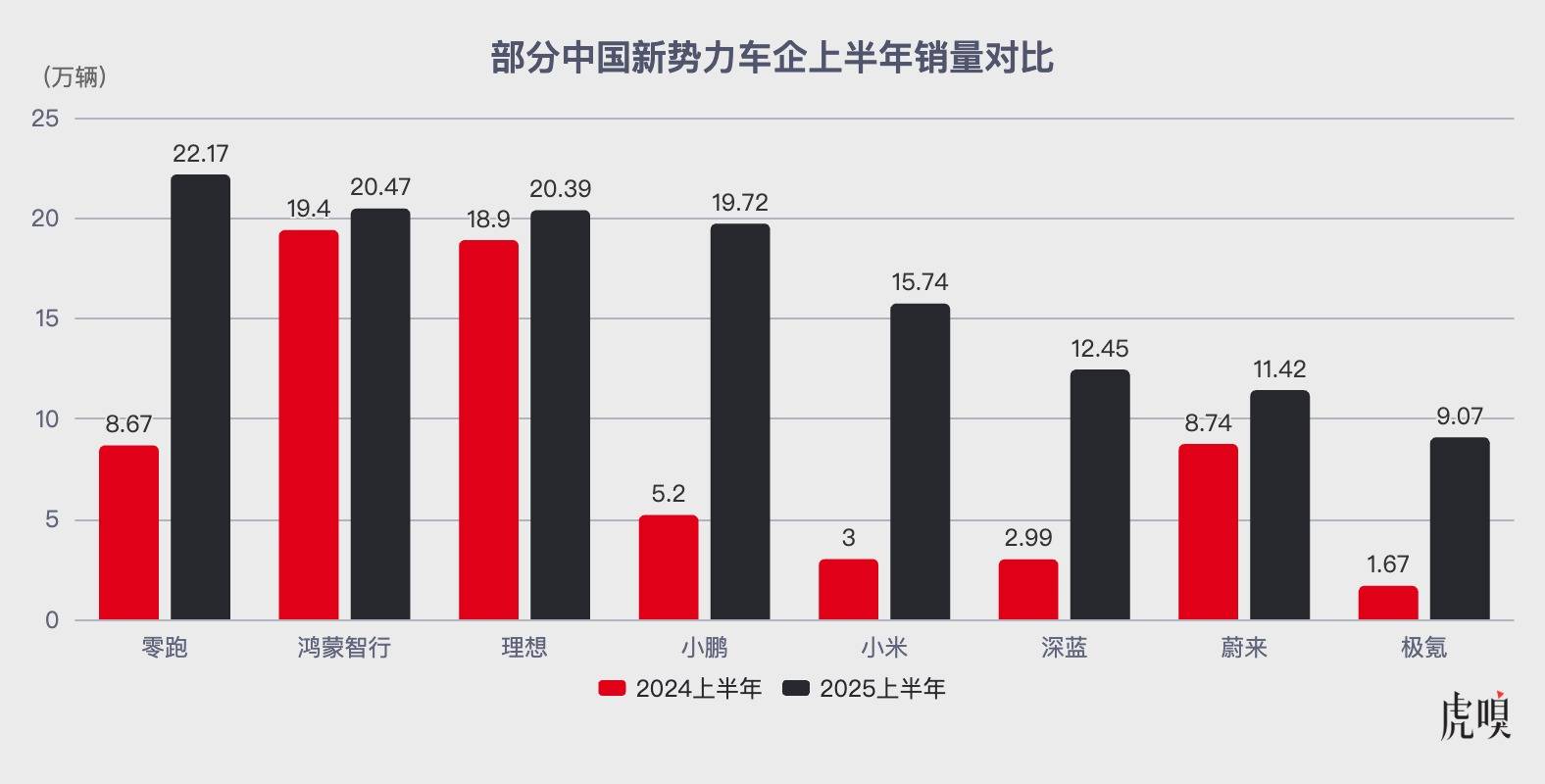
Core Viewpoint - The article discusses the performance of the "growth trio" in the Chinese automotive market, namely Xiaomi, Xiaopeng, and Leap Motor, highlighting their successful strategies amidst fierce competition and declining profits in the industry [1][10][46]. Group 1: Performance Overview - Mercedes-Benz's CEO stated that the company does not want to aggressively pursue market share in China, reflecting the challenges faced by traditional automakers [1]. - The "growth trio" has emerged as leaders in sales growth among new energy vehicle manufacturers, with Leap Motor, Xiaopeng, and Xiaomi showing significant sales increases [3][8]. - Leap Motor achieved a remarkable 53% quarter-on-quarter sales increase in Q2, reaching 134,000 units, and has raised its annual sales guidance to 580,000-650,000 units [20]. Group 2: Sales and Growth Metrics - The article presents sales data for the new energy vehicle companies, indicating that the "growth trio" not only ranks among the top five in sales but also has the highest completion rates for their annual sales targets [6][8]. - Xiaomi's SU7 model has seen over 100,000 units sold within four months of its launch, with July deliveries exceeding 30,000 units [21]. - Xiaopeng's Q2 sales increased by 10% quarter-on-quarter, showcasing the benefits of improved production capacity [21]. Group 3: Strategic Insights - The "growth trio" has achieved "healthy growth," characterized by simultaneous increases in sales volume and gross margin, attributed to strong economies of scale and precise market trend understanding [10][11]. - Leap Motor's cost control through vertical integration has allowed it to maintain a gross margin of 13.6% despite a decrease in average selling price [22]. - Xiaopeng's gross margin improved to 14.3% due to a shift in product mix towards higher-end models, demonstrating a focus on enhancing product quality [22]. Group 4: Market Positioning and Consumer Insights - Xiaomi's marketing strategy emphasizes emotional value, appealing to consumers who prioritize aesthetics and brand identity over mere specifications [25][26]. - The user demographic for Xiaomi's YU7 model is predominantly young, with a significant portion being first-time buyers, indicating a strong appeal to younger consumers [40]. - Leap Motor's strategy includes targeting mainstream markets while also planning to introduce a high-end flagship series, indicating a balanced approach to market segmentation [36]. Group 5: Global Expansion Plans - The "growth trio" is not only focusing on the domestic market but also planning international expansion, with Leap Motor establishing a joint venture with Stellantis and aiming for localized production in Malaysia [41][42]. - Xiaopeng is adopting a flexible approach for different markets, establishing direct sales in Europe while collaborating with local firms in Southeast Asia for assembly [43]. - Xiaomi has set a goal to enter the European market by 2027, indicating its ambition to expand its global footprint [45].


石头科技(688169.SH)业绩"阵痛"背后,并非"利润换份额"这么简单
Ge Long Hui· 2025-08-20 02:46
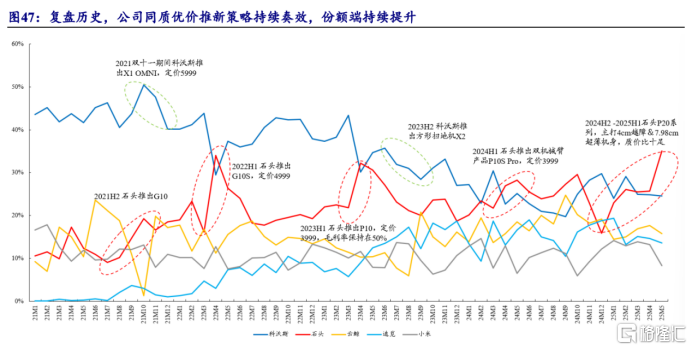
Core Insights - Stone Technology is experiencing a paradox where revenue growth is strong, yet net profit has declined for four consecutive quarters, contradicting the "winner takes all" principle in the industry [1] - The company is undergoing a strategic shift, reallocating resources from less efficient areas to core markets with growth potential, which is expected to stabilize profitability in the future [1] Group 1: Brand Building - Since H1 2024, Stone Technology has adopted more aggressive product and sales strategies, significantly increasing the speed of new product launches and marketing investments, leading to a rise in SG&A expenses [4] - Despite initial profit erosion, the company's market share continues to grow, with a 2.95% year-on-year increase in online market share for H1 2025 [4] - The strategic focus on the sweeping robot market allows Stone Technology to enhance brand loyalty and customer retention, while reallocating resources from the washing machine segment [4] Group 2: Supply Chain Efficiency - The company has established a manufacturing capacity of 300,000 units per month at its Huizhou factory, with a new factory in Vietnam set to begin production in Q4 2024, enhancing global supply chain stability [5] - Changes in sales accounting methods and increased marketing expenditures are expected to impact short-term financial performance but will strengthen long-term sales control and pricing stability [5] - The company is synchronizing product launches in Europe with domestic releases, solidifying its market share in Germany and experiencing rapid growth in Southern and Eastern Europe [6] Group 3: Research and Development - Stone Technology's R&D investment reached 685 million yuan in H1 2025, accounting for 8.67% of revenue, focusing on laser radar, AI algorithms, and smart interaction technologies [7] - The company is expected to maintain a competitive edge through continuous technological advancements, differentiating itself from lower-tier brands [7] - Upcoming product upgrades in 2025 will focus on improving cleaning methods, with new products addressing existing limitations in traditional designs [8] Group 4: Future Outlook - Historical product launch strategies have consistently led to market share increases, validating the company's approach to technology iteration and product direction [11] - As the company benefits from economies of scale and improved supply chain management, profit margins are expected to stabilize and improve starting Q3 2025 [11] - Analysts predict that Stone Technology will regain its status as a "profit cow," with a potential recovery in profitability and valuation as market conditions improve [11]

海油发展(600968):能技服务带动1H25毛利率创历史新高
Xin Lang Cai Jing· 2025-08-20 00:32
Core Insights - The company's 1H25 performance met expectations with revenue of 22.6 billion yuan, a year-on-year increase of 5%, and a net profit of 1.83 billion yuan, up 13% year-on-year, resulting in earnings per share of 0.16 yuan [1] - The company experienced a negative cash flow from operating activities of 480 million yuan, primarily due to increased procurement expenses [1] - The gross profit for 1H25 was 3.46 billion yuan, with a gross margin increase of 1.2 percentage points to 15.3%, marking a historical high for the same period [2] Revenue and Profitability - The energy technology segment achieved a gross profit of 1.72 billion yuan, with a gross margin increase of 2.5 percentage points to 21.5%, the highest in history [3] - The low-carbon environmental protection segment saw a revenue increase of 11% to 3.87 billion yuan, with significant growth in new energy technology and safety emergency services [3] - The company secured new external market orders worth 31.6 million yuan, a year-on-year increase of 141%, with notable breakthroughs in overseas markets [3] Energy Logistics and Future Outlook - The energy logistics segment reported a revenue increase of 5% to 11.6 billion yuan, with a gross profit increase of 6% to 1 billion yuan [4] - The company has commenced construction on 10 LNG transport vessels, expected to gradually enter production from 2026 to 2027, which is anticipated to drive sustained profit growth [4] Earnings Forecast and Valuation - The earnings forecast for 2025 and 2026 remains largely unchanged, with the current stock price corresponding to a price-to-earnings ratio of 10 times for 2025 and 8.7 times for 2026 [5] - The company maintains an outperform rating and a target price of 4.9 yuan, implying a potential upside of 24.4% based on the 2025 earnings multiple [5]

Black Hills (BKH) M&A Announcement Transcript
2025-08-19 13:30
Summary of Black Hills (BKH) M&A Announcement Company and Industry - **Company**: Black Hills Corporation (BKH) - **Industry**: Utility sector, specifically electric and natural gas utilities Core Points and Arguments 1. **Transaction Overview**: The merger is described as a strategic and financial rationale, enhancing scale in the utility industry, with both companies having aligned cultures and management teams [2][4][19] 2. **Customer Base and Workforce**: The combined entity will serve approximately 2,100,000 customers with a workforce of 4,400 employees, diversifying the business mix to 61% electric and 39% gas [1][6] 3. **Long-term EPS Growth**: The merger sets a long-term EPS growth target of 5% to 7%, which is 100 basis points higher than the standalone companies' previous target of 4% to 6% [3][11] 4. **Capital Investments**: The combined company plans to invest approximately $7.5 billion over five years, with more than 75% allocated to gas and electric transmission and distribution [10][11] 5. **Accretive to Shareholders**: The transaction is expected to be accretive to shareholders in the first full year post-closing, driven by operational optimization and incremental growth opportunities [3][11][19] 6. **Operational Synergies**: The merger is anticipated to produce strong and predictable earnings and cash flows, allowing for better management of regulatory outcomes and stable earnings profiles [4][5][19] 7. **Regulatory Approvals**: The merger requires approvals from various state and federal agencies, with expected closing in 12 to 15 months [18][19] 8. **Community Engagement**: The companies emphasize their commitment to serving over 1,200 communities across eight states, enhancing community partnerships and local philanthropic activities [7][20] Additional Important Content 1. **Diversity in Operations**: The merger will create a balanced business mix, with no single jurisdiction representing more than one-third of the rate base, which helps manage regulatory outcomes [5][19] 2. **Future Growth Opportunities**: The combined entity will explore growth in data centers and large load customer demands, leveraging the expanded geographic footprint [10][39] 3. **Dividend Policy**: Both companies will maintain their current dividend policies until closing, with plans for a competitive dividend growth rate post-merger [13][69] 4. **Cost Optimization**: The merger is expected to yield cost savings through operational efficiencies and improved negotiating power, enhancing overall financial performance [11][67] 5. **Generation Capacity**: The combined entity will have a diverse generation mix and plans for future generation build-outs to meet growing customer demands [76][82] This summary encapsulates the key points from the Black Hills M&A announcement, highlighting the strategic benefits, financial implications, and operational synergies expected from the merger.

新势力第二家!零跑实现半年盈利,明年挑战100万辆
Zhong Guo Qi Che Bao Wang· 2025-08-19 11:53
Core Insights - Leap Motor reported a significant financial performance for the first half of 2025, achieving a revenue of 24.25 billion yuan, a gross margin of 14.1%, and a net profit of 30 million yuan, making it the second Chinese new energy vehicle company to achieve semi-annual profitability after Li Auto [2] - The company raised its annual sales target from 500,000-600,000 units to 580,000-650,000 units and set a goal to challenge 1 million units in 2026 [2][6] Financial Performance - The delivery volume reached 221,664 units, a year-on-year increase of 155.7% - Revenue increased by 174% year-on-year to 24.25 billion yuan - Gross margin rose to 14.1%, marking a historical high for the company in the first half of the year - Operating cash flow and free cash flow were both positive, with cash reserves amounting to 29.58 billion yuan, indicating strong financial health [2][3] Research and Development - R&D expenditure for the first half of the year reached 1.89 billion yuan, a year-on-year increase of 54.9%, with a doubling of the scale and computational resources of the intelligent driving team [3] - The company aims to leverage its strong cash flow and reserves to support future R&D and global expansion [3] Profitability Drivers - Scale effects are fundamental to Leap Motor's profitability, with main models like C10 and C11 achieving significant sales milestones - Over 65% of core components are self-developed, enhancing cost structure and competitive differentiation [5] - The company reported nearly 1.1 billion yuan in revenue from non-automotive sales, contributing to overall revenue growth [5] Sales and Market Strategy - The annual sales target has been adjusted to 580,000-650,000 units, with a goal of reaching 1 million units by 2026 - The product matrix will continue to expand with new models launching in the coming months [6] - The company plans to establish a localized production base in Europe by the end of 2026 [8] International Expansion - Leap Motor is pursuing international growth through a "reverse joint venture" model, aiming to leverage partnerships for faster development in global markets - As of mid-2025, the company has established over 600 outlets in approximately 30 global markets, with Europe contributing 1.85 billion yuan in revenue [8]
新势力又一盈利新王浮现:零跑上半年营收翻1.7倍,下半年继续"量价齐升"?
3 6 Ke· 2025-08-19 09:42
Core Viewpoint - The Chinese electric vehicle market in 2025 is characterized by intense competition, with companies like Leap Motor setting ambitious sales targets, aiming for a significant increase in both volume and profitability, challenging the notion that new entrants cannot achieve profitability [1][3]. Group 1: Financial Performance - Leap Motor's revenue for the first half of 2025 reached 24.249 billion yuan, a 174% increase from 8.845 billion yuan in the same period last year, significantly outpacing the industry average and the company's own sales growth of 155.7% [3][4]. - The company achieved a net profit of approximately 33 million yuan, a turnaround from a loss of over 2.2 billion yuan in the previous year, making it the second new force after Li Auto to report a half-year profit [3][4]. - Leap Motor's gross margin improved dramatically from 1.1% to 14.1%, with expectations to reach around 15% in the second half of the year [3][4]. Group 2: Strategic Focus - Leap Motor's success is attributed to a dual strategy of cost control and product structure optimization, with sales costs increasing by only 137.9%, significantly lower than revenue growth [4][5]. - The company has shifted from a "money-for-market-growth" approach to a model that emphasizes efficiency for profit growth, with a revised sales target of 580,000 to 650,000 units for 2025 [5][6]. Group 3: Competitive Positioning - Leap Motor differentiates itself by targeting the mass market with high-value configurations, avoiding the pitfalls of the high-end market, and leveraging a platform strategy that enhances cost control through high parts commonality [6][7]. - The company employs a "light asset" strategy, utilizing leasing and contract manufacturing to minimize capital expenditure while maintaining cost control through centralized procurement and strict expenditure oversight [7][8]. Group 4: Market Challenges and Future Outlook - Despite its achievements, Leap Motor faces significant competition from established players like BYD, which has a strong market presence and vertical integration advantages [8][9]. - The company plans to launch its D series, targeting the 200,000 to 250,000 yuan segment, which will face intense competition from brands with higher recognition and established technological advantages [9][10]. - Leap Motor aims to enhance its smart driving capabilities and is investing heavily in R&D to compete with industry leaders by the end of 2025 [10][11].