出口管制

Search documents
螺纹热卷日报-20251013
Yin He Qi Huo· 2025-10-13 10:19
Report Information - Report Title: Black Metal R & D Report [1][4] - Date: October 13, 2025 [2] - Researcher: Qi Chunyi [3] Industry Investment Rating - Not provided Core Viewpoints - The steel price is expected to maintain a bottom - oscillating trend after the holiday, with limited downward space. If the downstream demand in October recovers beyond expectations, the steel price may rise further. The "14th Five - Year Plan" content will also affect the market fluctuations. [7] - Due to low production, rebar production increased before the holiday, while hot - rolled coil production continued to decrease, and the export performance remained strong, so the spread between hot - rolled coil and rebar is expected to expand. [7] Summary by Directory Market Information - Spot prices: Shanghai Zhongtian rebar is 3190 yuan (- 10), Beijing Jingye rebar is 3140 yuan (- 20), Shanghai Angang hot - rolled coil is 3320 yuan (- 20), and Tianjin Hegang hot - rolled coil is 3250 yuan (- 20). [6] Market Judgement - **Market Situation**: The black metal sector showed differentiation. Steel maintained a weak oscillating trend, while iron ore prices rose. Steel spot trading was generally weak, with speculative trading at low prices being acceptable during the market rebound, but rigid demand was average. Some steel mills reduced production of hot - rolled and rebar, and there was significant inventory accumulation during the holiday, with the inventory increase exceeding previous years and apparent demand dropping rapidly. [7] - **Price Forecast**: The steel price is expected to maintain a bottom - oscillating trend, with limited downward space. Short - term steel prices may be under pressure due to news, but the impact of this tariff may be weaker than the "reciprocal tariff" in April. If the downstream demand in October recovers beyond expectations, the steel price may rise further. [7] - **Trading Strategies** - **Single - side**: Maintain a bottom - oscillating trend, and it is recommended to buy on dips. [8] - **Arbitrage**: It is recommended to continue holding the 1 - 5 positive spread and go long on the spread between hot - rolled coil and rebar. [8] - **Options**: It is recommended to wait and see. [8] - **Important Information** - In October 2025, the total production schedule of air conditioners, refrigerators, and washing machines was 29.24 million units, a 9.9% decrease compared to the actual production in the same period last year. [8][10] - In September 2025, China exported 10.465 million tons of steel, a 10.0% month - on - month increase; from January to September, the cumulative steel export was 87.955 million tons, a 9.2% year - on - year increase. In September, China imported 548,000 tons of steel, a 9.6% month - on - month increase; from January to September, the cumulative steel import was 4.532 million tons, a 12.6% year - on - year decrease. [10] Relevant Attachments - The report provides multiple charts, including those related to rebar and hot - rolled coil prices, basis, spreads, and profits, with data sources from Galaxy Futures, Mysteel, and Wind. [14][16][18]
关税再升级——政策周观察第50期
Huachuang Securities· 2025-10-13 09:47
Group 1: Trade Restrictions - On October 10, President Trump announced a 100% tariff on all Chinese goods imported to the U.S., effective November 1[1] - The U.S. Department of Commerce added multiple Chinese entities to the export control "entity list" on October 8, further tightening trade restrictions[2] - China announced export controls on five categories of rare earth materials and lithium battery components, effective November 8, 2025, claiming limited impact on supply chains[1] Group 2: Regulatory Measures - The U.S. will impose port fees on Chinese vessels starting October 14, as part of the Section 301 measures targeting maritime, logistics, and shipbuilding industries[2] - China responded with its own port fees on U.S. vessels, citing legal grounds to protect its interests[2] - The State Administration for Market Regulation initiated an antitrust investigation against Qualcomm on October 12, indicating increased scrutiny on foreign companies operating in China[2] Group 3: Political Developments - The 20th Central Committee's Fourth Plenary Session is scheduled for October 20-23, focusing on economic and social development under the Party's leadership[3] - The meeting emphasized the importance of high-quality development and risk prevention in the context of the 14th Five-Year Plan[3]
中美经贸再生波澜,前三季度出口逆增7.1%
Sou Hu Cai Jing· 2025-10-13 09:22
Core Points - Despite complex international circumstances, China's exports achieved a growth rate of 7.1% in the first three quarters, marking eight consecutive quarters of growth [2][3] - The U.S. announced a new round of tariffs on Chinese imports, potentially raising average tariffs to over 150% [2][8] Group 1: Export Performance - In the first three quarters, China's total goods trade reached 33.61 trillion yuan, with exports at 19.95 trillion yuan and imports at 13.66 trillion yuan [2] - High-tech product exports amounted to 3.75 trillion yuan, growing by 11.9% and contributing over 30% to overall export growth [3] - Mechanical and electrical products accounted for 60.5% of total exports, with a growth of 9.6% [3] Group 2: Product Composition - Exports of industrial robots surged by 54.9%, while wind power equipment exports grew by 23.9% [4] - Traditional cultural products like dragon boats and paper-cutting crafts have gained popularity in international markets [4] - Exports of holiday goods and toys exceeded 50 billion yuan, showcasing the influence of Chinese traditional culture [4] Group 3: Regional Performance - The western region of China saw significant export growth, with traditional manufacturing products like home appliances and motorcycles growing over 20% [4] - High-tech product exports from the western region exceeded 450 billion yuan, growing by 26.4% [4] Group 4: E-commerce and Market Diversification - Cross-border e-commerce exports reached 1.09 trillion yuan, growing by 11.6% [5] - Trade with Belt and Road Initiative countries totaled 17.37 trillion yuan, growing by 6.2% and accounting for 51.7% of total trade [5][6] - ASEAN remains China's largest trading partner, with trade volume reaching 5.57 trillion yuan, a 9.6% increase [6] Group 5: Business Confidence and Market Expansion - Export enterprise confidence index has risen for five consecutive months, indicating a positive outlook for future trade [7] - The number of foreign trade entities exceeded 700,000 for the first time, with private enterprises leading in market expansion [7] - Private enterprises accounted for 54.2% of high-tech product exports, highlighting their significant role in the export sector [7]


瑞达期货焦煤焦炭产业日报-20251013
Rui Da Qi Huo· 2025-10-13 09:05
Report Summary 1. Report Industry Investment Rating No information provided. 2. Core Viewpoints - On October 13, the JM2601 contract of coking coal closed at 1,146.0, down 1.63%. The spot price of Tangshan Meng 5 clean coal was reported at 1,422, equivalent to 1,202 on the futures market. With the 20th Fourth Plenary Session of the CPC Central Committee scheduled from October 20 - 23 in Beijing, during the National Day, some regional coal mines had maintenance shutdowns, leading to a slight decline in production, an increase in mine - end inventory, a continuous decline in the cumulative import growth rate for three months, and a continuous three - week increase in inventory with a seasonal upward trend. Technically, the daily K - line is between the 20 - day and 60 - day moving averages. It should be treated as a volatile operation [2]. - On October 13, the J2601 contract of coke closed at 1,642.5, down 1.14%. The coke price increase was implemented on October 1. On the macro - front, on the evening of October 12, US Vice - President Vance signaled some easing regarding Trump's latest tariff threats, saying that Trump was willing to have rational negotiations with China. Fundamentally, in terms of demand, the current hot metal output is 2.4181 million tons, a decrease of 0.0055 million tons, with hot metal output in a high - level oscillation. The total coke inventory is higher than the same period. In terms of profit, the average profit per ton of coke for 30 independent coking plants nationwide is 9 yuan/ton. Technically, the daily K - line is below the 20 - day and 60 - day moving averages. It should be treated as a volatile operation [2]. 3. Summary by Relevant Catalogs Futures Market - JM main contract closing price was 1,146.00 yuan/ton, down 15.00; J main contract closing price was 1,642.50 yuan/ton, down 24.00 [2]. - JM futures contract open interest was 800,960.00 lots, down 8,116.00; J futures contract open interest was 49,973.00 lots, up 626.00 [2]. - Net position of the top 20 JM contracts was - 88,875.00 lots, up 16,441.00; net position of the top 20 J contracts was - 4,185.00 lots, up 103.00 [2]. - JM 5 - 1 month contract spread was 96.50 yuan/ton, down 1.50; J 5 - 1 month contract spread was 152.00 yuan/ton, down 0.50 [2]. - Coking coal warehouse receipts were 200.00, unchanged; coke warehouse receipts were 2,190.00, up 40.00 [2]. - JM main contract basis was 324.00 yuan/ton, up 15.00; J main contract basis was 77.50 yuan/ton, up 24.00 [2]. Spot Market - Dry Qimantage Meng 5 raw coal price was 1,028.00 yuan/ton, unchanged; Tangshan first - grade metallurgical coke price was 1,720.00 yuan/ton, unchanged [2]. - Russian prime coking coal forward spot price (CFR) was 151.50 US dollars/wet ton, unchanged; Rizhao Port quasi - first - grade metallurgical coke price was 1,520.00 yuan/ton, unchanged [2]. - Jingtang Port Australian imported prime coking coal price was 1,490.00 yuan/ton, unchanged; Tianjin Port first - grade metallurgical coke price was 1,620.00 yuan/ton, unchanged [2]. - Jingtang Port Shanxi - produced prime coking coal price was 1,630.00 yuan/ton, unchanged; Tianjin Port quasi - first - grade metallurgical coke price was 1,520.00 yuan/ton, unchanged [2]. - Shanxi Jinzhong Lingshi medium - sulfur prime coking coal price was 1,470.00 yuan/ton, unchanged; Inner Mongolia Wuhai - produced coking coal ex - factory price was 1,180.00 yuan/ton, unchanged [2]. Upstream Situation - 314 independent coal washing plants' clean coal output was 25.70 million tons, down 1.10; their clean coal inventory was 280.20 million tons, down 22.60 [2]. - 314 independent coal washing plants' capacity utilization rate was 0.35%, down 0.02; raw coal output was 39,049.70 million tons, up 951.00 [2]. - Coal and lignite imports were 4,600.30 million tons, up 326.30; 523 coking coal mines' daily average raw coal output was 183.90, down 10.30 [2]. - 16 ports' imported coking coal inventory was 507.47 million tons, up 5.00; 18 ports' coke inventory was 252.59 million tons, down 4.00 [2]. - Independent coking enterprises' total coking coal inventory was 959.06 million tons, down 78.65; their coke inventory was 63.84 million tons, up 1.53 [2]. - 247 steel mills' coking coal inventory was 781.13 million tons, down 6.93; their coke inventory was 650.82 million tons, down 12.58 [2]. - Independent coking enterprises' available coking coal days were 12.66 days, down 0.07; 247 steel mills' available coke days were 11.42 days, down 0.18 [2]. Industry Situation - Coking coal imports were 1,016.22 million tons, up 55.50; coke and semi - coke exports were 55.00 million tons, down 34.00 [2]. - Coking coal output was 3,696.86 million tons, down 392.52; independent coking enterprises' capacity utilization rate was 75.18%, up 0.05 [2]. - Independent coking plants' average profit per ton of coke was 9.00 yuan/ton, up 43.00; coke output was 4,259.70 million tons, up 74.20 [2]. Downstream Situation - 247 steel mills' blast furnace operating rate was 84.25%, down 0.02; their blast furnace iron - making capacity utilization rate was 90.53%, down 0.10 [2]. - Crude steel output was 7,736.86 million tons, down 228.96 [2]. Industry News - The Chinese Ministry of Commerce stated that export controls are not a ban, and applications that meet regulations will be approved, and the impact on the supply chain is limited [2]. - The Chinese Ministry of Commerce responded to counter - measures against the US 301 investigation on China's shipbuilding industry, and the Ministry of Transport will charge a special port fee for US ships [2]. - The State Administration for Market Regulation launched an anti - monopoly investigation into Qualcomm [2]. - The annual power consumption of global data centers accounts for over 3% of the world's total, and it is expected to reach 11% - 17% by 2030, which may impact the power supply [2].
稀土等出口管制不是禁止出口
Bei Jing Wan Bao· 2025-10-13 08:45
Core Points - China has implemented export control measures on rare earth materials, emphasizing that these controls are not a ban on exports but a legal framework to ensure compliance with regulations [1][2] - The Chinese government aims to maintain global peace and regional stability through these measures, particularly in light of the military applications of rare earth materials [1] - The U.S. has announced a 100% tariff on Chinese rare earth exports and additional export controls on key software, which China views as a double standard and a violation of fair trade practices [1][2] Group 1 - The Chinese government will conduct licensing reviews for export applications that meet regulations, with a focus on facilitating compliant trade [1] - The U.S. has recently intensified its restrictions on Chinese entities, impacting thousands of companies and undermining the atmosphere for economic talks [2] - China maintains a consistent stance against tariff wars, expressing a willingness to engage in dialogue while also preparing to defend its interests if necessary [2] Group 2 - The U.S. has a significantly larger export control list compared to China, with over 3,000 items compared to China's 900, highlighting a disparity in trade practices [1] - The Chinese government emphasizes its commitment to international obligations and the importance of maintaining stable global supply chains [1] - China urges the U.S. to correct its approach and engage in respectful dialogue to resolve trade concerns and manage differences effectively [2]
璞泰来:对锂电池和人造石墨负极材料相关物项实施出口管制事项 公司初步评估认为对公司业务的影响较小
Ge Long Hui A P P· 2025-10-13 08:14
Core Viewpoint - The recent export control policy on lithium batteries and artificial graphite anode materials issued by the Ministry of Commerce on October 9 has a minimal impact on the company's business and performance [1] Summary by Relevant Sections Export Control Policy Impact - The new export control regulations do not prohibit exports, and the company will prepare the necessary materials to apply for licenses as required [1] - The company's automation equipment business is primarily domestic, with overseas revenue accounting for less than 0.5% of total revenue, indicating a minimal impact [1] - The main products in the automation equipment segment, such as mixing, coating, and slitting equipment, are not included in the export control scope [1] Anode Material Business - From 2006 to 2023, domestic artificial graphite exports have been conducted in accordance with export control regulations, with export volumes significantly increasing based on market supply and demand [1] - The policy is expected to relax starting December 2023, allowing for the resumption of export license applications, which is anticipated to restore the original export model without negative impacts on the anode material export business [1] Production Equipment and Technology Transfer - The company currently does not have overseas factories, thus it is not affected by the need to import domestic production equipment for overseas operations [1] - The company's business model does not involve technology transfer, so it remains unaffected by related export control measures [1]

大越期货原油早报-20251013
Da Yue Qi Huo· 2025-10-13 08:07
Report Summary 1. Report Industry Investment Rating - Not provided 2. Core View of the Report - Trump's softened stance towards China has somewhat alleviated market concerns, leading to a partial recovery in oil prices on Monday morning. However, long - term confrontation persists. With continuous supply growth and ongoing demand - side concerns, oil prices face significant pressure. The current smooth progress of the Israel - Palestine peace talks means a lack of short - term geopolitical stimuli, and oil prices are expected to trend weakly. Short - term, the price is expected to range between 445 - 455, and long - term, it is advisable to wait and see [3]. 3. Summary by Directory 3.1 Daily Prompt - **Crude Oil 2511**: - **Technical Analysis**: The 20 - day moving average is downward, and the price is below the moving average, indicating a bearish trend [3]. - **Fundamentals**: Trump's statements on China and Ukraine have caused significant market expectation fluctuations, with a neutral impact [3]. - **Basis**: On October 10, the spot price of Oman crude was $65.60 per barrel, and that of Qatar Marine crude was $64.39 per barrel, with a basis of $19.98 per barrel, showing a spot premium over futures, a bullish sign [3]. - **Inventory**: From the week ending October 3, API and EIA crude inventories increased more than expected, while Cushing area inventory decreased. As of October 10, Shanghai crude oil futures inventory remained unchanged, a bearish factor [3]. - **Main Position**: As of September 23, WTI crude main position was long and increasing; as of October 7, Brent crude main position was long but decreasing, a bearish signal [3]. 3.2 Recent News - **Trade and Politics**: Trump announced a 100% tariff increase on Chinese imports and new export controls on key software in response to China's expanded rare - earth export controls. The FCC has removed millions of Chinese electronic products from major US online retail platforms [5]. - **Monetary Policy**: St. Louis Fed President Moussalem believes there may be one more rate cut, but warns of inflation risks. Fed Governor Waller thinks weak employment data supports further rate cuts [5]. - **Geopolitics**: Yemen's Houthi rebels said they would stop attacking Israeli - related ships in the Red Sea if Israel adheres to the Gaza cease - fire agreement [5]. 3.3 Bullish and Bearish Factors - **Bullish**: The threat of the Russia - Ukraine conflict to refineries and oil fields and the mitigation of Trump's tariff threats [6]. - **Bearish**: Easing of the Middle East situation, the risk of a US government shutdown, and OPEC+'s consideration of further production increases [6]. 3.4 Fundamental Data - **Futures Market**: The settlement prices of Brent, WTI, SC, and Oman crude all declined, with WTI having the largest decline of 4.24% [7]. - **Spot Market**: The spot prices of UK Brent Dtd, WTI, Oman, Shengli, and Dubai crude all decreased, with WTI and UK Brent Dtd having relatively large declines [9]. - **Inventory Data**: API and EIA crude inventories increased in the week ending October 3, while Cushing area inventory decreased [3][10][14]. 3.5 Position Data - **WTI Crude**: As of September 23, the net long position increased by 4,249 [17]. - **Brent Crude**: As of October 7, the net long position decreased by 61,713 [19].
璞泰来:初步评估出口管制措施对公司业务影响较小
Xin Lang Cai Jing· 2025-10-13 07:49
Core Viewpoint - The company has assessed the recent export control announcement by the Ministry of Commerce and the General Administration of Customs regarding lithium batteries and artificial graphite anode materials, concluding that the impact on its business will be minimal [1] Group 1: Automation Equipment Business - The company's automation equipment business is primarily domestic, with overseas revenue accounting for less than 0.5% of total revenue from January to August 2025, indicating a very small proportion [1] - The main products in the automation equipment segment include slurry, coating, and slitting equipment, which are not subject to the recent export controls [1] - Current overseas orders for mid-stage equipment, such as stacking and liquid injection, are limited in value, suggesting a minimal impact from the new regulations [1] Group 2: Anode Materials Business - From 2006 to 2023, domestic exports of artificial graphite have been conducted in accordance with export control regulations, with export volumes significantly increasing in response to market supply and demand [1] - There is no indication of a large-scale ban on exports, and the new regulations set to take effect in December 2023 will relax previous restrictions, allowing for the resumption of export license applications [1] - The company anticipates that the anode materials export business will not face negative impacts due to the expected return to previous operational models [1]
不是word,也不是pdf!商务部公告附件首次改为wps格式冲上热搜
Mei Ri Jing Ji Xin Wen· 2025-10-13 07:04
10月12日,"商务部公告附件首次改为wps格式"词条登上微博热搜。 10月9日,商务部发布2025年第61号公告,对含有中国成分的部分境外稀土相关物项实施出口管制。 新规明确,军事用途出口原则上不予许可。 值得注意的是,除管制规则外,公告附件采用wps格式,申请文件须以中文提交两大细节引发热议。据悉,此前公告附件都是word或pdf格式。 最终用途为研发、生产14纳米及以下逻辑芯片或者256层及以上存储芯片,以及制造上述制程半导体的生产设备、测试设备和材料,或者研发具有潜在军 事用途的人工智能的出口申请,逐案审批。 其中部分条款自12月1日起实施,原产于中国的物项即日起执行。 金山软件始创于1988年,是国内最早的互联网软件企业之一。历经30余载,目前主要涉及金山办公、西山居、金山世游、金山云等业务线。金山办公主要 业务涉及WPS Office办公软件产品及服务的设计研发及销售推广;西山居及金山世游从事游戏研发及运营;金山云提供安全、可靠、稳定、高品质的云计 算服务。 金山办公于2019年11月18日在上海证券交易所上市。 8月20日晚,金山办公发布2025年半年报。上半年金山办公实现营业收入26.57亿元 ...

中国造出EUV,美国建立起稀土全产业链,谁会更快?
Sou Hu Cai Jing· 2025-10-13 06:55
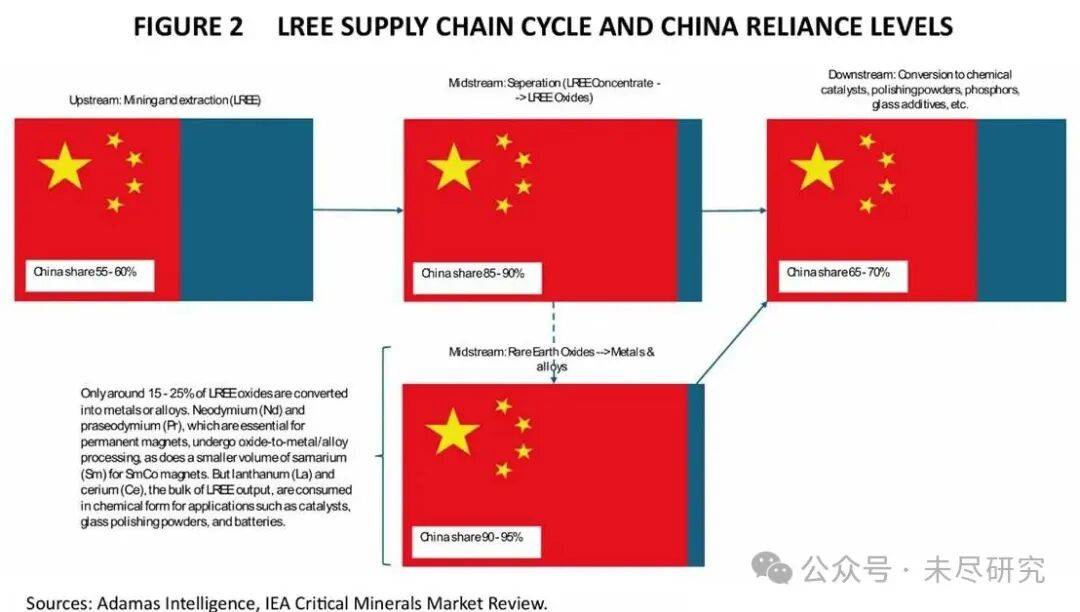
Core Viewpoint - The article emphasizes the critical role of rare earth elements, particularly medium and heavy rare earths, in the AI supply chain, highlighting China's near-monopoly in this sector and its implications for the global AI economy [1][7][11]. Group 1: Importance of Rare Earths in AI - Rare earths serve as a crucial lever that determines the performance limits and supply stability of AI chips, making them indispensable across various applications from chips to electric motors [1][2]. - A mere 0.1% content of rare earths can significantly impact the global AI supply chain, affecting everything from advanced logic chips to production equipment [2][3]. - The unique atomic properties of rare earths make them essential for enhancing the performance of AI hardware, with their specific electronic configurations allowing precise coupling with semiconductor materials [4][5]. Group 2: China's Dominance in Rare Earth Supply - China controls nearly the entire supply chain of medium and heavy rare earths, from mining to refining and manufacturing components, which is vital for the AI economy [1][7]. - Recent export controls by China on medium and heavy rare earths have further solidified its position, as 12 out of 17 rare earth elements are now subject to these restrictions [7][8]. - The extraction and processing of heavy rare earths are predominantly located in China, with the country holding 98% of the global reserves, making it difficult for other nations to compete [11][15]. Group 3: Challenges for the US and Other Countries - The US has initiated efforts to rebuild its rare earth supply chain but has made slow progress, primarily focusing on light rare earths rather than the more critical medium and heavy rare earths [8][9]. - Despite investments and subsidies, US companies are struggling to achieve profitability in the rare earth sector, with significant technological and economic challenges ahead [8][15]. - The ongoing competition for rare earths is expected to shape the future landscape of the global AI industry, with the race to establish a complete supply chain being a key factor [12][15].