
扩内需

Search documents
多维度锚定“十五五”经济发展新局面
Zhong Guo Zheng Quan Bao· 2025-11-09 20:15
Core Viewpoint - The conference highlighted the resilience and vitality of China's economy during the "14th Five-Year Plan" period, with a focus on high-quality development and various macroeconomic indicators that support this outlook [1][2]. Macroeconomic Indicators - China's GDP grew by 5.2% year-on-year in the first three quarters of 2025, laying a solid foundation for achieving the annual target [2]. - The growth of new economic drivers, particularly in equipment manufacturing and high-tech manufacturing, outpaced overall industrial growth [2]. - Significant increases in the production of smart products and green equipment were noted, alongside a marked growth in the value added by the digital product manufacturing sector [2]. Policy Impact - Demand-stimulating policies have shown effectiveness, with the "Two New" policies driving retail sales growth and facilitating large-scale equipment upgrades, creating a positive cycle of policy stimulus leading to increased demand, production growth, and subsequent investment [2]. - The external trade sector demonstrated strong resilience, achieving record high import and export volumes despite a complex external environment, with diversified markets providing robust support [2]. Capital Market Performance - The A-share market has seen a significant increase in trading volume and investor confidence since the introduction of a comprehensive set of measures on September 24 of the previous year [2]. Recommendations for the "15th Five-Year Plan" - The proposed recommendations emphasize economic construction as the central theme, promoting high-quality development while adhering to the principle of prioritizing people's needs and showcasing a spirit of reform and innovation [2]. Macroeconomic Policy Suggestions - There is a call for enhanced coordination between fiscal and monetary policies, leveraging various policy tools to foster an economy driven by domestic demand and consumption [3]. - The need for proactive macroeconomic policies that are consistent and capable of counter-cyclical adjustments is emphasized [3]. Focus on Real Economy - The emphasis is on maintaining a reasonable proportion of manufacturing while building a modern industrial system centered around advanced manufacturing [3]. - Accelerating self-reliance in technology and enhancing independent innovation capabilities are seen as crucial for seizing technological development opportunities [3]. Regional Development Strategy - The strategy aims to leverage the synergistic effects of various regional development strategies to enhance the high-quality development momentum in key areas such as Beijing-Tianjin-Hebei, the Yangtze River Delta, and the Guangdong-Hong Kong-Macau Greater Bay Area [3]. Domestic Demand Expansion - The approach combines improving livelihoods and promoting consumption with investments in both physical and human capital, aiming to create a virtuous cycle between supply and demand [3]. Green Transition Initiatives - The focus on carbon peak and carbon neutrality aims to synergize efforts in reducing carbon emissions, pollution, and promoting green growth while ensuring ecological safety [3].
物价水平企稳回升 释放需求修复暖意
Shang Hai Zheng Quan Bao· 2025-11-09 17:28
Core Viewpoint - Recent implementation of 500 billion yuan in new policy financial tools has been completed, with both existing and new policies continuing to exert influence, leading to a gradual stabilization of prices and a potential mild increase in the price center [1] Economic Indicators - CPI is expected to gradually recover from low levels, characterized by strong food prices, weak energy prices, and stable core prices [1] - A slight rebound in pork prices is anticipated due to reduced output plans from major pig farming companies and the arrival of the southern cured meat season [1] - Decreased supply of fruits and vegetables due to falling temperatures is likely to lead to price increases [1] Policy Impact - The year-on-year decline in food CPI is expected to narrow in November due to a high base effect from the previous year [1] - "Anti-involution" measures are expected to continue supporting automobile prices, while industrial consumer goods prices are likely to improve year-on-year, and service prices will remain stable [1] Market Outlook - With continued macro policy support and a recovery in market confidence, the overall price center is projected to rise moderately [1] - CPI is anticipated to enter a mild upward channel, while the year-on-year decline in PPI is expected to continue narrowing, with month-on-month figures likely to maintain a weak balance [1]
10月中国物价指数释放积极信号
Di Yi Cai Jing Zi Xun· 2025-11-09 15:13
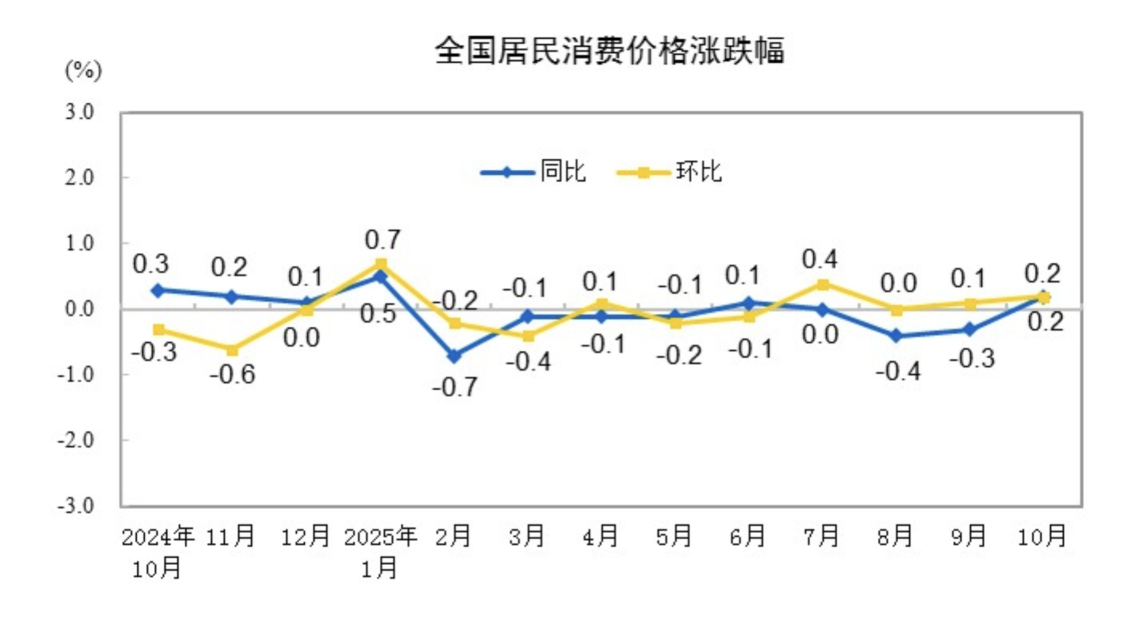
Core Insights - The inflation data for October indicates a steady recovery in China's economic vitality and domestic demand, with the Consumer Price Index (CPI) showing a year-on-year increase of 0.2% and a core CPI increase of 1.2%, marking the highest level since March 2024 [2][5][14] CPI Analysis - The CPI turned from a decline of 0.3% in September to an increase of 0.2% in October, with food prices decreasing by 2.9%, but the decline has narrowed [3][6] - The core CPI's continuous rise suggests a robust recovery in domestic consumption, particularly in service consumption, indicating a solid foundation for overall prices [5][6] PPI Analysis - The Producer Price Index (PPI) saw a month-on-month increase of 0.1% in October, marking the first rise of the year, while the year-on-year decline narrowed to 2.1% [2][7] - Factors contributing to the narrowing decline in PPI include improved supply-demand relationships and ongoing capacity governance in key industries [9][10] Future Outlook - The outlook for inflation suggests a "strong food, weak energy, stable core" scenario, with potential for slight rebounds in food prices due to seasonal factors [6][10] - The government's focus on expanding domestic demand and enhancing consumer spending is expected to support economic growth and stabilize inflation levels [12][14]

10月中国物价指数释放积极信号,行业供需全方位改善
Di Yi Cai Jing· 2025-11-09 13:13
Group 1: Inflation Data - The core CPI increased by 1.2% year-on-year in October, marking the highest level since March 2024 and the sixth consecutive month of growth [4] - The overall CPI turned from a decrease of 0.3% in September to an increase of 0.2% in October, indicating a positive shift in consumer prices [2][5] - The PPI decreased by 2.1% year-on-year in October, but the decline has narrowed for three consecutive months, reflecting improvements in certain industry supply-demand relationships [6][8] Group 2: Economic Signals - The October inflation data signals a steady enhancement of economic vitality and the continuous release of domestic demand potential, supported by effective policies [1][4] - The recovery in core CPI suggests a robust recovery in domestic consumption, particularly in service consumption, indicating a solidifying price foundation [4][13] - The improvement in price data is seen as a comprehensive result of macroeconomic policy effects and balanced supply-demand relationships [4][8] Group 3: Future Outlook - The upcoming inflation trends are expected to show "strong food, weak energy, and stable core" characteristics, with potential for slight rebounds in food prices due to seasonal factors [5] - The government emphasizes the need for policies to further stimulate domestic demand and enhance consumer spending, which is crucial for economic growth [10][12] - The overall economic environment is projected to improve, with CPI gradually rising and PPI deflationary pressures easing, contributing to a more stable price level [13]
浦发信用卡多元化场景实现“金融惠民”与“内需扩容”的双向共赢
Zhong Guo Jin Rong Xin Xi Wang· 2025-11-06 09:18
Core Insights - The recent proposal by the Central Committee emphasizes "boosting consumption" and increasing the effectiveness of inclusive policies directed at consumers [1][2] Group 1: Consumer Engagement Initiatives - The company has launched diverse promotional activities focusing on daily consumer needs and customer experience, translating consumption policies into tangible customer benefits [1] - The "Pen Pen Return" program allows cardholders to participate with a minimum single transaction of 16 yuan, offering up to 60 benefits during the promotional period, with a maximum reward of 666 yuan [1] - The "1 yuan tea drink" benefit collaborates with popular brands to meet the public's tea consumption needs, integrating inclusive benefits into daily life [1] Group 2: Service Quality Enhancement - The company has innovated the use of points by allowing cardholders to redeem phone bills through a "cash + points" combination and offering discounts on e-commerce platforms [2] - The "Runner Card Zone" targets running enthusiasts, providing up to 3000 yuan in rewards for completing specific marathon events, enhancing service for niche customer groups [2] - The launch of these diverse activities reflects the company's commitment to expanding domestic demand and promoting consumption, ultimately enhancing customer loyalty and market growth [2]

21社论丨需完善“投资于人”的财政保障机制
21世纪经济报道· 2025-11-06 00:11
Core Viewpoint - The article emphasizes the importance of "investment in people" as a strategic approach to drive economic transformation and enhance human capital, which is essential for sustainable development and competitiveness in the context of China's modernization [1][5]. Group 1: Investment in Human Capital - "Investment in people" is crucial for transforming the vast potential of China's 1.4 billion population into a driving force for domestic circulation, focusing on enhancing individual capabilities and safeguarding rights [1]. - The shift from capital-intensive to talent-intensive industries highlights the changing nature of human capital, where knowledge, skills, and innovation capabilities are now the core values [1][2]. - A comprehensive capability development system covering the entire life cycle is necessary, including reforms in basic education, higher education, and vocational training to align with new industrial demands [2]. Group 2: Human Capital as a Consumer Driver - "Investment in people" not only enhances supply-side quality but also activates the consumer market, facilitating internal circulation [2]. - Cultivating innovative talent leads to the creation of new technologies and industries, generating new consumption scenarios and products, thus stimulating previously non-existent consumer demands [2]. - As individual capabilities improve, consumer demand shifts from basic needs to higher-quality lifestyle pursuits, driving growth in sectors like education, culture, tourism, and health [2]. Group 3: Enhancing Consumer Capacity - A systematic policy approach is needed to enhance consumer capacity, focusing on employment promotion, income increase, and stabilizing expectations [3]. - Employment policies should prioritize new economies and industries to achieve higher quality employment, while income distribution reforms should increase labor compensation and expand the middle-income group [3]. - Fiscal spending should be optimized to prioritize public welfare, ensuring that more funds are directed towards essential services like education, healthcare, and elderly care [3]. Group 4: Long-term Mechanisms for Investment - "Investment in people" requires long-term and systematic efforts, including establishing stable fiscal mechanisms that align with population movements and development needs [4]. - Local government performance evaluation systems should incorporate metrics related to human capital accumulation and public welfare improvements [4][5]. - Collaborative efforts among government, enterprises, and society are essential for building infrastructure in education, healthcare, and elderly care sectors [5].

万辰集团:公司主营业务为量贩零食业务和食用菌业务
Zheng Quan Ri Bao Zhi Sheng· 2025-11-05 09:09
Core Viewpoint - Wancheng Group is committed to high-quality development in its main businesses of snack retail and edible fungi, responding positively to national policies aimed at promoting consumption and expanding domestic demand [1] Group 1 - The company focuses on improving operational efficiency to provide high-quality products and consumer experiences at a competitive price [1]
前三季度净利同比增120.78% 张小泉业绩持续稳健增长
Mei Ri Jing Ji Xin Wen· 2025-10-29 12:18
Core Insights - Zhang Xiaoqin reported a revenue of 254 million yuan in Q3, representing a year-on-year increase of 23.09% [1] - The net profit attributable to shareholders reached 10.47 million yuan in Q3, showing a significant year-on-year growth of 112.04% [1] - For the first three quarters, total revenue amounted to 726 million yuan, an increase of 14.11% year-on-year, while net profit attributable to shareholders was 37.98 million yuan, up 120.78% year-on-year [1] - The substantial growth in profit has resulted in a strong cash flow, with operating cash flow increasing by 554.70% year-on-year in the first three quarters [1] Financial Performance - Q3 revenue: 254 million yuan, up 23.09% year-on-year [1] - Q3 net profit: 10.47 million yuan, up 112.04% year-on-year [1] - Total revenue for the first three quarters: 726 million yuan, up 14.11% year-on-year [1] - Net profit for the first three quarters: 37.98 million yuan, up 120.78% year-on-year [1] - Operating cash flow increase: 554.70% year-on-year in the first three quarters [1] Market Context - The performance is supported by the national push to expand domestic demand and stimulate consumption, leading to a stronger consumer market [1] - Zhang Xiaoqin is leveraging both online and offline channels to enhance its market presence [1]
恒力石化(600346):公司信息更新报告:三季报超预期,反内卷及扩内需或推动行业景气向上
KAIYUAN SECURITIES· 2025-10-28 08:59
Investment Rating - The investment rating for Hengli Petrochemical is maintained as "Buy" [1] Core Views - The third-quarter report exceeded expectations, with industry conditions potentially improving due to anti-involution and domestic demand growth [5] - For the first three quarters of 2025, the company achieved operating revenue of 157.38 billion yuan, a year-on-year decrease of 11.46%, and a net profit attributable to shareholders of 5.02 billion yuan, a year-on-year decrease of 1.61% [5] - In Q3 2025, the company reported operating revenue of 53.50 billion yuan, a year-on-year decrease of 17.98% but a quarter-on-quarter increase of 14.15%, with a net profit of 1.97 billion yuan, a year-on-year increase of 81.47% and a quarter-on-quarter increase of 97.41% [5] - The average crude oil purchase price decreased quarter-on-quarter, while overall product prices stabilized and sales volume increased, indicating strong cost control and operational management [6] - The report forecasts net profits for 2025-2027 to be 7.64 billion, 9.97 billion, and 12.32 billion yuan respectively, with corresponding EPS of 1.09, 1.42, and 1.75 yuan, leading to a PE ratio of 15.7, 12.1, and 9.7 times [5][8] Financial Summary - For 2023A, the operating revenue is projected at 234.79 billion yuan, with a year-on-year growth of 5.6% [8] - The net profit for 2023A is estimated at 6.91 billion yuan, reflecting a significant year-on-year increase of 197.8% [8] - The gross margin is expected to be 11.2% in 2023A, with a net margin of 2.9% [8] - The return on equity (ROE) is projected at 11.5% for 2023A [8] Industry Outlook - The domestic PTA industry concentration ratio (CR7) reached 76% as of September 2025, indicating a high level of market concentration [7] - The report highlights that the anti-involution measures and continuous domestic demand growth may lead to an upward trend in the refining and chemical industry [7] - The report suggests that the company, as a leading player in the industry, possesses strong earnings growth potential due to favorable market conditions [7]

党的二十届四中全会公报在证券业引发热烈反响 预计科技创新、自主可控是“十五五”规划重点
Jin Rong Shi Bao· 2025-10-28 00:39
Core Insights - The document outlines a strategic framework for China's economic and social development over the next five years, emphasizing high-quality development and technological self-reliance [1][4]. Group 1: Strategic Focus Areas - The report highlights four main dimensions: technological self-reliance as a strategic core, expanding domestic demand and consumption as key to stable growth, balancing high-quality development with high-level security, and combining policy stability with dynamism [2]. - "New quality productivity" is introduced into the five-year planning framework, focusing on building a modern industrial system and enhancing the foundation of the real economy [3]. Group 2: Technological and Industrial Development - The report emphasizes the importance of original innovation and future industries, indicating a commitment to seizing competitive advantages in technological revolutions [1][3]. - A differentiated cultivation strategy for various industries is proposed, establishing a three-tier industrial system: upgrading traditional industries, expanding emerging industries, and laying out future industries [3]. Group 3: Domestic Demand and Consumption - The report reiterates the strategy of expanding domestic demand, linking it closely with improving people's livelihoods and promoting consumption [6]. - It emphasizes the need for a new demand-driven approach to supply, highlighting the importance of consumer demand in stimulating investment and economic growth [6][7]. Group 4: Capital Market Implications - The report does not provide direct guidance on capital market operations but suggests that a clear national development plan will help align policy expectations with capital allocation and market ecology [8]. - The capital market is expected to evolve from merely providing financing to becoming a comprehensive support platform for resource allocation, risk mitigation, and wealth management [9].


