产能优化

Search documents
生猪价格持续低位运行 养殖行业“优化产能+管理成本”多举措转向新阶段
Yang Shi Wang· 2025-12-23 03:31
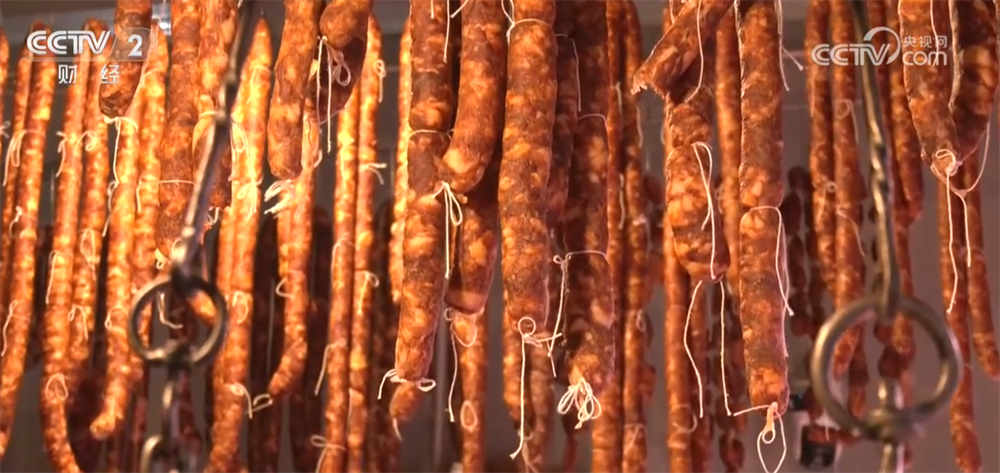
Group 1 - The core issue in the pork market this winter is the unexpected low demand during the traditional peak season, leading to downward pressure on prices [1][3] - In southern China, the slow decline in temperatures has resulted in lower-than-expected demand for preserved meats, while the later timing of the Spring Festival has delayed concentrated purchasing [3][10] - As of the end of Q3 this year, the national pig inventory reached 437 million heads, a year-on-year increase of 2.3%, indicating an oversupply situation [3][10] Group 2 - Current pork prices are significantly lower than last year, with prices for pork belly at 9 yuan/kg and for front and hind leg meat at around 8 yuan/kg, down by 3-4 yuan/kg compared to the same period last year [4][10] - The average national pig price in the second week of December was 12.13 yuan/kg, down 0.7% week-on-week and down 27.1% year-on-year, reflecting a prolonged period of low prices [10][12] - Many pig farmers are experiencing losses, with self-breeding operations losing approximately 100-130 yuan per head and purchased piglet operations losing 160-200 yuan per head [12] Group 3 - The industry is undergoing adjustments, with a shift from capacity expansion to a focus on cost control, risk management, and value extraction along the supply chain [13] - Companies are implementing advanced technologies, such as intelligent feeding systems and genetic breeding improvements, to enhance productivity and reduce costs [12][13] - Major enterprises are extending their operations downstream into slaughtering, meat processing, and brand fresh products to mitigate cyclical risks in the breeding segment [13]

南华期货工业硅产业周报:下方空间有限-20251221
Nan Hua Qi Huo· 2025-12-21 12:01
Group 1: Report Industry Investment Rating - No information provided Group 2: Core Views of the Report - In the short - term, there is no driving force, and the market shows a weak and volatile pattern, but winter environmental protection speculation should be vigilant. In the medium - to - long - term, the downward space of industrial silicon prices is limited, and it is cost - effective to lay out forward contracts for peak seasons at low prices. Also, industrial silicon prices are closely linked to the price fluctuations of related varieties such as polysilicon and coking coal [3] Group 3: Summary by Directory 1. Core Contradictions and Strategy Recommendations 1.1 Core Contradictions - The core driving logic of industrial silicon futures price trends will focus on factors such as the progress of eliminating backward production capacity under the "anti - involution" background, supply - side production cuts due to environmental protection constraints or cost increases, and demand - side production cut expectations due to weak terminal shipments. The industry has expectations for eliminating backward production capacity, but due to the large number of private enterprises and scattered layout, there is insufficient confidence in effective capacity clearance through industry self - discipline. The power cost accounts for 30% of the production cost of industrial silicon, and coal price fluctuations affect the power cost and then the industrial silicon price. In December, there is an expected decline in the start - up rate of industrial silicon production enterprises on the supply side, and downstream polysilicon industry has production cuts, downstream silicone monomer plants have maintenance plans, while the aluminum alloy industry maintains a stable start - up rate [2] 1.2 Industry Operation Suggestions - **Sales Management**: For enterprises with plans to produce industrial silicon in the future and worried about price drops during sales, the recommended hedging ratio is 20% for selling corresponding futures contracts and 20% for a combined options strategy (buying put options + selling call options) [6] - **Procurement Management**: For enterprises with plans to produce polysilicon/silicone/aluminum alloy in the future and worried about cost increases when purchasing industrial silicon, if the product price has no correlation, the recommended hedging ratio is 30% for buying corresponding futures contracts and 10% for a combined options strategy (selling put options + buying call options); if the product price is correlated, the recommended hedging ratio is 20% for selling corresponding futures contracts and 20% for a combined futures contract strategy (buying put options + selling call options) [6] - **Inventory Management**: For enterprises with high industrial silicon inventories and worried about inventory depreciation due to price drops, the recommended hedging ratio is 20% for selling the main futures contract and 10% for a combined options strategy (selling call options + buying put options) [6] 2. Important Information and Events to Watch - No important information was reviewed this week [7] 3. Disk Interpretation 3.1 Price - Volume and Capital Interpretation - **Futures Trends**: This week, the closing price of the industrial silicon futures weighted index contract on Friday was 8,677 yuan/ton, a week - on - week increase of 3.15%. The trading volume was 382,100 lots, a week - on - week decrease of 38.35%, and the open interest was 407,000 lots, a week - on - week decrease of 53,000 lots. The month - spread between SI2602 and SI2605 was in a Contango structure, a week - on - week decrease of 60 yuan/ton, and the number of warehouse receipts was 9,019 lots, a week - on - week increase of 400 lots. The MACD and moving averages (daily level) show a pattern of "short - position reduction and price increase", and the current price has risen from near the lower - rail of the Bollinger Band to near the middle - rail, with the bandwidth showing signs of widening. Attention should be paid to the support level of 8,000 yuan/ton and the pressure level near the middle - rail of the Bollinger Band [9] - **Option Situation**: The 20 - day historical volatility of industrial silicon has been fluctuating recently, indicating that the actual price fluctuation range has been gradually expanding. The implied volatility of at - the - money options has been strengthening. The PCR of option open interest has been declining, indicating that the proportion of put option open interest relative to call option open interest has decreased, and the market's bearish sentiment is gradually receding [12] - **Capital Trends**: The net short - position of key industrial silicon seats has decreased recently, indicating that some institutions are closing their short positions [14] - **Month - Spread Structure**: The term structure of industrial silicon futures shows a back structure, which is relatively stable [16] - **Basis Structure**: The basis of the main industrial silicon contract is generally at a normal level [18] 3.3 Spot Data of the Silicon Industry Chain - The prices of various grades of industrial silicon in different regions, industrial silicon powder, and downstream products such as trichlorosilane, polysilicon N - type price index, silicone DMC, and aluminum alloy ADC12 remained unchanged this week, except that the price of aluminum alloy ADC12 increased by 50 yuan/ton, a week - on - week increase of 0.23% [20][21] 4. Valuation and Profit 4.1 Tracking of Upstream and Downstream Profits in the Industry Chain - Since reaching the profit low in May, the average profit of the industrial silicon industry has been in a continuous recovery channel. The profit of the polysilicon industry is currently stable. The profit of the aluminum alloy industry is showing a weakening trend, while the profit level of the silicone industry is showing a warming trend [22] 5. Fundamental Analysis 5.1 Upstream - Industrial Silicon - **Production and Start - up Rate**: The weekly production and start - up rate data of industrial silicon samples in different regions show that there are different degrees of changes. For example, the weekly production of BAIINFO's industrial silicon increased by 400 tons, a week - on - week increase of 4.64%, and the start - up rate of Shanghai Steel Union's industrial silicon decreased by 0.01%, a week - on - week decrease of 0.79% [25][27] - **Inventory**: There are various inventory data for industrial silicon in different regions and types, such as the weekly inventory of industrial silicon in Xinjiang, Yunnan, Sichuan, and social inventories in ports like Kunming, Huangpu, and Tianjin [35][36] 5.2 Downstream - Polysilicon - **Production and Start - up Rate**: The weekly production of domestic polysilicon decreased, with SMM's weekly production decreasing by 100 tons, a week - on - week decrease of 0.40%, and BAIINFO's weekly production decreasing by 140 tons, a week - on - week decrease of 0.53%. The start - up rate also decreased, with BAIINFO's weekly start - up rate decreasing by 1%, a week - on - week decrease of 0.0238 [40] - **Inventory**: The weekly inventory data of domestic polysilicon shows that the total inventory is 512,000 tons, a week - on - week decrease of 0.015%, and there are also changes in the inventories of production enterprises, silicon wafer enterprises, and warehouse receipts [42] 5.3 Downstream - Aluminum Alloy - **Production and Start - up Rate**: The weekly start - up rates of primary and secondary aluminum alloys remained stable, with the start - up rate of primary aluminum alloy unchanged at 60%, and that of secondary aluminum alloy unchanged at 59.8%. The weekly inventory of primary aluminum alloy decreased by 0.13 million tons, a week - on - week decrease of 2.38%, and that of secondary aluminum alloy decreased by 100 tons, a week - on - week decrease of 0.51% [45] 5.4 Downstream - Organic Silicon - The weekly production of organic silicon DMC decreased by 0.07 million tons, a week - on - week decrease of 1.43% [49] 5.5 Terminal - There are data on China's total commercial housing sales area (residential + office + shops), monthly automobile production, and monthly new photovoltaic installed capacity [52]
华润啤酒东北大撤退余波
3 6 Ke· 2025-12-16 03:34
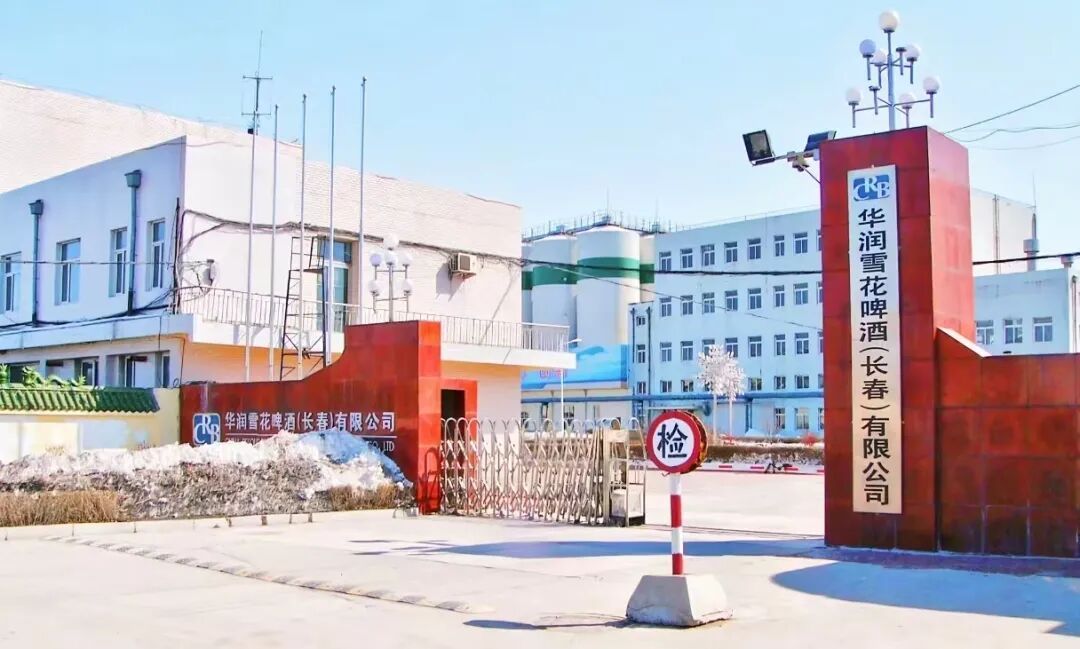
Core Viewpoint - The closure of the China Resources Snow Beer (Changchun) factory marks the end of an era for the company in Northeast China, highlighting the challenges of employee placement, asset disposal, and historical burdens as the company shifts its focus to Southern China [1][9]. Group 1: Company History and Operations - The Changchun factory, established in 2001, has roots dating back to the late 1990s, originally known as the "Nongan County Brewery" [3][4]. - China Resources Beer expanded rapidly in Northeast China after acquiring local brands and production lines, becoming a significant player in the region [4][15]. - At its peak in 2011, the factory achieved a production and sales volume of 216,000 kiloliters, contributing over 100 million yuan in taxes, and became the first Chinese beer company to exceed annual sales of 10 million tons [4][15]. Group 2: Labor Disputes and Factory Closure - Following the factory's closure in 2019, over 180 labor dispute cases were filed, primarily concerning compensation and recognition of employment periods [7][9]. - Many disputes arose after the factory's dissolution, with employees seeking compensation for their years of service, leading to lengthy legal processes [8][9]. - The formal cancellation of the factory signifies a resolution to many labor disputes, with most employees reportedly receiving compensation [9]. Group 3: Market Dynamics and Strategic Shifts - The beer industry in Northeast China has faced significant challenges, including overcapacity and declining market demand, leading to a strategic retreat by China Resources Beer from the region [17][19]. - From 2016 to 2024, the number of operational breweries decreased from 98 to 62, with 36 factories closed, reflecting a broader trend of capacity optimization [21]. - The company has been actively disposing of underperforming assets, particularly in Northeast China, with many factories remaining unsold despite multiple attempts to auction them off [22][23].

华润啤酒东北大撤退后工厂无人接:36家工厂关停、数亿安置费
Sou Hu Cai Jing· 2025-12-15 09:57
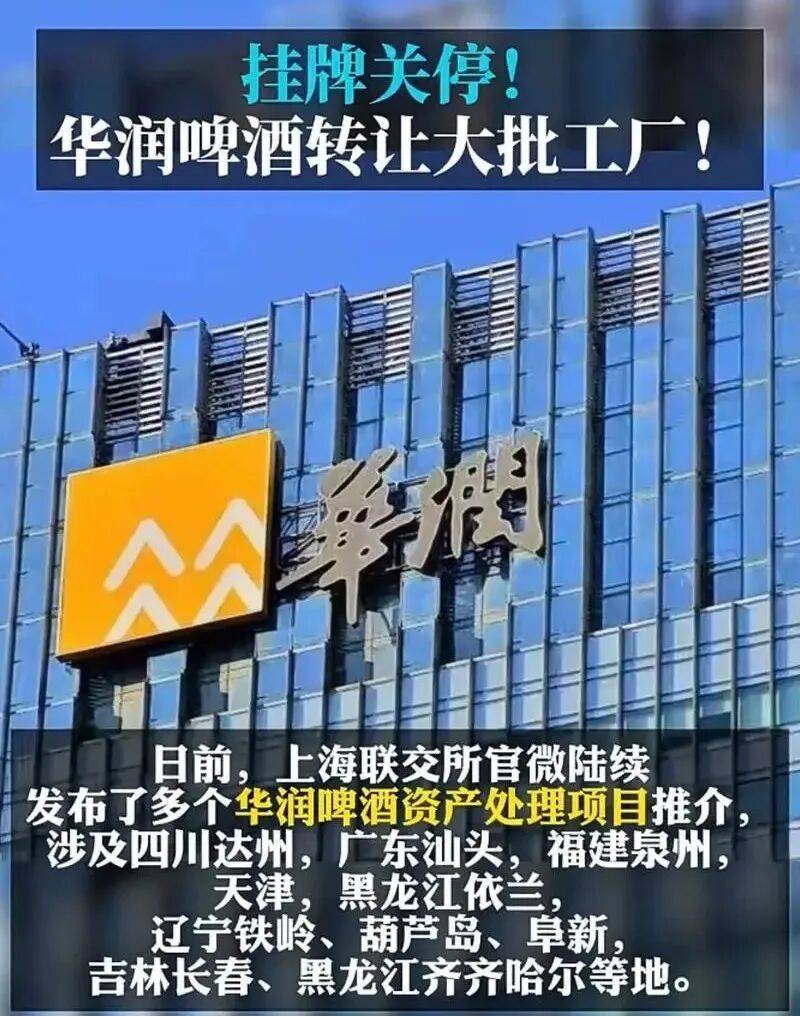
Core Insights - The article highlights the challenges faced by China Resources Beer in disposing of its assets in Northeast China, particularly the significant price drops and lack of buyers for its factories [1][5][6] Group 1: Asset Disposal Challenges - The land use rights and buildings of the Qiqihar factory were listed for transfer at a price reduced from 6.35 million yuan to 5.08 million yuan, a drop of over 1.2 million yuan, yet remained unsold [1] - The Changchun factory, which had been closed for six years, faced similar difficulties, with its transfer price dropping by over 40% in four attempts, but still found no buyers [1] - The closure of 36 breweries across the country, particularly in Northeast China, has resulted in significant challenges in asset disposal, with many low-efficiency capacities unable to sell even at reduced prices [1][5] Group 2: Historical Context and Market Dynamics - Northeast China was once a key market for China Resources Beer, with the company establishing a strong presence through aggressive acquisitions starting in 1993 [3] - By 2011, the company held a 68% market share in Liaoning, but began to face losses as the market entered a phase of excess capacity and declining demand [3][5] - The company initiated capacity optimization in 2017, focusing on eliminating low-efficiency production in Northeast China [3][5] Group 3: Financial Implications and Employee Issues - From 2016 to 2024, the number of factories decreased from 98 to 62, with 36 closures primarily in smaller cities, leading to substantial employee compensation costs totaling 1.823 billion yuan from 2017 to 2020 [5] - Labor disputes have arisen following factory closures, with over 180 disputes linked to the Changchun factory alone, highlighting ongoing challenges in employee relations [5] - The company has faced significant asset impairment losses, with a reported 1.301 billion yuan in fixed asset and inventory impairments in 2018 [5] Group 4: Strategic Shift and Future Outlook - In December 2025, the company announced the relocation of its headquarters from Beijing to Shenzhen, signaling a strategic shift away from reliance on the Northeast market [6] - Analysts suggest that the company's difficulties stem from the failure to effectively manage the historical burdens of its acquisitions, raising questions about balancing shareholder interests with social responsibilities [6] - The ongoing restructuring in the Northeast beer market may continue to have lasting effects on the company and the region [6]
南华期货工业硅产业周报:下方空间有限,时间换空间-20251214
Nan Hua Qi Huo· 2025-12-14 13:54
1. Report Industry Investment Rating No information provided in the report. 2. Core Viewpoints of the Report - In the short - term, there is no driving force, and the market shows a weak and volatile pattern. However, it is necessary to be vigilant about environmental protection speculation in winter. In the medium - to - long - term, the downside space for industrial silicon prices is limited, and it is cost - effective to buy long - term contracts during peak seasons at low prices. The price trend of industrial silicon is also closely related to the price fluctuations of related products such as polysilicon and coking coal [2]. 3. Summary by Relevant Catalogs 3.1 Core Contradictions and Strategy Suggestions 3.1.1 Core Contradictions - The core driving factors for the future price trend of industrial silicon futures include the progress of eliminating backward production capacity under the "anti - involution" background of the industry, production cuts on the supply side due to environmental protection constraints or rising costs, and the expected production cuts on the demand side due to weak terminal sales. The industry has expectations for eliminating backward production capacity, but due to the large number of private enterprises and scattered layout in the industrial silicon industry, there is a lack of confidence in effective capacity clearance through industry self - regulation. - Electricity costs account for 30% of the production cost of industrial silicon, and coal price fluctuations affect electricity costs and then industrial silicon prices. In December, the operating rate of industrial silicon producers is expected to decline. Downstream, the polysilicon industry is reducing production, the silicone monomer plants have maintenance plans, and only the aluminum alloy industry maintains a stable operating rate [1]. 3.1.2 Trading Logic - Near - term trading logic (before the end of 2025): Environmental protection disturbances, and expected production cuts on both the supply and demand sides. - Long - term trading logic (after early 2026): The progress of eliminating backward production capacity under the "anti - involution" background of the industry, and continuous attention to demand [4]. 3.1.3 Industrial Operation Suggestions - Sales management: For enterprises planning to produce industrial silicon in the future and worried about price drops during sales, they can sell corresponding futures contracts and use a combined options strategy (buy put options and sell call options) with a recommended hedging ratio of 20%. - Procurement management: For enterprises planning to produce polysilicon, silicone, or aluminum alloy in the future, if the finished product price is not correlated, they can buy corresponding futures contracts with a recommended hedging ratio of 30% and use a combined options strategy (sell put options and buy call options) with a ratio of 10%. If the finished product price is correlated, they can sell corresponding futures contracts and use a combined options strategy (buy put options and sell call options) with a ratio of 20%. - Inventory management: For enterprises with high industrial silicon inventory and worried about inventory depreciation due to price drops, they can short futures contracts and use a combined options strategy (sell call options and buy put options) with recommended hedging ratios of 20% and 10% respectively [5]. 3.2 Important Information and Events to Watch 3.2.1 This Week's Important Information Review - On December 8, Jianghan New Materials announced that a 60,000 - ton/year trichlorosilane plant was put into trial operation in October this year, 10,000 tons of silane production capacity is planned to be put into trial operation in December, and another 10,000 tons each will be put into trial operation in mid - and late - next year. In 2027, optical fiber - grade silicon tetrachloride and electronic - grade tetraethyl orthosilicate plants will be gradually built. - On December 8, GCL Technology announced that its subsidiaries and other parties signed a partnership agreement to establish a limited partnership, which plans to acquire a 42.469% stake in Inner Mongolia Xinyuan Silicon Materials Technology Co., Ltd. from Hongyuan Green Energy and Tibet Ruihua for a total consideration of RMB 2.01 billion [6]. 3.2.2 Next Week's Events to Watch No events to watch were mentioned in the report [7]. 3.3 Disk Interpretation 3.3.1 Price, Volume, and Capital Analysis - The closing price of the industrial silicon weighted index contract on Friday was 8,412 yuan/ton, a week - on - week decrease of 4.66%. The trading volume was 619,800 lots, a week - on - week increase of 113.65%, and the open interest was 460,100 lots, an increase of 19,000 lots week - on - week. The monthly spread between SI2601 and SI2605 was in a back structure, with a week - on - week increase of 90 yuan/ton. The number of warehouse receipts was 8,619 lots, an increase of 1,331 lots week - on - week. - The industrial silicon weighted futures price quickly fell below the 5 - day moving average this week. The disk showed the characteristic of "short - position increase and price decline". The current price quickly fell below the lower track of the Bollinger Band, and the Bollinger Bandwidth showed signs of widening. It is necessary to focus on the support level of 8,000 yuan/ton, and from Thursday to Friday, there was a characteristic of "short - position exit and price stabilization" [10][11]. 3.3.2 Option Analysis - The 20 - day historical volatility of industrial silicon has been strengthening in the past week, indicating that the actual price fluctuation range has been gradually expanding. The implied volatility of at - the - money options has also been strengthening. The PCR of option open interest has been rising, indicating an increasing bearish sentiment in the market [13]. 3.3.3 Term Structure Analysis - The term structure of industrial silicon futures shows a back structure, which is relatively stable. The basis of the main industrial silicon contract is at a relatively high level [17][19]. 3.3.4 Spot Data of the Silicon Industry Chain - The prices of different grades of industrial silicon in various regions have shown different degrees of decline. The prices of industrial silicon powder have also decreased. The price of trichlorosilane and polysilicon N - type price index remained unchanged, the price of silicone DMC was stable, and the price of aluminum alloy ADC12 increased slightly [22]. 3.4 Valuation and Profit - Since hitting the profit low in May, the average profit of the industrial silicon industry has been in a continuous recovery channel. The profit of the polysilicon industry is currently stable, providing important support for the demand of industrial silicon. The profit of the aluminum alloy industry is showing a weakening trend, while the profit of the silicone industry is recovering [23]. 3.5 Fundamental Analysis 3.5.1 Upstream - Industrial Silicon - The weekly production and operating rates of industrial silicon from different data sources showed different trends. The weekly production of some data sources increased, while others decreased. The operating rates also showed mixed trends [30]. - The inventory data of industrial silicon in different regions and warehouses showed different changes [47][48][50]. 3.5.2 Downstream - Polysilicon - The weekly production of domestic polysilicon decreased, and the operating rate also declined. The total inventory of polysilicon increased slightly, with different changes in the inventory of production enterprises, silicon wafer enterprises, and warehouse receipts [51][52][54]. 3.5.3 Downstream - Aluminum Alloy - The operating rates of primary and secondary aluminum alloys decreased slightly, and the inventory of primary aluminum alloy decreased, while the inventory of secondary aluminum alloy decreased significantly [58][59]. 3.5.4 Downstream - Organic Silicon - The weekly production of organic silicon DMC decreased, with a week - on - week decrease of 6.12% [64]. 3.5.5 Terminal - The report shows the data trends of China's commercial housing sales area, automobile monthly production, and photovoltaic monthly new installed capacity [67].

永顺泰:公司将继续增加中高端麦芽产能
Zheng Quan Ri Bao· 2025-12-08 12:41
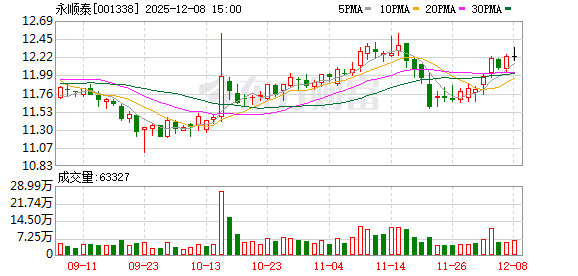
Core Viewpoint - The company is focused on optimizing production capacity and expanding both domestic and international markets for high-end malt products [2] Production Capacity Optimization - The company plans to increase high-end malt production capacity, having completed two initial fundraising projects and is implementing a new 50,000 tons/year specialty malt production line to meet market demand [2] - Future capacity structure optimization and layout improvements will be arranged according to strategic development needs [2] Market Development - The company aims to consolidate its domestic market while actively exploring overseas markets, achieving a year-on-year increase in malt sales [2] - There will be a focus on expanding overseas sales opportunities to achieve a balance between domestic and international business [2] Production Operations - The company employs a coordinated production and sales model, aligning production schedules with customer demand to ensure smooth operations [2] - This model allows the company to effectively cover major regions across the country, enhancing operational efficiency and reducing logistics costs [2] Product and Service Enhancement - The company is increasing collaboration with customers and research institutions to boost the sales proportion of customized products, better meeting customer needs [2]
钛白粉行业短期仍不乐观
Zhong Guo Hua Gong Bao· 2025-12-08 02:54
Core Viewpoint - The global titanium dioxide industry is facing significant challenges due to a supply-demand imbalance, with production rates declining and prices remaining weak, leading to severe impacts on profitability for Western producers [1][2]. Group 1: Industry Overview - Over the past four years, the titanium dioxide industry has experienced a substantial decline in operating rates, with a forecasted drop below 70% due to an increase in production capacity outpacing demand growth [1][2]. - In 2021, the industry was still healthy, with a global demand of 7.6 million tons, a net increase of 740,000 tons from 2017, and a compound annual growth rate (CAGR) of 2.6% [1]. - However, from 2021 to 2024, demand growth slowed significantly to an average of 0.8% per year, with only a net increase of 180,000 tons, while production capacity increased by 790,000 tons, exacerbating the supply-demand imbalance [1][2]. Group 2: Financial Performance - Major Western producers have seen a drastic reduction in profitability over the past four years, with Conoco's operating profit margin dropping from 9% in 2021 to 6% in 2024, and further declining to 2% in the first three quarters of 2025 [2]. - Similarly, Teno's operating profit margin fell from 16% to 7%, with only 1% in the first three quarters of 2025, while Chemours' titanium technology division's adjusted EBITDA margin halved from 24% to 12% [2]. Group 3: Market Dynamics - Geopolitical uncertainties have further complicated the industry's challenges, with customers reducing inventory due to these uncertainties, impacting sales and pricing structures [2]. - Conoco reported that while domestic market sales in Europe and the U.S. offset export declines, prices faced significant pressure, with a cumulative decline of 6% in the first three quarters of 2025 despite a 2% increase at the beginning of the year [2]. Group 4: Future Outlook - In response to the industry challenges, global titanium dioxide producers are focusing on capacity optimization and trade policy adjustments to restore supply-demand balance [3]. - Conoco has indicated that a large-scale capacity reduction process has begun, with several factories in China and Europe shutting down, and the implementation of anti-dumping taxes expected to support price recovery in 2026 [3]. - Teno's CEO noted potential demand recovery in the fourth quarter of 2025, signaling a positive outlook despite the current market conditions [3].
南华期货工业硅产业周报:基本面双弱,下方空间有限-20251207
Nan Hua Qi Huo· 2025-12-07 05:55
Group 1: Report Industry Investment Rating - No relevant content provided Group 2: Core Views of the Report - The industrial silicon market showed a weakening trend this week. In the short - term, there is no driving force, presenting a weakening and oscillating pattern, but winter environmental protection speculation should be vigilant. In the medium - to - long - term, the downside space of industrial silicon prices is limited, and it is cost - effective to arrange long - term contracts during the peak season at low prices [1][2]. - The core driving factors for the future price trend of industrial silicon futures include the progress of eliminating backward production capacity under the "anti - involution" background of the industry, the reduction of production on the supply side due to environmental protection constraints or rising costs, and the expected reduction of production on the demand side due to weak terminal shipments [1]. - The price of industrial silicon is closely related to the price fluctuations of related varieties such as polysilicon and coking coal [2]. Group 3: Summary by Directory Chapter 1: Core Contradictions and Strategy Recommendations 1.1 Core Contradictions - The core driving logic for the future price trend of industrial silicon futures focuses on the progress of eliminating backward production capacity, supply - side production cuts, and demand - side production reduction expectations [1]. - The optimization of production capacity in the industrial silicon industry faces resistance because it is mainly composed of private enterprises with a large number of scattered enterprises, leading to low confidence in effective production capacity clearance through industry self - discipline [1]. - Power cost accounts for 30% of the production cost of industrial silicon, and coal price fluctuations affect power cost and then the price of industrial silicon. In December, there are expectations of a decline in the operating rate of industrial silicon production enterprises on the supply side, and the polysilicon industry is likely to cut production, while downstream organic silicon monomer plants have maintenance plans, with only the aluminum alloy industry maintaining a stable operating rate [2]. 1.2 Trading - Type Strategy Recommendations - Trend judgment: Wide - range oscillation and bottom - building [4]. - Price range: Oscillation range is 8400 - 9500; low - level range is 7000 - 8400 [5]. - Basis strategy: Wait and see [5]. 1.3 Industrial Operation Recommendations - For sales management, enterprises with plans to produce industrial silicon in the future can sell corresponding futures contracts or use a combination option strategy (buy put options + sell call options) with a recommended hedging ratio of 20% to prevent price drops and profit reduction [5]. - For procurement management, enterprises with plans to produce polysilicon/organic silicon/aluminum alloy can buy corresponding futures contracts or use combination option strategies according to different situations, with recommended hedging ratios ranging from 10% to 30% to prevent cost increases [5]. - For inventory management, enterprises with high industrial silicon inventories can short the main futures contract or use a combination option strategy (sell call options + buy put options) with recommended hedging ratios of 20% and 10% respectively to prevent inventory depreciation [5]. Chapter 2: Important Information and Concerns 2.1 This Week's Important Information Review - On December 2nd, Hesheng Silicon Industry announced the partial share pledge of its controlling shareholder [6]. 2.2 Next Week's Concerns - No relevant content provided Chapter 3: Disk Interpretation 3.1 Price - Volume and Capital Interpretation - This week, the Friday closing price of the industrial silicon futures weighted index contract was 8823 yuan/ton, with a week - on - week decrease of 3.29%; the trading volume was 290,100 lots, with a week - on - week increase of 9.38%; the open interest was 441,100 lots, with a week - on - week increase of 59,600 lots. The month - spread of SI2601 - SI2605 was in a contango structure, with a week - on - week decrease of 60 yuan/ton; the number of warehouse receipts was 7288 lots, with a week - on - week increase of 692 lots [12]. - The industrial silicon weighted futures price gradually fell below the 60 - day moving average this week. Combining the MACD indicator signals and open interest data changes, the disk showed the characteristic of "short - position increasing and price falling" [12]. - The current industrial silicon futures price has gradually moved from the middle track to the lower track of the Bollinger Band, and the Bollinger Bandwidth has shown a certain expansion. The first support level of 8700 yuan/ton and the second support level of 8400 yuan/ton should be focused on [12]. 3.2 Option Situation - The 20 - day historical volatility of industrial silicon has been slowly weakening in the past week, indicating that the actual price fluctuation range has been gradually narrowing [14]. - The implied volatility of at - the - money options of industrial silicon has been oscillating and weakening in the past week [14]. - The PCR of industrial silicon option open interest has been decreasing recently, indicating that the proportion of put option open interest relative to call option open interest has decreased, and the market's bullish sentiment is gradually rising [14]. 3.3 Silicon Industry Chain Spot Data - The prices of different grades and regions of industrial silicon and its downstream products such as trichlorosilane, polysilicon N - type price index, organic silicon DMC, and aluminum alloy ADC12 are provided, along with their daily and weekly changes [24]. Chapter 4: Valuation and Profit 4.1 Up - and Downstream Profit Tracking of the Industry Chain - Since reaching the profit low in May, the average profit of the industrial silicon industry has been in a continuous repair channel. The profit in the southwest region has declined rapidly due to the dry season [25]. - The polysilicon industry, the core downstream demand area of industrial silicon, has stable profits, providing important support for the demand of industrial silicon. The profit of the aluminum alloy industry is showing a weakening trend, and the profit level of the organic silicon industry is declining [25]. Chapter 5: Fundamentals 5.1 Upstream - Industrial Silicon - The weekly production and operating rate data of industrial silicon from different sources (Baichuan, Steel Union, SMM) are provided, showing different trends of production and operating rate changes [32]. - The inventory data of industrial silicon in different regions and forms are presented, including national, regional, and port inventories [47][48][49]. 5.2 Downstream - Polysilicon - The weekly production data of domestic polysilicon from different sources (SMM, Baichuan) are provided, with different trends of production changes. The weekly inventory data of domestic polysilicon in different parts (total inventory, production enterprise inventory, silicon wafer enterprise inventory, etc.) are also given [51][52][54]. 5.3 Downstream - Aluminum Alloy - The weekly operating rate and inventory data of primary and secondary aluminum alloys are provided, showing different trends of operating rate and inventory changes [58][59]. 5.4 Downstream - Organic Silicon - The weekly production data of organic silicon DMC are provided, showing a slight decrease in weekly production but an increase in monthly production [63]. 5.5 Terminal - The data of terminal products such as Chinese commercial housing sales area, automobile monthly production, and photovoltaic monthly new installed capacity are presented [66].
日本乙烯设备利用率持续走低
Zhong Guo Hua Gong Bao· 2025-12-02 02:55
Core Insights - Japan's ethylene production facility utilization rate was reported at 76.2% in October, remaining below 70% for two consecutive months and below 90% for 39 months, indicating ongoing economic challenges in the sector [1] - Ethylene production in October reached 452,300 tons, a 9% year-on-year increase, attributed to the resumption of all plants after last year's maintenance [1] - The Japanese government plans to reduce the number of ethylene production facilities from 12 to 8 by around 2030 to address the low utilization rates [1] Industry Trends - The Japan Petrochemical Industry Association noted that despite structural reforms in production facilities, results have been minimal [1] - Major companies like Mitsui Chemicals, Idemitsu Kosan, and Sumitomo Chemical have announced plans to consolidate their domestic general resin businesses [1] - The association's president predicts that while a V-shaped economic recovery is unlikely in 2026, the ethylene utilization rate could reach around 80% [1] Operational Challenges - The need for stable supply in key industries like automotive is emphasized, as aging production facilities require investment to ensure reliability [1] - The president of Innospec highlighted that improving utilization rates through facility integration could enhance profitability, but stable operation of the adjusted facilities is becoming increasingly important [1] - The Japanese government has expressed its commitment to support corporate R&D and domestic investment policies to address these challenges [1]
晶科能源获2亿元火灾预付赔款,2026年储能发货目标翻倍
Zhong Guo Jing Ying Bao· 2025-12-01 09:27
Core Viewpoint - JinkoSolar has received a prepayment of 200 million yuan for fire insurance, which is expected to positively impact its financial performance in 2025, despite ongoing challenges in profitability due to market conditions in the photovoltaic industry [1][3]. Group 1: Financial Impact - JinkoSolar's subsidiary, Shanxi Jinko Energy No. 2 Manufacturing Co., has received a total of 220 million yuan in prepayments related to a fire incident that occurred in April 2024, which damaged some equipment and assets [1]. - The insurance compensation is expected to improve cash flow and financial performance, with the final impact to be determined by audit results [1]. - The company reported a net loss of approximately 3.9 billion yuan in the first three quarters of 2025, highlighting the financial pressures faced in the photovoltaic sector [1]. Group 2: Product Development and Market Strategy - JinkoSolar has officially launched the mass production of its Tiger Neo 3.0 solar module, achieving an efficiency of over 24.8% and a power output of up to 670W, with a bifacial rate of up to 90% [2]. - The company has secured contracts totaling 15GW during a recent global signing event, aligning with its strategy to optimize production capacity and enhance product competitiveness [2]. - JinkoSolar aims to focus on high-efficiency, high-power products, with a market shift expected towards products exceeding 650W, which are anticipated to have a stronger competitive edge [2]. Group 3: Energy Storage Business - JinkoSolar views its energy storage business as a crucial growth avenue, currently having a production capacity of 17GWh for storage systems and 5GWh for battery cells, with plans to exceed 30GWh by the end of 2026 [2][3]. - The company has set a target to double its energy storage system shipments to 6GWh in 2025, with over 80% expected to come from overseas markets, particularly in high-margin regions like Europe and North America [2][3]. - Despite not yet achieving profitability in its energy storage segment, JinkoSolar anticipates significant improvements in profitability as overseas orders are fulfilled and revenue is recognized in the fourth quarter and next year [3].