
宽松周期

Search documents
宽松周期尾声将至?新西兰联储如期降息后纽元不降反升
智通财经网· 2025-11-26 03:51
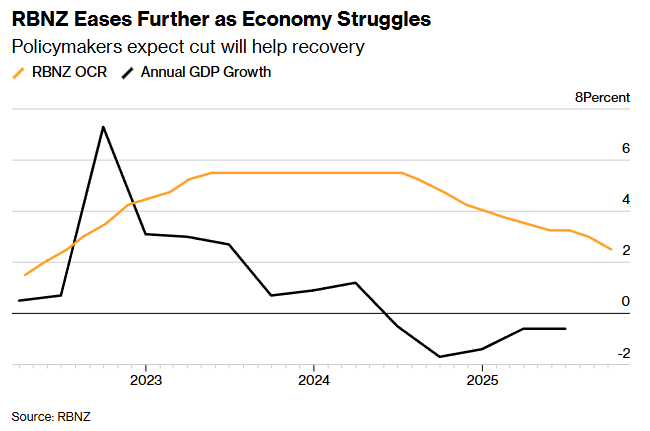
Group 1 - The Reserve Bank of New Zealand (RBNZ) has lowered the Official Cash Rate (OCR) by 25 basis points to 2.25%, marking the lowest level in three years to support the nascent economic recovery [1][3] - The RBNZ's decision aligns with the majority of economists' predictions, emphasizing that the OCR reduction will bolster consumer and business confidence [1][3] - The RBNZ's forward guidance indicates an average OCR of 2.2% by the second quarter of next year, suggesting a 20% chance of further rate cuts [3][4] Group 2 - Since the beginning of the easing cycle in August 2024, the RBNZ has been one of the most aggressive rate cutters among its peers, reducing the OCR by a total of 325 basis points [4] - The RBNZ forecasts GDP growth to accelerate by 2.8% annually in the 12 months ending March 2027, compared to only 0.5% in the previous year [4][5] - Inflation is expected to decrease from the current 3% to 2.1% by the third quarter of next year, reaching 2% a year later [5]

摩根大通:澳洲联储宽松周期或已结束 通胀风险仍偏高
Xin Hua Cai Jing· 2025-11-05 06:37
Core Viewpoint - The Reserve Bank of Australia has decided to maintain the benchmark interest rate unchanged, predicting that inflation risks will persist into next year, leading some economists to believe that the easing cycle initiated in February may have come to an end [1] Group 1 - The number of segments with high inflation levels remains concerning, posing a substantial challenge to the Reserve Bank of Australia's narrative of "inflation easing" over the past few quarters [1] - Morgan Stanley economist Tom Kennedy suggests that the easing cycle is likely over, with the cash rate expected to remain at 3.6% [1]

鲍威尔鹰派言论引发短期震荡,机构:宽松周期趋势明确,下跌反而可能是加仓机会
Mei Ri Jing Ji Xin Wen· 2025-10-31 06:04
Core Viewpoint - The Hong Kong stock market is experiencing a downturn, with the Hang Seng Technology Index declining significantly, while innovative pharmaceutical stocks are performing well amidst a broader market weakness [1][2]. Group 1: Market Performance - On October 31, the three major indices in Hong Kong fell, with the Hang Seng Technology Index seeing an afternoon drop of 2% [1]. - Technology stocks broadly declined, while innovative pharmaceutical stocks rose against the trend [1]. - The semiconductor sector weakened, with major stocks like Hua Hong Semiconductor and SMIC experiencing significant declines of over 7% and 5%, respectively [1]. Group 2: Economic Outlook - According to recent research from China Merchants Securities, the combination of the Federal Reserve's interest rate cuts and an unexpected end to balance sheet reduction is favorable for global risk assets [1]. - Despite hawkish comments from Powell increasing uncertainty around the rate cut path, the trend towards easing is clear, suggesting that current market dips may present buying opportunities [1]. - The institution anticipates a 25 basis point rate cut in December and three additional cuts in the following year, which is more aggressive than market expectations [1]. Group 3: Investment Recommendations - The institution believes that the dual easing policies from the US and China will benefit risk assets, with Hong Kong stocks expected to enter a "slow bull" market due to strong foreign capital inflows [2]. - The Hang Seng Technology Index ETF is currently valued at 23.50 times earnings, which is approximately 32.84% below historical averages, indicating a safety margin for investors [2]. - The report suggests focusing on leading internet technology companies, high-end manufacturing related to AI, AI-related power sectors, and selectively investing in innovative pharmaceutical stocks [2].


关键经济数据缺席 美联储“摸黑”前进 官员暗示10月将“谨慎降息”
Zhi Tong Cai Jing· 2025-10-17 23:24
Group 1 - The Federal Reserve is set to hold a meeting on October 28-29, but the government shutdown has led to the absence of key economic data, creating a more ambiguous policy-making environment [1] - Fed officials are inclined to adopt a "slow and steady" approach under incomplete information, potentially lowering interest rates by 25 basis points to continue the easing cycle while avoiding directional errors [1][2] - Fed Chair Powell indicated that a prolonged shutdown could not only delay data releases but also impact data collection, making decision-making increasingly difficult [1] Group 2 - The lack of official data complicates the assessment of whether the labor market is weakening, demand is slowing, and the persistence of inflation shocks, according to Fed Governor Waller [1] - Local Fed voices reflect a cautious rate-cutting tone, with St. Louis Fed President Bullard suggesting support for a rate cut if labor market weakness continues and inflation expectations remain anchored, while cautioning against excessive easing before inflation is fully contained [1] - Boston Fed President Collins acknowledged that balancing inflation control and labor market easing is more challenging in the absence of data [2]
四季度还有戏!机构预测央行或单独下调5年期LPR 房贷利率有望再降?
Sou Hu Cai Jing· 2025-09-28 08:40
Core Viewpoint - The anticipated interest rate cuts in China have not materialized, with the Loan Prime Rate (LPR) remaining stable for four consecutive months, while the Federal Reserve has initiated a new easing cycle with a 25 basis point cut [1][2][5] Group 1: Monetary Policy Context - The People's Bank of China (PBOC) has maintained the 1-year and 5-year LPR at 3.0% and 3.5% respectively, reflecting a cautious approach amid various economic pressures [1][5] - The Fed's recent rate cut to a range of 4.00%-4.25% marks the beginning of a new easing cycle, with expectations of further cuts in the fourth quarter [1][2] Group 2: Economic Conditions - Domestic economic conditions, including weak inflation and pressures in the real estate market, have led to expectations for a follow-up rate cut in China to stabilize the RMB and stimulate economic recovery [2][5] - The banking sector is facing significant pressure on net interest margins, which have dropped to approximately 1.45%, limiting the scope for further rate reductions [5] Group 3: Real Estate Market Challenges - The stability of the real estate market is under threat, with 69 out of 70 major cities reporting a decline in second-hand housing prices, particularly in first-tier cities [6][9] - The core issues in the real estate market extend beyond financing costs, highlighting structural problems in supply and demand [7][9] Group 4: Policy Recommendations - To address the real estate market's challenges, a combination of fiscal policy and structural adjustments is recommended, including optimizing market supply and enhancing demand through employment and income stability [9][11] - The government is encouraged to pause new land auctions and repurchase undeveloped land to alleviate supply pressures, aligning with recent policy directions [9][11] Group 5: Future Outlook - The potential for new monetary policy actions, including further rate cuts, is anticipated as the Fed's easing opens up more operational space for the PBOC [9][11] - The overall expectation is that with the gradual release of policy effects and ongoing economic recovery, the real estate market may stabilize over time [11]

多空因素交织 金银上有支撑下有波动
Jin Tou Wang· 2025-09-25 07:16
Market Overview - The US dollar index experienced a continuous rise, approaching the 98 mark but ultimately closing at 97.86, up 0.66% [2][3] - Spot gold fell from historical highs, hitting a low of $3717.52, down $60 from the daily high, and closed at $3735.89, down 0.75% [2][3] - Spot silver also declined, closing at $43.89, down 0.3% [2][3] Economic Insights - US Treasury Secretary Yellen expressed support for significant interest rate cuts, suggesting a reduction of 100 to 150 basis points, which strengthened market expectations for a loosening cycle [3] - Diverging opinions within the Federal Reserve were noted, with some members warning against excessive rate cuts while others supported further easing due to slowing economic growth and low inflation [3] Trade Relations - The US and EU reached an agreement on auto tariffs, but the US initiated a 232 investigation into medical devices, indicating ongoing trade friction [3] - The Kremlin criticized Trump's attempts to raise global energy prices, while the restoration of the Iraq-Turkey oil pipeline and the EU's plan to increase tariffs on Russian oil imports heightened energy and geopolitical tensions [3] Trading Strategy - The interplay of easing expectations and geopolitical risks provides support for gold and silver, but internal Fed disagreements and evolving trade situations may lead to volatility [4] - Key technical levels for gold are noted, with support around $3700 and resistance near $3900, while silver support is at $43 and target at $45 [4] - A strategy of accumulating positions on dips is recommended, with caution advised against chasing prices and managing positions carefully [4]
纳斯达克首席经济学家Phil Mackintosh:美联储或降息至3.5%左右 企业盈利增长支撑美股市场
2 1 Shi Ji Jing Ji Bao Dao· 2025-09-24 23:11
Group 1: Federal Reserve Actions and Economic Outlook - The Federal Reserve faces challenges of weak employment and rising inflation, leading to a cautious monetary policy stance regarding interest rate cuts [1][3] - The recent rate cut of 25 basis points marks the first reduction since December, indicating a shift in U.S. monetary policy after months of observation [1][3] - Future expectations suggest the Fed may continue to lower rates, potentially reaching around 3.5%, which could signal recession risks if rates decline further [3][4] Group 2: Stock Market Dynamics - Recent stock market gains are attributed to improved corporate earnings, particularly driven by investments in artificial intelligence [2][6] - The decline in interest rates has reduced corporate financing costs, boosting valuations alongside earnings growth, providing strong market support [2][9] - Despite consumer confidence weakening, institutional investors remain focused on fundamental factors, leading to optimistic projections for the S&P 500 index to reach 7000 points by year-end [8][9] Group 3: Consumer Behavior and Market Sentiment - Consumer confidence has shown signs of weakening, with many retail investors becoming more cautious, although they continue to invest in index ETFs [8] - The job market's deterioration and rising credit defaults indicate increasing financial pressure on lower-income groups, affecting their investment behavior [8][9] - The ongoing focus on AI-related investments suggests a broader market trend, with valuations supported by actual earnings growth, although potential risks remain if earnings do not keep pace [7][9]
贝森特:鲍威尔本应发出100至150个基点降息的信号
Sou Hu Cai Jing· 2025-09-24 12:34
Core Viewpoint - The U.S. Treasury Secretary suggests that the Federal Reserve's interest rates have been too high for too long and anticipates a shift towards a loosening cycle [1] Group 1: Federal Reserve Insights - The Treasury Secretary expresses surprise that Fed Chair Powell has not indicated a target for interest rates [1] - There is an expectation for a signal of a 100 to 150 basis point rate cut from Powell [1] - The need to lower rates to at least a neutral level is emphasized, with a belief that inflation will significantly decrease [1] Group 2: Economic Developments in Argentina - The U.S. is collaborating with Argentina to end tax incentives for commodity producers exchanging foreign currency [1] - The U.S. is prepared to purchase Argentine dollar bonds and provide substantial standby credit through a foreign exchange stabilization fund [1] - Negotiations are ongoing with Argentine officials regarding a $20 billion swap line with the Argentine central bank [1]
纳斯达克首席经济学家:美利率或降至3.5%
21世纪经济报道· 2025-09-24 06:45
Core Viewpoint - The Federal Reserve's recent interest rate cut reflects ongoing challenges in the labor market and inflation, with a cautious monetary policy stance expected to continue [1][4][5] Group 1: Federal Reserve Actions - The Federal Reserve cut interest rates by 25 basis points, bringing the target range for the federal funds rate to 4% to 4.25%, marking the first rate cut since December of the previous year [1][4] - Future rate cuts are anticipated, potentially lowering rates to around 3.5%, indicating a response to economic data and external pressures [2][5] Group 2: Economic Outlook - Despite signs of economic cooling, there are no large-scale layoffs, and consumer spending remains stable, suggesting the U.S. economy may continue to grow, albeit at a slower pace than in previous years [6] - The current economic environment is characterized as "neither hot nor cold," with inflation close to neutral levels and a manageable unemployment rate [5][6] Group 3: Stock Market Dynamics - Recent stock market gains are primarily driven by corporate earnings growth, particularly from investments in artificial intelligence, which have lowered financing costs and boosted valuations [2][8] - The market's upward trend is supported by declining interest rates and increasing corporate profits, leading to optimistic projections for the S&P 500 index [12] Group 4: Consumer Behavior and Market Sentiment - Consumer confidence is weakening, with many retail investors becoming more cautious, yet institutional investors remain focused on fundamental factors, leading to a divergence in market sentiment [11][12] - The ongoing investment in AI-related sectors is seen as a key driver for future profitability, although the sustainability of these investments will be crucial for maintaining market valuations [9][13]

英国央行暂停降息,机构普遍押注宽松周期延至2026年
Sou Hu Cai Jing· 2025-09-19 23:45
Core Viewpoint - The Bank of England has decided to maintain its key interest rate, leading major financial institutions to adjust their forecasts regarding future rate cuts, with expectations that no further cuts will occur until 2025 [1] Group 1: Interest Rate Decisions - The Bank of England's decision to pause interest rate cuts follows a 25 basis point reduction in August, aligning with market expectations [1] - The decision is influenced by ongoing inflation pressures and uncertainties in economic growth and employment prospects [1] Group 2: Forecast Adjustments by Financial Institutions - Goldman Sachs and Morgan Stanley predict that the next round of easing by the Bank of England will begin in February 2026, with subsequent cuts occurring quarterly [1] - Both institutions note that a significant deterioration in economic data could lead to a potential rate cut in December [1] - JPMorgan has revised its forecast for the first rate cut from November 2025 to February and April 2026, emphasizing that a notable weakening in economic data could still make a December cut possible [1]


