期货技术分析

Search documents
技术解盘20251016 | 生猪空头占优;鸡蛋二次探底
Qi Huo Ri Bao· 2025-10-15 22:42
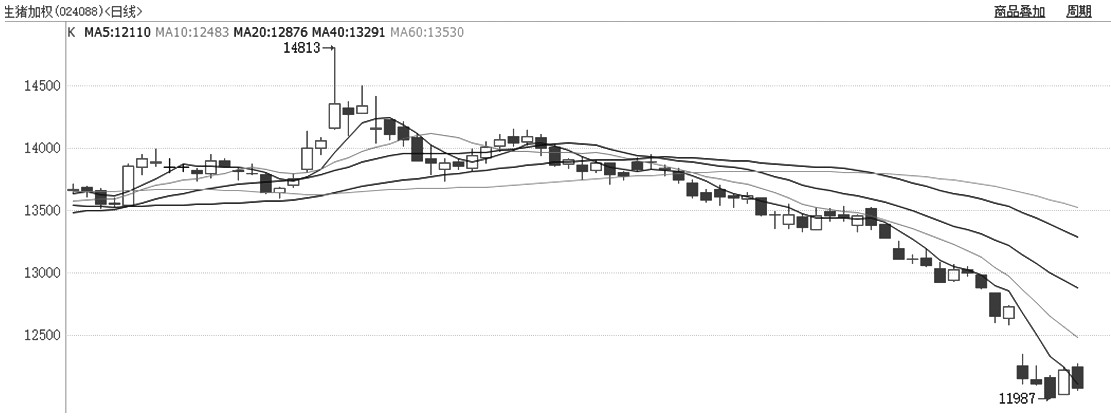
Group 1: Swine Market Analysis - The weighted price of live pigs has recently hit a new low since its listing, indicating a prevailing bearish sentiment in the market [3] - The trading volume has reached a historical high, suggesting active trading despite the overall dominance of short positions [3] - The moving average system shows a bearish arrangement, and the medium to long-term downward trend remains unchanged [3] Group 2: Egg Market Analysis - The weighted price of eggs has rebounded near previous lows, indicating a potential stabilization after a period of decline [6] - There has been a continuous decrease in trading volume and open interest since September, suggesting that short-selling funds are gradually exiting the market [6] - The moving averages have formed a death cross, which may exert downward pressure on prices in the short term, but the bearish momentum appears to be weakening [6]

期货技术分析周报:2025年第42周-20251013
Dong Zheng Qi Huo· 2025-10-13 02:43
1. Report Industry Investment Rating No relevant content provided. 2. Core Viewpoints of the Report - Technical indicators show various signals for different commodity sectors. In the non - ferrous and precious metals sector, gold shows a bearish signal, silver is mainly oscillating, aluminum alloy is bullish, and nickel, polysilicon, and stainless steel are bearish. In the black and shipping sector, wire rods and European line container shipping are strong, while rebar, hot - rolled coils, and manganese silicon show bearish signals. In the energy and chemical sector, most energy products show bearish signals except asphalt, and methanol is bullish while PTA, plastics, etc. are bearish. In the agricultural products sector, rapeseed, apples, etc. are bullish, and rapeseed meal, soybean No.1, etc. are bearish [1][2][3][4]. - Attention should be paid to price breakthroughs near pivot points and position management in each sector [3][4]. 3. Summaries According to Relevant Catalogs 3.1 Non - ferrous and Precious Metals Sector 3.1.1 Technical Indicator Signal Summary - Precious metals: Gold shows a bearish signal, and silver is mainly oscillating. Non - ferrous metals: Aluminum alloy shows a bullish signal, while nickel, polysilicon, and stainless steel show bearish signals, and the rest are mainly oscillating [11][12]. - Lithium carbonate LC2511 is expected to fluctuate in the range of 71,300 - 76,800 yuan/ton, oscillating around the MA60 moving average [13]. 3.1.2 Weekly Pivot Analysis - Copper and aluminum are mainly oscillating. Copper has strong resistance near R3, and the core support of copper price fluctuates in the range of 80,000 - 83,000 yuan/ton. Aluminum also has strong resistance near R3. Gold and silver maintain an upward trend, but gold is oscillating at a high level, and silver is approaching the overbought area, so attention should be paid to resistance breakthroughs [18]. 3.2 Black and Shipping Sector 3.2.1 Technical Indicator Signal Summary - Wire rods and European line container shipping show bullish signals, while rebar, hot - rolled coils, and manganese silicon show bearish signals, and the rest are mainly oscillating. Rebar is currently restricted by weak trading volume and open interest, and the upward repair space is limited, with the key resistance near the MA60 moving average [20][21][24]. 3.2.2 Weekly Pivot Analysis - Rebar and hot - rolled coils show an oscillating feature, and the market may be in a short - term technical balance. Iron ore shows narrow - range fluctuations. Coking coal and coke have high volatility, and attention should be paid to price breakthroughs near pivot points [26]. 3.3 Energy and Chemical Sector 3.3.1 Technical Indicator Signal Summary - In the energy sector, most products show bearish signals except asphalt. In the chemical sector, methanol shows a bullish signal, while PTA, plastics, PVC, etc. show bearish signals [30][31][32]. - PTA2601 is mainly oscillating. If the price breaks down, the secondary support is near 4,380 - 4,430 yuan/ton; if the breakdown fails, the upper pressure range is 4,940 - 5,010 yuan/ton [34]. 3.3.2 Weekly Pivot Analysis - Crude oil has high volatility and shows a wide - range oscillating pattern. PTA, styrene, etc. have high price elasticity, and plastics and other chemical products are in a stable state recently. Attention should be paid to price breakthroughs near pivot points [37]. 3.4 Agricultural Products Sector 3.4.1 Technical Indicator Signal Summary - Rapeseed, apples, jujubes, and peanuts show bullish signals, while rapeseed meal, soybean No.1, and eggs show bearish signals, and the rest are mainly oscillating. The M2601 contract of soybean meal is mainly oscillating this week, with the center of gravity moving down by about 100 yuan/ton, and the short - term support range is 2,920 - 3,050 yuan/ton [42][43][44][47]. 3.4.2 Weekly Pivot Analysis - Soybean No.1, soybean meal, rapeseed meal, etc. show narrow - range consolidation. Soybean oil, palm oil, etc. have high price volatility. Pigs and apples show medium - wide pivot oscillating intervals, and attention should be paid to price breakthroughs near pivot points [49].
地缘消息扰动再促原油反弹,能化再震一日
Tian Fu Qi Huo· 2025-09-25 10:37
Report Industry Investment Rating No relevant content provided. Core View of the Report - Most short positions on energy and chemical products entered the market in early and mid - August and have gained significant profits after nearly two months. Before the National Day holiday, it is recommended to gradually reduce positions and only keep a small part of the positions. If WTI breaks through the strong support of $60 during the holiday, there will be significant short - term acceleration space [1][2] Summary by Directory 1. Overall Situation - The short positions on energy and chemical products entered the market in early and mid - August and have been held for nearly two months with large profit margins. It is suggested to gradually reduce positions before the National Day holiday and only keep part of the positions. If WTI breaks through the $60 support during the holiday, short - term acceleration space is large [1][2] 2. Individual Varieties (1) Crude Oil - Logic: In the context of OPEC+ increasing production and seasonal decline in US demand, the probability of oversupply in the second half of the year is high. The mid - term bearish view based on oversupply should be maintained without over - emphasizing short - term positive factors [3] - Technical Analysis: The daily - level shows a mid - term downward structure, and the hourly - level shows a short - term upward structure. It rebounded today after reducing positions and stood above the short - term pressure at 485. The hourly cycle turned bullish again, with the short - term support at 482. There are two strategies: stop - loss of short positions at the hourly level or widen the stop - loss to the upper limit of the daily - level oscillation at 500 [3] (2) Styrene (EB) - Logic: The weekly fundamentals of styrene have not improved significantly. Despite a slight decline in supply due to device maintenance, high production and inventory levels remain. New device production in September - October will add to the supply pressure, so the bearish view remains [5] - Technical Analysis: The hourly - level shows a short - term downward structure. It oscillated today and closed above the short - term pressure at 6935, but the rebound was weak. Half of the short positions should be taken profit [5][8] (3) Rubber - Logic: Overseas raw material prices have declined, weakening cost support. Domestic inventory reduction is slow, and there is pressure from falling crude oil prices and synthetic rubber substitution. The demand side is mixed, with semi - steel tire开工 falling and full - steel tire开工 remaining high. The fundamentals are neutral [11] - Technical Analysis: The daily - level shows a mid - term oscillating structure, and the hourly - level shows a downward structure. It oscillated today, with the short - term pressure at 16000. Short positions should be held [12][13] (4) Synthetic Rubber (BR) - Logic: The supply - demand situation of synthetic rubber has no major contradictions. The supply side has seen an increase in production after device maintenance. The main concern is the cost of butadiene, with port inventory increasing and supply pressure expected to rise. The cost side is bearish [14][17] - Technical Analysis: The daily - level shows a mid - term oscillating/downward structure, and the hourly - level shows a downward structure. It oscillated today, with the short - term pressure at 11730. Short positions should be held, and take - profit can be set at 11730 [17] (5) PX - Logic: PX has good profits and high production. The short - term supply - demand has weakened slightly, mainly driven by crude oil costs [21] - Technical Analysis: The hourly - level shows a short - term oscillating structure. It rebounded today after reducing positions and stood above the short - term pressure at 6655. The remaining short positions should be stopped - loss [21] (6) PTA - Logic: The cost of crude oil is expected to decline, and PTA has a high probability of inventory accumulation due to high supply and weak demand. The fundamentals are pessimistic [22] - Technical Analysis: The hourly - level shows a short - term oscillating structure. It rebounded today after reducing positions and stood above the short - term pressure at 4620. The remaining short positions should be taken profit [22] (7) PP - Logic: The demand has improved slightly during the peak season, but the supply pressure has increased due to new device production. Be cautious about short - selling after the price decline, and pay attention to the cost - collapse logic caused by falling crude oil prices [24] - Technical Analysis: The hourly - level shows a short - term downward structure. It oscillated today, with the short - term pressure at 6935. After taking profit last week, there is no good entry point, so it is recommended to wait and see [24] (8) Methanol - Logic: The situation of weak current and strong expectation continues. The domestic production is still high, and the port inventory is at a historical high. Although there is a potential for improvement in the fourth quarter, the current 01 contract has a high premium, so it is not recommended to buy on the left side. The downward trend since August has not ended [28] - Technical Analysis: The daily - level shows a mid - term downward structure, and the hourly - level shows a downward structure. It oscillated today, with the short - term pressure at 2375. The remaining short positions should be held cautiously, and the take - profit can be set at 2375 [28] (9) PVC - Logic: The supply pressure is high due to new device production, and the demand is weak both domestically and overseas. The inventory has reached a historical high, and the pressure remains [32] - Technical Analysis: The daily - level shows a mid - term downward structure, and the hourly - level shows a downward structure. It oscillated today, with the short - term pressure at 4980 and the 15 - minute pressure at 4930. Short positions on the 15 - minute cycle can be held, with the stop - loss at 4945 [32] (10) Ethylene Glycol (EG) - Logic: The current supply - demand situation is relatively stable, but attention should be paid to the potential supply pressure from new device production and the impact of falling crude oil prices [35] - Technical Analysis: The daily - level shows a mid - term oscillating/downward structure, and the hourly - level shows a downward structure. It oscillated today, with the short - term pressure at 4275. Short positions should be held, and take - profit can be set at 4275 [35] (11) Plastic - Logic: The supply pressure has increased due to new device production, and the demand improvement during the peak season is limited. The supply - demand situation is bearish, and attention should be paid to the cost - driven impact of falling crude oil prices [37] - Technical Analysis: The daily - level shows a mid - term oscillating/downward structure, and the hourly - level shows a downward structure. It oscillated today, with the short - term pressure at 7205. The remaining short positions should be held [39] (12) Soda Ash - Logic: The supply of soda ash remains high, and the high - production and high - inventory situation has not improved [41] - Technical Analysis: The hourly - level shows an oscillating structure. It oscillated today, with the short - term pressure at 1321. The remaining short positions should be held [41] (13) Caustic Soda - Logic: The supply of liquid chlorine is abundant, and the demand from non - aluminum industries has limited improvement. The inventory has increased again, and the short - term fundamentals have weakened. Attention should be paid to the demand improvement during the peak season and device maintenance in the medium term [44] - Technical Analysis: The hourly - level shows a downward structure. It oscillated today, with the short - term pressure difficult to determine, and the 15 - minute pressure at 2575. After taking profit last week, there is no good entry point, so it is recommended to wait and see [44]
期货技术分析周报:2025年第36周-20250907
Dong Zheng Qi Huo· 2025-09-07 13:47
Report Information - Report Title: Weekly Report - Risk Management: Futures Technical Analysis Weekly Report (Week 36, 2025) - Report Date: September 7, 2025 Industry Investment Ratings The report does not explicitly provide an overall industry investment rating. However, it offers specific technical analysis and signal summaries for different sectors, which can be used to infer potential investment trends for each sector. Core Views - Different sectors in the futures market show diverse trends. Some sectors have clear bullish signals, while others are in a state of oscillation. The volatility of each sector and variety also varies significantly, with some showing high volatility and others more stable [1][2][3][4]. Sector Summaries 1. Non - ferrous and Precious Metals Sector - **Technical Indicator Signal Summary**: Non - ferrous metals such as copper, aluminum, lead, tin, nickel, industrial silicon, and polycrystalline silicon show bullish signals, while most precious metals are in an oscillating state. Gold shows a bullish signal, and silver is oscillating. For example, aluminum, tin, and nickel have strong bullish signals [10][11]. - **Analysis of Specific Varieties**: - **Copper (CU2510)**: The adjustment is not over yet. Although the moving average shows a bullish arrangement and the risk of decline is weak, it is necessary to wait for price signals. The price has the potential to break through, but it needs volume - price driving signals [12]. - **Lithium Carbonate (LC2511)**: The downward momentum has weakened, and it has temporarily found support at the MA60 moving average. However, there is a need to be vigilant about the risk of a callback, especially the support effectiveness in the range of 66,800 - 69,600 [17]. - **Weekly Pivot Analysis**: New energy and high - tech metals represented by lithium carbonate and polycrystalline silicon have a wide price fluctuation range, indicating high market volatility. Traditional industrial metals and precious metals have relatively more stable price trends [21]. 2. Black and Shipping Sector - **Technical Indicator Signal Summary**: The black sector mainly has bullish and oscillating signals. Rebar, wire rod, iron ore, coking coal, and ferrosilicon show bullish signals, while other black varieties are oscillating. The European line shipping shows a bullish signal [26][27]. - **Analysis of Specific Varieties**: - **Rebar (RB2601)**: The price has been oscillating and falling this week, but the support around 3,050 - 3,070 yuan/ton is effective. The MACD shows a potential golden cross. If the price breaks below this range, it may fall to the 2,950 - 3,000 range [30]. - **Weekly Pivot Analysis**: Coking coal, coke, ferrosilicon, manganese silicon, and European line shipping have a wide range of support and resistance levels, indicating high market volatility. Rebar, hot - rolled coils, and iron ore have relatively more stable price trends [35]. 3. Energy and Chemical Sector - **Technical Indicator Signal Summary**: The energy sector is in an oscillating state. In the chemical sector, glass, methanol, synthetic rubber, and pure benzene show bullish signals, while other varieties are oscillating [37][38][39]. - **Analysis of Specific Varieties**: - **Soda Ash (SA601)**: The downward trend has stabilized, but it needs volume - price signals to confirm a rebound. The short - term support range of 1,230 - 1,250 yuan/ton is effective [43]. - **Weekly Pivot Analysis**: Paraxylene (PX), styrene, short - fiber, and bottle chips have a wide range of support and resistance levels, with high market volatility. Crude oil, methanol, and other varieties have relatively more stable price trends [45]. 4. Agricultural Products Sector - **Technical Indicator Signal Summary**: In the agricultural products sector, soybean oil, peanuts, rapeseed oil, and the corn series show bullish signals. Eggs have changed from a bullish to a bearish signal, and cotton shows a bearish signal. Other varieties are oscillating [50][51][52]. - **Analysis of Specific Varieties**: - **Soybean Meal (M2601)**: The price has shown signs of stabilizing in the range of 2,980 - 3,020 yuan/ton, and the MA60 moving average provides effective support. However, it needs increased volume to confirm bullish momentum [56]. - **Weekly Pivot Analysis**: Palm oil, cotton, and other varieties have a wide range of support and resistance levels, with high market volatility. Corn, corn starch, and logs have relatively more stable price trends [59].
期货技术分析周报:2025年第33周-20250817
Dong Zheng Qi Huo· 2025-08-17 13:46
1. Report Industry Investment Rating Not provided in the given content. 2. Core Viewpoints of the Report - In the non - ferrous and precious metals sector, copper, aluminum, lead, polysilicon, and aluminum alloy are bullish; tin, alumina, and gold are bearish; and zinc, nickel, etc. are range - bound. In the black and shipping sector, the black series is in a full - scale shock, while European line container shipping is independently bullish. In the energy and chemical sector, LPG and 20 - gauge rubber are strongly bullish, some are bullish, and others are mainly in shock. In the agricultural products sector, palm oil, sugar, and jujubes are bullish, soybean meal is mainly in shock, and the corn series is bearish [1][2][3][4]. 3. Summaries Based on Relevant Catalogs 3.1 Non - ferrous and Precious Metals Sector - **Technical Indicator Signal Summary**: Copper, aluminum, lead, polysilicon, and aluminum alloy show bullish signals; tin, alumina, and gold show bearish signals; and the rest are mainly in shock [10][11]. - **Weekly Pivot Analysis**: Bullish varieties are above the pivot point, and short - term long positions can be arranged if the support is not broken. Bearish varieties are under pressure at the pivot point, and short - term short positions can be considered when rebounding to the resistance with volume. Volatile varieties need to be vigilant against breakthrough risks [15][18]. 3.2 Black and Shipping Sector - **Technical Indicator Signal Summary**: The black sector is mainly in shock, and the shipping sector shows bullish signals [22][23]. - **Weekly Pivot Analysis**: The black series is in a full - scale shock, and European line container shipping is independently bullish. Coal and coke varieties need to be vigilant against wide - range fluctuations, and the shock pattern may be broken if the boundary is broken [30]. 3.3 Energy and Chemical Sector - **Technical Indicator Signal Summary**: 20 - gauge rubber, synthetic rubber, and caustic soda show bullish signals, and the rest are mainly in shock [34][35]. - **Weekly Pivot Analysis**: LPG and 20 - gauge rubber are strongly bullish. Bullish varieties are dominant above the pivot point, and the chemical sector is in shock. Soda ash is in wide - range shock and can be operated in the short - term range [42]. 3.4 Agricultural Products Sector - **Technical Indicator Signal Summary**: Palm oil, sugar, and jujubes show bullish signals, soybean meal is mainly in shock, and corn and corn starch show bearish signals [46][47][49]. - **Weekly Pivot Analysis**: Palm oil, sugar, and jujubes are bullish. The bean and oil varieties are generally in shock, and the corn series is mainly bearish [55].
金信期货日刊-20250815
Jin Xin Qi Huo· 2025-08-14 23:54
Report Summary 1. Report Industry Investment Rating No relevant content provided. 2. Report Core View - On August 14, 2025, the palm oil futures price dropped, with a closing price of 9368 yuan and a decline of 1.04%. If supply continues to increase and demand fails to improve effectively, the palm oil futures price may face continued pressure [3]. - For stock index futures, due to the high - level bearish candlestick, the short - term market will enter a high - level consolidation phase [6]. - The July non - farm payroll data in the US was significantly lower than expected, and the data for May and June were significantly revised downwards, increasing the probability of a September interest rate cut, which is positive for gold. Currently, the weekly adjustment is relatively sufficient, and it is in a short - term small - range consolidation [10]. - For iron ore, the overall fundamentals are strongly supported, and it shows a resonance upward trend. Technically, it closed with a large bearish candlestick today and should be treated as a high - level wide - range consolidation [14][15]. - For glass, the supply - demand situation has slightly improved, and the main driving force for the recent market is the improvement of the domestic economic recovery expectation. Technically, the lower support is effective, and a low - buying strategy is recommended [18][19]. - For alumina, it has continuous themes and high capital enthusiasm, with high long - term volatility in futures. After EGA condemned Guinea's government for revoking GAC's mining license, a low - buying strategy is recommended [22]. 3. Summary by Related Catalogs Palm Oil Futures - On August 14, 2025, the palm oil futures closed at 9368 yuan, down 1.04%. The reasons for the decline are complex. On the supply side, Malaysia is in a seasonal production - increasing cycle, and Reuters expects the July inventory to reach a nearly two - year high, with the production - increasing expectation still in place in August. Indonesia's biodiesel and export policy adjustments bring uncertainty to international supply. On the demand side, domestic terminal consumption is weak, the spot basis in Chinese ports is continuously weakening despite low inventory, EU imports are down year - on - year, and India's high imports in June cannot change the overall weak demand. In addition, the weak price of soybean oil intensifies competition from substitutes, and technically, the daily line is near the over - bought area, with insufficient short - term upward momentum [3]. Stock Index Futures - Multiple institutions interpreted policies such as fiscal subsidies for personal consumer loans, and the National Data Bureau stated that China's total computing power ranks second in the world. Due to the high - level bearish candlestick, the short - term market will enter a high - level consolidation phase. Today, the three major A - share indices rose first and then fell, and the Shanghai Composite Index failed to break through 3700 points, ending an 8 - day winning streak with a small bullish candlestick with an upper shadow [6][7]. Gold - The July non - farm payroll data in the US was significantly lower than expected, and the data for May and June were significantly revised downwards, increasing the probability of a September interest rate cut, which is positive for gold. Currently, the weekly adjustment is relatively sufficient, and it is in a short - term small - range consolidation [10]. Iron Ore - With the improvement of steel mills' profitability, the molten iron output remains at a high level, and the overall fundamentals are strongly supported. In addition, the anti - involution sentiment in the black industry chain has led to a relatively healthy state, showing a resonance upward trend. Technically, it closed with a large bearish candlestick today and should be treated as a high - level wide - range consolidation [14][15]. Glass - The supply - demand situation has slightly improved, but the recovery of terminal deep - processing orders is still weak. The main driving force for the recent market is the improvement and continuous strengthening of the domestic economic recovery expectation. Technically, the lower support is effective, and a low - buying strategy is recommended [18][19]. Alumina - As a "mineral with stories", alumina has continuous themes and high capital enthusiasm, with high long - term volatility in futures. After EGA condemned Guinea's government for revoking GAC's mining license, a low - buying strategy is recommended [22].
期货技术分析周报:2025年第32周-20250810
Dong Zheng Qi Huo· 2025-08-10 14:45
Report Industry Investment Rating The report does not provide an overall industry investment rating. Instead, it offers specific ratings for different sectors and varieties within the futures market, including "strongly bullish," "bullish," "sideways," "bearish," and "strongly bearish" [11][23][34][44]. Core Viewpoints The report analyzes the futures market from a technical perspective, providing signals and trends for various sectors and varieties. It suggests different trading strategies based on the volatility and trends of each variety, emphasizing the importance of risk management and trading with pivot points [1][2][3][4]. Summary by Directory 1. Non-ferrous and Precious Metals Sector - **Technical Indicator Signal Summary**: Carbonate lithium and cast aluminum alloy show bullish signals, while lead, tin, nickel, alumina, and stainless steel show bearish signals. The rest are sideways [10][11]. - **Weekly Pivot Analysis**: High-volatility varieties like carbonate lithium have upward potential but are volatile; alumina faces downward pressure. Industrial silicon and polysilicon are suitable for range trading. Medium-volatility varieties are generally bearish, and low-volatility varieties like copper, aluminum, and gold suggest conservative strategies [15][18]. 2. Black and Shipping Sector - **Technical Indicator Signal Summary**: Hot-rolled coil, iron ore, rebar, coking coal, ferromanganese, and ferrosilicon show bearish signals, with rebar, coking coal, ferromanganese, and ferrosilicon being strongly bearish. The rest are sideways [22][23][24]. - **Weekly Pivot Analysis**: High-volatility varieties such as coking coal, ferromanganese, and ferrosilicon face downward risks. Coke is highly volatile but trendless. Medium-volatility varieties are under pressure, and low-volatility varieties like European container shipping are expected to be stable [29]. 3. Energy and Chemical Sector - **Technical Indicator Signal Summary**: Asphalt shows a bearish signal, and the rest are sideways. In the chemical sector, soda ash, caustic soda, and urea are sideways, while glass and methanol are bearish [33][34]. - **Weekly Pivot Analysis**: High-volatility varieties like glass and PVC face significant downward pressure, while natural rubber has opportunities but is volatile. Medium-volatility varieties are generally bearish, and low-volatility varieties suggest a wait-and-see approach [40]. 4. Agricultural Products Sector - **Technical Indicator Signal Summary**: Rapeseed oil, live pigs, soybean No. 2, palm oil, rapeseed meal, apples, and jujubes show bullish signals, while sugar and soybean No. 1 show bearish signals [43][44]. - **Weekly Pivot Analysis**: High-volatility varieties like apples have significant upward potential but are volatile, while rapeseed has no trend and is suitable for range trading. Medium-volatility bullish varieties have upward momentum, while bearish varieties like soybean No. 1 and sugar are under pressure. Oscillating varieties suggest a wait-and-see or range-trading approach [55].
期货技术分析周报:2025年第31周-20250803
Dong Zheng Qi Huo· 2025-08-03 15:14
Report Industry Investment Rating No specific industry investment ratings were provided in the report. Core Views - The bullish trends in the Shanghai aluminum, zinc, nickel, and alumina futures markets have ended and turned into a volatile state, with alumina showing a bearish signal and industrial silicon showing a strong bearish signal. The Shanghai copper CU2509 is mainly volatile with a risk of further decline. The Shanghai lead PB2509 is at risk of falling to the bottom [1][10][14]. - The overall technical rating of the black sector is stable, with rebar turning bearish. Coking coal and coke are in an adjustment period after a sharp rise last week, showing a bearish signal next week. The coking coal JM2601 is at risk of a short - term decline [2][26][30]. - In the energy - chemical sector, asphalt is bullish, crude oil and fuel oil are volatile, and low - sulfur fuel oil and LPG are bearish. The glass, caustic soda, and soda ash in the chemical sector are mainly volatile, and the glass FG509 is at risk of a short - term decline [3][35][39]. - In the agricultural products sector, soybean oil is strongly bullish, and soybean No.2, soybean meal, rapeseed oil, red dates, and logs are cautiously bullish. Sugar and live pigs are bearish, and the sugar SR509 is at risk of a short - term decline [4][44][51]. Summary by Directory 1. Non - ferrous Metals Sector 1.1 Non - ferrous Metals Sector Technical Indicator Signal Summary - The bullish trends in the Shanghai aluminum, zinc, nickel, and alumina futures markets have ended and turned into a volatile state, with alumina turning bearish and industrial silicon showing a strong bearish signal. The Shanghai copper CU2509 is mainly volatile with a risk of further decline, and the Shanghai lead PB2509 is at risk of falling to the bottom [10][11][14]. 1.2 Non - ferrous Metals Sector Weekly Pivot Analysis - Tin, lithium carbonate, and nickel have the largest fluctuation space, especially lithium carbonate S2 has a 7.4% jump compared to S3, so short - term fluctuation risks need to be noted. The pivot points of copper, aluminum, and zinc are concentrated, and there is strong resistance in the R2 - R3 of international copper. Alumina, lead, and stainless steel have the weakest fluctuations. Polysilicon/industrial silicon shows non - continuous price jumps, and tin and lithium carbonate have significant breakthrough opportunities, so position management is necessary [23]. 2. Black and Shipping Sector 2.1 Black and Shipping Sector Technical Indicator Signal Summary - The overall signal indicator rating of the black sector is relatively stable. Rebar has turned into a bearish signal. Coking coal and coke were mainly in a volatile adjustment this week after a sharp rise last week, and the technical indicator signal is bearish next week [26][27]. 2.2 Black and Shipping Sector Weekly Pivot Analysis - Iron ore and European line container shipping had the smallest fluctuations this week. Coking coal and coke showed a stepped jump. Manganese silicon/silicon iron had the highest absolute price and dense resistance levels. The technical structure of hot - rolled coils is similar to that of rebar but at a higher price level. The resistance interval from the pivot point to R1 of wire rods jumped by 152 yuan. The R3 resistance of coke is close to the R2 of coking coal, and the prices of the two are strongly correlated. Overall, manganese silicon, silicon iron, and coke have greater breakthrough potential, while iron ore and European line container shipping have limited fluctuation space [33]. 3. Energy - Chemical Sector 3.1 Energy - Chemical Sector Technical Indicator Signal Summary - In the energy - chemical sector, except for asphalt showing a bullish technical indicator signal, crude oil and fuel oil have turned volatile, and low - sulfur fuel oil and LPG have turned bearish. The chemical sector is mainly divided into volatile and bearish parts, with glass, caustic soda, and soda ash being mainly volatile [35][36]. 3.2 Energy - Chemical Sector Weekly Pivot Analysis - Crude oil had low volatility this week. The support and resistance intervals of soda ash, glass, and urea are narrow. Para - xylene, plastics, and styrene have high prices and significant fluctuations. PVC shows a jump - up structure. Natural rubber and 20 - grade rubber have dense resistance levels [40][42]. 4. Agricultural Products Sector 4.1 Agricultural Products Sector Technical Indicator Signal Summary - According to the technical indicator signal summary, soybean oil, soybean No.2, soybean meal, rapeseed oil, red dates, and logs in the agricultural products sector show bullish signals, among which soybean oil shows a strong bullish signal, and the others are cautiously bullish signals. Sugar and live pigs show bearish technical indicator signals [44][46]. 4.2 Agricultural Products Sector Weekly Pivot Analysis - The live pig has the most dramatic fluctuations in the support and resistance intervals (the S3 - R3 span is 2264 yuan). There are short - term interval operation opportunities in the volatile market, but position management needs to be cautious. The technical structures of soybean varieties are dense (the R3 - S3 of soybean meal is only 297 yuan), and the interval operation space is small. Corn and its by - products have the weakest fluctuations, so position management is necessary [52].
整体旺季成色不足 沪铅期货回到震荡区间
Jin Tou Wang· 2025-07-30 08:12
Core Viewpoint - The domestic non-ferrous metal market showed mixed results on July 30, with lead futures experiencing slight declines while the spot market remained stable [1] Supply Analysis - The supply of recycled lead is under pressure due to increased losses, with only a slight recovery expected in July for refined recycled lead. Regular maintenance of primary lead in regions like Yunnan and Inner Mongolia has not yet concluded, which may provide strong bottom support for lead prices [1] Demand Analysis - The lead-acid battery market shows slight improvements in some areas, but overall demand during the peak season is insufficient. The recent imposition of anti-dumping duties on Chinese lead-acid batteries by the Middle East raises concerns about future demand [1] Market Outlook - According to technical analysis, lead prices have returned to a fluctuating range, with risks of further declines gradually being released. The market is approaching the completion of the fourth wave, with expectations of a fifth wave rebound. It is suggested to consider buying on dips or purchasing call options [1]
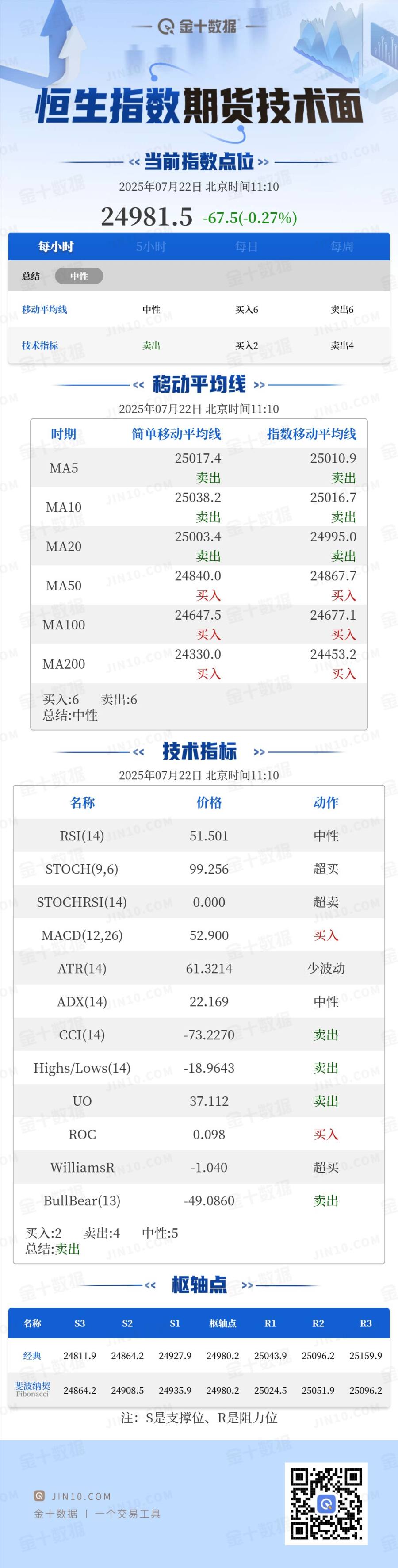
金十图示:2025年07月22日(周二)香港恒生指数期货技术面一览(一小时图)
news flash· 2025-07-22 03:12
Group 1 - The overall market sentiment is neutral, with a balance of buy and sell signals across various moving averages [2][5]. - The 5-day simple moving average (MA5) is at 25017.4, indicating a sell signal, while the 50-day (MA50) and 100-day (MA100) moving averages show buy signals at 24840.0 and 24647.5 respectively [4][5]. - Technical indicators such as RSI(14) at 31 suggest a neutral position, while the Stochastic Oscillator indicates overbought conditions at 99.256 [6]. Group 2 - The Average True Range (ATR) is at 61.3214, indicating low volatility in the market [6]. - The Commodity Channel Index (CCI) is at -73.2270, suggesting a bearish trend [6]. - The market is experiencing a mixed sentiment with equal buy and sell recommendations, leading to an overall neutral summary [5].