
经济增长目标

Search documents
如何解读2025年全年经济数据︱重阳问答
重阳投资· 2026-01-23 07:58
Economic Overview - The nominal GDP for 2025 reached 140.2 trillion yuan, achieving a growth target of 5%, with a fourth-quarter GDP growth rate of 4.5% [2] - Fixed asset investment decreased by 3.8%, while exports grew by 6.1% and household consumption increased by 4.4%, with service retail sales growing by 5.5% [2] - The contributions to economic growth from final consumption expenditure and net exports were 52% and 32.7%, respectively, indicating that exports and service consumption were the main drivers of growth [2] Investment Trends - National fixed asset investment, excluding real estate, fell by 0.5%, with infrastructure investment down by 2.2% due to local government special bonds being used for debt repayment [3] - Real estate investment saw a significant decline of 17.2%, with residential sales area dropping to 730 million square meters, an 8.7% decrease from the previous year [3] - Manufacturing investment grew by 0.6%, supported by a notable 11.8% increase in equipment renewal investment due to long-term special treasury bonds [3] Future Economic Projections - The central economic work conference indicated a goal to stabilize investment, with expectations for investment growth to turn positive in 2026 due to increased infrastructure spending from local special bonds [3] - The economic growth target for 2026 is likely to remain stable, with a projected GDP growth rate of 4.17% from 2025 to 2035, considering the demographic changes [3]


越南抛出“年均10%增长”目标,远高于上一轮未完成的6.5%-7%
Hua Er Jie Jian Wen· 2026-01-20 04:00
Group 1 - The core objective of Vietnam's leadership is to achieve an average economic growth rate of over 10% annually by 2030, significantly higher than the previously set target of 6.5%-7.0% for 2021-2025, which was not met [1][2] - The Vietnamese government plans to make strategic breakthroughs in three key areas: institutional reform, infrastructure development, and human resources, to support this ambitious growth target [2] - Vietnam aims to attract between $150 billion to $200 billion in foreign direct investment (FDI) from 2026 to 2030, funded by an expanded fiscal deficit projected to reach around 5% of GDP [2] Group 2 - Despite external pressures, Vietnam's economy has shown resilience, with GDP growth of 8.46% in Q4 2025, surpassing economists' expectations of 7.7%, driven by strong manufacturing and export performance [3] - Vietnam's manufacturing sector grew over 10% in the last quarter, contributing significantly to economic growth, while exports surged nearly 24% year-on-year, achieving a record trade surplus with the U.S. [3] - The impact of U.S. tariffs, which were imposed at 20% in August 2025, may have delayed effects, prompting Vietnam to seek stronger trade relationships with other partners to mitigate risks [3] Group 3 - The pursuit of high growth targets has revealed vulnerabilities in Vietnam's financial system, with credit growth reaching 17.9%, significantly outpacing the 14% growth in deposits, leading to liquidity shortages in the banking sector [4] - Fitch Ratings has warned that the rapid lending pace in Vietnam's banking sector exceeds overall economic growth, increasing financial risks associated with credit-driven growth [4] - Regulatory measures, including dollar swap transactions, have been implemented to inject liquidity into the market and alleviate pressure on the banking system [4]
重磅年度经济数据即将发布,5%左右目标有望较好实现
Di Yi Cai Jing· 2026-01-15 11:59
Core Viewpoint - The Chinese economy is expected to stabilize and improve in 2026, driven by counter-cyclical policies aimed at supporting the real estate sector, boosting investment, and stimulating consumption [2][3]. Economic Growth - The GDP growth for 2025 is projected to be around 5%, with a slight decline in growth rate expected in the fourth quarter to approximately 4.6% [3][4]. - The first three quarters of 2025 saw a GDP growth of 5.2%, but the third quarter experienced a slowdown to 4.8%, indicating weakening economic momentum [3]. Investment Trends - Fixed asset investment is forecasted to decline by 2.2% in December 2025, showing a slight recovery from November's -2.6% [9]. - Infrastructure projects are expected to benefit from new policy financial tools, with a 28% increase in project bidding amounts in December [9][10]. - Excavator sales, a key indicator of infrastructure investment, rose by 19.2% year-on-year in December 2025, with domestic sales increasing by 10.9% [9][10]. Consumption Insights - The retail sales growth for December 2025 is predicted to be 1.8%, an increase from the previous month's 1.3% [8]. - Consumer spending showed signs of recovery during the New Year holiday, with a 6.1% year-on-year increase in consumption from January 1 to 3, 2026 [8]. - However, service consumption remains weak due to seasonal effects and high base comparisons from the previous year [8]. Industrial Performance - The industrial output growth for December 2025 is expected to be 4.9%, slightly up from 4.8% in the previous month [5]. - The manufacturing PMI rose to 50.1% in December, indicating a return to expansion after eight months below 50% [7]. - Increased coal consumption by key power plants in December suggests a high level of production activity [7].
智利2025年11月经济活动指数低于市场预期
Shang Wu Bu Wang Zhan· 2026-01-08 02:40
Core Viewpoint - Chile's economic activity index (Imacec) for November 2025 grew only 1.2% year-on-year, falling short of market expectations, primarily due to declines in mining (especially copper extraction) and electricity production [1] Economic Performance - The overall economic vitality in Chile remains insufficient, with cumulative growth of 2.3% for the first eleven months of 2025 [1] - The Chilean Treasury's annual growth target of 2.5% is now at risk, requiring a significant economic growth of 3.8% in December to meet this goal, which is considered challenging [1]
2025年11月经济数据点评:经济数据波动,不阻碍经济目标即将完成
Chengtong Securities· 2025-12-16 11:55
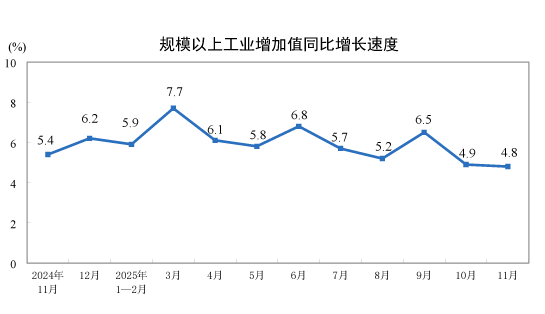
Economic Growth and Stability - Despite increased volatility in economic data in the second half of the year, the annual economic growth target is expected to be met due to a strong first half, with GDP growth of 5.2%[1] - Industrial production growth remains stable, with a year-on-year increase of 4.8% in November, slightly down from 4.9% in October[12] - Exports have rebounded significantly, with a year-on-year growth of 5.9% in November, up from -1.1% in October, driven by external demand[12] Investment Trends - Fixed asset investment cumulative year-on-year growth decreased from -1.7% to -2.6%, with a monthly decline of 11.5% in November[15] - Manufacturing investment maintained positive growth at 1.9% year-on-year, although monthly growth was negative at -4.5%[16] - Real estate investment saw a cumulative year-on-year decline of 15.9%, with a monthly drop of 30% in November[27] Consumer Spending - Social retail sales growth fell to 1.3% year-on-year in November, a decrease of 1.6 percentage points from the previous month, marking six consecutive months of decline[31] - The retail sales total saw a month-on-month decline of 0.42%, indicating weakened consumer momentum[31] - Major consumer categories, including jewelry and home appliances, experienced significant drops in sales growth, with jewelry sales falling from 37.6% to 8.5% year-on-year[34]
对2026经济政策的理性预期
2025-12-08 00:41
Summary of Key Points from Conference Call Industry Overview - The conference call discusses the economic outlook for China in 2026, focusing on growth targets, fiscal policies, infrastructure investment, real estate market trends, and consumer spending challenges. Core Insights and Arguments 1. **Economic Growth Target**: The expected GDP growth target for 2026 is set between 4.8% and 4.9%, with a fiscal deficit rate maintained at 4% [1][3][17] 2. **Infrastructure Investment**: A rebound in infrastructure investment is anticipated in 2026, driven by a slowdown in the decline of special bonds, stable issuance of special treasury bonds, and new projects under the "15th Five-Year Plan" [1][4] 3. **Real Estate Market Recovery**: The drag from the real estate market on the economy is expected to diminish, with sales growth stabilizing and investment as a percentage of GDP nearing the lower limit of developed countries [1][5] 4. **Fixed Asset Investment**: Fixed asset investment is projected to improve in 2026, with real estate investment expected to turn positive as sales and prices stabilize [1][9] 5. **Consumer Spending Challenges**: The consumer sector faces challenges due to insufficient national subsidy funds and potential saturation of certain goods, although non-subsidized goods are showing higher growth rates than subsidized ones [1][10] 6. **Fiscal and Monetary Policy Outlook**: Increased fiscal spending is expected in 2026, with a likelihood of interest rate cuts in the first quarter, supporting a positive economic growth outlook [1][11][17] 7. **Export Stability**: Exports are expected to remain stable, with a projected growth rate of 4.5% to 5% for the current year, despite a slight decline in actual export value next year [1][12] 8. **CPI and PPI Trends**: CPI is under pressure to rise, while PPI's ability to turn positive will depend on policy factors related to anti-involution efforts [1][13][14] Additional Important Insights 1. **Real Estate Policy**: Future real estate policies will focus on inventory reduction and supply optimization, with local governments playing a key role in addressing financing pressures [1][7] 2. **Mortgage Rate Subsidy Feasibility**: The feasibility of mortgage rate subsidy policies is low due to operational difficulties and limited success in other regions [1][8] 3. **Consumer Goods Focus**: There may be a shift in focus towards durable goods like sports equipment and smart wearable devices as subsidy levels for major consumer goods decrease [1][10] 4. **Impact of Economic Policies**: Future economic policies will emphasize capacity reduction and anti-involution, with potential implications for industry organization and competition [1][15][16] This summary encapsulates the key points discussed in the conference call, providing a comprehensive overview of the anticipated economic landscape for 2026 in China.
11月份大宗商品“成绩单”出炉 利好叠加为实现全年经济增长目标提供稳支撑
Yang Shi Wang· 2025-12-05 05:17
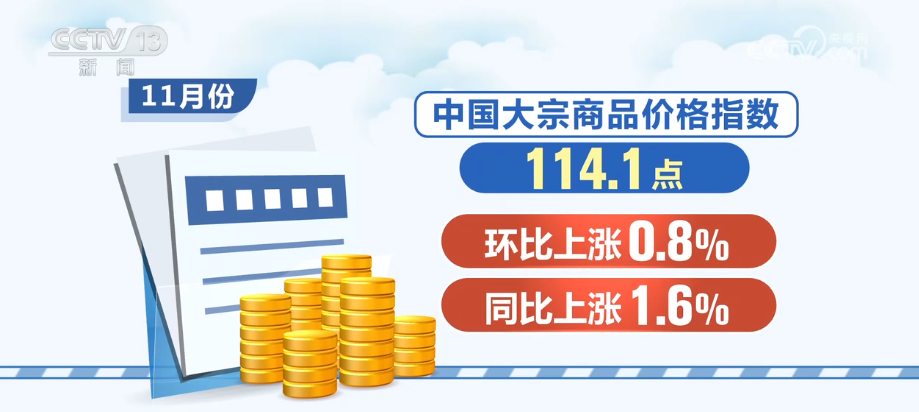
Core Insights - The China Logistics and Purchasing Federation reported that the commodity price index for November has increased for seven consecutive months, performing better than the same period in 2024 [1] Group 1: Commodity Price Index - The commodity price index for November stood at 114.1 points, reflecting a month-on-month increase of 0.8% and a year-on-year increase of 1.6% [3] - Among the 50 monitored commodities, 25 saw price increases month-on-month, with lithium carbonate, coke, and corrugated paper leading the gains at 15%, 7.2%, and 7.1% respectively [6] Group 2: Industry Performance - The non-ferrous metal price index rose by 1.4% month-on-month, driven by the rapid development of the global new energy industry and the continued expansion of domestic high-tech manufacturing [9] - The energy price index and agricultural product price index rebounded, increasing by 1.2% and 0.9% respectively, due to seasonal heating demand and tight supply of certain agricultural products [11] Group 3: Economic Outlook - Overall, the commodity market is showing a recovery in prosperity levels, indicating a stable and positive trend. This reflects the strengthening of domestic economic resilience and internal momentum, supported by various economic stabilization measures [14]
机构展望明年经济增速在5%左右 宏观政策和重大项目将持续发力
2 1 Shi Ji Jing Ji Bao Dao· 2025-12-01 23:13
Economic Overview - The overall economic performance in 2025 is expected to show a "high first, low second" trend, with a projected annual growth target of around 5% [1][4][6] - The economy grew by 5.2% year-on-year in the first three quarters of 2025, with quarterly growth rates of 5.4%, 5.2%, and 4.8% respectively [1][2] Economic Indicators - The manufacturing PMI for November recorded at 49.2%, indicating a slight improvement but still below the expansion threshold [2][5] - The CPI decreased by 0.1% and the PPI fell by 2.8% in the first three quarters, reflecting weak overall demand [3] Sector Performance - Industrial value added grew by 6.2% year-on-year, while the service sector increased by 5.4%, indicating resilience in supply chains despite external pressures [3] - Exports showed strong resilience, with a 5.3% year-on-year increase from January to October, attributed to competitive products and diversified market strategies [4][10] Policy Recommendations - To counteract the economic downturn in the fourth quarter, more proactive macroeconomic policies are recommended, including increased fiscal spending and monetary easing [6][9] - Suggestions include raising the fiscal deficit rate to 5% and enhancing public financial support for consumption and infrastructure projects [8][10] Future Outlook - The economic growth for 2026 is anticipated to be around 5%, with expectations of a "low first, high second" trend due to new opportunities arising from the "14th Five-Year Plan" [6][8] - The need for a robust fiscal and monetary policy framework is emphasized to support economic recovery and growth [9][10]
机构展望明年经济增速在5%左右
2 1 Shi Ji Jing Ji Bao Dao· 2025-12-01 16:25
Economic Overview - In December, the economic performance for 2025 is expected to show a "high first, low second" trend, with a projected annual growth rate of around 5% [1][3] - The economy grew by 5.2% year-on-year in the first three quarters of 2025, with quarterly growth rates of 5.4%, 5.2%, and 4.8% respectively [1][3] Economic Indicators - The manufacturing PMI for November recorded at 49.2%, indicating a slight improvement but still below the expansion threshold [3][6] - The industrial added value increased by 6.2% year-on-year in the first three quarters, while the service sector grew by 5.4% [5][6] - CPI decreased by 0.1% and PPI fell by 2.8% in the same period, reflecting weak demand [5][6] Policy Measures - The government has introduced policies to stabilize investment and mitigate risks, including the accelerated deployment of 500 billion yuan in new policy financial tools [3][6] - There is an expectation for more proactive macroeconomic policies to support growth in 2026, including significant infrastructure projects and fiscal measures [9][10] Future Projections - For 2026, economic growth is anticipated to remain around 5%, with a potential shift to a "low first, high second" trend due to new opportunities arising from the 14th Five-Year Plan [10][13] - The fiscal deficit rate is expected to increase to 5% in 2026, with a focus on enhancing public spending and supporting consumer demand [11][12] Sector-Specific Insights - The export sector has shown resilience, with a 5.3% year-on-year increase in exports from January to October 2025, despite external pressures [6][13] - The real estate market continues to face challenges, with ongoing adjustments and a need for policy interventions to stabilize the sector [6][12]

机构展望明年经济增速在5%左右
21世纪经济报道· 2025-12-01 16:02
Economic Overview - In December, the economic performance for 2025 is expected to show a "high first, low second" trend, with a projected annual growth rate of around 5% [1] - The economy grew by 5.2% year-on-year in the first three quarters, with quarterly growth rates of 5.4%, 5.2%, and 4.8% respectively [1] Manufacturing and Investment - The manufacturing PMI for November recorded at 49.2%, indicating slight improvement but still below the expansion threshold [3] - The introduction of 500 billion yuan in new policy financial tools and the activation of 500 billion yuan in local debt are expected to provide additional investment funds [3] Economic Challenges - The economy is facing downward pressure in the fourth quarter, with growth expected to slow to around 4.5% [3] - Demand remains weak, as evidenced by a CPI decline of 0.1% and a PPI drop of 2.8% in the first three quarters [5] Export and Market Resilience - Exports showed strong resilience, with a 5.3% year-on-year increase from January to October, despite external pressures [6] - The capital market has strengthened, particularly in technology stocks, due to reforms and improved risk appetite [6] Future Economic Projections - For 2026, the economic growth target is also expected to be around 5%, with a focus on proactive macroeconomic policies to stimulate growth [8][10] - The "14th Five-Year Plan" will initiate significant projects aimed at infrastructure and consumption upgrades, which are expected to support economic recovery [9] Policy Recommendations - It is suggested to increase the fiscal deficit rate to 5% for 2026 to enhance public spending and support economic growth [12] - Monetary policy may see further easing, including potential interest rate cuts, to stimulate demand [12][13]
