
预防性降息

Search documents
通胀粘性VS就业疲软,全球央行在紧缩与宽松间艰难求衡
Xin Hua Cai Jing· 2025-09-26 03:06
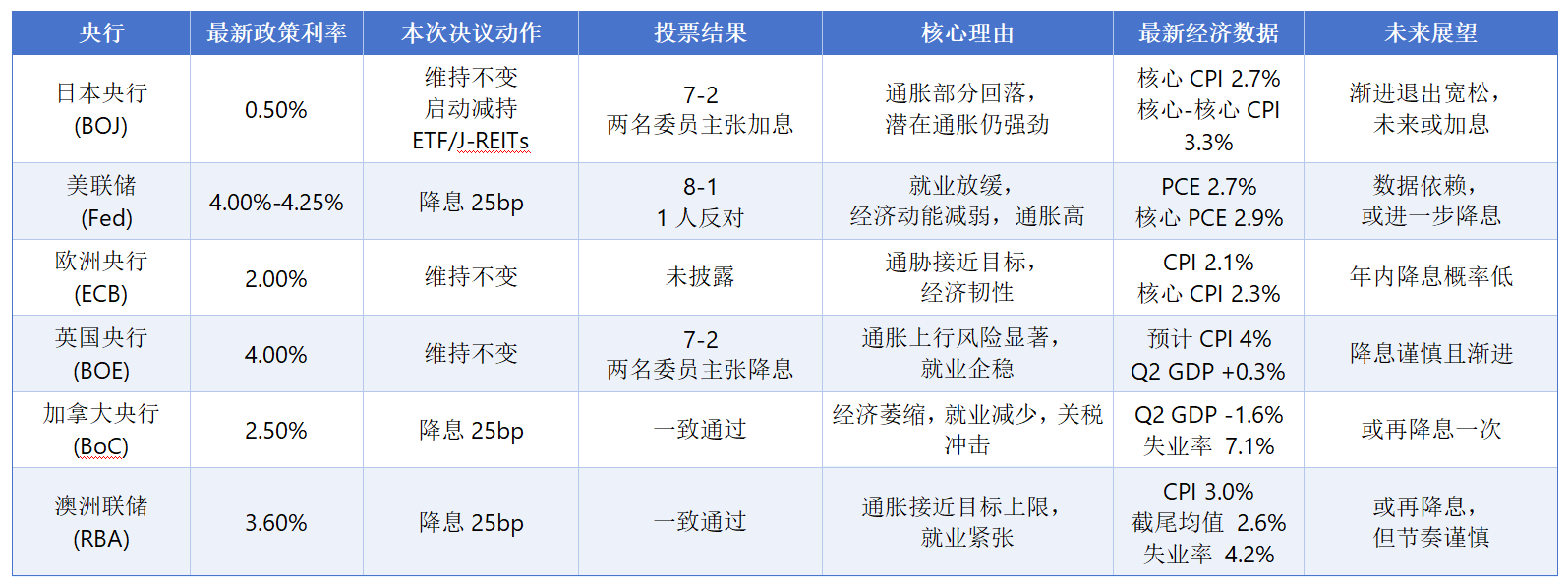
Core Viewpoint - Global central banks are entering a new phase of policy adjustment characterized by unprecedented divergence, with Japan initiating asset reduction, the Federal Reserve starting preventive rate cuts, while the European and UK central banks remain cautious amid persistent inflation pressures [1][18]. Central Bank Policy Summary Japan - The Bank of Japan (BOJ) maintained its policy rate at 0.50% while initiating a reduction plan for its large ETF and J-REITs holdings, starting with an annual reduction of approximately 620 billion yen (about 4.2 billion USD) [2][6]. - The decision reflects a significant step towards normalizing the ultra-loose monetary policy that has been in place for over a decade, despite the slow pace of asset reduction indicating a cautious approach [6][7]. United States - The Federal Reserve lowered the federal funds rate target range by 25 basis points to 4.00%-4.25%, citing economic slowdown and labor market cooling as key factors [3][4]. - Fed Chair Powell emphasized that the decision was a risk management measure, balancing the dual risks of a weakening labor market and persistent high inflation [3][4]. Europe - The European Central Bank (ECB) kept the deposit facility rate unchanged at 2%, indicating that current inflation is close to the medium-term target of 2% and that the eurozone economy shows resilience [9][10]. - There are internal divisions within the ECB regarding future actions, with some members advocating for rate cuts due to long-term deflation risks, while others believe current rates are sufficient to address multiple challenges [10][11]. United Kingdom - The Bank of England (BoE) maintained its rate at 4%, highlighting significant medium-term inflation pressures despite a slight GDP growth [11][12]. - The BoE plans to slow its quantitative tightening from £100 billion to £70 billion annually, reflecting concerns over long-term bond market pressures [12][13]. Canada and Australia - The Bank of Canada cut its benchmark overnight rate by 25 basis points to 2.50%, responding to economic shrinkage and employment declines due to U.S. tariffs [14][15]. - The Reserve Bank of Australia (RBA) has also reduced its cash rate to 3.60%, indicating a cautious shift towards easing while monitoring economic data closely [16][17]. Global Monetary Policy Landscape - The global monetary policy environment is marked by high uncertainty, with central banks facing complex challenges such as intricate inflation structures, external risks from trade policies, and political instability [18]. - The divergence in policy approaches among major central banks reflects a transition from a highly coordinated response during the pandemic to a more nuanced, differentiated strategy in response to evolving economic conditions [18].

市场对美联储10月份降息预期较高
Sou Hu Cai Jing· 2025-09-24 16:36
Core Viewpoint - The U.S. economy is facing dual risks of rising inflation and declining employment, complicating monetary policy decisions [1] Group 1: Monetary Policy - The Federal Reserve lowered the federal funds rate target range by 25 basis points to between 4.00% and 4.25%, marking its first rate cut since December 2024 [1] - The rate cut is seen as a preventive measure in response to the deteriorating employment data, which is perceived to pose a greater risk than the moderate rebound in inflation [3] - Market expectations for another rate cut in October are high, with a 91.9% probability of a 25 basis point reduction [3] Group 2: Employment Market - The U.S. job market is showing signs of significant weakening, with the average number of new non-farm jobs added in August at around 30,000, a historical low [2] - The unemployment rate has risen, and job vacancies have decreased, indicating a further decline in the employment market [2] - The dual slowdown in labor supply and demand is increasing the risks associated with employment [3] Group 3: Economic Challenges - The main challenges for the U.S. economy include structural imbalances in the job market and weakness in the manufacturing sector, which may not be effectively addressed through interest rate policies alone [4] - The Fed's risk management strategy aims to buy time for fiscal policies and structural reforms, but reliance solely on gradual monetary policy may not prevent further economic decline [4]
美联储“重启”降息有何影响?
2025-09-23 02:34
Summary of Conference Call Records Industry Overview - The records discuss the impact of the Federal Reserve's interest rate cuts on the global financial markets, particularly focusing on the Chinese economy and its currency dynamics [1][2][4]. Key Points and Arguments 1. **Federal Reserve's Interest Rate Cuts** - The Federal Reserve cut interest rates by 25 basis points, aligning with market expectations, and indicated potential further cuts in October and December, depending on inflation and labor market conditions [1][4]. 2. **Impact on Chinese Yuan and Equity Markets** - The Chinese Yuan is expected to appreciate, with projections of reaching around 7.0 by the end of 2025 and potentially breaking 7 in 2026. This appreciation is supported by exporters accumulating approximately $1.3 trillion in unconverted foreign exchange [2][3]. 3. **Liquidity and Market Sentiment** - The Fed's rate cuts are expected to increase global liquidity, positively impacting risk assets such as U.S. stocks and supporting the Chinese equity market [2][5]. 4. **Potential for Further Rate Cuts by PBOC** - The Fed's actions provide the People's Bank of China (PBOC) with room to lower rates, especially given the current macroeconomic data showing negative CPI and PPI growth [1][2]. 5. **Historical Context of Rate Cuts** - Historical analysis indicates that similar Fed actions typically lead to positive performance in various asset classes, particularly in non-recessionary periods [5][6]. 6. **Market Reactions to Different Economic Contexts** - The effectiveness of the Fed's rate cuts varies based on the economic context, with preemptive cuts generally benefiting emerging markets and growth stocks, while commodity and gold prices may see moderate gains [7][8]. 7. **Current Economic Conditions** - The U.S. economy shows signs of marginal weakening but does not exhibit clear signs of a hard landing. This environment suggests a cautious but upward-trending outlook for global markets, with emerging markets like A-shares benefiting from liquidity expansion [8]. Other Important Insights - The records highlight the importance of monitoring the basic economic conditions as they significantly influence market performance following Fed rate cuts. Historical precedents show that the market's response can vary widely based on the underlying economic health at the time of the cuts [6][8].
美联储官员强调9月降息为预防性措施 谨慎看待进一步行动
智通财经网· 2025-09-22 14:47
Group 1: Federal Reserve Policy and Economic Outlook - The Federal Reserve's recent 25 basis point rate cut was supported by St. Louis Fed President Bullard for "preventive reasons" to avoid further deterioration in the labor market, but he noted limited room for future cuts given current rates are near neutral [1] - Atlanta Fed President Bostic does not support further rate cuts due to persistently high inflation, indicating a cautious approach to monetary policy [2] - The Fed faces a complex situation with signs of a cooling labor market and inflation not stabilizing at the 2% target, raising concerns about a potential economic recession [2] Group 2: Gold Market Dynamics - Global central bank gold purchases and increased investment demand are driving gold prices to record highs, with international gold prices reaching $3,728 per ounce, doubling since the end of 2022 [2][3] - Central banks have been net buyers of over 1,000 tons of gold annually since 2022, with expectations of 900 tons in 2023, driven by "de-dollarization" efforts [3] - Gold ETFs have seen significant inflows, with 397 tons in the first half of 2023, the highest since 2020, and total holdings reaching 3,615.9 tons by June [3] Group 3: Jewelry and Investment Demand Trends - Global demand for gold jewelry has declined significantly, with a projected 14% drop in Q2 2025 to 341 tons, marking the lowest level since the pandemic [3] - Despite the decline in jewelry demand, investment demand for physical gold remains strong, with a 10% increase in bar purchases expected in 2024, while coin purchases are down 31% [4] - Overall retail investment demand is projected to grow by 2% to 1,218 tons in 2025, particularly driven by strong purchasing power in Asian markets [4]
“杀”疯了,金价再创新高!
Guo Ji Jin Rong Bao· 2025-09-22 13:40
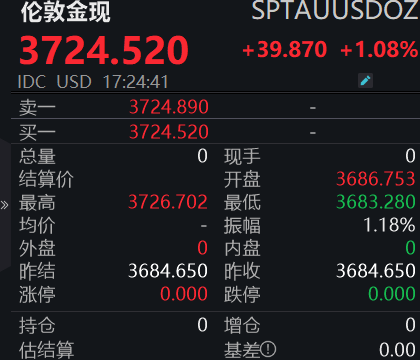
Core Viewpoint - Gold prices have surged recently, with London gold breaking the $3,720 per ounce mark and COMEX gold futures reaching $3,756.9 per ounce, both hitting historical highs [1][3]. Group 1: Price Movements - As of the latest report, London gold reached $3,720 per ounce, increasing over 1%, with an intraday high of $3,726.702 per ounce [1]. - COMEX gold futures rose nearly 1.4%, closing at $3,756.9 per ounce, with a peak of $3,761.2 per ounce during the trading session [1][2]. Group 2: Factors Driving Price Increase - The rise in gold prices is attributed to the Federal Reserve's "preventive rate cut" policy, concerns over stagflation risks, and worries about the Fed's independence [3][4]. - A decline in the U.S. dollar index and issues surrounding the security of cryptocurrencies, particularly the drop in Bitcoin prices, have also contributed to the upward momentum in gold prices [3]. Group 3: Market Analysis and Future Outlook - Analysts suggest that the market's expectation of a rate cut by the Federal Reserve has bolstered gold prices, especially following a dovish shift from Fed Chair Powell [3][5]. - The ongoing geopolitical tensions and economic pressures in regions like Europe and the Middle East have heightened risk aversion, further supporting gold's price increase [3][4]. - Looking ahead, analysts believe that the long-term upward trend for gold is likely to continue, with potential targets of $3,800 and even $4,000 per ounce by year-end [5].
【广发宏观团队】年内第三轮政策集中发力期
郭磊宏观茶座· 2025-09-21 08:57
Group 1 - The article discusses the third round of macroeconomic policy measures in 2025, focusing on stimulating consumer confidence and supporting the real estate sector [1][3] - The first round of policies in early 2025 aimed at enhancing consumer expectations through measures like equipment upgrades and optimizing housing fund policies [1][2] - The second round in May focused on easing financial conditions, including monetary policy loosening and accelerating the implementation of key projects [2][3] Group 2 - Economic indicators show a slowdown in the third quarter, with industrial output and retail sales declining, indicating a need for further policy support [3][4] - The article highlights the importance of fiscal and monetary policy coordination to stabilize the economy, with recent meetings signaling a collaborative approach [3][4] - The article notes that the construction and real estate sectors are experiencing significant challenges, necessitating targeted policy interventions [4][24] Group 3 - The article mentions the global market's response to the Federal Reserve's interest rate cuts, with U.S. stock markets performing well, particularly in technology sectors [5][6] - It highlights the performance of various asset classes, with a notable increase in the Nasdaq and S&P 500 indices following the rate cut [6][10] - The article also discusses the implications of the Fed's actions on international markets, including Japan and Europe, where central banks are maintaining their policies [17][18] Group 4 - The article outlines the government's efforts to boost service consumption through new policies aimed at enhancing consumer experiences and expanding service sectors [30][31] - It emphasizes the importance of domestic product standards in government procurement to support local industries [30] - The article also discusses the initiatives to promote light industry growth, focusing on innovation and quality improvements in key sectors [25][26][27]

美联储降息25基点!37万亿债务压顶,特朗普提线木偶操控利率决议
Sou Hu Cai Jing· 2025-09-21 08:43
Group 1: Federal Reserve's Monetary Policy - The Federal Reserve announced a rate cut of 25 basis points, reflecting a complex economic landscape with conflicting signals from employment and inflation data [2][4] - The U.S. economy is showing a dual picture, with non-farm payrolls growing by only 22,000 in August, significantly below the expected 75,000, and the unemployment rate rising to 4.3%, the highest in nearly two years [4] - Inflation remains a concern, with the CPI rising 2.9% year-on-year and core CPI at 3.1%, both above the Fed's 2% target, complicating the Fed's decision-making process [4] Group 2: Political Influence and Economic Pressure - The rapid confirmation of Stephen Milan as a Fed governor has introduced political dynamics into monetary policy, as he is aligned with the Trump administration's pro-growth agenda [1][6] - The current U.S. national debt has surpassed $37 trillion, and a 25 basis point rate cut could save nearly $100 billion in interest payments annually, highlighting fiscal pressures as a significant factor in policy decisions [5][9] - The Congressional Budget Office projects a fiscal deficit of $1.9 trillion for FY2025, which is 6.2% of GDP, further intensifying the pressure for rate cuts as a means to alleviate fiscal burdens [9] Group 3: Market Reactions and Investment Opportunities - The market has already begun to price in rate cuts, with gold prices reaching a historical high of $3,730 per ounce, reflecting a 48.94% increase since the last rate cut cycle began [10] - Historical data suggests that during initial rate cut cycles, technology growth stocks tend to outperform value stocks, indicating potential short-term gains for the tech sector if the Fed proceeds with cuts [10] - Commodity markets are showing divergent trends, with precious metals like gold benefiting from the anticipated cuts, while industrial metals' performance will depend on the strength of global economic recovery [12]
降息预期兑现,有色阶段性回调
Tianfeng Securities· 2025-09-21 05:11
Investment Rating - Industry Rating: Outperform the market (maintained rating) [6] Core Views - The report indicates that the expectation of interest rate cuts has been realized, leading to a phase of price adjustments in both base and precious metals [1][2][18] - Copper prices have seen a downward shift, with the Shanghai copper closing at 80,080 CNY/ton, while aluminum prices have also experienced a phase adjustment, closing at 20,760 CNY/ton [1][18] - Precious metals, particularly gold and silver, have seen price increases following the Federal Reserve's interest rate cut, with gold averaging 829.33 CNY/gram and silver at 9,964 CNY/kilogram [2][22] Summary by Sections Basic and Precious Metals - Copper: Prices have decreased, with cautious purchasing from downstream enterprises. The market is expected to stabilize with potential increases in demand as the National Day holiday approaches [1][13] - Aluminum: Following the interest rate cut, aluminum prices have adjusted. The supply remains stable, but demand from the automotive sector has shown weakness [1][18] - Precious Metals: Gold and silver prices have risen due to the Federal Reserve's rate cut, with market concerns about the U.S. economic outlook supporting these increases [2][22] Minor Metals - Antimony: Prices have decreased, with a cautious market outlook and weak supply-demand dynamics [3][32] - Lithium: Prices have slightly increased, but the market remains cautious with ample supply [32][33] - Cobalt: Prices have shown a slight upward trend, but demand remains subdued due to high costs [37][38] - Tin: Prices have weakened, with market sentiment cooling despite some support from raw material prices [45][46] - Tungsten: Prices have decreased, driven by weak demand and cautious trading behavior [51][52] - Molybdenum: Prices have declined, with market confidence shaken and a cautious outlook prevailing [57][58] Rare Earths - Prices for rare earths have shown slight increases, with ongoing improvements in the fundamental market conditions [4][32]
美联储今年首次降息25个基点,中美利差收窄,中国资产抢占发展机遇
Hua Xia Shi Bao· 2025-09-19 12:29
Group 1 - The Federal Reserve has lowered the federal funds rate target range from 4.25%-4.5% to 4%-4.25%, marking the fourth adjustment since the rate cut cycle began in September 2024 [2][4] - The Fed's dot plot indicates an expectation of an additional 50 basis points of rate cuts by the end of 2025, suggesting a total potential cut of 75 basis points for the year [2][7] - Following the rate cut, global capital markets experienced volatility, with U.S. stock indices initially rising before quickly retreating, and the dollar index showing mixed movements [2][8] Group 2 - The current economic conditions in the U.S. show increasing downward pressure, with market predictions suggesting the possibility of three more rate cuts within the year [3][9] - The Fed's decision to cut rates is seen as a preventive measure in response to deteriorating employment data, which has become a more pressing concern than moderate inflation [4][6] - The Fed has adjusted its GDP growth forecast for the U.S. from 1.4% to 1.6% for the year, while also lowering unemployment rate expectations, indicating some confidence in economic resilience [6][7] Group 3 - The narrowing of the interest rate differential between China and the U.S. is expected to ease external pressures on the Chinese yuan, creating a more favorable environment for the People's Bank of China to implement monetary easing [9][10] - The Fed's rate cut is anticipated to provide a window for policy adjustments in China, allowing for a focus on stimulating domestic economic growth [10][11] - Historical trends suggest that domestic equity assets in China may yield excess returns during Fed rate cut cycles, while bond prices typically rise and yields fall [11][12]
铜产业链周度报告-20250919
Zhong Hang Qi Huo· 2025-09-19 09:51
1. Report Industry Investment Rating No relevant content provided. 2. Core Viewpoints of the Report - The Fed cut interest rates by 25 basis points as expected, lowering the federal funds rate to 4.00%-4.25%. The meeting was generally in line with expectations, but the attitude was neutral and slightly hawkish. After the interest rate cut was realized, the US dollar rebounded after hitting a low, and commodities adjusted overall. The expectation of multiple interest rate cuts within the year was confirmed, and liquidity growth would continue [5][11]. - The copper price is expected to be weakly volatile in the short term. Pay attention to the support around 79,200. The mid - term strategy of buying on dips remains unchanged [5][57]. 3. Summary According to the Directory 3.1 Report Summary - The Fed cut interest rates by 25 basis points, the first rate cut this year and the resumption of rate cuts after 9 months. Most Fed officials expect two more rate cuts this year and one next year [11]. - From January to August, the national industrial added - value above designated size increased by 6.2% year - on - year, with the growth rate falling. Infrastructure investment, manufacturing investment growth rates declined, and real estate development investment decreased [14]. - The copper price is expected to be weakly volatile in the short term, and the mid - term strategy of buying on dips remains unchanged [5]. 3.2 Multi - and Short - Focus 3.2.1 Bullish Factors - There is an expectation that the smelting output center will shift downward [8]. - The spot processing fee remains at a low level, and the tightness at the mine end still exists [8]. - Social inventory has decreased [8]. 3.2.2 Bearish Factors - The interest rate cut has been realized, and the bullish news is exhausted [8]. - The spot premium continues to decline [8]. 3.3 Data Analysis 3.3.1 Copper Ore Imports - In August, China's imports of copper ore and concentrates were 275.9 tons, and the cumulative imports from January to August were 20.054 million tons, a year - on - year increase of 7.9% [17]. 3.3.2 Copper Concentrate TC - As of the week of September 12, the Mysteel standard clean copper concentrate TC weekly index was - 40.68 US dollars per dry ton, up 0.17 US dollars per dry ton from the previous week. The spot TC of copper concentrate increased slightly, but the overall sentiment was cautious, and spot transactions remained light [21]. 3.3.3 Copper Production - In August 2025, China's refined copper (electrolytic copper) output was 1.301 million tons, a year - on - year increase of 14.8%. In September, it is expected that the output will decline due to smelter maintenance and anode copper supply shortages [25]. 3.3.4 Scrap Copper Imports - In July, China's scrap copper imports were 183,200 tons, a month - on - month increase of 3.73% and a year - on - year decrease of 1.98%. The main driving factor was strong domestic demand [29]. 3.3.5 Copper Products Output - In August 2025, China's copper products output was 2.222 million tons, a year - on - year increase of 9.8%, a month - on - month increase of 2%, and a multi - year high for the same period [33]. 3.3.6 Premium between Refined and Scrap Copper - As of September 18, the premium between refined and scrap copper was around - 530 yuan per ton, which was beneficial to refined copper consumption [37]. 3.3.7 Social Inventory - Last week, LME copper inventory continued to decline. SHFE copper inventory increased by 14.9% to 94,054 tons in the week of September 12. COMEX copper inventory reached a new high since January 2004. On September 18, the domestic electrolytic copper spot inventory decreased by 0.13 tons compared with September 15 [50]. 3.3.8 Copper Spot Premium - On September 18, the spot premium of Shanghai Wumaotrade 1 copper was around 30 yuan per ton, with the premium narrowing. The LME 0 - 3 spot discount was around - 71.09 US dollars per ton, with the discount widening [54]. 3.4 Market Outlook - The copper price is expected to be weakly volatile in the short term. Pay attention to the support around 79,200. The mid - term strategy of buying on dips remains unchanged [57].