
AI资本开支

Search documents
市场做多情绪浓厚!公募:高景气行业行情有望延续
券商中国· 2026-01-04 23:34
Core Viewpoint - The A-share market is expected to enter a new phase in 2026, with strong bullish sentiment and potential for high-growth sectors to continue performing well, driven by policy support and structural changes in the economy [2][4]. Market Sentiment - During the New Year holiday, the Hang Seng Tech Index rose by 4%, and the Nasdaq China Tech Index increased by 4.81%, indicating a strong bullish sentiment in the market [2][4]. - In 2025, 90 funds saw their annual returns double, with the top-performing fund achieving a 233.29% increase in net value [3]. Sector Performance - High-performing sectors in 2025 included computing power, humanoid robots, innovative pharmaceuticals, non-ferrous metals, and new consumption, which contributed to significant returns for funds focused on these areas [3][6]. - The market is expected to shift from valuation-driven growth to a healthier model driven by fundamentals and structural reforms, with a focus on long-term growth sectors such as new energy and innovative pharmaceuticals [6]. Economic Outlook - The economic growth engine is transitioning from monetary easing to credit expansion, with credit resources expected to flow more precisely into new productive sectors, aiding the recovery of the real economy [5]. - A significant increase in credit issuance is anticipated in January, potentially reaching 3-4 trillion yuan, which could benefit both the A-share and Hong Kong markets [5]. Investment Opportunities - There is a focus on sectors with long-term growth potential, including technology and consumption, with an emphasis on companies that are expanding globally [6]. - The investment community is particularly interested in themes such as commercial aerospace and low-altitude economy, which are expected to gain traction in 2026 [6]. Risks and Concerns - Fund managers express concerns about the potential negative impacts of a real estate downturn, uncertainties in US-China trade relations, and the risk of over-investment in certain AI sectors [7]. - Close attention is required regarding changes in capital expenditure in the AI sector, as any weakening could significantly alter investment logic [7].


2025年最后一天“有惊喜”!反弹未结束,还有哪些投资机会?
Sou Hu Cai Jing· 2025-12-30 05:59
Group 1 - Global stock markets experienced a collective pullback due to three main factors: increased financial fragility from overseas liquidity issues, protective options unwinding causing volatility, and concerns over the sustainability of capital expenditures among major US tech companies [1] - As of Q3 2025, the capital expenditure of US tech giants has significantly increased as a percentage of operating cash flow, indicating rising financial pressure [1] - Oracle Corporation issued $18 billion in bonds in September, with its rolling 12-month capital expenditure exceeding its operating cash inflow [1] Group 2 - Solid-state batteries, which completely replace liquid electrolytes with solid electrolytes, offer disruptive advantages in safety and energy density [3] - The focus of industrialization has shifted from "materials science" to "production engineering," with equipment becoming crucial for realizing advantages [3] - Semi-solid battery equipment is expected to see significant volume production by 2026, while full solid-state battery equipment is anticipated to ramp up between 2027 and 2030 [3] Group 3 - The recent surge in silver prices and the continuous rise in US stocks led gold to briefly exceed $4,400, although it later followed the decline of US stocks [5] - The market's focus on silver's influence on gold, alongside expectations regarding the Federal Reserve's successor and concerns over its independence, are critical [5] - Insurance companies are shifting from trading to allocation strategies, favoring long-term holdings of high ROE and high dividend quality assets [5] Group 4 - The short-term trend of the market is strong, with noticeable inflows of incremental capital and a positive market sentiment [7] - The number of stocks that increased in value was 2,478, while 2,719 stocks decreased, indicating a mixed market performance [8] Group 5 - The Shanghai Composite Index has shown resilience despite December typically being a poor month, with recent rebounds indicating potential for recovery [10] - The A-share market's fluctuations are influenced by external market volatility and tightening liquidity in the US, leading to increased domestic risk aversion [10] - Mid-term economic growth in China is expected to support upward movement in equity markets, with recommendations to focus on technology growth, advanced manufacturing, and dividend assets [10]
关于商品长期叙事和大轮动的讨论
对冲研投· 2025-12-29 11:35
Core Viewpoint - The article emphasizes the importance of historical context in understanding current market dynamics, particularly in the commodity sector, where a potential recovery is anticipated due to a weakening dollar and macroeconomic factors [4][5]. Group 1: Historical Context and Current Market Dynamics - The current economic landscape is reminiscent of the 1980s "Reagan cycle," characterized by high inflation, supply chain restructuring, and geopolitical tensions, which are influencing commodity pricing [6]. - The Federal Reserve's aggressive interest rate hikes and capital repatriation echo the strategies of the Reagan era, but the sources of inflation and the nature of global competition have shifted [6][8]. - The article suggests that the commodity market is transitioning from being driven by economic cycles to being influenced by political logic, with a focus on geopolitically sensitive commodities [8]. Group 2: Commodity Market Insights - The article identifies two main themes in the commodity market: the demand for geopolitically sensitive metals and the structural expansion of new energy resources [8]. - The current bullish sentiment in the non-ferrous metals market may not effectively transmit to other sectors due to structural challenges and differing demand dynamics [10][12]. - The aluminum market is experiencing a supply-demand imbalance, with significant imports from Guinea and a potential oversupply situation, which could impact pricing [13][14]. Group 3: Currency and Economic Implications - The appreciation of the Renminbi is largely supported by a record trade surplus, but the stock market reflects underlying economic pressures, indicating a disconnect between currency strength and equity performance [20]. - The future trajectory of the Renminbi is expected to influence asset valuations, particularly in equity markets, as foreign capital may return based on currency outlook and asset attractiveness [20].

资深科技分析师:英伟达真的很便宜
美股IPO· 2025-12-24 09:24
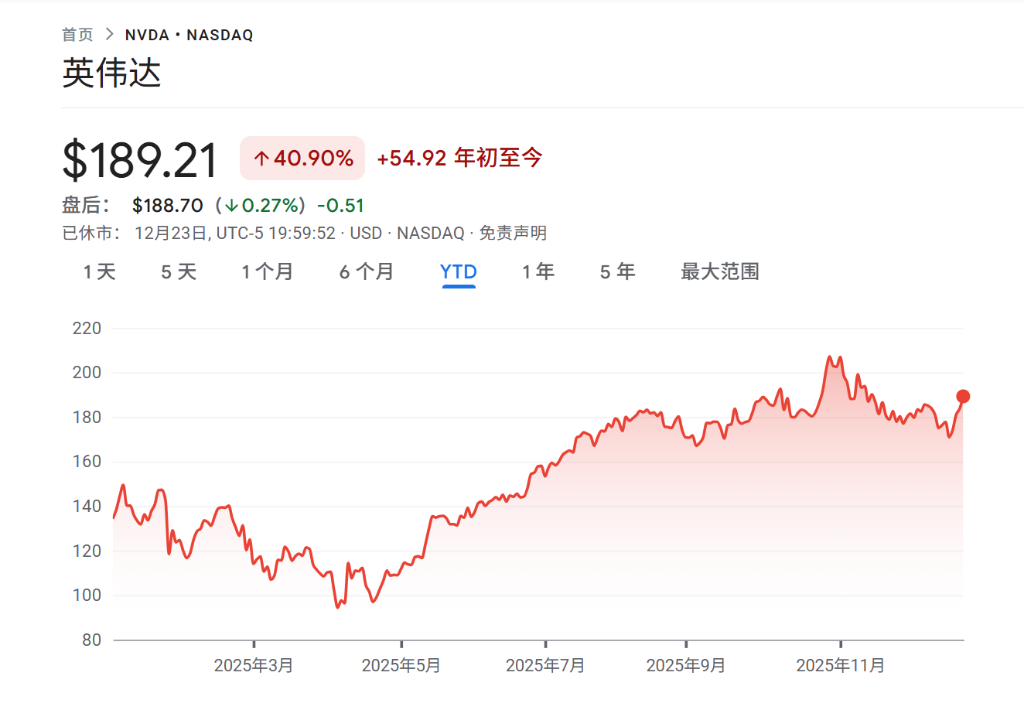
Core Viewpoint - Bernstein's report indicates that Nvidia's valuation has dropped to a historical low, with the expected price-to-earnings ratio falling below 25 times, representing a rare discount relative to the semiconductor industry. Despite recent stagnation in stock price, earnings continue to be revised upward, and new architectures like Blackwell are on the horizon. Analysts believe this is an excellent buying opportunity, with a target price set at $275 [1][3][6]. Group 1 - Nvidia's stock price has stagnated since July, with a year-to-date increase of approximately 30%, underperforming the Philadelphia Semiconductor Index (SOX) which rose by 38%. This stagnation, coupled with rising earnings, has led to a significant drop in the expected price-to-earnings ratio (P/FE) to below 25 times [3][5]. - Analysts from Bernstein assert that Nvidia is currently extremely "cheap" in both absolute and relative valuation terms, trading at about a 13% discount compared to the overall semiconductor industry, placing it in the first percentile of the past decade [5][6]. - Historical data shows that investors buying Nvidia when the price-to-earnings ratio is below 25 times typically see substantial returns, with an average one-year return exceeding 150%, and no negative returns during such periods [5][6]. Group 2 - Bernstein's analysis indicates that a 25 times expected price-to-earnings ratio places Nvidia's valuation in the 11th percentile of the past decade, marking it as an absolute low. Notably, there have only been 13 trading days in the past ten years where Nvidia's price relative to the SOX index was cheaper than it is now [6]. - Addressing market concerns regarding the sustainability of AI capital expenditures, analysts note that current capital expenditure intentions remain healthy, and the competitive narrative of GPUs versus ASICs is regaining momentum. Upcoming events like CES and GTC are expected to provide further catalysts, with new products based on the Rubin architecture set to launch [6]. - Bernstein reaffirms its "outperform" rating for Nvidia, setting a target price of $275, suggesting that current market expectations may be too low given the company's guidance of over $500 billion from Blackwell/Rubin [6].

资深科技分析师:英伟达真的很便宜
Hua Er Jie Jian Wen· 2025-12-24 08:33
Core Viewpoint - Bernstein's report indicates that despite Nvidia's decent stock performance this year, its valuation has undergone significant compression, currently sitting at an attractive historical low [1][4]. Group 1: Stock Performance and Valuation - Since July, Nvidia's stock price has stagnated, with a year-to-date increase of approximately 30%, underperforming the Philadelphia Semiconductor Index (SOX) which rose by 38% [1]. - This stagnation in stock price, coupled with rising earnings expectations, has led to a substantial decline in its expected price-to-earnings ratio (P/FE) to below 25 times [1][4]. Group 2: Relative Valuation - Nvidia is currently trading at about a 13% discount relative to the overall semiconductor industry, placing it in the first percentile of its valuation over the past decade [4]. - Historical data shows that when Nvidia's P/E ratio falls below 25 times, investors typically see substantial returns, with an average one-year return exceeding 150%, and no negative returns during such periods [4]. Group 3: Future Catalysts - Bernstein estimates that a 25 times expected P/E ratio indicates Nvidia's valuation is at the 11th percentile of its range over the past ten years, marking an absolute low [5]. - The report highlights that there are multiple catalysts on the horizon, including healthy capital expenditure intentions and the upcoming CES and GTC conferences, which are expected to provide further momentum [5]. - The anticipated release of the Rubin architecture products and potential market opportunities in China due to the Trump administration's approval of H200 chips are also noted as positive developments [5]. Group 4: Analyst Rating and Price Target - Bernstein reaffirms its "outperform" rating for Nvidia, setting a target price of $275, suggesting that current market expectations may be too low given the company's guidance of over $500 billion from Blackwell/Rubin [5].

12.24盘前速览 | 卫星巨震,伦敦铜价再创史高,结构性机会延续
Jin Rong Jie· 2025-12-24 01:32
Macroeconomic Dynamics - The RMB to USD exchange rate is expected to gradually appreciate from 7.0 to around 6.0 over the next decade [1] - The US economy grew by 4.3% in Q3, with former officials suggesting that the Federal Reserve is lagging behind in addressing interest rate cuts [1] Satellite Internet - The Long March 12A rocket's maiden flight was successful for the first stage, but the recovery of the sub-stage failed [1] - Related ETF: Satellite Industry ETF (on-market: 159218) [1] Non-ferrous Metals - London copper prices have surpassed $12,000 per ton, setting a new historical high [1] - Sellers are optimistic about the prices of gold, silver, platinum, and lithium [1] - Related ETF: Mining ETF (on-market: 159690) [1] Semiconductor - Sellers emphasize that clean rooms are a necessary engineering phase for the continued expansion of global AI capital expenditure [1] - The US has announced zero tariffs on Chinese semiconductor products until June 2027 [1] - Related ETF: Semiconductor Equipment ETF (on-market: 561980, off-market link: 020464) [1] Artificial Intelligence - Reports indicate that ByteDance plans to invest $23 billion in purchasing top-tier chips and building AI infrastructure [1] - Volcano Engine will become the AI cloud partner for the Spring Festival Gala in 2026 [1] - Market rumors suggest that ByteDance may significantly increase its procurement framework for Huawei's AI chips [1] - Related ETF: Cloud Computing ETF (on-market: 159890, off-market link: 021716), Semiconductor Equipment ETF (on-market: 561980, off-market link: 020464) [1] New Energy - The market is focused on the progress of long-term negotiations for lithium hexafluorophosphate, with price expectations shifting upward [1] - Leading manufacturers are expected to start bidding for solid-state battery pilot lines in January next year [1] - Policies aim for a total installed capacity of solar thermal power generation to reach around 15 GW by 2030 [1] - Related ETF: Battery ETF (on-market: 561910, off-market link: 016020) [1] Autonomous Driving - Beijing has issued the first batch of special license plates for L3 level autonomous driving vehicles, all of which are from BAIC's Arcfox brand [1] - Related ETF: Consumer Electronics 50 ETF (on-market: 159779, off-market link: 016007) [1] Market Observation - On December 23, the market transaction volume reached 1,899.8 billion, an increase of 37.9 billion [2] - The market is experiencing strong fluctuations at high levels, with sectors like electric equipment, building materials, and electronics leading the gains [2] - The satellite launch recovery failure may lead to a shift in expectations towards high-level fluctuations; AI core leaders are consolidating while upstream sectors like liquid cooling and PCB are showing determined performance [2] - The upstream energy storage sector rebounded due to news catalysts [2] - The market is expected to experience short-term fluctuations near previous highs, but the clear industrial trends in technology and commodities remain focal points [2]
商品宏观全景图:2026能否孕育新一轮大宗商品牛市?
对冲研投· 2025-12-19 08:04
Group 1 - The core viewpoint of the article emphasizes that the main driving force for future commodities will be overseas, particularly the "big fiscal" cycle in the United States and AI capital expenditure, which is unprecedented since World War II [4][25] - The report quantifies the demand for copper and aluminum driven by AI data centers, highlighting it as a significant growth driver for the coming years [4][31] - The consensus ranking for commodities is established as non-ferrous metals > precious metals > agricultural products > energy > ferrous metals, reflecting the current market pricing consensus [4][15][66] Group 2 - The analysis delves into the vulnerabilities behind the consensus, noting that the market may underestimate the complexity of domestic capacity clearance, which has been disrupted by traditional paradigms [5] - The report warns against over-reliance on the current supply-demand balance, suggesting that structural changes may not be fully priced in [5] - The retreat from global decarbonization consensus is particularly evident in Asia, where energy security and economic considerations are overshadowing climate agendas, potentially impacting commodity pricing [5] Group 3 - Several coherent themes for trading opportunities are proposed, including the re-inventorying and competition for key minerals driven by geopolitical tensions [6][7] - The rise of the renminbi is highlighted, with expectations that its internationalization will gradually weaken the traditional pricing power of LME compared to SHFE [7] - The report advocates for an "odds thinking" approach, suggesting that when market consensus is overly optimistic, investors should seek undervalued opportunities [7] Group 4 - The article draws historical parallels between current fiscal, technological, and geopolitical characteristics and the "stagflation" commodity bull market of the 1970s, indicating a potential for another "high-light year" in the commodity market [8][9] - The U.S. fiscal deficit is projected to remain historically high, with significant implications for economic resilience and corporate capital expenditure, particularly in AI-related infrastructure [25][24] - The report notes that AI capital expenditure is expected to account for over 60% of U.S. GDP growth, underscoring its critical role in the economy [25]

芯片股牛市叙事仍在“主升浪”! 2026年配置主题紧抓AI芯片、半导体设备与光互连
智通财经网· 2025-12-18 02:00
Core Viewpoint - The semiconductor sector, particularly AI chips, is expected to continue its bullish trend into 2026, driven by unprecedented AI infrastructure investments and strong inventory depletion of traditional chips [1][2][4]. Group 1: Investment Outlook - Morgan Stanley and Bank of America both highlight that the semiconductor sector will remain a focal point for investment, with Nvidia (NVDA.US) and Broadcom (AVGO.US) identified as top picks for 2026 [1][2][4]. - The semiconductor market is projected to grow significantly, with estimates suggesting a total market value of $975.5 billion by 2026, representing a 26% year-over-year increase [5]. Group 2: Key Investment Themes - Three main investment themes are identified: AI chip leaders, expansion of semiconductor equipment spending, and key players in the data center optical interconnect industry [2][3]. - The demand for AI chips, particularly from Nvidia and Broadcom, is expected to remain robust, with significant investments in advanced semiconductor equipment from companies like TSMC and Samsung [3][6]. Group 3: Market Dynamics - The semiconductor industry is experiencing a strong recovery, with a notable resurgence in MCU and analog chips anticipated by 2026 [5]. - The ongoing AI arms race is still in its early to mid-stages, with expectations of continued high growth rates for AI semiconductors, potentially exceeding 50% year-over-year [4][6]. Group 4: Company-Specific Insights - Morgan Stanley favors Micron (MU) in the storage chip market and Applied Materials (AMAT.US) and TSMC (TSM.US) in the semiconductor equipment sector [7]. - In the optical interconnect space, Lumentum (LITE.US) and Coherent (COHR.US) are recognized as leaders, particularly in supporting AI data center networks [10][11].

帮主郑重:纳指暴跌400点!科技股的“定心丸”为何突然失效?
Sou Hu Cai Jing· 2025-12-18 00:35
Core Viewpoint - The recent decline in the U.S. stock market, particularly in technology stocks, is a correction of overly optimistic expectations regarding AI capital expenditures and the Federal Reserve's imminent interest rate cuts [4][6]. Group 1: Market Reaction - The immediate trigger for the market drop was news that Oracle's $100 billion data center project might face obstacles, raising concerns about whether high capital expenditures in AI will yield tangible returns [3][4]. - Major AI stocks like Nvidia, Broadcom, AMD, and Oracle experienced significant declines, indicating a shift in investor sentiment from optimism to scrutiny [2][4]. Group 2: Economic and Policy Expectations - The latest employment data showed an increase in job creation despite a rise in unemployment, complicating the economic outlook and reducing the urgency for the Federal Reserve to implement aggressive rate cuts [4]. - The market is recalibrating its expectations regarding the U.S. economy and Federal Reserve policies, moving away from a phase driven solely by liquidity and dreams to one that requires more reliance on fundamental data and profit realization [4][6]. Group 3: Investment Strategy Recommendations - Investors are advised to maintain composure and not overreact to short-term market fluctuations, as the core drivers of the A-share market are domestic economic recovery, industrial policies, and company competitiveness [5]. - It is recommended to optimize portfolio structures by balancing dreams with reality, being cautious of companies with high valuations based solely on unfulfilled concepts, and focusing on firms with reasonable valuations and visible performance [5]. - Investors should identify opportunities arising from irrational sell-offs of quality tech companies due to external emotional shocks, as long as the fundamental strengths of these companies remain intact [5].


突发跳水!原因找到了
Zhong Guo Ji Jin Bao· 2025-12-15 08:11
Market Performance - On December 15, A-shares experienced a significant decline, with the Shanghai Composite Index falling by 0.55%, the Shenzhen Component Index down by 1.1%, and the ChiNext Index dropping by 1.77% [2] - A total of 2,314 stocks rose, while 2,968 stocks fell, indicating a broad market downturn [3][4] Sector Performance - The consumer sector showed resilience, with companies like Sunshine Dairy (001318) and Dongbai Group (600693) hitting the daily limit up. This was supported by a notice from the Ministry of Commerce and other financial authorities aimed at boosting consumption through 11 specific measures [5] - The commercial aerospace sector remained active, with stocks such as Reco Defense (002413) and Tongyu Communication (002792) also reaching the daily limit up [7] Economic Data Impact - The National Bureau of Statistics reported that the total retail sales of consumer goods in November reached 43,898 billion yuan, growing by 1.3% year-on-year, a decrease from the previous value of 2.9%. This slowdown in consumption growth was attributed to a high base from the previous year [12] - From January to November, national real estate development investment totaled 78,591 billion yuan, a year-on-year decline of 15.9%, with residential investment down by 15.0%. Despite this, investment growth excluding real estate development remained positive [13] External Influences - The decline in the market was partly influenced by negative sentiment from the U.S. tech sector, particularly in AI stocks, which saw significant drops. This led to a spillover effect on A-shares, contributing to a decrease in market risk appetite [12]
