K型分化

Search documents
北京天通苑,一共有700栋楼,房价从2650涨到40000,如今价格分化
Sou Hu Cai Jing· 2026-01-30 10:45
Core Insights - The article discusses the evolution of the Tiantongyuan area in Beijing, highlighting its transformation from a barren land in 1999 to a densely populated residential community, reflecting the city's housing needs and urban expansion [3][6]. Group 1: Historical Context - In 1999, Tiantongyuan was primarily farmland and a garbage dump, with the introduction of affordable housing concepts due to the cessation of welfare housing [3]. - The initial phase of Tiantongyuan faced challenges, including limited public transport and heavy traffic congestion, leading to its nickname "Tianbu Yuan" [5]. Group 2: Price Evolution - The price per square meter in the early days was around 2,650 yuan, with no lottery system for purchasing homes, making it accessible for first-time buyers [2][6]. - The opening of the subway Line 5 in 2007 significantly boosted the area's appeal, leading to a surge in property prices, which reached over 40,000 yuan per square meter during the 2015 real estate boom [9]. Group 3: Current Market Dynamics - The Tiantongyuan community now exhibits price differentiation, with newer developments near the 17th subway line maintaining high prices due to their proximity to key employment areas [11]. - In contrast, older buildings without modern amenities are experiencing price declines, with some units dropping below 20,000 yuan per square meter [13]. Group 4: Global Trends - The article notes a global trend of K-shaped price differentiation in real estate markets, where properties are no longer uniformly appreciating, as seen in cities like Tokyo and New York [14]. - The current market emphasizes efficiency and quality over mere square footage, with commuting efficiency and community maintenance becoming critical factors in property valuation [16]. Group 5: Future Implications - The narrative suggests that in the new economic cycle, properties are viewed as resources rather than just physical structures, indicating a shift in investment perspectives [18].


列国鉴|记者观察:细究美国“斩杀线”的三笔账
Xin Hua She· 2026-01-30 05:38
新华社纽约1月29日电(记者杨士龙)源自中文互联网游戏社群的词汇"斩杀线"近期成了观察美国民生压力的独特透镜:一旦家庭收入或储蓄 跌破某个临界点,便可能因连锁反应而坠入困境,难以回到先前的生活。 在美国公共讨论中,与"斩杀线"相呼应的关键词是生活成本的"可负担性",这标志着民生压力已从阶段性问题转变为结构性问题。民生困境何 以出现在人均GDP高达8.4万美元的美国?要理解这一现象,不妨算算"斩杀线"的三笔账——历史账、现实账、政治账。 历史账:政府、工会运动、社会共识同步退化 美国《纽约时报》专栏作家托马斯·埃德萨尔在评估关税、税收与支出政策影响后称,在多项政策效应叠加下,2025年美国中等收入家庭的实 际购买力可能面临约2250美元量级的年度净损失。 美国布鲁金斯学会的研究指出,截至2023年,大约三分之一的美国中产阶级难以负担食品、住房和儿童护理等基本必需品的成本。研究所 指"中产阶级"是年收入在3万至15.3万美元之间的美国人群。 上述数据共同指向一个现实:对越来越多美国家庭而言,"可负担性"危机不再是阶段性压力,而正在逼近一个难以逆转的生存阈值。 这是2025年10月15日拍摄的日落时分的美国华盛顿纪 ...

列国鉴丨记者观察:细究美国“斩杀线”的三笔账
Xin Hua Wang· 2026-01-30 02:45
新华社纽约1月29日电(记者杨士龙)源自中文互联网游戏社群的词汇"斩杀线"近期成了观察美国民生压力的独特透镜:一旦家庭收入或储蓄跌破 某个临界点,便可能因连锁反应而坠入困境,难以回到先前的生活。 2025年11月5日,在美国首都华盛顿,联邦雇员排队领取免费食物。新华社记者胡友松摄 回顾20世纪50年代的美国,当时通过税收优惠安排、强工会和积极的社会投资,创造并维持一个规模庞大、具有消费能力的中产阶级。布鲁金斯 学会高级研究员威廉·盖尔指出,当时的政策逻辑在于通过制度设计分担社会风险,政府被视为经济体系中的"风险缓冲器"。 转折发生在20世纪70年代末,滞胀危机、石油冲击以及制造业外流开始冲击上述设计,真正的制度性拆除随后开始。里根政府推动最高边际税率 从70%降至50%,1986年进一步降至28%,政府税收随之减少并殃及社会保障水平。与此同时,资本利得税长期维持在低于劳动所得税的水平。 工会的退潮更为剧烈。美国劳工统计局数据显示,工会会员率从1983年的20.1%降至2023年的10%。工资与生产率之间的长期联动被打破,企业利 润和资本回报在国民收入中的占比持续上升。工会衰落后,收入不平等首先在市场环节被迅速 ...

报告派研读:2026年消费行业深度报告
Sou Hu Cai Jing· 2026-01-30 02:36
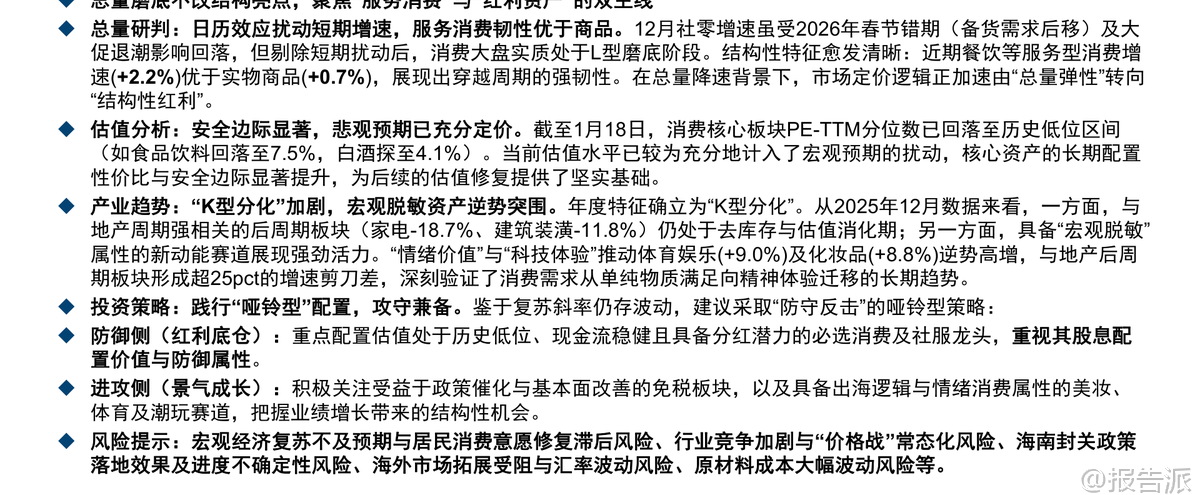
Core Insights - The Chinese consumer market is transitioning from total expansion to structural differentiation, characterized by an "L-shaped bottoming" trend as of early 2026, with retail sales growth impacted by factors like the timing of the Spring Festival and a decline in promotional activities [1] - A "K-shaped" differentiation is emerging, where resilient "extreme value-for-money" essential consumption contrasts with high-premium emotional consumption, while traditional mid-range discretionary spending faces growth challenges [1][2] - The marginal propensity to consume (MPC) is recovering slowly, reflecting a rational return in middle-class consumption decisions, with consumers being more cautious about non-essential spending but willing to pay premiums for categories that satisfy "self-pleasure" and "social" needs [1] Consumer Trends - In December 2025, restaurant revenue grew by 2.2%, significantly outpacing the 0.7% growth in retail sales, with online food products seeing a remarkable growth of 14.5%, serving as a stabilizing force for overall consumption [2] - Emotional consumption sectors, such as sports entertainment (+9.0%), cultural office supplies (+9.2%), and cosmetics (+8.8%), are experiencing robust growth, contrasting sharply with the downturn in real estate-related sectors like home appliances (-18.7%) and construction decoration (-11.8%) [2] Valuation Insights - Core consumer sectors have fallen to historical low valuations, providing a significant safety margin for investors [3] - As of January 2026, the price-to-earnings (PE) ratio for food and beverage is at 7.5%, with liquor even lower at 4.1%, indicating that pessimistic expectations are already priced in, highlighting the long-term value of core assets [4] Investment Strategy - The report suggests a "barbell" investment strategy, recommending defensive positions in essential consumption and social service leaders with low valuations and strong cash flows, such as grain and oil, traditional Chinese medicine, and gold jewelry, while also emphasizing their dividend value and defensive attributes [5] - On the offensive side, investors should capture growth sectors benefiting from policy catalysts and fundamental improvements, including the duty-free sector and emotional consumption categories like cosmetics, sports goods, and trendy toys [5] Policy Impact - The first month of the Hainan Free Trade Port's duty-free sales reached 4.86 billion yuan, a year-on-year increase of 46.8%, demonstrating the strong appeal of "zero tariffs and low tax rates" for high-end consumption [6] - China Duty Free Group holds a dominant market share of 78.7% and continues to strengthen its channel and brand barriers through acquisitions and expanding its presence in city stores [7] Emerging Markets - The pet economy is experiencing a "humanization" upgrade, and the "going out" trend in categories like home appliances is also contributing to significant incremental alpha sources [9] - The shift in pet ownership towards viewing pets as family members is driving both volume and price increases, while the home appliance sector leverages China's supply chain advantages to replicate successful "extreme value-for-money" strategies overseas [10] Market Dynamics - Overall, while the total consumption recovery is not steep, the market opportunities are shifting from a "beta market" to "structural alpha" under low valuations and clear structures [11] - Investors are encouraged to abandon linear thinking of a "full recovery" and focus on "dividend assets" and "emotional consumption" as dual main lines, employing a "barbell" strategy to seize certain opportunities amid uncertainty [12]
穿越“K型”周期,解码运动户外品牌的增长密码
Di Yi Cai Jing Zi Xun· 2026-01-29 13:07
Core Insights - The outdoor sports industry is demonstrating strong growth potential despite macroeconomic challenges, driven by a shift towards health economy, emotional connections, and technological innovation [1][5][36] Group 1: Industry Trends - The industry is transitioning from traditional retail to a new paradigm focused on health, emotional connections, and technology [1] - The growth of the outdoor sports sector is supported by favorable policies and urban development strategies, with cities increasingly branding themselves around sports and outdoor activities [5][6] - The industry is characterized by a strong external influence, with products like camping gear creating a complete camping economy [6] Group 2: Consumer Behavior - The outdoor sports market has a user base of 400 million, with a penetration rate of one-third of the national population, indicating significant growth potential compared to developed countries [7] - The industry is expected to achieve a compound annual growth rate (CAGR) of 15.5% over the next five years, driven by increased penetration among existing users rather than population growth [7] - Consumer demand is evolving towards specialization, technology integration, and quality, with a notable rise in high-end and value-for-money products [8] Group 3: Market Segmentation - The current consumer market is experiencing a K-shaped differentiation, where the upper segment continues to thrive while the lower segment faces challenges [11] - Growth in the outdoor sports sector is primarily driven by three demographic groups: women, middle-aged and elderly consumers, and youth, each with distinct consumption patterns and preferences [11][12] - The market is witnessing a dual trend where luxury brands are shifting online while maintaining a strong offline presence, indicating a complex consumer landscape [12][13] Group 4: Investment Insights - The valuation logic of the outdoor sports industry is shifting from traditional retail metrics to a focus on health economy factors, emphasizing direct-to-consumer sales, supply chain technology, and community building [14][16] - Investors are increasingly interested in brands that demonstrate resilience, community engagement, and a clear product philosophy, as these factors contribute to long-term growth [19][18] - The integration of AI and technology is becoming essential for brands to enhance operational efficiency and consumer engagement [32][34] Group 5: Marketing Strategies - Successful brands in the future will focus on niche markets, innovation, and creating strong mental associations with their products [29] - Brands should prioritize user engagement and community building over sheer scale, focusing on enhancing customer lifetime value [30] - The marketing approach must adapt to dynamic consumer profiles and leverage multiple channels for effective communication [31]


穿越“K型”周期,解码运动户外品牌的增长密码
第一财经· 2026-01-29 12:42
Core Insights - The outdoor sports industry is demonstrating strong certainty and growth potential against the backdrop of a new normal in the macro economy and profound changes in consumption structure [1][3] - The industry is evolving from traditional retail to a new paradigm driven by health economy, emotional connection, and technological innovation [1][4] Macro Trends - The outdoor sports industry is in a certain development channel, with China's retail sales growing by 4% and GDP expected to grow by 5%, which is low compared to the past decade but higher than recent expectations [6] - Consumption is becoming the leading driver of economic growth, as highlighted in the "14th Five-Year Plan" which emphasizes increasing the consumption rate [6] - Changes in global trade patterns and domestic consumption structure are creating new opportunities, with emerging categories like high-end fragrances experiencing significant growth [6] Industry Opportunities - The "Sports Power" policy is shifting focus from Olympic gold medals to comprehensive sports development, providing policy support for the outdoor sports industry [6] - Local governments are transitioning from solely pursuing GDP to creating unique city labels, with many cities planning to focus on sports and outdoor activities as core identifiers [6] Consumer Insights - The outdoor sports market has a user base of 400 million, with a penetration rate equivalent to one-third of the national population, indicating substantial growth potential compared to developed countries [9] - The industry is expected to achieve a compound annual growth rate of 15.5% over the next five years, driven by increased penetration among existing users rather than population growth [9] - Key characteristics of current consumer demand include specialization, technological integration, and quality enhancement, with a notable trend towards high-end and value-for-money products [9][10] Demographic Shifts - The growth of the outdoor sports industry is primarily driven by three demographic groups: women, middle-aged and elderly consumers, and youth, each exhibiting distinct consumption patterns and preferences [12][14] - The youth market is seen as a potential growth area, with a significant opportunity for brands to develop products and ecosystems tailored to their needs [12] Brand Strategies - Brands are advised to focus on building deep user relationships, embracing cutting-edge technology, and practicing long-termism to reshape value [1][4] - The shift in consumer behavior towards viewing outdoor gear as an investment rather than a consumable is influencing brand strategies [10] Marketing and Community Engagement - Successful brands are those that prioritize community engagement and emotional storytelling, moving beyond traditional marketing funnels to foster deeper connections with consumers [25][27] - The importance of emotional value in consumer decision-making is increasing, necessitating brands to create spaces for consumers to express their feelings [31][33] Future Growth Pathways - Brands should focus on niche success, transformative innovation, and the integration of technology and new product categories to achieve long-term growth [36] - The introduction of AI and data-driven strategies is expected to enhance operational efficiency and consumer engagement, marking a significant shift in brand evaluation metrics [40][42]

美联储降息门槛抬升
Qi Huo Ri Bao Wang· 2026-01-29 03:26
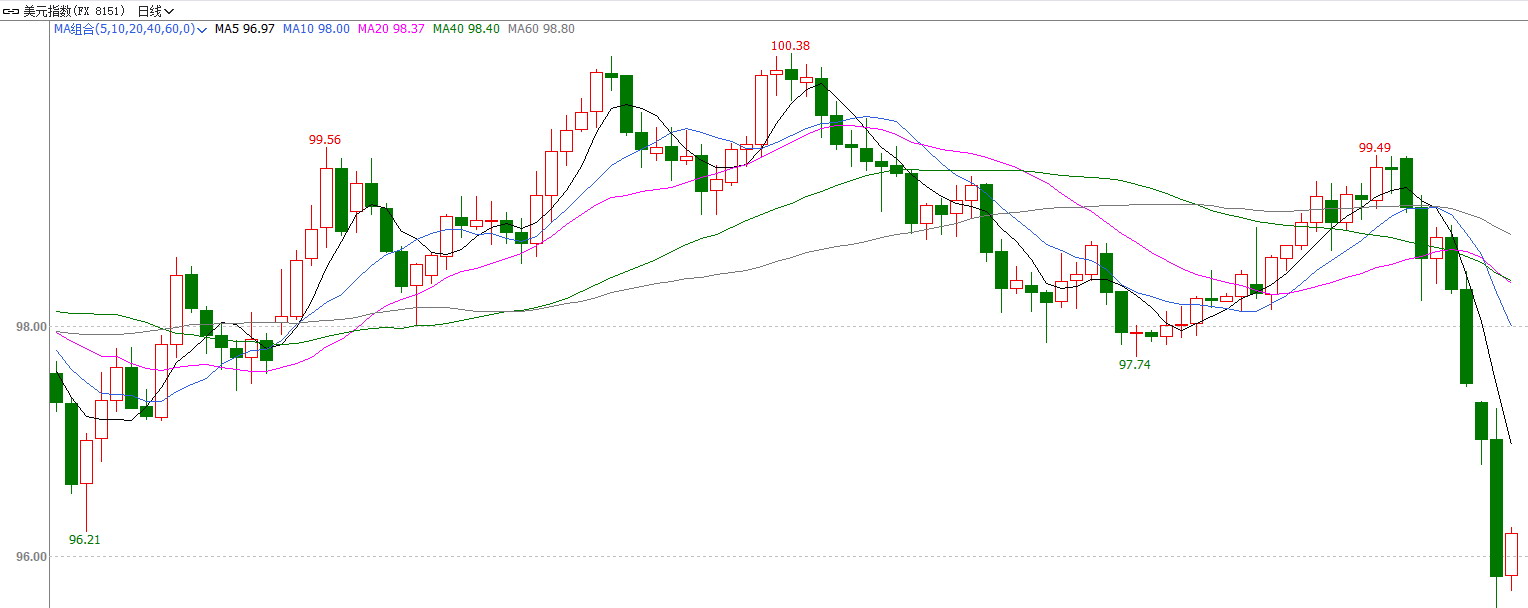
美国政策不确定性上升引发金融市场剧烈波动,美国一度出现"股债汇三杀",驱动避险资金涌入黄金市场。1月27日至28日,美联储召开议息会议。特朗普 政府正挑战美联储的独立性,美国财政扩张需要货币政策配合,美联储货币政策在很大程度上决定了包括美股在内的各类资产价格的走势。 目前,美国经济还处于放缓初期,依旧有韧性,就业市场短期不会出现恶化,这使得美联储降息的必要性下降。此外,历史上引发美联储突发降息的两大因 素——美元流动性紧张和美股暴跌引发系统性风险,均没有显现。 美国经济仍有韧性 对美国经济而言,部分宏观指标表现相对强劲,GDP、私人消费和出口等均呈现增长势头。不过,消费者信心指数不断走低,制造业持续萎缩,房地产市场 低迷,就业市场不断降温。另外,中小企业景气度远弱于大型企业,传统行业景气度远低于科技行业,这是典型的"K型"分化。 美国经济保持增长得益于财政扩张,关税收入的增加为财政支出带来了资金来源。数据显示,2025年,美国通过加征关税,使得实际关税税率升至11.1%, 实现关税收入2870亿美元,这缓解了"大而美"法案带来的财政压力。通过测算,2025财年,美国政府赤字从上一财年的1.83万亿美元缩减至1 ...
消费专题报告:估值低位下的结构演绎,聚焦“红利资产”与“情绪消费”
Huajin Securities· 2026-01-28 06:04
Investment Rating - The report assigns an "Outperform" rating for the consumer services sector, indicating a positive outlook for investment opportunities in this industry [1]. Core Insights - The report emphasizes a dual focus on "service consumption" and "dividend assets" as key investment themes, highlighting the resilience of service consumption compared to goods [4]. - It notes a significant shift in market pricing logic from "total elasticity" to "structural dividends," driven by a clear L-shaped bottoming phase in overall consumption [4]. - The report identifies a "K-shaped differentiation" in the market, with macro-sensitive assets showing strong performance against cyclical sectors like real estate [4]. Summary by Sections Trend Analysis - The report discusses the increasing "K-shaped differentiation" in the market, where service consumption is outperforming goods, with restaurant services growing by 2.2% compared to a mere 0.7% for physical goods [4][14]. - It highlights the impact of the calendar effect on short-term growth rates, particularly due to the timing of the 2026 Spring Festival, which has caused a temporary dip in consumption figures [4][14]. Valuation Analysis - As of January 18, 2026, the core consumer sector's PE-TTM has fallen to historical low levels, with food and beverage sectors at 7.5% and liquor at 4.1%, indicating a significant safety margin and potential for valuation recovery [4][28]. - The report suggests that current valuation levels have adequately priced in macroeconomic disturbances, enhancing the long-term investment appeal of core assets [4][28]. Investment Strategy - The report recommends a "barbell strategy" for investment, balancing defensive positions in essential consumer goods with aggressive positions in sectors benefiting from policy catalysts and improving fundamentals, such as cosmetics and sports [4]. - It emphasizes the importance of focusing on dividend-paying stocks with strong cash flows as a defensive strategy while also targeting high-growth sectors for potential upside [4]. Sector Rotation - The report outlines a sector rotation strategy, advising investments in essential consumption and real estate on the left side, while embracing growth opportunities in overseas markets on the right side [21]. - It notes that the food and beverage sector is poised for growth due to the upcoming Spring Festival, which is expected to catalyze demand [22].
对内:斩杀线
Xin Lang Cai Jing· 2026-01-21 19:34
连锁反应 无家可归的美国人露宿街头 在世界经济论坛年会现场,记者问:"37%的美国成年人拿不出400美金的应急费,有人称这种现象为'斩杀线',你 怎么看这种说法?" 美国财政部长贝森特表示,拜登政府执政期间,他们(低收入家庭)最关心的食品、杂货、房租等都上涨了35% 到37%,我们每天都在想办法把它降下来,如果你回看特朗普总统的第一任期,会发现时薪工人比管理层生活得 更好,我相信你所描述的家庭,将会收到一笔可观的退税。 美国民生安全网的严重缺陷 贝森特提到的退税是指美国《大而美法案》规定在2026年增加给美国民众的退税,但事实上美国税务专家指出, 退税主要利好中高收入人群,低收入家庭很难拿到这笔钱,无法直接解决"斩杀线"困境。 "斩杀线"本是指游戏中玩家角色血条的血量低于某条线时,就随时可能被击杀。现在被用来指代美国社会中的一 种残酷现实:普通人一旦收入和储蓄跌破某个水平,一个小小的意外都可能让他立即陷入死局。 这个词形象勾勒出当下部分美国人脆弱的生活现状:一场突发疾病、一笔逾期房租,便可击穿他们的经济基础, 继而引发连锁反应,令他们陷入难以逆转的生存危机。 专家指出,"斩杀线"的存在,暴露了美国民生"安全网 ...

37%美国成年人拿不出400美金应急费?美国政府首次回应“斩杀线”:拜登的“锅”
Mei Ri Jing Ji Xin Wen· 2026-01-21 03:43
据玉渊谭天,当地时间1月20日,美国财政部长贝森特在世界经济论坛年会现场举办公开活动。谭主在现场问了贝森特对"斩杀线"的看法,美国财 长称"斩杀线是上届政府的锅"。 玉渊谭天:37%的美国成年人拿不出400美金的应急费,有人称这种现象为"斩杀线",你怎么看这种说法? 贝森特表示,拜登政府执政期间,他们(低收入家庭)最关心的食品、杂货、房租等都上涨了35%到37%,我们每天都在想办法把它降下来,如 果你回看特朗普总统的第一任期,会发现时薪工人比管理层生活得更好,我相信你所描述的家庭,将会收到一笔可观的退税。 贝森特提到的退税是指美国《大而美法案》规定在2026年增加给美国民众的退税,但事实上美国税务专家指出,退税主要利好中高收入人群,低 收入家庭很难拿到这笔钱,无法直接解决"斩杀线"困境。 "斩杀线"本是指游戏中玩家角色血条的血量低于某条线时,就随时可能被击杀。现在被用来指代美国社会中的一种残酷现实:普通人一旦收入和 储蓄跌破某个水平,一个小小的意外都可能让他立即陷入死局。 这个词形象勾勒出当下部分美国人脆弱的生活现状:一场突发疾病、一笔逾期房租,便可击穿他们的经济基础,继而引发连锁反应,令他们陷入 难以逆转的 ...