
稳增长

Search documents
石化化工稳增长方案出台,细分行业供需面有望优化 | 投研报告
Zhong Guo Neng Yuan Wang· 2025-10-01 14:44
Core Viewpoint - The introduction of the "Stabilizing Growth Work Plan for the Petrochemical Industry (2025-2026)" aims to guide this pillar industry of the national economy to achieve high-quality development while maintaining reasonable growth, focusing on "stabilizing growth, adjusting structure, and promoting innovation" [2][3] Industry Growth and Structure - The plan requires an average annual growth of over 5% in industry value-added from 2025 to 2026, while pursuing improvements in economic efficiency and innovation capabilities [2][3] - The plan is expected to promote the elimination of outdated production capacity and lead to healthier industry development, optimizing supply-side dynamics [3] Capacity Control and Market Dynamics - The plan emphasizes strict control over new refining capacity and rational determination of new ethylene and paraxylene production scales, aiming to prevent overcapacity risks in the coal-to-methanol sector [3] - Future supply of refining and ethylene will be significantly limited, potentially optimizing the competitive landscape of the industry [3] Chemical Products and Investment Recommendations - The report highlights key investment directions in the chemical sector, including potassium fertilizers, pesticides, refrigerants, and fluorinated liquids, driven by improving supply-demand dynamics and resource scarcity [5][6] - The global potassium fertilizer industry is characterized by high concentration and tight supply-demand balance, with companies like "Yara International" expected to maintain high prices [6] - The pesticide sector is anticipated to see price recovery due to increased demand from South America and limited export growth from India and the U.S. [6] Emerging Trends and Policy Support - The plan supports the development of new chemical materials, such as electronic chemicals and high-performance fibers, to meet the needs of emerging industries like semiconductors and renewable energy [3] - The fertilizer industry is encouraged to strengthen raw material supply and stabilize production, ensuring a reliable supply during critical agricultural periods [4] Price Trends and Economic Indicators - The chemical product price index (CCPI) reported a decline of 8.4% from the beginning of the year, indicating ongoing challenges in the market [5] - The manufacturing PMI showed a slight recovery, but demand remains weak, highlighting the need for continued monitoring of economic conditions [5]
2025年四季度还能实施哪些稳增长举措?|政策与监管
清华金融评论· 2025-10-01 09:05
Core Viewpoint - The article presents six policy recommendations aimed at promoting stable economic growth and addressing current economic challenges, including limited domestic demand, structural overcapacity, deflationary pressures, and unstable expectations [1][4][8]. Group 1: Policy Recommendations - Recommendation 1: Advance the government investment and financing quotas for the next year to utilize fiscal resources effectively, with an expected increase in local special bond quotas to over 4.5 trillion yuan, suggesting an early allocation of 1.5-2 trillion yuan [9][10]. - Recommendation 2: Continue to release positive signals through monetary policy, potentially lowering the reserve requirement ratio by 0.5% and interest rates by 0.2% in the fourth quarter, while considering the resumption of government bond purchases [11][12]. - Recommendation 3: Lower the operational thresholds for two monetary policy tools supporting the capital market and standardize the operations of the Central Huijin Investment Company [12][13]. - Recommendation 4: Further reduce mortgage rates and optimize personal housing tax policies, including a suggested 25 basis point reduction in long-term housing provident fund loan rates [14][15]. - Recommendation 5: Increase the consumption subsidy for replacing old goods by 100 billion yuan and expand the subsidy scope to include various consumer goods [16][17]. - Recommendation 6: Strengthen fiscal and financial support, optimize tax refund services, enhance trade facilitation, and provide assistance to foreign trade enterprises and unemployed individuals [18][19][20]. Group 2: Economic Challenges - Domestic demand remains limited, with fixed asset investment growth slowing to 0.5% year-on-year from January to August, and infrastructure investment declining by 2.0% [4][5]. - The real estate market continues to face challenges, with a year-on-year drop in national commercial housing sales area of 11% in August, and real estate investment down by 12.9% from January to August [5][6]. - Credit growth is notably weak, with a decrease in credit balance for the first time since 2005, and new credit issuance in August at 590 billion yuan, below last year's already low levels [6][7]. - Deflationary pressures persist, with the Consumer Price Index (CPI) falling to -0.4% year-on-year in August, and the Producer Price Index (PPI) at -2.9% [7].

稳增长!国家统计局节前发布重要数据!
Zheng Quan Ri Bao Zhi Sheng· 2025-09-30 04:13
Core Insights - The manufacturing Purchasing Managers' Index (PMI) rose to 49.8% in September, indicating a slight improvement in economic activity [1][2] - The non-manufacturing business activity index remained stable at 50.0%, showing a slight decline from the previous month [1][5] - Overall, the composite PMI output index increased to 50.6%, suggesting a slight acceleration in economic output [1] Manufacturing Sector - Manufacturing production activities accelerated, with the production index reaching 51.9%, the highest in nearly six months [2] - The new orders index improved to 49.7%, indicating a slight recovery in market demand [2] - Key industries such as food and beverage, automotive, and aerospace showed strong production and new orders indices above 54.0% [2][3] - Small enterprises saw a PMI increase to 48.2%, while large enterprises maintained a stable expansion with a PMI of 51.0% [2] Non-Manufacturing Sector - The service sector's business activity index was at 50.1%, indicating continued expansion [5] - The construction sector's business activity index slightly improved to 49.3%, reflecting a marginal recovery [5] - The business activity expectation index for the service sector remained optimistic at 56.3%, indicating stable growth expectations [5][6] Market Outlook - Analysts expect macroeconomic conditions to improve in the fourth quarter, driven by policy support and seasonal demand factors [4][6] - The manufacturing sector is anticipated to continue its stable growth, supported by favorable market prices and completion of annual business targets [4] - The construction and service sectors are expected to see a rebound in activity due to year-end effects and holiday demand [6]
2025年8月经济数据点评:重“质”稳“量”,经济阶段性回调
Jing Ji Guan Cha Wang· 2025-09-29 22:48
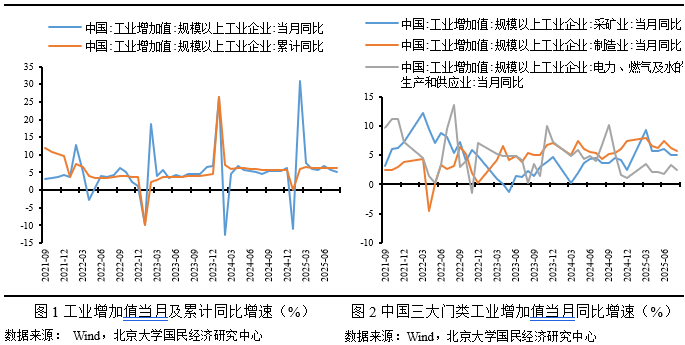
Economic Outlook - The overall policy tone remains "seeking progress while maintaining stability," with signals of policy adjustments indicating increased economic downward pressure in the second half of the year [2][3] - Short-term economic pressures exist, but long-term benefits are expected for high-quality development, with "anti-involution" potentially influencing economic trends [2][3] Supply Side - In August 2025, China's industrial added value for large-scale industries grew by 5.2% year-on-year, a slowdown of 0.5 percentage points from July, with cumulative growth at 6.2% [3][9] - The slowdown is attributed to supply chain disruptions due to extreme summer heat, seasonal fluctuations in export orders, and continued weakness in real estate investment [3][9] - High-tech industries show resilience, indicating a shift towards high-quality industrial transformation [3][9] Demand Side - Retail sales of consumer goods in August 2025 increased by 3.4% year-on-year, a decrease of 0.3 percentage points from the previous month, reflecting policy adjustments and a slowdown in consumption growth [4][16] - Fixed asset investment from January to August 2025 grew by 0.5% year-on-year, a decline of 1.1 percentage points from the previous period, indicating a phase of adjustment in investment growth [4][20] - Exports totaled $321.81 billion in August, up 4.4% year-on-year, but down 2.8 percentage points from the previous month, with structural changes in exports continuing [4][23] Price Trends - In August 2025, the Consumer Price Index (CPI) decreased by 0.4% year-on-year, while the Producer Price Index (PPI) fell by 2.9%, with both indices showing signs of narrowing the gap due to base effects [7][34][47] - The CPI's decline is influenced by high base effects in food prices, while the PPI's decrease reflects external uncertainties and domestic market adjustments [7][34][47] Monetary and Financial Conditions - In August 2025, the new social financing scale was 25.693 billion yuan, a decrease of 15.3% year-on-year, indicating seasonal adjustments in credit and off-balance-sheet financing [8][51] - The M1 money supply grew by 6% year-on-year, reflecting an acceleration in corporate demand for liquidity, while M2 remained stable at 8.8% [8][70] - The overall financing environment shows signs of improvement, but structural challenges in economic recovery persist [8][70]
平安证券:2025年利率债四季报:多重挑战下,债市的机会与风险
Ping An Securities· 2025-09-29 10:47
Report Information - Report Title: [Ping An Securities] 2025 Interest Rate Bond Quarterly Report: Opportunities and Risks in the Bond Market under Multiple Challenges [1] - Release Date: September 29, 2025 [1] - Analysts: Liu Lu, Zheng Zichen [1] Industry Investment Rating - Stronger than the Market (Expected to outperform the market by more than 5% in the next 6 months) [94] Core Views - The bond market entered a headwind period in Q3 due to multiple factors, with a bearish steepening of the yield curve, a decline in the inter - bank leverage ratio, a reduction in the duration of asset management accounts, and a certain demand maintained by allocation accounts [2]. - The necessity of stabilizing growth is increasing in Q4. Policy measures may include interest rate cuts of 10BP, reserve requirement ratio cuts of 25BP, restarting bond purchases, and fiscal stimulus leading to a year - on - year increase of over 1 trillion yuan in Q4 [3]. - There are trading opportunities for bonds with maturities within 10 years in Q4, while ultra - long bonds face repricing risks [4]. Summary by Directory PART1: Domestic Bond Yields Reach New Highs - **Multiple Negative Factors Lead to Q3 Bond Market Adjustment**: In June, "anti - involution" drove up commodity prices; in July, the Shanghai Composite Index broke through 3400 points; in August - September, policy adjustments such as the readjustment of VAT on treasury bond interest and concerns about the cancellation of tax - exemption policies for public funds led to bond fund redemptions and rising interest rates [2][6]. - **Deviation from Fundamentals and Funds, Dominated by Sentiment and Institutional Behavior**: The adjustment deviated from fundamentals and funds, with stable funds and a marginal decline in fundamentals in July - August. Market sentiment and institutional behavior played a dominant role [8]. - **Market Leverage Declines, Asset Management Accounts Reduce Positions, Allocation Accounts Maintain Demand**: During the market adjustment, institutions tended to reduce leverage, asset management accounts reduced positions, and allocation accounts supported the market [11]. - **Performance of Different Bond Types**: Short - term treasury bonds were relatively resistant to decline due to large - bank purchases; credit bonds weakened as fund and wealth management demand declined; ultra - long bonds performed weakly, with increased supply exceeding demand from insurance and rural commercial banks. There was also a global resonance of rising ultra - long bond yields [2][17][19][26]. PART2: The Necessity of Stabilizing Growth Increases in Q4 - **Policy Support Needed to Achieve the Annual Growth Target**: To achieve the annual GDP growth target of 5%, Q4 requires stronger stabilizing - growth policies than in 2022 - 2023 but weaker than in 2024. Without additional policies, government bond net financing in Q4 is expected to be about 1 trillion less year - on - year [3][46]. - **Fiscal and Monetary Policy Tools**: Fiscal policy may involve policy - based development financial tools of about 500 billion yuan and the possible early issuance of 2 trillion special refinancing bonds in 2026. Monetary policy is expected to remain stable, with no obvious constraints on marginal easing [51]. - **Policy Implementation Timing**: Short - term bond purchases by the central bank are more likely, while reserve requirement ratio and interest rate cuts are more likely to occur at the end of the year, perhaps to align with the December Central Economic Work Conference [52]. - **Central Bank Bond Purchase Maturity**: Based on institutional behavior, the central bank's bond purchases may be extended to within 5 - year maturities [57]. PART3: Bond Market Strategies - **Trading Opportunities for Bonds within 10 Years**: Leading indicators such as social financing and M1 growth are approaching a phased peak. In terms of valuation, 10 - year treasury bonds are relatively cheap compared to listed companies' ROIC and are close to the upper limit of the interest rate corridor. The 10 - year treasury bond yield has risen by 17BP, fully pricing in the current stabilizing - growth policies but not pricing in potential monetary policy benefits [4][64][71]. - **Repricing Risks for Ultra - long Bonds**: Ultra - long bonds may face repricing risks. Based on calculations, the current ultra - long bond yields may have fully priced in inflation improvement. The potential risks include continuous stabilizing - growth policies and global fiscal expansion [80]. - **Short - term Market Contradictions and Strategies**: Short - term market contradictions lie in institutional behavior and sentiment. It is recommended to focus on short - term treasury bonds within 5 years and certificates of deposit in the short term and participate in duration - offensive bonds after negative factors are realized [87].
2025年四季度橡胶策略报告-20250929
Guang Da Qi Huo· 2025-09-29 05:15
1. Report Industry Investment Rating No relevant content provided. 2. Core Viewpoints of the Report - Supply side: Domestic rubber production areas have been affected by rainfall and tropical cyclones, especially Hainan. Overseas rainfall is relatively normal, and production will increase in the fourth - quarter peak season. There is a high probability of a La Nina event in 2025, and the zero - tariff scope for imported rubber continues to expand. Rubber supply in China is expected to recover in the fourth quarter without extreme weather [100]. - Demand side: The demand for all - steel tires is better than that of semi - steel tires. Overseas trade barriers for domestic tires are rising, increasing export pressure. The "Automobile Industry Steady Growth Work Plan (2025 - 2026)" was introduced, but the automobile sales in the fourth quarter still face challenges [100]. - Price: Due to uncertain weather, tariff barriers, and the test of domestic demand, rubber prices are expected to fluctuate widely in the fourth quarter, with support at around 14,500 yuan/ton and a mid - term fluctuation range of 14,500 - 17,000 yuan/ton [100]. 3. Summary by Directory 3.1 Price: Narrow - range Fluctuation in the Futures Market No detailed content provided in this regard. 3.2 Supply: Double La Nina Events, Increased Weather Uncertainty - **Domestic Weather Impact**: This year, there have been more tropical cyclones affecting Hainan, and the precipitation in domestic production areas has been affected. It is predicted that there will be 10 - 12 typhoons in the northwest Pacific and South China Sea in the autumn of 2025, with 3 - 4 landing in China [10][13]. - **Global Output**: In July 2025, the global natural rubber output was expected to decrease slightly by 0.1% to 1.328 million tons, but increased by 7.9% compared with the previous month. The full - year output in 2025 is expected to increase by 0.5% to 14.892 million tons [19][24]. - **La Nina Probability**: The probability of a La Nina event from October to December 2025 is 71%. A double La Nina event may occur in 2025, which may make Southeast Asia wetter and southern China drier in winter [30]. - **Tariff Policy**: Since December 1, 2024, zero - tariff policies have been implemented for rubber from Myanmar, Laos, Cambodia, etc. Thailand plans to export rubber through the Mekong River channel with zero - tariff. African rubber imports to China are expected to increase in the fourth quarter [33][36]. - **Overseas Exports**: The total exports of major overseas producers increased year - on - year. For example, Thailand's exports in the first 8 months increased by 6.3% year - on - year, and Indonesia's increased by 10% year - on - year [37]. - **EUDR Delay**: The implementation of the EU Forest Law Enforcement, Governance and Trade (EUDR) has been postponed for one year due to IT and supply - chain issues [38]. - **Other Supply Factors**: The demand for natural rubber in Europe, America, Japan, and South Korea is limited. China's imports of natural and mixed rubber increased both year - on - year and month - on - month. The net import of butadiene rubber turned into net export [39][41][51]. 3.3 Demand: Supported by Steady Growth - **Automobile Industry Policy**: The "Automobile Industry Steady Growth Work Plan (2025 - 2026)" aims to achieve about 32.3 million automobile sales in 2025, with new - energy vehicle sales of about 15.5 million, and an increase of about 3% year - on - year [57]. - **Tire Market**: The growth momentum of semi - steel tire demand is restricted. Overseas anti - dumping investigations and tariff policies have affected tire exports. However, the production and sales of automobiles and heavy - duty trucks in China from January to August increased year - on - year [58][60][61]. 3.4 Inventory: Inflection Point in Natural Rubber Inventory Accumulation - **Natural Rubber Inventory**: As of September 24, 2025, the natural rubber warehouse receipts were 155,830 tons, and the 20 - rubber warehouse receipts were 44,856 tons. The social inventory of natural rubber in China was 123,500 tons as of September 14, 2025 [70][74]. - **Butadiene Rubber Inventory**: As of September 24, 2025, the inventory of domestic butadiene rubber sample enterprises was 32,300 tons [78]. 3.5 Position: Low Position As of September 24, 2025, the total position of natural rubber was 183,283 lots, a decrease of 26,214 lots compared with June 30; the total position of 20 - rubber was 119,808 lots, a decrease of 627 lots; the total position of BR was 102,425 lots, an increase of 47,106 lots [82].
上证早知道|央行,最新操作;“AI+交通运输”,七部门部署;石化化工行业,稳增长方案来了
Shang Hai Zheng Quan Bao· 2025-09-28 23:13
Monetary Policy and Economic Measures - The People's Bank of China announced a 7-day reverse repurchase operation of 181.7 billion yuan at a fixed interest rate of 1.4% on September 28 [4] - The monetary policy committee of the People's Bank of China emphasized the use of securities, funds, and insurance company swap facilities to maintain capital market stability [4] - The Ministry of Transport expects a total of 2.36 billion cross-regional passenger flows during the National Day and Mid-Autumn Festival holiday, averaging about 295 million per day, a 3.2% increase from the previous year [4] Industry Development Initiatives - The Ministry of Industry and Information Technology, along with other departments, issued a work plan for the petrochemical and chemical industry, aiming for an average annual growth of over 5% in value added from 2025 to 2026 [10] - The plan focuses on key product breakthroughs in integrated circuits, new energy, and medical equipment, supporting the development of high-end chemical products [10] - The Ministry of Industry and Information Technology and other departments also released a work plan for the non-ferrous metals industry, targeting an average annual growth of around 5% in value added from 2025 to 2026 [12] AI and Transportation - The Ministry of Transport and other departments issued implementation opinions on "Artificial Intelligence + Transportation," aiming for widespread application of AI in the transportation sector by 2027 [8] - The opinions focus on seven key areas, including smart driving assistance, intelligent railway systems, and smart logistics [8] - Companies like Les Information and COSCO Shipping Technology are developing AI-integrated products to enhance their capabilities in the low-altitude economy and shipping logistics [8] Company Developments - Galaxy Magnetics plans to acquire 100% of Kyoto Longtai's shares through a combination of stock issuance and cash payment, expanding its product range in magnetic materials for the automotive sector [15] - Dongxing Medical intends to purchase 90% of Wuhan Yijiaobao's shares to enhance its position in high-end orthopedic and biomedical materials [15] - East Star Medical's overseas subsidiary secured an order worth approximately 1.8 billion yuan, representing 22.3% of the company's projected revenue for 2024 [16]
百亿融资撤离 VS ETF大举低吸,五大行业利好关注!
Sou Hu Cai Jing· 2025-09-28 15:24
Market Overview - The market experienced a significant adjustment on Friday afternoon, attributed to pre-holiday effects and style drift in portfolio adjustments, with external trade impacting sentiment [3] - The Shanghai stock market saw a substantial decrease in financing balance by 11.2 billion, marking the largest drop recently, particularly affecting sectors like robotics and gaming [4] Industrial Profit Recovery - Industrial profits showed a remarkable recovery, with August profits increasing by 20.4%, the highest growth rate since December 2023, indicating a positive trend in industrial revenue [6][8] - The State-owned Assets Supervision and Administration Commission emphasized the need to resist "involution" competition, which is contributing to the improvement in industrial profits [6] Growth Strategies in Various Industries - Multiple government departments have released growth stabilization plans for key industries, including petrochemicals and non-ferrous metals, aiming for an average annual growth of over 5% from 2025 to 2026 [8][9] - The focus on new materials and technologies is seen as a catalyst for emerging industries, enhancing the performance of leading companies [9] Technology Sector Developments - Xiaomi reported strong sales for its new product line, with the Xiaomi 17 series breaking sales records shortly after launch, indicating robust consumer demand [10] - The National Development and Reform Commission announced measures to foster innovation in digital economy enterprises, which is expected to strengthen the technology sector [13] Energy Storage and Battery Industry - The lithium battery industry in China has seen significant activity, with 183 new projects signed or initiated from January to August, amounting to a planned investment of 400 billion [15] - Major battery manufacturers are operating at full capacity due to strong demand for energy storage cells, indicating a bullish outlook for the sector [15] Strategic Market Outlook - The market is expected to experience short-term volatility due to pre-holiday effects, but the long-term outlook remains positive with a focus on self-sufficiency in technology and stable growth strategies [17] - Institutional investors are showing a strong commitment to sectors with confirmed growth, while the focus on "involution" and stable growth continues to provide opportunities for long-term investment [17]
宏观与大类资产周报:政策基调或暂时重回稳增长-20250928
CMS· 2025-09-28 14:01
Domestic Economic Trends - Q3 price stabilization trend has strengthened, with traditional industry prices rebounding in September, and a more pronounced recovery in the new energy sector due to improved downstream demand[1] - Domestic growth stabilization policies are expected to intensify, with concentrated fiscal efforts in Q4, although achieving the annual growth target remains under pressure due to significant economic data declines in July and August[1] International Economic Developments - On September 25, Trump announced tariffs on heavy trucks, kitchen and bathroom materials, furniture, and pharmaceuticals, with some tariffs supported by Section 232 investigations[1] - The US Q2 GDP was revised up to an annualized rate of 3.8%, the highest in nearly two years, and August durable goods orders increased by 2.9%, significantly exceeding expectations[1] Asset Market Insights - The domestic policy tone has temporarily shifted back to growth stabilization, potentially leading to a dual bull market in stocks and bonds, with expectations of a short-term buying window for interest rate bonds[1] - The US economic fundamentals show no recession risk, and the recent FOMC has significantly lowered the 2026 rate cut expectations, suggesting that changes in future rate cut expectations are unlikely to negatively impact the market[1] Monetary Liquidity and Market Conditions - The overall funding environment remains tight as the quarter-end and National Day holiday approach, with the benchmark interest rate rising by approximately 1.92 basis points[2] - The average daily transaction volume in the interbank pledged repo market increased by about 1,047.21 billion yuan, reaching 72,679.9995 billion yuan[5] Government Debt and Financing - The net financing of government bonds was negative at -3,225.7 billion yuan, with a planned issuance of 107.15 billion yuan for the upcoming week, a significant decrease from 443.58 billion yuan this week[6] - The weighted issuance rate of interbank certificates of deposit rose to 1.6589%, reflecting a slight increase of 1.79 basis points compared to the previous week[7]

行业周报:建材行业稳增长方案出台,积极布局建材机会-20250928
KAIYUAN SECURITIES· 2025-09-28 12:51
Investment Rating - The investment rating for the building materials industry is "Positive" (maintained) [1] Core Viewpoints - The Ministry of Industry and Information Technology and five other departments have jointly issued the "Building Materials Industry Steady Growth Work Plan (2025-2026)", which aims to stabilize growth and promote transformation. Key goals include achieving over 300 billion yuan in revenue from green building materials by 2026 and establishing "zero external electricity, zero carbon emissions" demonstration factories [3][4] - The report recommends several companies in the consumer building materials sector, including Sankeshu (channel penetration and retail expansion), Dongfang Yuhong (waterproof leader with optimized operational structure), Weixing New Materials (high-quality operations with a high retail business ratio), and Jianlang Hardware. Beneficiary stocks include Beixin Building Materials (gypsum board leader with diversified expansion into coatings and waterproof sectors) [3][4] - The cement sector is expected to benefit from the "Energy Saving and Carbon Reduction Special Action Plan" issued by the National Development and Reform Commission, which aims to control cement clinker capacity at around 1.8 billion tons by the end of 2025 [3][4] Summary by Sections Market Overview - The building materials index fell by 2.11% in the week from September 22 to September 26, 2025, underperforming the CSI 300 index by 3.18 percentage points. Over the past three months, the CSI 300 index rose by 13.80%, while the building materials index increased by 10.96%, underperforming by 2.84 percentage points [4][11] - The average PE ratio for the building materials sector is 28.92 times, ranking it 15th from the bottom among all A-share industries, while the PB ratio is 1.32 times, ranking it 8th from the bottom [17][21] Cement Sector - As of September 26, 2025, the average price of P.O42.5 bulk cement nationwide was 287.55 yuan/ton, an increase of 3.06% month-on-month. The clinker inventory ratio reached 70.17%, up by 5.06 percentage points [22][23] - Regional price trends show increases in various areas, with the highest increase in the southwest region at 7.67% [22][23] Glass Sector - The spot price of float glass as of September 26, 2025, was 1283.80 yuan/ton, up by 6.19% from the previous period. The inventory of float glass decreased by 2.60%, with a total of 53.29 million weight boxes [73][75] - The price of photovoltaic glass remained stable at 125.00 yuan/weight box [77] Fiberglass Sector - The market price for non-alkali 2400tex direct yarn ranges from 3400 to 4000 yuan/ton, with variations depending on the region and specific product type [6][4] Consumer Building Materials - As of September 26, 2025, the price of crude oil was 72.09 USD/barrel, showing a week-on-week increase of 7.76%. The price of asphalt remained stable at 4570 yuan/ton [6][4]