新型政策性金融工具

Search documents
新型政策性金融工具前瞻:稳外贸促投资 PSL或重启扩张
Zheng Quan Shi Bao· 2025-08-13 05:51
Core Viewpoint - The Chinese government is implementing a series of proactive macroeconomic policies to stabilize the market and expectations, with new policy financial tools expected to be introduced in the second quarter to support foreign trade and effective investment [1][2]. Group 1: Policy Measures - Since the Politburo meeting on April 25, a package of financial policies has been rapidly released, including interest rate cuts and new structural monetary policy tools [1]. - The People's Bank of China (PBOC) has indicated that new policy tools may be created based on economic conditions and the effectiveness of existing tools [2][6]. - The introduction of new policy financial tools is anticipated to provide targeted support for foreign trade, technological innovation, and consumption [4][5]. Group 2: Financial Tools and Their Impact - In 2022, three policy financial institutions created and deployed approximately 740 billion yuan in policy and development financial tools, leading to a total credit support exceeding 3.5 trillion yuan [2]. - The new policy financial tools may innovate in funding usage, such as supporting basic research and original innovation, as well as facilitating "export to domestic sales" [4]. - The potential introduction of export buyer credit-like tools is expected to alleviate the impact of external demand fluctuations on foreign trade enterprises [4]. Group 3: Support for Investment - Stimulating consumption is prioritized, but effective investment is also a crucial aspect of counter-cyclical adjustments [5]. - The PBOC may restart and expand the Pledged Supplementary Lending (PSL) program to provide long-term low-cost funding for policy banks [6]. - Central fiscal support is deemed essential for the success of new policy financial tools, with expectations for fiscal measures to alleviate project funding costs [6][7].
避险资产仍有表现机会 风险资产需重视结构——专访财信金控首席经济学家伍超明
Xin Hua Cai Jing· 2025-08-12 07:03
Group 1 - The core viewpoint is that China's economic growth in the first half of the year exceeded expectations, laying a solid foundation for achieving annual targets [1][2] - The GDP for the first half of the year reached 66,053.6 billion yuan, with a year-on-year growth of 5.3%, driven primarily by final consumption expenditure, which contributed 52% to economic growth [2] - The supply side saw industrial production and the demand side experienced a rebound in consumption, while exports showed resilience despite external uncertainties [2] Group 2 - Looking ahead to the second half of the year, the main factors driving major asset performance are expected to shift from external to internal [3] - Investment opportunities in the capital market include high-growth sectors such as innovative pharmaceuticals, AI, military industry, new consumption driven by emotional value demand, and high dividend yield sectors [3] - The bond market may experience fluctuations in the short term due to policy observation, but opportunities may arise in the fourth quarter with potential interest rate cuts by the central bank [3]
稳就业稳经济 增量政策本月底有望“上新”
Xin Hua Wang· 2025-08-12 05:52
Group 1: Economic Policies and Measures - Relevant departments are accelerating the introduction of measures to stabilize employment and the economy, with most policies expected to be implemented by the end of June [1] - The plan includes the issuance of a project list for the "two重" construction and central budget investment by the end of June 2025, along with the establishment of new policy financial tools to address capital shortages for project construction [1] - The new policy financial tools are seen as an innovative upgrade to traditional policy financial instruments, aimed at providing capital support for "two重" projects through market-oriented financing [1] Group 2: Employment Support and Trade Stability - A combination of policies will be introduced to support employment, including increased support for job expansion, employment subsidies for individuals, and higher unemployment insurance for affected enterprises [2] - To stabilize foreign trade, there will be increased financial support to lower domestic sales costs for foreign trade enterprises, and efforts will be made to include more sectors in the "trade-in" support program [2] - Continuous policy research and preparation will be conducted to ensure timely implementation of necessary measures for stabilizing employment and the economy [2] Group 3: Macro Policy and Economic Outlook - The implementation of more proactive macro policies indicates a significant push for domestic demand expansion, focusing on boosting consumption, accelerating infrastructure investment, and stabilizing the real estate market [3] - Domestic macro policies are expected to play a crucial role in stabilizing economic operations, countering the slowdown in external demand [3]
国债期货:股债跷跷板效应施压 期债走势先扬后抑
Jin Tou Wang· 2025-08-05 02:04
Market Performance - Treasury futures opened significantly higher but weakened in the afternoon, with mixed closing performances; the 30-year main contract rose by 0.08%, while the 10-year main contract increased by 0.02%, and the 5-year main contract fell by 0.01% [1] - Notably, there was a clear divergence in performance among different delivery months for the same maturity; for example, the 10-year treasury futures T2509 rose by 0.02%, while T2512 and T2603 fell by 0.17% and 0.34% respectively [1] - In the interbank market, major interest rate bonds initially saw yields decline but later turned to a noticeable increase; as of 17:00, the yield on the 30-year treasury bond "25 Super Long Special Treasury 02" rose by 1.9 basis points to 1.9220% [1] Funding Situation - The central bank announced a 7-day reverse repurchase operation of 544.8 billion yuan at a fixed rate of 1.40%, with the same amount being the bid and winning amount [2] - On that day, 495.8 billion yuan of reverse repos matured, resulting in a net injection of 49 billion yuan [2] - The interbank market remains stable with a slight increase in DR001, hovering around 1.31%, while overnight funding rates for non-bank institutions' pledged certificates and credit bonds decreased slightly [2] Policy Developments - The National Development and Reform Commission indicated plans to expedite the approval of new policy financial instruments, with several regions already holding meetings to seize policy dividends [3] - The issuance of government bonds, including ultra-long special treasury bonds and new special bonds, is expected to accelerate, supporting infrastructure investment in the second half of the year [3] - A new tax policy on bond interest income will take effect on August 8, 2025, imposing a 6% VAT on interest income from newly issued government bonds, while existing bonds will remain exempt until maturity [3] Operational Recommendations - The new tax regulations on treasury bonds may enhance demand for older bonds, potentially widening the yield spread between new and old bonds [4] - There is a possibility that new bonds issued after August 8 may become the deliverable bonds for T, TF, and TS contracts, leading to weaker performance in long-term contracts [4] - The overall expectation for early August includes a favorable environment for bond trading, with anticipated stability in interest rates and potential for upward movement in bond prices [4]
国债等债券利息收入恢复征收增值税,银行间主要利率债收益率普遍下行
Dong Fang Jin Cheng· 2025-08-04 14:05
1. Report Industry Investment Rating - Not provided in the content 2. Core Viewpoints - On August 1, after the month - end, the money market was abundant with major repo rates declining. The yield of major interest - rate bonds in the inter - bank market generally decreased, and the convertible bond market rebounded. The yields of US Treasury bonds across different maturities dropped significantly, and the yields of 10 - year government bonds in major European economies showed a divergent trend [1] 3. Summary by Directory 3.1 Bond Market News 3.1.1 Domestic News - From August 8, 2025 (inclusive), the VAT on the interest income of newly issued treasury bonds, local government bonds, and financial bonds will be restored. Natural persons buying treasury bonds with a monthly limit of no more than 100,000 yuan will enjoy the VAT exemption on interest income until December 31, 2027 [3] - The central bank will use the re - loan policy for scientific and technological innovation and technological transformation to promote the rapid growth of loans to science - and - technology small and medium - sized enterprises. The State Administration of Foreign Exchange will optimize and improve the fund management of domestic enterprises' overseas listings [4] - As of August 1, 800 billion yuan of this year's "Two Major" construction project list has been fully allocated, and 69 billion yuan of the third - batch ultra - long - term special treasury bond funds for consumer goods trade - in have been allocated, with the fourth batch of 69 billion yuan to be allocated in October. The issuance progress of this year's ultra - long - term special treasury bonds has exceeded 60% [5][6] - The Ministry of Finance reported six typical cases of local government implicit debt accountability, requiring local governments to prevent and resolve implicit debt risks [7] - New policy - based financial instruments are expected to be launched soon, and infrastructure investment is expected to pick up in the second half of the year [8] 3.1.2 International News - In July, the non - farm payrolls in the US increased by 73,000, far lower than expected, and the data of the previous two months was significantly revised down by 258,000. The unemployment rate rose to 4.2% [9] - Two Fed officials said the labor market remained robust, and inflation was still the main consideration for policy - making [10] - On August 1, international crude oil futures prices continued to fall, and international natural gas prices declined slightly [11] 3.2 Money Market 3.2.1 Open Market Operations - On August 1, the central bank conducted 126 billion yuan of 7 - day reverse repurchase operations, with a net withdrawal of 663.3 billion yuan due to the maturity of 789.3 billion yuan of reverse repurchases [13] 3.2.2 Funding Rates - On August 1, despite the large - scale net withdrawal by the central bank, the money market was abundant after the month - end, and major repo rates declined. DR001 dropped 8.18bp to 1.314%, and DR007 dropped 13bp to 1.424% [14] 3.3 Bond Market Dynamics 3.3.1 Interest - rate Bonds - **Spot Bond Yield Trends**: On August 1, affected by the stock - bond seesaw effect, the bond market fluctuated narrowly in the morning. After the Ministry of Finance announced the VAT on new treasury bonds in the afternoon, the bond market recovered. The yields of major interest - rate bonds in the inter - bank market generally declined, with long - term bonds showing larger fluctuations [16] - **Bond Tendering**: The tendering information of 25进出清发02 (Additional Issue 1), 25附息国债12 (Second Continued Issue), and 25超长特别国债03 (Continued Issue) was provided [18] 3.3.2 Credit Bonds - **Secondary Market Transaction Abnormalities**: On August 1, no credit bond transaction price deviated by more than 10% [18] - **Credit Bond Events**: Various credit - related events of companies such as Qingdao Huangdao Development, Zhejiang Xinchang Investment and Development were reported [20] 3.3.3 Convertible Bonds - **Equity and Convertible Bond Indexes**: On August 1, the three major A - share stock indexes fell, while the main convertible bond indexes rose. The convertible bond market rebounded, with most individual bonds rising [19] - **Convertible Bond Tracking**: Information on the approval of convertible bond issuance by companies such as Jinlang Technology and the expected trigger of conversion price downward adjustment and early redemption of some convertible bonds was reported [27] 3.3.4 Overseas Bond Markets - **US Bond Market**: On August 1, due to the weak non - farm data and significant downward revision of the previous value, the yields of US Treasury bonds across different maturities declined significantly. The yield spread between 2 - year and 10 - year US Treasury bonds and that between 5 - year and 30 - year US Treasury bonds widened [23][25] - **European Bond Market**: On August 1, the yields of 10 - year government bonds in major European economies showed a divergent trend [28] - **Daily Price Changes of Chinese - funded US Dollar Bonds**: The daily price changes of the top 10 Chinese - funded US dollar bonds with the largest gains and losses were reported [30]
2025下半程:促经济增长有哪些实招?
Jin Rong Shi Bao· 2025-08-04 12:06
Group 1: Economic Overview - The global economy in 2025 is at a crossroads, influenced by trade protectionism and geopolitical tensions, particularly the "America First" policy of the Trump administration [1] - China's economy reported a stable GDP growth of 5.3% in the first half of the year, but faces challenges such as low prices and insufficient domestic demand [1][2] Group 2: Structural Analysis of Economic Growth - The GDP growth of 5.3% reflects a stable overall trend, but there is significant structural differentiation, with the secondary industry declining due to weak construction and real estate investment [2] - Exports showed unexpected resilience, partly due to progress in US-China tariff negotiations, while fixed asset investment only grew by 2.8%, contributing to economic slowdown in the second quarter [2][3] Group 3: Domestic Demand Challenges - The decline in retail sales and fixed asset investment in June highlights insufficient domestic demand, with consumer spending affected by the timing of promotional events and slow growth in income [3] - The manufacturing sector is facing challenges, with a low capacity utilization rate of 74.3% in the second quarter, indicating weak corporate expectations [3] Group 4: External Challenges and Export Outlook - Trump's tariff policy is reshaping the global industrial system, with potential trade agreements among major economies but high uncertainty due to fluctuating tariffs [4] - The export growth rate is expected to slow in the second half of the year, as US tariffs on China remain significantly higher than before Trump's presidency, leading to pressure on exports [4] Group 5: Policy Focus Areas - The policy focus will be on effectively implementing existing policies while preparing for potential new policies, particularly in consumer spending and investment [5] - Specific measures include increasing income for low- and middle-income groups, promoting service consumption, and stabilizing real estate through financial support [5][6] Group 6: Reform and Future Planning - The government aims to deepen reforms and open up the economy, with a focus on implementing significant measures and enhancing the unified national market [6] - The upcoming "15th Five-Year Plan" is expected to emphasize high-quality development and resilience in supply chains, pushing for upgrades in manufacturing towards high-end, intelligent, and green production [6]

宝城期货资讯早班车-20250804
Bao Cheng Qi Huo· 2025-08-04 03:10
Report Industry Investment Rating No relevant content provided. Core Views of the Report - The financial support for the continuous improvement of the economy has increased. China's central bank implements a moderately loose monetary policy, aiming to maintain ample liquidity and promote a decline in financial market interest rates and social comprehensive financing costs [2]. - The US labor market has slowed down rapidly, with the July non - farm payrolls increasing by only 73,000, the lowest in 9 months, and the unemployment rate rising slightly to 4.2%, which may trigger new recession concerns [3]. - The real estate industry policy implementation rhythm is expected to accelerate, and the policy flexibility of first - tier cities and core areas may exceed expectations [29]. - The macro - policy may focus more on monetary policy relaxation in the third quarter, considering the low possibility of short - term fiscal incremental policies [29]. Summary by Directory 1. Macro Data Overview - In Q2 2025, GDP at constant prices had a year - on - year quarterly increase of 5.2%, slightly lower than the previous quarter's 5.4% but higher than the same period last year's 4.7% [1]. - In July 2025, the manufacturing PMI was 49.3%, down from 49.7% in the previous month; the non - manufacturing PMI for business activities was 50.1%, down from 50.5% in the previous month [1]. - In June 2025, the year - on - year growth rates of M0, M1, and M2 were 12.0%, 4.6%, and 8.3% respectively, with M1 and M2 showing significant increases compared to the same period last year [1]. 2. Commodity Investment Reference Comprehensive - China's central bank will implement a moderately loose monetary policy in the second half of 2025, including reducing the deposit reserve ratio and lowering policy interest rates [2]. - The US President Trump modified "reciprocal tariffs" for dozens of countries, with rates ranging from 10% to 41%, and postponed the effective date to August 7 [2]. Metals - The price of tungsten has reached a new high due to supply contraction and an increase in long - term contract prices. In the past two weeks, the price of black tungsten concentrate has risen by 7.82% to 193,000 yuan/ton, and the price of ammonium paratungstate has risen by 7.95% to 285,000 yuan/ton [5]. - Three major steel enterprises jointly opposed the speculation of high molybdenum prices, as the profit of the industrial chain is highly concentrated in the mining end [5]. Coal, Coke, Steel, and Minerals - The China Coking Industry Association decided to raise the price of coke on July 31, with different price increases for different types of coke [9]. - In July 2025, India's coal production was 46.4 million tons, a year - on - year decrease of 16%; sales were 53.7 million tons, a year - on - year decrease of 11% [9]. Energy and Chemicals - China plans to reform the pricing mechanism of provincial natural gas pipelines, transitioning from "one - line, one - price" and "one - enterprise, one - price" to regional pricing or unified provincial pricing [11]. - OPEC+ core members will decide whether to fully exit the 2.2 million barrels per day crude oil production cut plan in September or take a more cautious approach [12]. Agricultural Products - On August 3, the average price of live pigs was 14.29 yuan/kg, with a daily decline of 0.01 yuan/kg. The price increase at the beginning of the month failed to meet expectations [14]. - On August 1, the average price of pork in the national agricultural product wholesale market was 20.60 yuan/kg, a 1.3% decrease from July 25 [15]. 3. Financial News Compilation Open Market - This week, 1.6632 trillion yuan of reverse repurchases in the central bank's open market will expire. Last week, the central bank conducted 1.6632 trillion yuan of reverse repurchase operations, with a net investment of 6.9 billion yuan [16]. Important News and Information - Starting from August 8, 2025, the interest income from newly issued national bonds, local government bonds, and financial bonds will be subject to value - added tax [17]. - The central bank requires steady and solid progress in the internationalization of the RMB, including expanding the use of RMB in trade and enhancing its financing currency function [19]. Bond Market Summary - China's bond market showed narrow - range fluctuations, with treasury bond futures rising and falling unevenly, and the yield of major interest - rate bonds in the inter - bank market fluctuating within 1 bp [23]. Foreign Exchange Market Express - The on - shore RMB closed at 7.2106 against the US dollar on August 4, down 176 basis points from the previous trading day [28]. Research Report Highlights - CICC Fixed Income believes that the policy focus will shift from fiscal to monetary policy in the second half of the year, and monetary policy relaxation will help reduce the fiscal interest burden [29]. - Huatai Securities believes that the policy implementation rhythm of the real estate industry is expected to accelerate, and the policy flexibility of first - tier cities may exceed expectations [29]. 4. Stock Market Important News - The new - share market of the Beijing Stock Exchange continues to be booming. The first - day increase of Dingjia Precision on July 31 was 479.12%, and the funds frozen in the online subscription exceeded 60 billion yuan for the first time [33]. - The Hong Kong Stock Exchange's IPO pricing mechanism has been reformed, with new rules taking effect on August 4, including optimizing the new - share allocation ratio and reducing the public shareholding threshold [34].
政策层“剧透”下半年三大关键词,基建投资或将回升
Huan Qiu Wang· 2025-08-04 01:52
Core Viewpoint - The Chinese government is accelerating the approval of new policy financial instruments and plans to expedite the issuance of government bonds, including ultra-long special treasury bonds and new special bonds, to stimulate economic growth in the second half of the year [1] Group 1: Policy Initiatives - The National Development and Reform Commission (NDRC) and other departments are focusing on practical measures to boost domestic demand and promote the integration of "two innovations" [1] - The introduction of new policy financial tools is aimed at capturing policy dividends, with several regions already holding related meetings [1] Group 2: Economic Outlook - Analysts suggest that infrastructure investment is expected to rebound in the second half of the year, supported by multiple factors, and will continue to play a stabilizing role in the economy [1] - Key themes for the second half include effectively releasing domestic demand potential, promoting the integration of innovations, and advancing capacity governance in key industries [1]
中原期货晨会纪要-20250804
Zhong Yuan Qi Huo· 2025-08-04 00:30
Group 1: Industry Investment Rating - No relevant content provided Group 2: Core Viewpoints of the Report - The market shows a complex situation with various factors influencing different sectors. In the commodity market, most chemical products prices declined on August 4, 2025, compared to the previous day. The macro - economic environment has both positive and negative factors, with some policies supporting economic growth while trade and geopolitical issues bring uncertainties. In the financial market, A - shares had a short - term adjustment, and different investment strategies are recommended based on market trends [5][7][8][21][23] Group 3: Summary by Related Catalogs 1. Commodity Market Chemicals - On August 4, 2025, most chemical product prices decreased. For example, crude oil dropped by 2.823% to 513.00, and fuel oil fell by 1.852% to 2,862.00. Only paper pulp remained unchanged [5] Agricultural Products - Some agricultural products like yellow soybean 1 and soybean meal increased, while others such as soybean oil, palm oil, and cotton decreased. For instance, yellow soybean 1 rose 0.267% to 4,133.00, and palm oil dropped 1.414% to 8,784.00 [5] 2. Macro - economic News - Policy news includes tax exemption for natural - person bond interest income, expected acceleration of government bond issuance, and promotion of new policy - based financial instruments. Market news shows a booming North - exchange new - stock market and frequent price - increase notices from paper companies. Economic data indicates stable growth in national enterprise sales revenue in the first half of the year, with the manufacturing sector growing faster than the overall average [7][8][9] 3. Morning Meeting Views on Major Varieties Agricultural Products - Peanut market is in a weak supply - demand situation, expected to be slightly strong in the short - term but with a downward trend. Oil market lacks driving forces and is expected to be weak. Sugar market is recommended to short at high prices. Corn market suggests waiting and seeing. Hog market is expected to fluctuate within a range. Egg market recommends shorting on rebounds. Cotton market may have a small technical rebound [13][15] Energy and Chemicals - Urea price is expected to be weak in the short - term. Caustic soda price is expected to be stable with a slight decline. Coking coal and coke are expected to face pressure. [14][15][17] Industrial Metals - Copper price is under pressure, and aluminum price is expected to continue high - level adjustment. Alumina price is in a high - level adjustment with an over - supply situation. Steel prices are expected to be weak in the short - term. Ferroalloy prices are expected to fluctuate within a range. Lithium carbonate price suggests waiting and seeing [16][17][18] Options and Finance - A - shares had a short - term adjustment. Trend investors can focus on arbitrage opportunities between varieties, and volatility investors can sell wide - straddles to short volatility. It is recommended to be flexible in investment and focus on small - and medium - cap index opportunities [20][21][23]
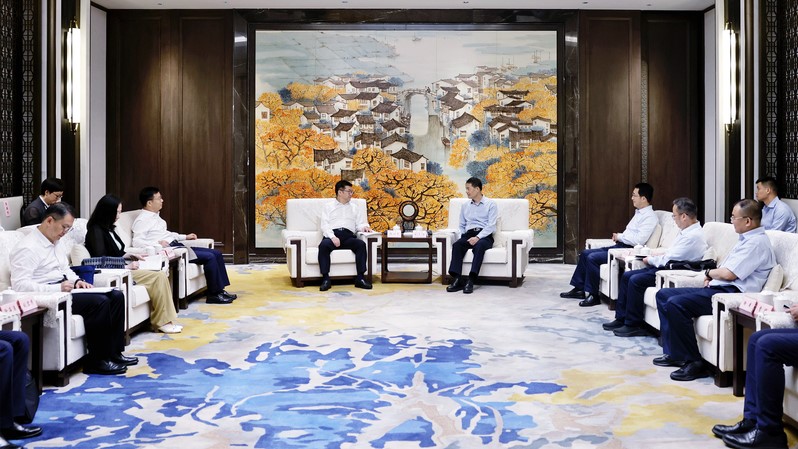
刘小涛吴庆文会见中国进出口银行董事长陈怀宇
Su Zhou Ri Bao· 2025-08-01 23:00
Core Viewpoint - The meeting between Suzhou officials and the chairman of the China Export-Import Bank emphasizes the importance of strategic collaboration to enhance financial support for Suzhou's economic development and international trade initiatives [1][3]. Group 1: Suzhou's Economic Strategy - Suzhou is committed to deepening the implementation of Xi Jinping's important speeches, expanding high-level opening-up, and stabilizing foreign trade and investment [3]. - The city aims to improve the quality and efficiency of its open economy and promote sustainable economic recovery [3]. Group 2: Financial Support and Collaboration - Suzhou officials requested the China Export-Import Bank to prioritize the city in its strategic layout, focusing on new policy financial tools, digital finance, foreign trade transformation, and supporting enterprises in going global [3]. - The China Export-Import Bank expressed gratitude for Suzhou's support and highlighted the city's strong industrial foundation, vast market space, excellent business environment, and good financial ecosystem as key factors for investment [3]. Group 3: Future Development Focus - The China Export-Import Bank aims to integrate deeply into Suzhou's modernization process, leveraging its advantages to expand functional business areas [3]. - The bank will focus on technology innovation, industry cultivation, international cooperation, and financing for small and medium-sized foreign trade enterprises to empower Suzhou's high-quality development of its open economy [3].