社会融资规模

Search documents
9月金融数据点评:M1同比增速继续回升,“剪刀差”持续收窄
Mai Gao Zheng Quan· 2025-10-17 11:04
Financing Data - In September 2025, the new social financing scale increased by 35,296 billion yuan, with a year-on-year decrease of 2,339 billion yuan[10] - The total social financing stock growth rate for the first three quarters was 8.7%, down 0.1 percentage points from August[10] - New corporate bonds in September amounted to 136 billion yuan, an increase of 2,062 billion yuan year-on-year, primarily due to low base effects and policy support[11] Loan and Credit Analysis - In September, new RMB loans totaled 12,900 billion yuan, an increase of 7,000 billion yuan month-on-month, but a decrease of 3,000 billion yuan year-on-year[12] - Short-term corporate loans recorded a significant increase of 6,400 billion yuan month-on-month, reflecting heightened operational activity among enterprises[12] - New medium- and long-term loans increased by 4,400 billion yuan month-on-month, indicating a gradual recovery in project investment willingness among enterprises[12] Monetary Supply Trends - M2 grew by 8.4% year-on-year in September, down 0.4 percentage points from August, but still 1.6 percentage points higher than the same period last year[2] - M1 increased by 7.2% year-on-year, up 1.2 percentage points from August, with the M1-M2 growth rate gap narrowing to 1.2%[2] - The acceleration in M1 growth is attributed to increased credit issuance, enhanced fiscal spending, and heightened market transaction activity[20]
【东吴芦哲】直接融资回暖、存款继续活化——2025年9月金融数据点评
Sou Hu Cai Jing· 2025-10-17 00:00
Core Insights - In September 2025, the People's Bank of China reported a new social financing scale of 3.53 trillion yuan, which is a year-on-year decrease of 229.7 billion yuan, slightly below seasonal performance [2][4] - The total amount of RMB loans increased by 1.29 trillion yuan, a year-on-year decrease of 300 billion yuan, also lower than seasonal averages [2][6] Social Financing Scale - The social financing scale saw a slight decline compared to the seasonal average of 3.81 trillion yuan over the past three years, with a notable decrease in RMB loans and government bond financing [2][4] - The breakdown of social financing shows that corporate bond financing increased by 105 million yuan, a year-on-year increase of 2.03 billion yuan, while stock financing also rose by 500 million yuan, marking a continuous increase for seven months [2][5] Loan Issuance - Financial institutions reported an increase of 1.29 trillion yuan in RMB loans, which is 300 billion yuan less than the same period last year, indicating a decline in loan demand [2][6] - The balance of RMB loans as of September 2025 showed a year-on-year growth rate decrease of 0.2 percentage points to 6.60% [2][3] Monetary Supply - As of the end of September 2025, M1 grew by 7.2% year-on-year, while M2 growth slowed to 8.4%, reflecting a narrowing of the M2-M1 gap [3][7] - The total new RMB deposits in September amounted to 2.21 trillion yuan, a year-on-year decrease of 1.53 trillion yuan, with significant reductions in fiscal deposits [3][7] Financing Structure - The financing structure is showing signs of optimization, with a shift towards direct financing, as evidenced by the increase in corporate bond and stock financing [5][6] - The proportion of government bonds, corporate bonds, and stock financing in new social financing reached 44.36%, an increase of 9.52 percentage points compared to the previous year [5][6] Policy Outlook - Anticipated fiscal and monetary policy measures in the fourth quarter may stimulate financing demand, including early issuance of local government bonds and continued liquidity support [8] - The implementation of policy financial tools is expected to enhance project financing and improve the overall financing environment [8]


东吴证券晨会纪要-20251017
Soochow Securities· 2025-10-16 23:30
Macro Strategy - The report highlights a recovery in direct financing and the continued activation of deposits, with expectations for fiscal and monetary policies to boost financing demand in Q4 2025 [1][4][6] - The social financing scale in September 2025 saw an increase of 3.53 trillion yuan, which is a year-on-year decrease of 229.7 billion yuan, slightly below the seasonal average [4][6] - The report notes that the structure of social financing is improving, indicating a recovery in direct financing, with corporate bond financing increasing by 10.5 billion yuan year-on-year [4][6] Fixed Income - The report discusses the upcoming issuance of Jinlang Convertible Bond 02, with a total issuance scale of 1.677 billion yuan, aimed at funding distributed photovoltaic projects [7][8] - The expected listing price range for Jinlang Convertible Bond 02 is between 111.44 and 123.92 yuan, with an anticipated subscription rate of 0.0069% [7][8] - Jinlang Technology, the issuer, has shown steady revenue growth with a compound annual growth rate of 33.10% from 2020 to 2024, despite fluctuations in net profit [8] Company Analysis - China Pacific Insurance (02328.HK) is projected to see a net profit increase of 40%-60% year-on-year for the first three quarters of 2025, driven by strong performance in both underwriting and investment [9][10] - The underwriting profit for the first half of 2025 is expected to be 13 billion yuan, a year-on-year increase of 45%, with a combined cost ratio of 94.8% [9][10] - The report raises the profit forecast for China Pacific Insurance, estimating net profits of 48 billion, 49.4 billion, and 52.8 billion yuan for 2025-2027 [9][10]

M1与M2剪刀差明显收敛 9月末社融存量同比增8.7%
Mei Ri Jing Ji Xin Wen· 2025-10-16 14:53
Core Insights - The People's Bank of China reported that the total social financing scale reached 437.08 trillion yuan by the end of September, with a year-on-year growth of 8.7% [1] - The increase in social financing is significantly supported by accelerated government bond issuance and improved corporate bond and equity financing channels [4] Monetary Policy and Financing - The broad money supply (M2) stood at 335.38 trillion yuan at the end of September, reflecting a year-on-year increase of 8.4%, supported by proactive fiscal policies and moderately loose monetary policies [3][8] - The weighted average interest rate for new corporate loans was approximately 3.1%, down about 40 basis points year-on-year, indicating a generally abundant supply of credit resources [3][5] Social Financing Growth - In the first three quarters, the incremental social financing totaled 30.09 trillion yuan, which is 4.42 trillion yuan more than the same period last year [4] - Government bonds played a crucial role in supporting social financing, with net financing of 11.46 trillion yuan in the first three quarters, an increase of 4.28 trillion yuan year-on-year [4] Credit Supply and Demand - By the end of September, the balance of RMB loans was 270.39 trillion yuan, showing a year-on-year growth of 6.6% [5] - The low interest rates indicate a high level of credit resource supply, meeting the financing needs of the real economy effectively [6][7] Consumer Behavior and Market Dynamics - The recent increase in M1, which reached 113.15 trillion yuan with a year-on-year growth of 7.2%, signals a recovery in personal investment and consumption demand [8] - The phenomenon of "deposit migration" reflects residents reallocating their savings into higher-yielding assets, influenced by changing interest rates and market conditions [9]
宏观数据观察:东海观察9月信贷需求企稳,政府融资持续发力
Dong Hai Qi Huo· 2025-10-16 14:01
Report Summary 1. Report Industry Investment Rating No relevant content provided. 2. Core View of the Report - China's M2 declined in September and was lower than expected, mainly due to a short - term sharp decrease in non - bank deposits. The overall M2 remained at a reasonable level, and the monetary policy continued to be loose. The new social financing decreased slightly year - on - year, mainly due to the decline in fiscal financing and the decrease in the financing demand of the household and enterprise sectors. The transmission from loose money to loose credit continued. Given the existing external shock risks and the stable domestic economic growth, the monetary policy will continue to be moderately loose. With fiscal efforts and the easing of external shocks, the financing demand of enterprises, households, and the government is expected to gradually recover, and the transmission from loose money to loose credit is expected to accelerate. In the short term, financial data has little impact on domestic risk assets and the RMB exchange rate, while in the long - term, the process of loose credit is expected to speed up as domestic support policies are implemented and take effect [1]. 3. Summary by Related Content M2 Situation - In September, M2 increased by 8.4% year - on - year, with an expected 8.5% and a previous value of 8.8%. The growth rate decreased by 0.4 percentage points from the previous month and increased by 1.6 percentage points from the same period last year. The year - on - year growth rate of M2 declined and was lower than expected because of the large increase in enterprise and household deposits and the significant decrease in non - bank deposits due to the return of wealth management funds to the balance sheet. The overall money supply maintained reasonable growth. M1 increased by 7.2% year - on - year, 1.2 percentage points higher than the previous month and higher than the expected 6.1%, reflecting the improvement of enterprise profits and the continuous current - account of household and enterprise deposits. M0 increased by 11.5% year - on - year, down 0.2%. With M1 rising and M2 remaining high, the overall capital supply remained stable, and the monetary policy continued to be loose. Due to the stable domestic economic growth and existing external shock risks, the monetary policy will continue to be moderately loose. With the acceleration of debt resolution, the implementation of fiscal and real - estate policies, and the short - term improvement of the real - estate market, the demand for credit creation will pick up, and M2 is expected to rise in the short term [1][2]. New RMB Loans - In September, new RMB loans were 129 billion yuan, with an expected 1460 billion yuan and a previous value of 59 billion yuan, 30 billion yuan less than the same period last year. The new loans in September were less than the same period last year and lower than market expectations, mainly due to the decline in bill financing and household loans. New household short - term loans were 14.21 billion yuan, 12.79 billion yuan less than the same period last year, and new household long - term loans were 25 billion yuan, 2 billion yuan more than the same period last year. The decline in household loans may reflect the weak income expectations of households. The long - term loans were moderately boosted by the optimized real - estate demand policies in first - tier cities. New enterprise loans were 122 billion yuan, 27 billion yuan less than the same period last year. Short - term and long - term loans were 71 billion and 91 billion yuan respectively, with short - term loans increasing by 25 billion yuan and long - term loans decreasing by 5 billion yuan year - on - year, partly affected by local governments' repayment of enterprise arrears. The new bill financing was - 40.26 billion yuan, 47.12 billion yuan less than the same period last year, and off - balance - sheet bills increased year - on - year, possibly reflecting the decline in banks' bill - padding demand at the end of the quarter [1][3][4]. Social Financing Scale - In September, the increment of the social financing scale was 353.37 billion yuan, with an expected 335 billion yuan and a previous value of 256.68 billion yuan, 22.98 billion yuan less than the same period last year. At the end of September, the stock of the social financing scale was 437.08 trillion yuan, a year - on - year increase of 8.7%, 0.1 percentage points lower than the previous month. The transmission from loose money to loose credit continued. In terms of the structure of new social financing, the credit financing demand of the real economy decreased year - on - year, with household credit demand picking up and enterprise credit decreasing. Enterprise bond financing increased, government bond issuance continued to accelerate, and non - standard financing demand rose. New credit in September was 160.8 billion yuan, 36.62 billion yuan less than the same period last year, mainly related to the decline in the bill financing demand of households and real - economy enterprises. Non - standard assets such as trust loans, entrusted loans, and bank acceptances not yet discounted increased by 35.79 billion yuan in total, 18.69 billion yuan more than the same period last year. Enterprise bond financing increased by 1.05 billion yuan, 20.31 billion yuan more than the same period last year, mainly supported by the issuance of science and technology innovation bonds and private enterprise bonds. Government bond net financing was 118.86 billion yuan, 34.71 billion yuan less than the same period last year, mainly due to the large - scale issuance of government bonds in the same period last year. Overall, the financing demand of the real - economy sector decreased year - on - year. In the short - and medium - term, due to the negative impact of tariffs, the government will continue to expand financing. The enterprise sector's financing demand is expected to improve gradually in the long - term, and the household sector's financing demand is expected to continue the slow recovery trend. Although the current social financing demand has declined slightly year - on - year in the short term, the process of loose credit is expected to accelerate in the long - term as the domestic monetary policy continues to be loose and support policies are further strengthened and implemented [1][5].
9月M2-M1剪刀差创近四年最低,货币活化程度提速
Hua Xia Shi Bao· 2025-10-16 08:58
Core Insights - The overall financial data for September indicates stability, with significant growth in both broad (M2) and narrow (M1) money supply, supporting economic recovery [2][6][9] - The increase in RMB loans and social financing reflects strong support for the real economy, although there are signs of seasonal adjustments in credit issuance [3][9] Monetary Supply - As of September, the broad money supply (M2) reached 335.38 trillion yuan, growing by 8.4% year-on-year, while the narrow money supply (M1) was 113.15 trillion yuan, up 7.2% year-on-year [6][7] - The narrowing gap between M2 and M1 indicates improved liquidity and a more active economy, with M2-M1 "scissors difference" at its lowest in nearly four years [7][9] Loan Growth - In the first three quarters, RMB loans increased by 14.75 trillion yuan, with September alone contributing 1.29 trillion yuan, although this was 300 billion yuan less than the previous year [3][4] - Corporate loans in September rose by 1.22 trillion yuan, while household loans increased by 389 billion yuan, indicating a mixed performance across sectors [4][5] Social Financing - The total social financing scale reached 437.08 trillion yuan by the end of September, with a year-on-year growth of 8.7%, although the monthly increase was lower than in previous years [9][10] - The decline in new social financing in September was attributed to reduced government bond issuance and lower corporate loan growth compared to the previous year [9][10] Future Outlook - Analysts predict that the fourth quarter will see continued supportive monetary policy to bolster economic recovery, with expectations of new policy financial tools to support corporate loans [10][11] - The stability and sustainability of retail loan growth will depend on improvements in employment and income levels, which are crucial for boosting consumer demand [5][10]

2025年9月社融数据点评:社融增速延续回落,政府债融资减速
Southwest Securities· 2025-10-16 08:34
Loan Growth and Structure - In September 2025, corporate loans increased by CNY 12,200 billion, a year-on-year decrease of CNY 2,700 billion[2] - Short-term corporate loans rose by CNY 7,100 billion, a year-on-year increase of CNY 2,500 billion, indicating increased short-term financing needs[2] - Long-term corporate loans increased by CNY 9,100 billion, a year-on-year decrease of CNY 500 billion, reflecting weak demand[2] - Resident loans added CNY 3,890 billion, a year-on-year decrease of CNY 1,110 billion, with short-term loans down by CNY 1,279 billion[2] Social Financing Trends - The total social financing stock grew by 8.7% year-on-year in the first nine months of 2025, a slight decline of 0.1 percentage points from January to August[4] - In September, the social financing increment was CNY 16,080 billion, a year-on-year decrease of CNY 3,662 billion[4] - Government bond financing decreased by CNY 11,886 billion, a year-on-year decline of CNY 3,471 billion, continuing a downward trend[4] Monetary Supply and Deposits - In September 2025, RMB deposits increased by CNY 22,100 billion, a year-on-year decrease of CNY 15,300 billion[6] - M2 growth was 8.4%, down 0.4 percentage points from the previous month, while M1 growth rose to 7.2%, an increase of 1.2 percentage points[6] - The M1-M2 gap narrowed to -1.2%, a further contraction of 1.6 percentage points from the previous month[6]
最新金融数据出炉 释放了什么信号?
Sou Hu Cai Jing· 2025-10-16 05:19
Core Insights - The People's Bank of China reported a strong growth in social financing and monetary supply, indicating a supportive monetary environment for economic recovery [1][3][8] Group 1: Social Financing and Monetary Supply - As of September 2025, the total social financing stock reached 437.08 trillion yuan, a year-on-year increase of 8.7% [1] - The broad money supply (M2) stood at 335.38 trillion yuan, growing by 8.4% year-on-year, while the narrow money supply (M1) was 113.15 trillion yuan, up 7.2% [1] - The incremental social financing for the first three quarters was 30.09 trillion yuan, exceeding the previous year's figure by 4.42 trillion yuan, reflecting a robust financial support for the real economy [1][3] Group 2: Government and Corporate Financing - In the first three quarters, net financing through corporate bonds was 1.57 trillion yuan, a decrease of 151 billion yuan year-on-year, while government bonds saw net financing of 11.46 trillion yuan, an increase of 4.28 trillion yuan [3] - The issuance of special long-term government bonds amounted to 1.3 trillion yuan, an increase of 300 billion yuan compared to the previous year [4] Group 3: Credit Growth and Loan Distribution - Corporate loans increased by 13.44 trillion yuan in the first three quarters, with medium to long-term loans accounting for over 60% of this amount [5] - By the end of September, the balance of inclusive small and micro loans was 36.09 trillion yuan, reflecting a year-on-year growth of 12.2% [5] - Household loans increased by 1.1 trillion yuan in the first nine months, with medium to long-term loans rising by 1.33 trillion yuan [6] Group 4: Economic Implications - The data indicates a commitment from policymakers to maintain a stable economic growth through a moderately loose credit environment, especially in light of ongoing internal and external demand challenges [8] - The narrowing gap between M1 and M2 growth rates suggests an increase in business activity and a recovery in personal consumption demand [7]
透过多项三季度金融数据看经济高质量发展动能更强、底气更足
Yang Shi Wang· 2025-10-16 04:05
Core Insights - The People's Bank of China reported that in September, the social financing scale and broad money (M2) growth rates remained high, indicating strong financial support for the real economy [1][3]. Financial Data Summary - As of the end of September, the balance of broad money (M2) was 335.38 trillion yuan, with a year-on-year growth of 8.4%. The social financing scale stood at 437.08 trillion yuan, growing by 8.7% year-on-year, maintaining a high growth rate. The cumulative increase in social financing for the first three quarters was 30.09 trillion yuan, with RMB loans increasing by 14.75 trillion yuan [3]. - The structure of credit continued to optimize in September, with corporate loans showing a good growth trend and a rebound in household credit demand [4]. Loan Growth and Demand - In September, inclusive small and micro loans and medium to long-term loans for the manufacturing sector grew by 12.2% and 8.2% year-on-year, respectively, outpacing the growth rate of other loans. Corporate financing needs were effectively released [6]. - The implementation of new policy financial tools in various regions has helped alleviate capital shortages for major projects, contributing to the growth of related credit funds [6]. Interest Rate Trends - Loan interest rates have remained low throughout the year, with the average interest rate for newly issued corporate loans in September at approximately 3.1%, down about 40 basis points from the same period last year. The average interest rate for new personal housing loans was also around 3.1%, down about 25 basis points year-on-year [9]. - The continued implementation of moderately loose monetary policies, including reserve requirement ratio cuts and interest rate reductions, has created a favorable monetary environment for the development of the real economy [9].

视说丨央行发布最新金融数据!
Sou Hu Cai Jing· 2025-10-16 03:49
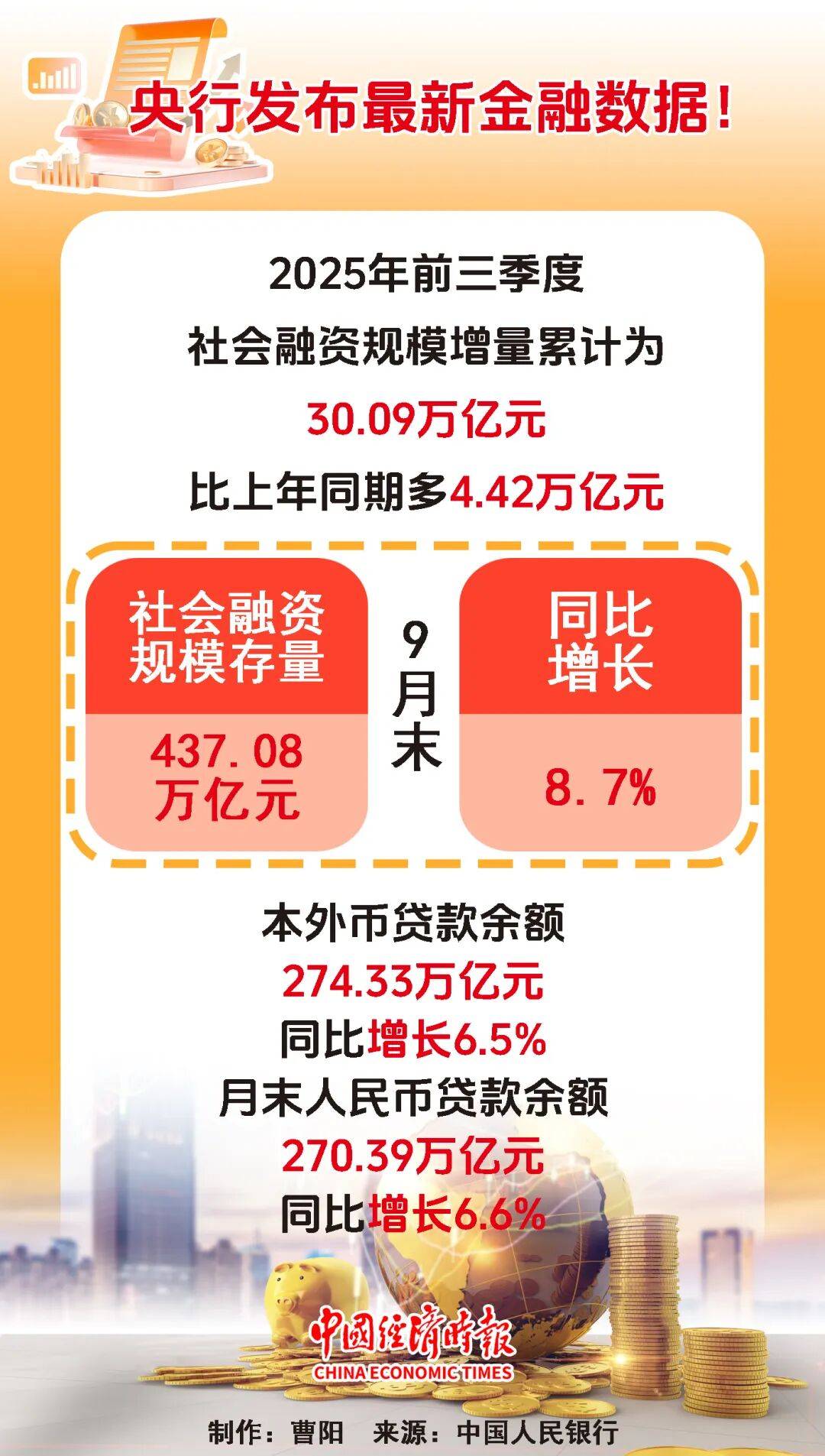
Core Insights - The central bank has released the latest financial data indicating significant growth in social financing and loan balances for the first three quarters of 2025 [1] Group 1: Social Financing - The cumulative increase in social financing for the first three quarters of 2025 reached 30.09 trillion yuan, which is an increase of 4.42 trillion yuan compared to the same period last year [2][6] - As of the end of September 2025, the total social financing stock was 437.08 trillion yuan, reflecting a year-on-year growth of 8.7% [3][6] Group 2: Loan Balances - The total balance of domestic and foreign currency loans stood at 274.33 trillion yuan, showing a year-on-year increase of 6.5% [4][6] - The balance of RMB loans at the end of September was 270.39 trillion yuan, with a year-on-year growth of 6.6% [4][6]