
通胀预期

Search documents
贵金属早报-20251211
Da Yue Qi Huo· 2025-12-11 01:59
Report Summary 1. Report Industry Investment Rating No information about the report industry investment rating is provided in the given text, so this part is skipped. 2. Core Views - Market perceives Fed Chair Powell's speech as more dovish than expected, leading to an upward trend in gold and silver prices. The market ignores the pause in rate - cuts, and the London market accelerated its upward movement before the domestic market opened, in line with the upward trend of the domestic market [4][5]. - For gold, the upward trend remains unchanged. The morning premium of Shanghai gold is - 12 yuan/gram, indicating a potential price increase of 9 yuan/gram [4]. - For silver, the bullish sentiment in Shanghai silver remains strong. The morning premium of Shanghai silver is 20 yuan/gram, suggesting a price increase of 380 yuan/kg, hitting a new high. However, the gold - silver ratio is extremely low, and usually, the recovery of the gold - silver ratio is mainly driven by a decline in silver prices, so cautious operation is recommended. The market believes the Fed is dovish, and the target of 15000 for Shanghai silver is hard to abandon [5]. 3. Summary by Directory 3.1. Previous Day Review - **Gold**: COMEX gold futures rose 0.45% to $4236.6 per ounce. The 10 - year US Treasury yield rose 2.35 basis points to 4.188%. The US dollar index rose 0.14% to 99.24, and the offshore RMB appreciated against the US dollar to 7.0602. The gold futures price was 956.4, the spot price was 951.2, with a basis of - 5.3 (spot at a discount to futures). Gold futures warehouse receipts were 91299 kg, unchanged. The 20 - day moving average was upward, and the k - line was above the 20 - day moving average. The main net position was long, but the main long positions decreased [4]. - **Silver**: COMEX silver futures rose 4.72% to $61.16 per ounce. The silver futures price was 14373, the spot price was 14351, with a basis of - 22 (spot at a discount to futures). Shanghai silver futures warehouse receipts were 741845 kg, an increase of 24057 kg compared to the previous day. The 20 - day moving average was upward, and the k - line was above the 20 - day moving average. The main net position was long, but the main long positions decreased [5]. 3.2. Daily Tips - **Gold**: The market believes the Fed is dovish, and the upward trend of gold prices remains unchanged. The morning premium of Shanghai gold is - 12 yuan/gram, indicating a potential price increase of 9 yuan/gram [4]. - **Silver**: The bullish sentiment in Shanghai silver remains strong. The morning premium of Shanghai silver is 20 yuan/gram, suggesting a price increase of 380 yuan/kg, hitting a new high. However, the gold - silver ratio is extremely low, and cautious operation is recommended. The market believes the Fed is dovish, and the target of 15000 for Shanghai silver is hard to abandon [5]. 3.3. Today's Focus - 07:50: Japan's Q4 BSI large - scale manufacturing confidence index - 08:30: Australia releases its November employment report (including employment population and unemployment rate) - 15:00: China's Ministry of Commerce holds its second regular press conference in December - 16:30: Swiss National Bank announces its interest - rate decision - 17:00: Swiss National Bank President Schlegel holds a press conference - 17:50: Bank of England Governor Bailey participates in a pre - recorded fireside chat with the Financial Times, with the topic related to global financial stability - 18:00: Bank of England Governor Bailey presents evidence at the "UK COVID Inquiry" - 20:00: National Bank of Ukraine announces its interest - rate decision - 21:30: US initial jobless claims for the week ending December 6, September trade balance; Canada's September trade balance - Next day 01:00: Fed releases data on the financial health of US households from the Q3 2025 Flow of Funds Report [14] 3.4. Fundamental Data - **Gold**: After Trump took office, the world entered a period of extreme turmoil and change. The inflation expectation shifted to an economic recession expectation, making it difficult for gold prices to decline. Recently, the Fed's rate cuts and the optimistic expectation of Russia - Ukraine peace talks have jointly affected the market, and combined with liquidity concerns, there is still upward momentum for gold prices, but it is limited [9]. - **Silver**: After Trump took office, the world entered a period of extreme turmoil and change. The inflation expectation shifted to an economic recession expectation, and silver prices still mainly follow gold prices. Tariff concerns have a stronger impact on silver prices, and there is a risk of an enlarged increase in silver prices [12]. 3.5. Position Data - **Gold**: The main net position is long, but the main long positions are decreasing. The long positions of the top 20 in Shanghai gold increased by 651 (0.38%) to 173,961 on December 10 compared to December 9; the short positions decreased by 209 (- 0.36%) to 58,557; the net position increased by 860 (0.75%) to 115,404 [4][29]. - **Silver**: The main net position is long, but the main long positions are decreasing. The long positions of the top 20 in Shanghai silver increased by 21,648 (5.33%) to 428,103 on December 10 compared to December 9; the short positions increased by 24,468 (8.15%) to 324,706; the net position decreased by 2,820 (- 2.65%) to 103,397 [5][31].
巴西央行将利率维持在15%高位不变 以应对通胀预期居高不下局面
Xin Lang Cai Jing· 2025-12-10 23:30
尽管经济放缓的迹象日益明显,但由于通胀预期在可预见的未来仍将高于目标水平,巴西央行将关键利 率维持在近二十年来的最高水平。 责任编辑:王永生 尽管经济放缓的迹象日益明显,但由于通胀预期在可预见的未来仍将高于目标水平,巴西央行将关键利 率维持在近二十年来的最高水平。 Gabriel Galipolo领导的政策委员会周三一致投票决定维持Selic利率在15%不变,为连续第四次会议按兵 不动,与彭博调查的所有经济学家预期一致。政策制定者在2024年9月至今年6月期间将借贷成本提高了 4.5个百分点。 Gabriel Galipolo领导的政策委员会周三一致投票决定维持Selic利率在15%不变,为连续第四次会议按兵 不动,与彭博调查的所有经济学家预期一致。政策制定者在2024年9月至今年6月期间将借贷成本提高了 4.5个百分点。 责任编辑:王永生 ...
Fed cuts interest rates by a quarter percentage point
Youtube· 2025-12-10 19:31
Federal Reserve Interest Rate Decision - The Federal Reserve has reduced interest rates by a quarter point to a new range of 3.5% to 3.75% [1] - The decision saw three dissenting votes, marking the first occurrence of such dissent since September 2019 [1] Dissenting Opinions - Two dissenters opposed the rate cut, including Chicago Fed President Austin Goulby and Kansas City Fed President Jeff Smith [1] - A new Fed governor, Steven Myron, also dissented, advocating for a 50 basis point cut [2] Future Rate Outlook - The Fed indicated a higher threshold for future rate cuts, stating it will assess incoming data for timing and extent of future moves [3] - The consensus suggests only one more cut next year and another in 2027 [3] Balance Sheet Management - The Fed has determined its balance sheet is at an ample level of reserves and plans to purchase shorter-term treasuries [4] - Starting December 12, the Fed will begin buying $40 billion in bills, which is sooner than market expectations [5] Economic Outlook - The GDP outlook for next year has been revised upward by half a point to 2.4% [6] - The inflation outlook has been slightly lowered to 2.5%, approaching the target of 2.1% by 2027 [6] Employment and Inflation - The economy is expanding at a moderate pace, with job gains slowing and a slight increase in unemployment [7] - The statement no longer describes the unemployment rate as low, indicating a shift in economic conditions [7] Dot Plot Insights - The dot plot reveals that six officials wanted no change in the funds rate, with seven preferring no change for next year [8] - One official, presumed to be Steven Myron, advocates for a rate reduction to 2.12% next year, which is 150 basis points lower [8]


2026债市,或比预期好一点
Xin Lang Cai Jing· 2025-12-10 13:52
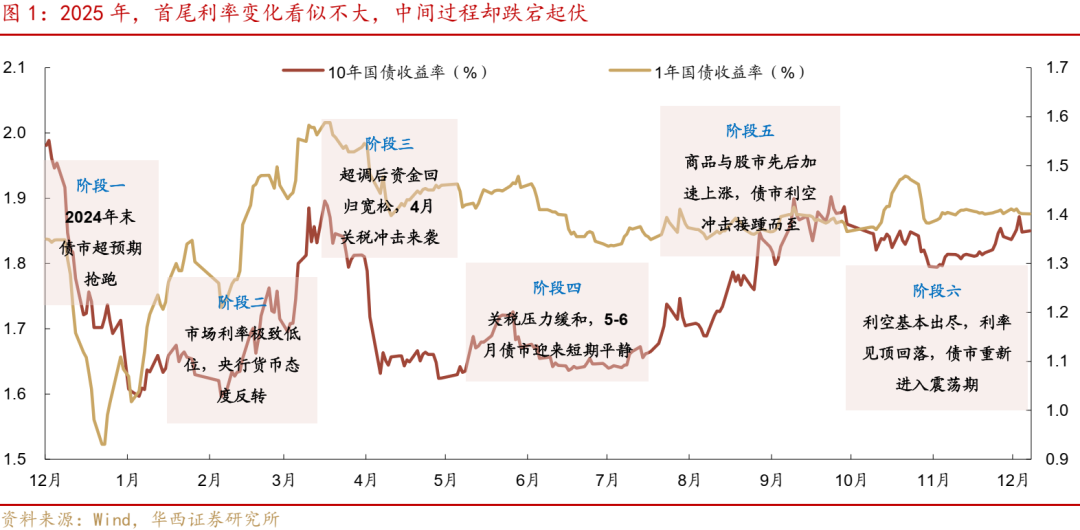
Group 1 - The core viewpoint of the articles indicates that the bond market in 2025 is expected to face significant challenges, transitioning from a "bullish long, bearish short" to a "bullish short, bearish long" market, making it increasingly difficult to generate returns [1][38] - Key variables affecting the bond market include "expansive fiscal policy," "stable monetary policy," "strong risk appetite," "strict regulation," and "weak reality," which are expected to shape the market dynamics in 2026 [1][38] - The fiscal deficit for 2025 is projected to increase by 2.9 trillion yuan compared to 2024, reaching a historical high since 2021, with a total deficit of 5.66 trillion yuan [1][39] Group 2 - The "expansive fiscal policy" is likely to continue into 2026, with a projected broad fiscal deficit of 15.1 to 15.9 trillion yuan, although the contribution to economic growth may be more stable than in 2025 [2][50] - The monetary policy in 2025 acted more as a supporting role, with expectations for 2026 to potentially see a shift towards a more expansive monetary policy, which could exceed market expectations [3][55] - Regulatory measures in 2025 have led to stricter behaviors among institutions, impacting the bond market, with asset management institutions likely to maintain lower bond allocation ratios [4][56] Group 3 - The macroeconomic indicators have shown marginal weakening since early 2025, but have not significantly influenced asset pricing, as the bond market has been more closely tied to equity market performance [5][38] - The bond market is expected to experience a "slow start, fast finish" rhythm in 2026, with potential for significant movements in the second and third quarters as monetary policy evolves [6][38] - The overall sentiment in the bond market is anticipated to remain cautious, with the need to monitor macroeconomic events that could trigger changes in monetary policy [6][55]
布米普特拉北京投资基金管理有限公司:美国家庭为何对财务状况愈发悲观?
Sou Hu Cai Jing· 2025-12-10 09:50
尽管对未来物价上升的普遍预期保持稳定,但美国家庭在十一月对自身财务健康的担忧却显著加深。纽约联邦储备银行十二月八日发布的月度消费者预期调 查揭示了这一矛盾现象。调查指出,受访者对当前财务状况的看法"明显恶化",对一年后财务状况的展望也"略有下降"。这份在美联储十二月议息会议前夕 发布的报告,为理解消费者心态与经济政策之间的复杂互动提供了关键线索。 与财务层面的悲观情绪形成对比的是,美国劳动力市场的预期出现轻微改善。受访者认为美国失业率在未来一年上升的平均概率下降至百分之四十二点一。 对个人失业的担忧也有所缓解,预计未来十二个月内失去工作的平均概率降至百分之十三点八,为二零二四年十二月以来的最低水平;自愿离职的预期概率 也同步下降。同时,家庭名义收入增长预期中值从十月的百分之二点八微升至二点九。 尽管有这些积极信号,但美国家庭对整体财务的感受并未好转。报告显示,认为自身财务状况比一年前更差的比例显著增加。此外,美国消费者对未来获取 信贷难度的看法恶化,预计未来三个月无法偿付最低债务额的平均概率也上升至百分之十三点七。这些数据共同描绘出一幅图景:即使工作安全感略有增 强,但高昂的生活成本、债务压力以及对信贷环境的 ...

【comex白银库存】12月9日COMEX白银库存较上一日减少9.99吨
Jin Tou Wang· 2025-12-10 08:40
纽约联储周一发布的报告显示,尽管美国家庭对未来通胀走势的预期保持稳定,但他们在11月对当前和 未来财务状况的看法却更加悲观。该地区联储在调查中指出,受访者对当前财务状况的看法"明显恶 化",而对一年后的展望则"略有恶化"。 不过,受访者对就业市场的看法在11月有所改善。报告称,对未来一年失业率上升的预期有所减弱,而 在未来一年内失业的可能性降至自2024年12月以来的最低水平。家庭也下调了主动离职的概率。 | 日期 | comex白银库存量(吨) | 增持/减持(吨) | | --- | --- | --- | | 2025-12-09 | 14177.65 | -9.99 | | 2025-12-08 | 14187.64 | -28.86 | 【要闻回顾】 12月9日,COMEX白银库存录得14177.65吨,较上一日减少9.99吨;comex白银周二(12月9日)收报 61.23美元/盎司,上涨4.74%,comex白银价格日内最高上探至61.27美元/盎司,最低触及57.99美元/盎 司。 最新comex白银库存数据: 此外,纽约联储报告显示,11月通胀预期方面总体温和。未来一年的通胀预期维持在3.2 ...
大越期货贵金属早报-20251210
Da Yue Qi Huo· 2025-12-10 02:13
Report Summary 1. Report Industry Investment Rating No industry investment rating is provided in the report. 2. Core Viewpoints - **Gold**: On the eve of the Fed's interest - rate decision, the number of job openings in the US unexpectedly increased, and risk appetite decreased, causing the gold price to rise slightly. The premium of Shanghai gold has expanded to around - 4.6 yuan/gram. Based on historical performance, the gold price may reach a stage high on the day before the Fed meeting, so cautious operation is recommended [4]. - **Silver**: The market is waiting for the Fed meeting, and risk appetite has decreased. Shanghai silver saw an increase of 50,000 lots at night, pushing the silver price to a new high. The premium of Shanghai silver has converged to 380 yuan/gram, and domestic sentiment remains strong. However, the sustainability of overnight capital inflows is questionable, and attention should be paid to the intraday position changes [5]. 3. Summary by Directory 3.1. Previous Day's Review - **Gold**: The US 10 - year JOLTS job openings unexpectedly increased before the Fed's interest - rate decision. The US three major stock indices closed mixed, European three major stock indices closed mixed, US bond yields rose, the US dollar index rose 0.14% to 99.24, and COMEX gold futures rose 0.45% to $4236.6 per ounce. The basis shows that the spot is at a discount to the futures, the inventory remains unchanged, the 20 - day moving average is upward with the k - line above it, and the main net position is long but the long position is decreasing [4]. - **Silver**: Before the Fed's interest - rate decision, Shanghai silver saw an increase of 50,000 lots at night. The US three major stock indices closed mixed, European three major stock indices closed mixed, US bond yields rose, the US dollar index rose 0.14% to 99.24, and COMEX silver futures rose 4.72% to $61.16 per ounce. The basis is neutral, the inventory of Shanghai silver futures increased, the 20 - day moving average is upward with the k - line above it, and the main net position is long but the long position is decreasing [5]. 3.2. Daily Tips - **Gold**: Pay attention to the Fed's interest - rate decision and Powell's speech early the next morning, and China's November CPI, speeches by the ECB president and officials, and the UK Chancellor of the Exchequer's defense of the tax - increase plan today. The market is waiting for the Fed's meeting decision, and the increase in job openings in October has cooled risk appetite, causing the gold price to rise slightly. Be cautious as the gold price may reach a stage high on the day before the Fed meeting [4]. - **Silver**: The market is waiting for the Fed meeting, and the increase in positions at night has pushed the silver price to a new high. The sustainability of capital inflows is questionable, and attention should be paid to intraday position changes [5]. 3.3. Today's Focus - **Events**: At 09:30, China's November CPI and PPI; the UK Chancellor of the Exchequer will attend a hearing to defend a £26 billion tax - increase budget; at 18:45, the Bank of England Governor Bailey will speak; at 18:55, the ECB President Lagarde will speak in London; at 20:30, ECB Governing Council member Sharon Donnery will host a panel discussion; at 22:45, the Bank of Canada will announce its interest - rate decision; early the next morning, various central bank officials will speak, and the Fed will announce its FOMC interest - rate decision, economic outlook, and the US November government budget, followed by a press conference by Fed Chairman Powell; at 05:30, the Central Bank of Brazil will announce its interest - rate decision [14]. 3.4. Fundamental Data - **Gold**: The basis is - 4.82, indicating that the spot is at a discount to the futures; the inventory of gold futures is 91,299 kg and remains unchanged; the 20 - day moving average is upward with the k - line above it; the main net position is long but the long position is decreasing [4]. - **Silver**: The basis is - 5, the inventory of Shanghai silver futures increased by 18,497 kg to 717,788 kg; the 20 - day moving average is upward with the k - line above it; the main net position is long but the long position is decreasing [5]. 3.5. Position Data - **Gold**: The main net position is long, but the long position is decreasing. The long position of the top 20 holders decreased by 3.02% to 173,310 lots, the short position decreased by 1.39% to 58,766 lots, and the net long position decreased by 3.83% to 114,544 lots [4][29]. - **Silver**: The main net position is long, and the long position of the top 20 holders decreased by 0.70% to 406,455 lots, the short position decreased by 1.81% to 300,238 lots, and the net long position increased by 2.56% to 106,217 lots [5][31]. - **ETF Positions**: The SPDR gold ETF position decreased slightly, while the silver ETF position increased again [33][35]. - **Warehouse Receipts**: The Shanghai gold warehouse receipts increased slightly, the COMEX gold warehouse receipts continued to decrease but remained at a high level, the Shanghai silver warehouse receipts continued to increase and were at the lowest level in the past six years, and the COMEX silver warehouse receipts started to decrease [37][38][40].
美股观察|美股小幅上涨,关注本周FOMC会议
Xin Lang Cai Jing· 2025-12-09 12:48
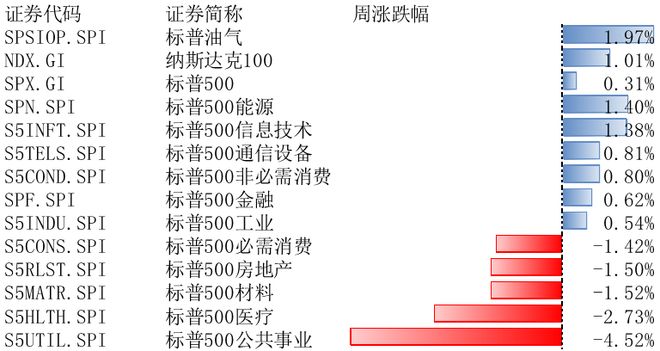
Group 1: US Macroeconomic Data - The US PCE price index for September remained high, with a year-on-year increase of 2.8%, matching expectations and up from the previous value of 2.7% [1] - The month-on-month PCE price index for September rose by 0.3%, consistent with expectations and the previous value [1] - The core PCE price index for September increased by 2.8% year-on-year, in line with expectations but lower than the previous value of 2.9% [1] - The month-on-month core PCE price index for September rose by 0.2%, matching expectations and the previous value [1] - Personal consumption expenditures in September increased by 0.3% month-on-month, in line with expectations but lower than the previous value of 0.5% [1] - Actual personal consumption expenditures for September showed no growth, falling short of the expected increase of 0.1% and the previous value of 0.2% [1] - The ISM manufacturing index for November recorded 48.2, below expectations of 49 and the previous value of 48.7, indicating continued contraction in manufacturing [1] - The ISM services index for November recorded 52.6, exceeding expectations of 52 and the previous value of 52.4, indicating accelerated expansion in services [1] - The ADP employment report for November showed a decrease of 32,000 jobs, significantly below the expected decrease of 10,000 and the previous decrease of 42,000 [1] - Consumer confidence improved significantly in December, with inflation expectations declining [1] Group 2: Consumer Confidence and Inflation Expectations - The preliminary consumer confidence index from the University of Michigan for December recorded 52.3, better than the expected value of 52 and the previous value of 51 [2] - The one-year inflation expectation from the University of Michigan for December was 4.1%, lower than both the expected and previous values of 4.5% [2] - The five-year inflation expectation from the University of Michigan for December was 3.2%, lower than both the expected and previous values of 3.4% [2] Group 3: Major Index Performance - The S&P Oil & Gas Index rose by 1.97% during the week of December 1-5, while the Nasdaq 100 Index increased by 1.01% and the S&P 500 Index rose by 0.31% [3] - Among the 11 sectors covered by the S&P 500, 6 sectors experienced gains, with the S&P 500 Energy sector leading with a 1.40% increase, while the S&P 500 Utilities sector lagged with a 4.52% decline [3] Group 4: Market Outlook - US stocks experienced slight gains during the week of December 1-5, driven by disappointing employment data and stable interest rate cut expectations [5] - The market is closely monitoring the upcoming FOMC meeting for voting and dot plot information [6]
【白银etf持仓量】12月8日白银ETF较上一交易日减少36.67吨
Jin Tou Wang· 2025-12-09 08:36
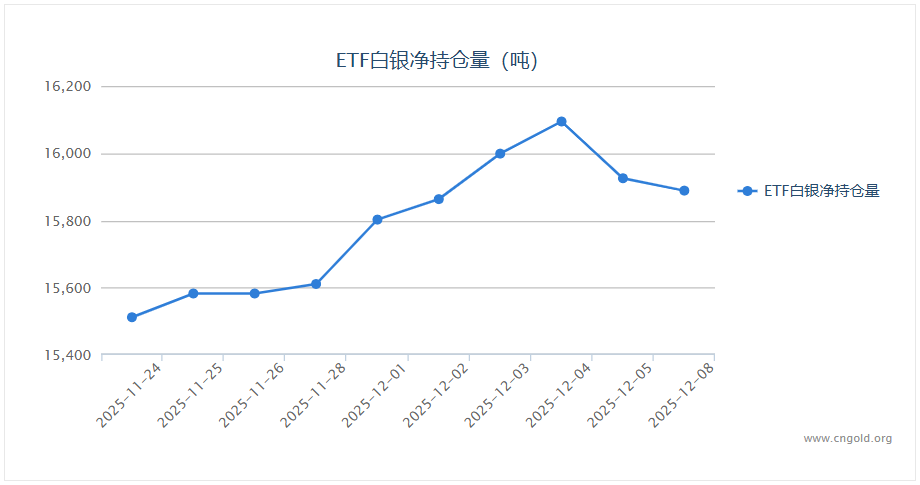
Group 1 - The iShares Silver Trust, the world's largest silver ETF, reported a holding of 15,888.54 tons of silver as of December 8, a decrease of 36.67 tons from the previous trading day [1] - On December 8, the spot silver price closed at $58.11 per ounce, down 0.29%, with an intraday high of $58.61 and a low of $57.52 [1] Group 2 - The New York Federal Reserve's report indicated that while U.S. households' expectations for future inflation remained stable, their views on current and future financial conditions became more pessimistic in November [3] - Respondents reported a "notable deterioration" in their views on current financial conditions, while their outlook for the next year showed a "slight deterioration" [3] - However, perceptions of the job market improved in November, with expectations for rising unemployment over the next year decreasing, and the likelihood of unemployment reaching its lowest level since December 2024 [3] - Households also lowered their probability of voluntary job quitting [3] - The report showed that inflation expectations remained moderate, with a one-year inflation expectation steady at 3.2%, and three- and five-year expectations also holding at 3% [3] - Home price expectations remained stable, with an anticipated increase of 3%, while outlooks for various commodity prices showed little change [3] - However, the one-year expectation for medical costs rose to 10.1%, the highest level since January 2014 [3]
邦达亚洲:澳洲联储如期按兵不动 澳元小幅收涨
Xin Lang Cai Jing· 2025-12-09 08:19
Group 1: US Consumer Inflation Expectations - The New York Fed's survey indicates that US consumer inflation expectations remained stable in November, with a one-year inflation expectation of 3.2% and three- and five-year expectations also at 3% [1][7]. - Respondents' perception of unemployment probability decreased to 13.8%, marking the lowest level of the year [1][7]. - There is a general market expectation that the Federal Reserve will lower the benchmark interest rate for the third consecutive time to prevent deterioration in the labor market [1][7]. Group 2: Australian Central Bank Policy - The Reserve Bank of Australia maintained its cash rate target at 3.60%, aligning with market expectations [2][8]. - RBA Governor Philip Lowe emphasized the need for caution regarding monthly CPI data, stating that inflation and employment data will be crucial for the February meeting [2][8]. - The RBA sees an upward bias in inflation risks and has not ruled out the possibility of tightening policy if inflation remains high [2][8]. Group 3: Market Reactions and Currency Movements - Gold prices experienced a slight decline, trading around 4180, influenced by profit-taking and a rebound in the US dollar index due to expectations of a hawkish signal from the Fed [4][9]. - The Australian dollar also saw a slight decrease, trading around 0.6650, affected by profit-taking and the strengthening US dollar [5][10]. - The USD/CAD pair rose slightly, trading around 1.3850, supported by technical buying and a rebound in the US dollar index [6][11].