社会融资规模

Search documents
视说丨央行发布最新金融数据!
Sou Hu Cai Jing· 2025-10-16 03:49
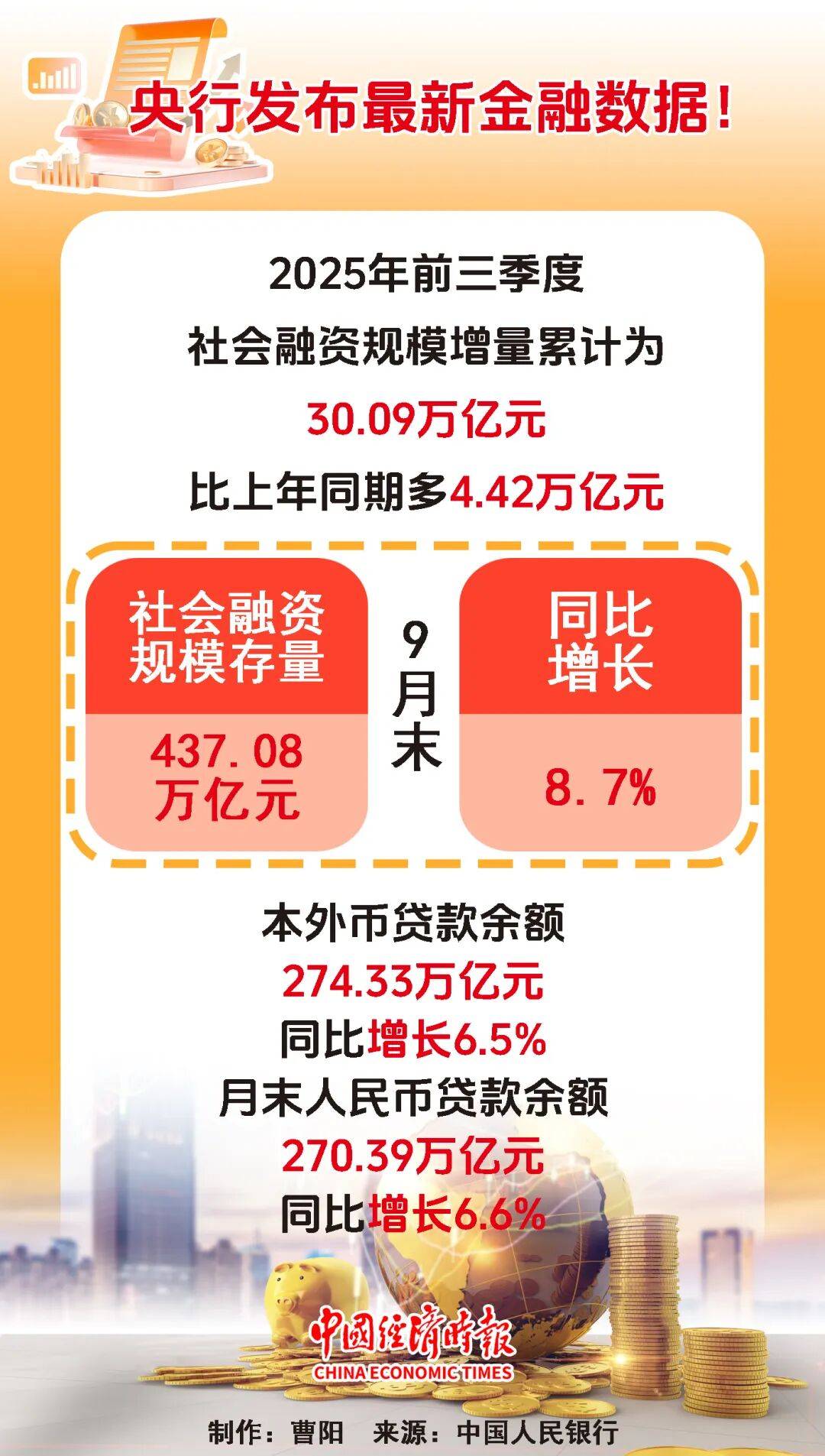
Core Insights - The central bank has released the latest financial data indicating significant growth in social financing and loan balances for the first three quarters of 2025 [1] Group 1: Social Financing - The cumulative increase in social financing for the first three quarters of 2025 reached 30.09 trillion yuan, which is an increase of 4.42 trillion yuan compared to the same period last year [2][6] - As of the end of September 2025, the total social financing stock was 437.08 trillion yuan, reflecting a year-on-year growth of 8.7% [3][6] Group 2: Loan Balances - The total balance of domestic and foreign currency loans stood at 274.33 trillion yuan, showing a year-on-year increase of 6.5% [4][6] - The balance of RMB loans at the end of September was 270.39 trillion yuan, with a year-on-year growth of 6.6% [4][6]

金融支持实体经济力度稳固
Zhong Guo Jing Ji Wang· 2025-10-16 03:32
Core Insights - The financial statistics released by the People's Bank of China indicate a sustained growth in social financing and broad money supply (M2), supported by a moderately loose monetary policy [1][2] Monetary Supply and Financing - As of the end of September, M2 reached 335.38 trillion yuan, growing by 8.4% year-on-year, maintaining a high growth rate despite a higher base from the previous year [1] - The total social financing stock was 437.08 trillion yuan, with a year-on-year increase of 8.7%, which is 0.7 percentage points higher than the same period last year [1] - In the first three quarters, the cumulative increase in social financing was 30.09 trillion yuan, which is 4.42 trillion yuan more than the previous year [1][2] Government Bonds and Direct Financing - The acceleration in government bond issuance has significantly contributed to social financing, with net financing from government bonds reaching 11.46 trillion yuan in the first three quarters, an increase of 4.28 trillion yuan year-on-year [2] - The issuance of special refinancing bonds and government bonds has been rapid, supporting various initiatives aimed at expanding domestic demand and mitigating risks [2] Loan Growth and Structure - By the end of September, the balance of RMB loans was 270.39 trillion yuan, reflecting a year-on-year growth of 6.6% [3] - In the first three quarters, RMB loans increased by 14.75 trillion yuan, with household loans rising by 1.1 trillion yuan and corporate loans increasing by 13.44 trillion yuan [3] - The loan structure is improving, with significant growth in medium to long-term loans for both households and enterprises [3][4] Cost of Financing - The average interest rate for newly issued corporate loans was approximately 3.1% in September, which is about 40 basis points lower than the same period last year [4] - The implementation of the "loan transparency" initiative has helped reduce the overall financing costs for enterprises, enhancing their access to credit [4][5] Consumer Loan Demand - There has been a rebound in consumer loan demand, driven by interest rate reductions and the implementation of subsidy policies for personal consumption loans [5] - The average interest rate for new personal housing loans was also around 3.1% in September, down by 25 basis points year-on-year [5][6] Economic Outlook - The overall economic environment is stabilizing, with positive changes in corporate operations, consumer spending, and trade [6] - The continuation of moderately loose monetary policy and proactive fiscal measures is expected to support the economy's recovery in the fourth quarter [6]
汽车下游充电服务扩张
Hua Tai Qi Huo· 2025-10-16 03:31
Report Summary 1. Industry Investment Rating There is no information about the industry investment rating in the provided content. 2. Core Viewpoints - The six - department plan aims to double the charging service capacity by the end of 2027, with 28 million charging facilities, over 300 million kilowatts of public charging capacity, and meeting the charging needs of over 80 million electric vehicles [1]. - In Q3 2025, the social financing scale increased strongly, with a cumulative increase of 30.09 trillion yuan, 4.42 trillion yuan more than the same period last year. As of the end of September, M2, RMB loans, and other financial data showed certain growth trends [1]. 3. Summary by Related Catalogs 3.1 Macro - economic and Policy - On October 15, six departments including the National Development and Reform Commission issued the "Three - year Doubling Action Plan for the Service Capacity of Electric Vehicle Charging Facilities (2025 - 2027)" [1]. - On October 15, the central bank released September financial data. As of the end of September 2025, the stock of social financing scale was 437.08 trillion yuan, a year - on - year increase of 8.7% [1]. 3.2 Upstream Industry - Non - ferrous metals: Copper and zinc prices continued to rise. On October 15, the spot price of copper was 85,410 yuan/ton, a year - on - year increase of 2.73%; the spot price of zinc was 22,000 yuan/ton, a year - on - year increase of 0.81% [2][35]. - Agriculture: The prices of eggs, palm oil, and corn declined. On October 15, the spot price of eggs was 5.9 yuan/kg, a year - on - year decrease of 6.79%; the spot price of palm oil was 9,362 yuan/ton, a year - on - year decrease of 2.46%; the spot price of corn was 2,185.7 yuan/ton, a year - on - year decrease of 2.30% [2][35]. 3.3 Mid - stream Industry - Chemical industry: The polyester start - up rate declined slightly, and the PTA start - up rate and other relevant data were also presented in the figures [2][3]. - Infrastructure: The asphalt start - up rate was at a three - year high [2]. 3.4 Downstream Industry - Real estate: The sales of commercial housing in second - and third - tier cities showed a slight recovery [2]. - Service industry: The number of domestic flights decreased slightly [2].
9月核心CPI增长回升至1%,创19个月新高
Bank of China Securities· 2025-10-16 03:23
Index Performance - The Hang Seng Index (HSI) closed at 25,911, up 1.8% for the day and 29.2% year-to-date[2] - The Hang Seng China Enterprises Index (HSCEI) rose 1.9% to 9,251, with a year-to-date increase of 26.9%[2] - The MSCI China index increased by 1.9% to 87, reflecting a year-to-date growth of 33.8%[2] Commodity Price Performance - Gold prices reached $4,207 per ounce, up 1.6% for the day and 60.3% year-to-date[3] - Brent Crude oil remained stable at $62 per barrel, showing a year-to-date decline of 13.1%[3] - The Baltic Dry Index (BDI) stood at 2,144, unchanged for the day but up 115.0% year-to-date[3] US Economic Indicators - Initial jobless claims in the US were reported at 218,000, lower than the consensus of 230,000[4] - The Producer Price Index (PPI) for final demand showed a year-over-year increase of 2.6%[4] - New privately owned housing units started decreased by 8.5% month-over-month[4] China Economic Indicators - In September, new loans in China totaled RMB 1.29 trillion, down RMB 300 billion year-over-year[9] - The growth of outstanding social financing moderated to 8.7% in September, down from 9% in July[9] - Core CPI growth in China reached 1.0% in September, the highest in 19 months, despite a 0.3% decline in overall CPI[6][8]
国债期货:股市走强压制债市情绪 期债宽幅震荡后多收跌
Jin Tou Wang· 2025-10-16 03:17
Market Performance - Treasury futures opened lower and experienced wide fluctuations, with the 30-year main contract down 0.14%, the 10-year main contract down 0.06%, the 5-year main contract down 0.03%, and the 2-year main contract unchanged [1] - Major interbank interest rate bond yields mostly rose, with the 10-year policy bank bond "25 Guokai 15" yield up 0.4 basis points to 1.9370%, the 10-year treasury bond "25附息国债11" yield up 0.45 basis points to 1.7570%, and the 30-year treasury bond "25超长特别国债02" yield up 0.25 basis points to 2.1075% [1] Funding Conditions - The central bank announced a fixed-rate, quantity tender operation of 43.5 billion yuan for a 7-day reverse repurchase on October 15, with an operation rate of 1.40% and a full bid amount of 43.5 billion yuan [2] - The interbank market continued to show ample liquidity, with overnight repurchase rates for deposit institutions stabilizing at a low level of 1.31% [2] - Long-term funding conditions indicated that the latest transaction for one-year interbank certificates of deposit was at 1.665%, showing little change from the previous day [2] Economic Fundamentals - China's September PPI decreased by 2.3% year-on-year, slightly better than the expected decline of 2.4%, and improved from a previous decline of 2.9% [3] - The September CPI fell by 0.3% year-on-year, worse than the expected decline of 0.1%, but improved from a previous decline of 0.4% [3] - The central bank reported that in the first three quarters of the year, new RMB loans increased by 14.75 trillion yuan, and RMB deposits increased by 22.71 trillion yuan [3] Operational Suggestions - The bond market is expected to continue fluctuating within a range, with the T2512 contract likely maintaining a range of 107.4 to 108.3 [4] - The current loose funding conditions and the normalization of the long-short interest rate spread may limit the extent of long bond declines [4] - The market remains cautious, influenced by risk preferences and institutional behaviors, with uncertainty regarding the bond market's recovery [4]
2025年前三季度国内金融数据概览
Sou Hu Cai Jing· 2025-10-16 02:52
Monetary Supply and Growth - As of the end of September, the broad money supply (M2) reached 335.38 trillion yuan, reflecting a year-on-year growth of 8.4% [1] - The narrow money supply (M1) stood at 113.15 trillion yuan, with a year-on-year increase of 7.2% [1] - The currency in circulation (M0) amounted to 13.58 trillion yuan, showing a year-on-year growth of 11.5% [1] - In the first three quarters, a net cash injection of 761.9 billion yuan was recorded [1] Social Financing and Loans - The total social financing scale increased by 30.09 trillion yuan in the first three quarters, surpassing the previous year's figure by 4.42 trillion yuan [2] - The balance of loans to the real economy reached 267.03 trillion yuan by the end of September, with a year-on-year growth of 6.4% [3] - In the first three quarters, RMB loans increased by 14.75 trillion yuan, with household loans rising by 1.1 trillion yuan and corporate loans increasing by 13.44 trillion yuan [4] Deposits and Financial Market Rates - By the end of September, the total balance of RMB deposits was 324.94 trillion yuan, reflecting a year-on-year growth of 8% [5] - The average interbank borrowing rate in September was 1.45%, down 0.33 percentage points from the same period last year [6] - The one-year loan market quoted interest rate was 3.00%, and the rate for loans over five years was 3.50%, both lower by 0.1 percentage points compared to the end of last year [7] Currency Exchange Rates - As of the end of September, the CFETS RMB exchange rate index was 96.77, a decrease of 4.63% compared to the end of last year [8] - The RMB appreciated by 1.17% against the US dollar but depreciated by 9.71% against the euro and 3.40% against the Japanese yen [8]
M2与社融增速保持较高水平
Jin Rong Shi Bao· 2025-10-16 00:50
Core Insights - The central viewpoint of the reports indicates that the growth rates of M2 and social financing remain high, creating a favorable monetary environment for economic recovery [1][2][3] Monetary Supply and Financing - As of September 2025, the M2 balance reached 335.38 trillion yuan, with a year-on-year growth of 8.4%, which is 1.5 percentage points higher than the same period last year [1] - The social financing scale stood at 437.08 trillion yuan, with a year-on-year increase of 8.7%, reflecting a sustained high growth rate [2] - Government bonds have significantly supported the growth of social financing, with accelerated issuance this year aiding direct financing [2][3] Credit Growth and Structure - In September, the year-on-year growth of RMB loans was 6.6%, which adjusts to approximately 7.7% after accounting for local special bond replacements [4] - Corporate loans have shown strong growth, particularly in the manufacturing sector, which accounted for over half of the bank's corporate loans [4][7] - Personal consumption loans have increased due to lower interest costs and adjustments in housing purchase policies in major cities, leading to a rise in housing loan demand [5][6] Financial Support for the Real Economy - The financial system's support for the real economy is not limited to loans, as banks are also significant participants in bond investments, holding about 25% of total bank assets in bonds [3][6] - The balance of inclusive small and micro loans reached 36.09 trillion yuan, growing by 12.2%, while medium and long-term loans for manufacturing increased by 8.2% [7][8] - The structure of credit is evolving, with a shift towards supporting manufacturing and technology innovation, while traditional sectors like real estate are seeing a decrease in loan proportions [7][8]
前三季度社会融资规模增量超30万亿元
Zheng Quan Ri Bao· 2025-10-15 23:25
Group 1 - The core viewpoint of the article highlights the robust support of financial policies for the real economy, with significant growth in social financing, broad money supply (M2), and RMB loan balances outpacing economic growth [1][7][8] - As of September 2025, the total social financing scale reached 437.08 trillion yuan, with a year-on-year growth of 8.7%, and the incremental social financing for the first three quarters was 30.09 trillion yuan, an increase of 4.42 trillion yuan compared to the previous year [2][3] - The structure of credit has been optimized, with RMB loans increasing by 14.75 trillion yuan in the first three quarters, and the balance of inclusive small and micro loans growing by 12.2% year-on-year [4][5] Group 2 - In September 2025, new social financing amounted to 3.53 trillion yuan, driven by accelerated government bond issuance and improved corporate financing channels [3][4] - The balance of M2 reached 335.38 trillion yuan, with a year-on-year growth of 8.4%, indicating a recovery in corporate production and consumer demand [7][8] - The current financial scale in China is substantial, with social financing exceeding 430 trillion yuan, suggesting that future financial impacts on the real economy will primarily be through interest rate mechanisms [8]
前三季度社融增量超30万亿元;现货黄金突破4200美元/盎司 | 金融早参
Mei Ri Jing Ji Xin Wen· 2025-10-15 23:23
Group 1 - The total social financing increment in China for the first three quarters of 2025 reached 30.09 trillion yuan, with RMB loans accounting for only 48.32% of this increment, indicating a shift towards more diversified financing channels [1] - Government and corporate bond financing has increased its share to 43.3% of the total social financing increment, compared to 28.95% in the first quarter of this year [1] - Experts suggest that the financial system's support for the real economy extends beyond loans, advocating for a broader perspective on financing metrics [1] Group 2 - Spot gold prices have surged by 1.4%, surpassing the 4200 USD/ounce mark for the first time in history, reflecting heightened demand for safe-haven assets [2] - The rise in gold prices is driven by geopolitical tensions, global economic uncertainties, and inflation expectations, prompting potential reallocation of investments towards precious metals [2] Group 3 - China Pacific Insurance has indicated a strategy to increase equity asset allocation in response to macroeconomic trends, aiming to enhance investment returns while adhering to asset-liability matching requirements [3] - This move reflects the insurance sector's growing confidence in equity markets amid a prolonged low-interest-rate environment [3] Group 4 - The insurance industry has paid out 1.41 billion yuan in compensation for various losses related to autumn grain in disaster-affected areas, demonstrating efficient emergency response capabilities [4] - The industry has established a green channel for claims processing, which is expected to expedite compensation as coordination among parties improves [4] Group 5 - China Gold has announced that CITIC Securities has completed its plan to reduce its stake by 0.83%, selling 1,391,940 shares at prices ranging from 8.23 to 9.00 yuan per share, totaling approximately 118 million yuan [5] - The reduction in stake reflects strategic adjustments by institutional investors in the company [5]
每日债市速递 | 国内最新信贷和通胀数据出炉
Wind万得· 2025-10-15 22:34
Group 1: Open Market Operations - The central bank conducted a 7-day reverse repurchase operation on October 15, with a fixed rate and quantity tendering, amounting to 43.5 billion yuan at an interest rate of 1.40%, with the same amount being the bid and winning amount [1] - There were no reverse repos maturing on that day, resulting in a net injection of 43.5 billion yuan [1] Group 2: Liquidity Conditions - The interbank market remains abundant, with overnight repurchase rates for deposit institutions stabilizing at a low level of 1.31% [3] - Non-bank institutions are borrowing overnight against credit bonds at rates below 1.4% [3] - The latest transaction for one-year interbank certificates of deposit is at 1.67%, unchanged from the previous day [7] Group 3: Monetary Statistics - As of the end of September, the broad money supply (M2) was 335.38 trillion yuan, with a year-on-year growth of 8.4% [13] - The narrow money supply (M1) was 113.15 trillion yuan, showing a year-on-year increase of 7.2% [13] - The cash in circulation (M0) was 13.58 trillion yuan, with a year-on-year growth of 11.5% [13] - The weighted average interest rate for new corporate loans in September was approximately 3.1%, down about 40 basis points year-on-year [13] Group 4: Economic Indicators - China's Consumer Price Index (CPI) decreased by 0.3% year-on-year in September, while the Producer Price Index (PPI) fell by 2.3% year-on-year [14] - The core CPI, excluding food and energy prices, rose by 1.0% year-on-year, marking the fifth consecutive month of expansion [14] Group 5: Bond Market Developments - The Ministry of Finance successfully issued 11 billion yuan of government bonds in Hong Kong [18] - Recent negative events in the bond market include rating downgrades and payment delays for various issuers, indicating potential risks in the sector [19]