
存款搬家

Search documents
申万宏观·周度研究成果(11.8-11.14)
申万宏源宏观· 2025-11-15 06:32
Core Viewpoint - The article discusses the current macroeconomic situation in China and the implications of U.S. tariff policies, highlighting the potential decline in tariff levels and its impact on trade dynamics [5][8]. Deep Dive - The macroeconomic analysis by Zhao Wei emphasizes the need for a comprehensive understanding of China's economic landscape and future outlook, particularly in light of recent global events [6][7]. Hot Topics - The article analyzes the ongoing debate regarding U.S. tariffs, suggesting that the scale of tariffs may decrease by 25% under baseline scenarios, which could significantly affect trade relations [8]. - The Supreme Court's deliberations on the legality of "countervailing tariffs" under the International Emergency Economic Powers Act (IEEPA) are highlighted, with various justices expressing differing views on the extent of executive power in imposing tariffs [8]. High-Frequency Tracking - The article identifies three main factors contributing to the recent rise in inflation, indicating that the impact of internal competition is limited, and other external factors are more influential [11]. - It discusses the necessity of maintaining relatively loose social financing conditions through a combination of policy tools to support economic growth [12]. - The recent resolution of the U.S. government shutdown and stronger-than-expected ADP employment figures are noted as positive developments for the U.S. economy [16][19]. Economic Insights - The article points out the challenges in the economy, such as overspending in commodity demand and investment drag, while also noting the recovery in service consumption and easing debt pressures as positive signs [20]. - The phenomenon of "deposit migration" is mentioned, indicating shifts in consumer behavior regarding savings [22].


数据点评 | “存款搬家”再现(申万宏观·赵伟团队)
Sou Hu Cai Jing· 2025-11-14 18:11
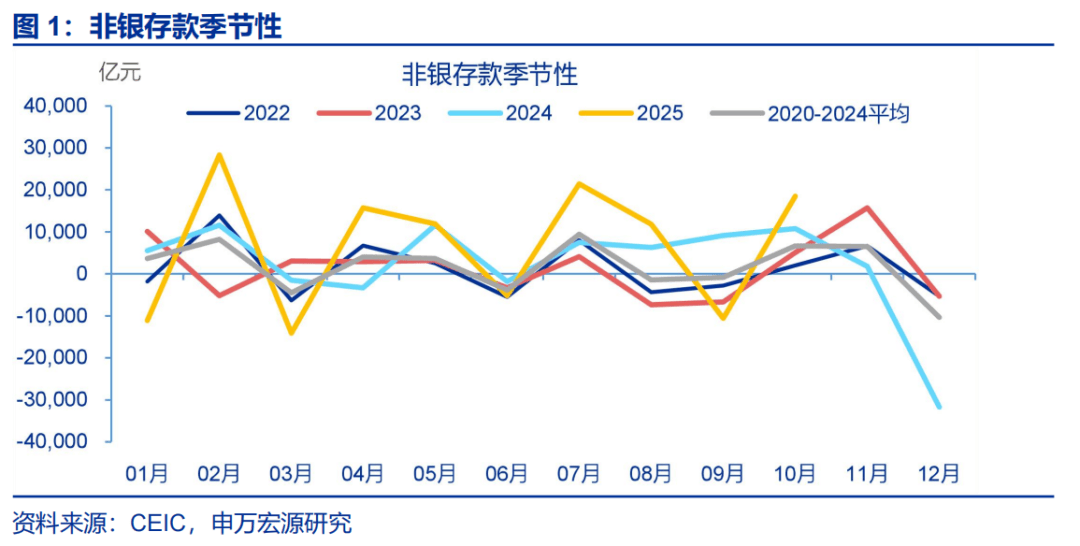
Group 1 - The core viewpoint highlights the re-emergence of the "deposit migration" phenomenon, with a decrease of approximately 770 billion yuan in resident deposits and a corresponding increase of 770 billion yuan in non-bank institution deposits, indicating a "seesaw" relationship [1][5][33] - The M1 growth rate decline is attributed to the decrease in resident deposits, which is directly related to the contraction in resident credit demand, particularly a reduction of 335.6 billion yuan in short-term loans [1][8][33] - In October, corporate loans remained primarily focused on short-term financing, with a year-on-year growth rate of short-term loans and bill financing increasing by 0.6 percentage points to 10.0%, while medium- and long-term loans saw a slight decline [2][13] Group 2 - The growth rate of social financing (社融) further declined, primarily due to a decrease in net government bond financing by 560.2 billion yuan, which was a key factor in the slowdown of social financing growth [2][18] - The outlook for social financing stability is optimistic with the implementation of two fiscal policies, including the full deployment of 500 billion yuan in new policy financial tools and the issuance of 500 billion yuan in local government bond limits expected in November and December [2][20] - In October, new social financing amounted to 815 billion yuan, a year-on-year decrease of 597 billion yuan, driven by declines in government bonds and RMB loans [3][26]
数据点评 | “存款搬家”再现(申万宏观·赵伟团队)
赵伟宏观探索· 2025-11-14 16:03
Core Viewpoint - The phenomenon of "deposit migration" has re-emerged, with a significant decrease in resident deposits and a corresponding increase in non-bank institution deposits, indicating a shift in financial asset allocation [2][10][48]. Financial Data Summary - In October, the credit balance decreased by 0.1 percentage points year-on-year to 6.5%, while the social financing stock fell by 0.2 percentage points to 8.5%, and M1 decreased by 1.0 percentage point to 6.2% [1][9][46]. - Resident deposits decreased by approximately 770 billion yuan year-on-year, while non-bank institution deposits increased by the same amount, reflecting a "seesaw" relationship [2][10][48]. - M1 growth rate decline is linked to the decrease in resident deposits, which is directly related to the contraction in resident credit [2][10][13]. Loan Structure Analysis - In October, corporate loans remained predominantly short-term, with short-term loans and bill financing increasing by 0.6 percentage points year-on-year to 10.0%, while medium to long-term loans decreased by 0.1 percentage points to 7.7% [3][19][48]. - Despite a recovery in the Producer Price Index (PPI) for three consecutive months, corporate investment sentiment remains cautious, as indicated by a decline in the PMI business expectations index [3][19][48]. Social Financing Trends - The growth rate of social financing stock has further declined, primarily due to a decrease in net government bond financing following the end of front-loaded fiscal financing [3][23][48]. - In October, net government bond financing decreased by 560.2 billion yuan year-on-year, which was a core factor in the slowdown of social financing growth [3][23][48]. Future Outlook - The stability of social financing is expected to improve with the implementation of two fiscal policies, including the full deployment of 500 billion yuan in new policy financial tools and the issuance of 500 billion yuan in local government bond limits [4][49][26]. - These policies aim to stabilize economic operations towards the end of the year and align with the government bond issuance at the beginning of 2026, creating favorable conditions for economic growth [4][49][26]. Regular Monitoring - In October, new credit amounted to 220 billion yuan, a year-on-year decrease of 280 billion yuan, primarily from the resident sector [5][50]. - The total social financing added in October was 815 billion yuan, a year-on-year decrease of 597 billion yuan, driven by declines in government bonds and RMB loans [5][32][50]. - M2 decreased by 0.2 percentage points year-on-year to 8.2%, while the new M1 decreased by 1 percentage point to 6.2%, with significant changes in deposit structures [5][38][50].

数据点评 | “存款搬家”再现(申万宏观·赵伟团队)
申万宏源宏观· 2025-11-14 14:15
Core Viewpoint - The phenomenon of "deposit migration" has re-emerged, with a significant decrease in resident deposits and a corresponding increase in non-bank institution deposits, indicating a shift in financial asset allocation [2][10][47]. Financial Data Overview - In October 2025, the credit balance decreased by 0.1 percentage points to 6.5%, social financing stock fell by 0.2 percentage points to 8.5%, and M1 decreased by 1.0 percentage point to 6.2% [1][9][46]. - Resident deposits decreased by approximately 770 billion yuan, while non-bank institution deposits increased by the same amount, reflecting a "seesaw" relationship [2][10][47]. Loan and Financing Trends - Short-term financing remains dominant in corporate loans, with a 0.6 percentage point increase in short-term loans and bill financing to 10.0%, while medium to long-term loans decreased by 0.1 percentage points to 7.7% [3][19][48]. - The decline in social financing growth is primarily due to a decrease in net government bond financing, which fell by 560.2 billion yuan in October [3][23][48]. Future Outlook - The stability of social financing is expected to improve with the implementation of two fiscal policies: the full deployment of 500 billion yuan in new policy financial tools and the issuance of 500 billion yuan in local government bond limits [4][26][49]. - These policies aim to stabilize economic operations towards the end of the year and align with early 2026 government bond issuances, creating favorable conditions for economic growth [4][26][49]. Regular Monitoring - In October, new credit totaled 220 billion yuan, a decrease of 280 billion yuan year-on-year, primarily from the residential sector [5][27][50]. - The total social financing added was 815 billion yuan, down 597 billion yuan year-on-year, largely due to declines in government bonds and RMB loans [5][32][50]. - M2 growth fell by 0.2 percentage points to 8.2%, while M1 decreased by 1 percentage point to 6.2%, with significant reductions in both resident and corporate deposits [5][38][50].

存款还在“搬家”,降息窗口是否会在四季度打开?
Jing Ji Guan Cha Wang· 2025-11-14 11:08
11月13日,央行公布2025年10月金融数据。 截至2025年10月末,广义货币(M2)余额335.13万亿元,同比增长8.2%,比上年同期高0.8个百分点, 在上年同期基数提高的背景下,仍保持较高增速;社会融资规模存量437.72万亿元,同比增长8.5%,比 上年同期高0.7个百分点;1—10月,社会融资规模增量为30.9万亿元,同比多增3.83万亿元。 但如果从单月数据来看,10月金融数据仍有波动。2025年10月人民币贷款增加2200亿元,同比少增2800 亿元;10月社会融资增量8150亿元,同比少增5970亿元,社融余额同比从9月的8.7%降至8.5%;10月 M1同比从9月的7.2%降至6.2%,10月M2同比从9月的8.4%降至8.2%。 如何看待10月金融数据的波动? 中国民生银行首席经济学家温彬认为,从金融数据可以看出,在季节性效应、政策影响以及中长期趋势 变化下,10月信贷增速延续回落,但社融、M2增速仍维持在相对高位,反映金融对实体经济的支撑仍 有力。 温彬进一步指出,伴随经济金融结构变迁,当前企业融资渠道已从过去更多依赖于银行贷款,转变为综 合运用债券、股票等更丰富的市场化融资方式。 ...


10月金融数据点评:\存款搬家\再现
Shenwan Hongyuan Securities· 2025-11-14 10:38
Group 1: Financial Data Overview - In October 2025, the credit balance decreased by 0.1 percentage points to 6.5% year-on-year[1] - The total social financing (社融) stock fell by 0.2 percentage points to 8.5% year-on-year[1] - M1 decreased by 1.0 percentage points to 6.2% year-on-year[1] Group 2: Deposit Trends - The phenomenon of "deposit migration" reappeared, with resident deposits decreasing by approximately 770 billion yuan year-on-year[2] - Non-bank institution deposits increased by approximately 770 billion yuan year-on-year, reflecting a "seesaw" relationship with resident deposits[2] - The decline in M1 growth may be linked to the decrease in resident deposits, which is directly related to the contraction in resident credit[2] Group 3: Corporate Lending and Economic Outlook - In October, corporate loans remained primarily short-term, with short-term loans and bill financing increasing by 0.6 percentage points to 10.0% year-on-year[3] - The net financing of government bonds decreased by 560.2 billion yuan year-on-year, significantly impacting the growth rate of social financing[3] - Two fiscal policies, including the issuance of 500 billion yuan in new policy financial instruments, are expected to stabilize credit performance and support social financing[4]
中国银河发布10月金融数据点评:社融信贷均偏弱,存款搬家继续演绎
Sou Hu Cai Jing· 2025-11-14 08:39
Group 1 - The core viewpoint of the article highlights that social financing (社融) has shown a year-on-year decrease, with a stable but slowing growth rate [1] - The main drag on the increase in social financing is attributed to the decline in RMB loans and government bond issuance [1] - There is a continued weak demand for financing in the real sector, with a notable increase in bill financing [1] - The growth rates of M1 and M2 have slowed down, indicating a trend of deposit migration [1]
10月金融数据点评:“存款搬家”再现
Shenwan Hongyuan Securities· 2025-11-14 08:14
Group 1: Financial Data Overview - In October 2025, the credit balance decreased by 0.1 percentage points year-on-year to 6.5%[1] - The total social financing stock fell by 0.2 percentage points year-on-year to 8.5%[1] - M1 decreased by 1.0 percentage points year-on-year to 6.2%[1] Group 2: Deposit Migration Phenomenon - The "deposit migration" phenomenon re-emerged in October, with household deposits decreasing by approximately 770 billion RMB[2] - Non-bank institution deposits increased by about 770 billion RMB, showing a "seesaw" relationship with household deposits[2] - The decline in household deposits may lead to further adjustments in financial asset allocation, impacting bank liability structures[2] Group 3: Loan Trends - In October, corporate loans remained primarily short-term, with short-term loans and bill financing increasing by 0.6 percentage points year-on-year to 10.0%[3] - The year-on-year growth rate of medium- and long-term corporate loans decreased by 0.1 percentage points to 7.7%[3] - Despite a recovery in PPI to -2.1%, corporate investment attitudes remain cautious, as indicated by a drop in the PMI production expectation index from 54.1 to 52.8[3] Group 4: Social Financing and Government Debt - The decline in social financing growth is primarily due to a decrease in net government bond financing, which fell by 560.2 billion RMB year-on-year[4] - The issuance of 500 billion RMB in local government bonds is expected to provide direct support to social financing in November and December[4] - Two fiscal policies are anticipated to stabilize social financing, aiding economic performance towards the end of the year[4] Group 5: Credit and Monetary Aggregates - In October, new credit amounted to 220 billion RMB, a year-on-year decrease of 280 billion RMB, mainly from the household sector[5] - New social financing totaled 815 billion RMB, down 597 billion RMB year-on-year, driven by declines in government bonds and RMB loans[5] - M2 growth fell by 0.2 percentage points to 8.2%, while new M1 decreased by 1 percentage point to 6.2%[5]
2025年10月金融数据点评:社融信贷均偏弱,存款搬家继续演绎
Yin He Zheng Quan· 2025-11-14 07:21
Investment Rating - The report maintains a "Recommended" rating for the banking industry [1]. Core Viewpoints - The growth of social financing (社融) has slowed down, with October's new social financing amounting to 814.9 billion yuan, a year-on-year decrease of 597.1 billion yuan. The total social financing stock increased by 8.49% year-on-year, with a slight month-on-month decline of 0.18 percentage points [3]. - Demand for loans remains weak, with a notable decrease in both household and corporate financing needs. In October, the balance of RMB loans grew by 6.5% year-on-year, a decrease of 0.1 percentage points from the previous month [3]. - The phenomenon of "deposit migration" continues, as M1 and M2 growth rates have declined. In October, M1 and M2 increased by 6.2% and 8.2% year-on-year, respectively, with month-on-month declines of 1 percentage point and 0.2 percentage points [3]. Summary by Sections Social Financing - In October, the new social financing was 814.9 billion yuan, down 597.1 billion yuan year-on-year. The government bond issuance has weakened its support for social financing [3]. - RMB loans decreased by 20.1 billion yuan in October, a year-on-year reduction of 316.6 billion yuan. The issuance of new government bonds was 489.3 billion yuan, down 560.2 billion yuan year-on-year [3]. Loan Demand - The demand for loans from the real economy remains weak, with household loans decreasing by 360.4 billion yuan in October, a year-on-year drop of 520.4 billion yuan. Corporate loans increased by 350 billion yuan, primarily driven by a significant rise in bill financing [3]. Deposit Trends - The total RMB deposits in financial institutions increased by 610 billion yuan in October, a year-on-year increase of 100 billion yuan. However, household deposits decreased by 1.34 trillion yuan, indicating ongoing deposit migration [3]. - Non-bank deposits increased by 1.85 trillion yuan year-on-year, reflecting a shift in capital towards more active markets [3]. Investment Recommendations - The report suggests that the weakening support from government bonds for social financing and the ongoing weak loan demand necessitate attention to the effectiveness of new policy financial tools. The banking sector's transformation driven by the 14th Five-Year Plan is expected to provide opportunities for fundamental recovery [3]. - Specific stock recommendations include Industrial and Commercial Bank of China (601398), Agricultural Bank of China (601288), Postal Savings Bank of China (601658), Jiangsu Bank (600919), Hangzhou Bank (600926), and China Merchants Bank (600036) [3].






10月社融信贷解读
2025-11-14 03:48
Summary of Key Points from Conference Call Industry Overview - The conference call primarily discusses the state of the Chinese banking sector and the broader financial landscape, particularly focusing on social financing (社融) and credit data for October 2025. Core Insights and Arguments 1. **Social Financing Data**: In October, new social financing amounted to 800 billion yuan, marking the lowest level in nearly a decade and falling short of market expectations, primarily due to a year-on-year decrease of 560 billion yuan in government bonds, indicating issues with fiscal spending timing [1][2][4]. 2. **Loan Performance**: New RMB loans totaled 220 billion yuan, a year-on-year decrease of 280 billion yuan. Household loans decreased by 520 billion yuan, reflecting weak mortgage demand due to sluggish real estate sales, while mortgage rates stabilized between 3.1% and 3.3% [1][5]. 3. **Corporate Loan Demand**: There remains insufficient demand for medium to long-term corporate loans, although financing rates for emerging industries have slightly increased, indicating a willingness among companies to bear higher financing costs [1][6][7]. 4. **Deposit Trends**: The phenomenon of "deposit migration" continues, with household deposits decreasing by 770 billion yuan year-on-year, while non-bank financial institution deposits increased by the same amount, suggesting a shift of funds from household savings to equity markets [1][8]. 5. **Banking Sector Performance**: In the first three quarters, listed banks reported a net profit growth of 1.6% year-on-year, with improvements across various types of banks. The asset expansion has helped offset declining interest margins, and the reduction in impairment losses has positively impacted profits [1][11][12]. 6. **Future Outlook for Banking**: The banking sector is expected to maintain stable performance for the year, driven by asset expansion, growth in non-interest income, and reduced impairment losses. However, uncertainties related to bond market fluctuations and external macroeconomic events could impact credit costs [1][12][13]. 7. **Credit Quality**: As of the end of Q3, the non-performing loan (NPL) ratio for listed banks was stable at 1.23%. However, there are concerns regarding the rising overdue rates in retail loans and potential impacts on asset quality due to adjustments in loan support policies for real estate developers [1][20][21]. 8. **Capital Adequacy**: By the end of Q3, the core capital adequacy ratio for listed banks was 10.55%, showing an increase from the previous year, supported by government injections and favorable stock performance. This stability in capital adequacy is expected to sustain dividend payouts [1][23][24]. Other Important Insights - **Market Reaction**: The market's focus on social financing data has diminished due to the significant year-on-year decreases observed, particularly since Q2. The high base effect from previous years continues to influence current credit data [2]. - **Investment Trends**: Despite the Shanghai Composite Index reaching a ten-year high of 4,000 points, the ratio of household deposits to A-share market capitalization remains around 160%, indicating that large-scale retail investment has not yet materialized [1][10]. - **Non-Interest Income**: Non-interest income for listed banks increased by 4.6% year-on-year, benefiting from improved wealth management-related revenues and favorable capital market conditions [1][17]. This summary encapsulates the critical points discussed in the conference call, providing a comprehensive overview of the current state and outlook of the banking sector and social financing in China.