
资产荒

Search documents
今年以来涨幅喜人 银行保险股强势能否延续
Zhong Guo Zheng Quan Bao· 2025-08-20 20:17
Core Viewpoint - The strong performance of bank and insurance stocks in 2023 is attributed to high dividend yields, stable returns, and low valuations, with expectations for continued strength due to market recovery and increased capital inflows [1][2]. Group 1: Stock Performance - As of August 20, 2023, the bank sector in A-shares has seen a cumulative increase of approximately 14% since 2025, while the insurance sector has risen about 13% [1]. - Individual stocks such as Agricultural Bank, Shanghai Pudong Development Bank, and Qingdao Bank have each increased over 30% this year, with New China Life Insurance and China Pacific Insurance rising over 15% [1]. - In the Hong Kong market, banks like Qingdao Bank, CITIC Bank, and Chongqing Rural Commercial Bank have also shown strong performance, with some H-shares increasing over 30%, and New China Life Insurance H-shares rising over 120% [1]. Group 2: Factors Driving Growth - The rise in bank and insurance stocks is driven by a combination of market recovery and their inherently low valuations, with high dividends and improved asset quality contributing to their appeal [2]. - Insurance capital inflows have been significant, with favorable policies encouraging long-term investments, leading to increased demand for bank stocks among insurance funds [2]. - The low interest rate environment and asset scarcity have made bank stocks attractive to insurance capital due to their high dividends and stable valuations [2]. Group 3: Future Outlook - Analysts believe that the valuation of bank and insurance stocks remains attractive, with expectations for continued strong performance driven by increased capital from insurance companies [3]. - The potential for significant capital inflows is supported by regulatory guidance encouraging insurance companies to invest a portion of new premiums in A-shares starting in 2025 [3]. - The insurance sector is expected to benefit from improved market conditions, which may alleviate pressure from interest rate reductions and enhance long-term investment value [4].
险资“接手”不动产 另类资产选配能力受考验
Zhong Guo Jing Ji Wang· 2025-08-20 02:14
Core Viewpoint - Insurance capital is accelerating its investment in commercial real estate and alternative assets, aiming for long-term stable returns amid an "asset shortage" environment, while also facing risks related to liquidity, valuation, and asset-liability matching [1][8]. Group 1: Investment Activities - Xinhua Insurance has been actively acquiring Wanda Plaza properties through its real estate fund, with significant transactions in cities like Wuxi, Beijing, and Wuhan, totaling approximately 16 billion yuan [2]. - Sunshine Life has established a fund worth 5.51 billion yuan to invest in six Wanda Plaza locations in cities such as Hefei and Dongguan [2]. - Other insurance companies, including China Ping An and Dajia Insurance, have also made substantial investments in existing real estate projects, with a total exceeding 4.7 billion yuan reported by August [3]. Group 2: REITs and Alternative Assets - Insurance capital has shown increased interest in alternative assets, particularly in real estate investment trusts (REITs), with a total investment of 2.631 billion yuan in REITs products by August, surpassing the total for the entire previous year [4]. - The average allocation of insurance capital in REITs has risen, with 7.92% for insurance accounts and 1.12% for insurance asset management products in 2023, compared to lower percentages in 2024 [4]. - Notably, two REITs focused on new infrastructure have seen significant participation from insurance capital, with allocations exceeding 10% [5]. Group 3: Strategic Considerations - The insurance industry is shifting towards commercial real estate due to declining yields on traditional fixed-income assets, which are insufficient to cover the rigid liabilities of life insurance products [7]. - The focus on real estate and alternative assets is driven by the need for stable cash flows and long-term investment returns, aligning with the long-term nature of insurance liabilities [7]. - However, experts caution that while diversifying into real estate offers more options, it also introduces risks related to liquidity and valuation, particularly in a changing market environment [8].


完善市场化定价是国债做市的核心
第一财经· 2025-08-20 00:51
Core Viewpoint - The article emphasizes the importance of improving the government bond yield curve as a foundation for the financial market, highlighting recent measures taken by the Ministry of Finance to enhance liquidity in the secondary market for government bonds [2][3]. Summary by Sections Government Bond Market Operations - The Ministry of Finance announced operations to support the market for government bonds, specifically selling 2.7 billion yuan of 2025 10-year bonds and 2.8 billion yuan of 2025 12-year bonds to improve liquidity and reflect market supply and demand [2][3]. Current Market Conditions - The article discusses the ongoing asset shortage and declining policy interest rates, which have increased investor preference for government bonds, leading to a liquidity squeeze in the bond market [2][3][4]. - In July, there was a net decrease of 1.11 trillion yuan in household deposits, indicating a shift in financial asset distribution among residents [3]. Importance of a Healthy Yield Curve - A well-functioning government bond yield curve is crucial for the stability and predictability of the financial system, especially as household asset exposure risks change [3][4]. - The Ministry of Finance's operations aim to balance supply and demand in the market, preventing excessive price increases and ensuring that the yield curve reflects market conditions [3][4]. Challenges in the Market - The article identifies two main issues contributing to the current market's risk-averse behavior: low policy interest rates leading to credit tightening and insufficient capacity to generate effective risk assets, exacerbating the asset shortage [4][5]. - The focus on safe assets like government bonds has resulted in liquidity problems in the secondary market, as investors prefer to hold rather than trade these securities [4][5]. Recommendations for Improvement - To enhance the government bond yield curve and market pricing mechanisms, it is essential to address low interest rates and promote a more open economic environment that encourages risk-taking and innovation among market participants [5][6]. - The article advocates for comprehensive reforms to eliminate barriers to market efficiency and foster a competitive legal market order, ultimately improving investment returns and addressing the asset shortage [5][6].


完善市场化定价 是国债做市的核心
Sou Hu Cai Jing· 2025-08-19 16:42
Group 1 - The core viewpoint emphasizes the importance of improving the government bond yield curve as a foundation for the financial market [1][2] - The Ministry of Finance has initiated operations to support the market for government bonds, specifically through selling operations for 2025 government bonds, with amounts of 270 million and 280 million respectively [1][2] - The current market conditions, including a significant decrease in household deposits and an increase in non-bank deposits, highlight the need for a healthy government bond yield curve to ensure financial stability [2] Group 2 - The government bond market is experiencing liquidity issues due to a strong preference for safe assets among investors, driven by an ongoing asset shortage [3][4] - The Ministry of Finance's selling operations aim to address supply-demand imbalances in the market, preventing excessive price increases and ensuring liquidity [2][3] - A comprehensive approach is needed to reform and open up various sectors, removing barriers to market efficiency and enhancing the marginal return on investments [4][5]
一财社论:完善市场化定价是国债做市的核心
Di Yi Cai Jing· 2025-08-19 12:56
Core Viewpoint - The article emphasizes the importance of improving the government bond yield curve and establishing a solid pricing foundation for the financial market, which requires addressing the benefits and drawbacks of low interest rate policies and fostering market participants' risk-taking spirit and creativity [1][4][5] Group 1: Government Bond Market Operations - The Ministry of Finance announced operations to support the market for government bonds, specifically through selling operations for the 2025 government bonds, with amounts of 270 million and 280 million respectively [1][2] - The government bond market support operations are not new, having been implemented since the issuance of the operational rules in September 2016, and are increasingly regularized due to recent changes in the financial market [1][2] - The current selling operations reflect a supply-demand imbalance in the market for key maturity government bonds, aiming to prevent excessive price increases and improve liquidity in the secondary market [2][3] Group 2: Financial Asset Distribution Changes - In July, there was a net decrease of 1.11 trillion yuan in household deposits, highlighting the significance of a healthy government bond yield curve as the distribution of household financial assets changes [2] - The shift in household asset exposure risks necessitates a more stable and predictable financial system, which places higher demands on the healthy operation of the government bond yield curve [2] Group 3: Market Pricing Mechanism - To create a healthy liquidity environment for the government bond market, it is crucial to establish a sound pricing mechanism and reduce transaction costs, allowing the yield curve to effectively cover risk exposures [3][4] - The current market's risk-averse behavior is driven by a persistent asset shortage and low policy interest rates, leading to liquidity issues in the government bond secondary market [3][4] - The article suggests that addressing low interest rates and enhancing the marginal investment return is essential for guiding changes in the government bond yield curve [4][5] Group 4: Structural Reforms - Comprehensive reforms and opening up various sectors are necessary to broaden the productive boundaries of market participants and eliminate non-market barriers to effective market operation [4][5] - The government bond market support operations are seen as a starting point, with the ultimate goal being to improve the yield curve and market pricing foundation through deeper reforms [5]
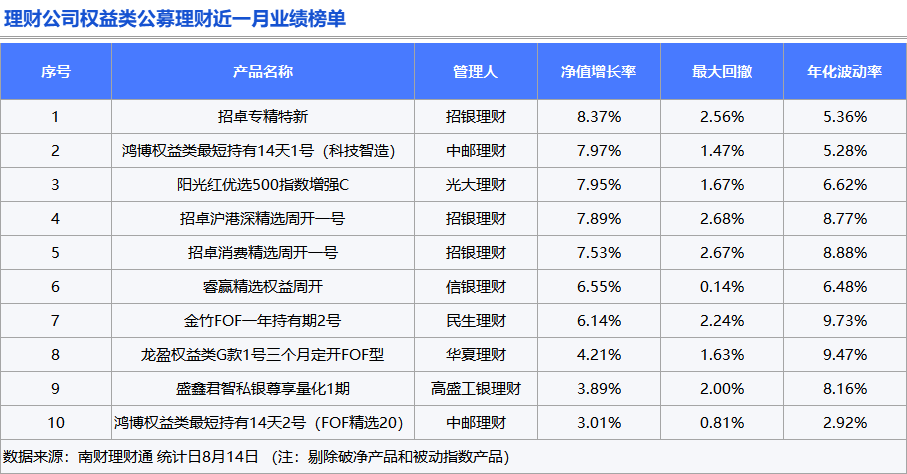
科技热潮新选:中邮科技智造权益新品近一月收益率7.97%
2 1 Shi Ji Jing Ji Bao Dao· 2025-08-19 10:19
Group 1 - The stock market has shown a reversal in sentiment since September 24 last year, with a notable increase in risk appetite and structural market trends expected to continue into 2025 [1] - The Shanghai Composite Index reached a nearly ten-year high of 3731.76 points on August 18, indicating a strong performance in technology stocks, AI, robotics, and military sectors [1] - There is a noticeable divergence in the market, where the index rises but individual stocks do not follow suit, highlighting a selective investment environment [1] Group 2 - For ordinary investors, equity products from wealth management companies are a favorable choice, with an average net value growth rate of 28.74% over the past year and a maximum drawdown of 12.85% [2] - The top three equity public wealth management products in terms of one-month returns are from China Merchants Bank, China Post, and Everbright, with notable performances from new products launched by China Post [2][3] - China Post's "Hongbo Equity Class Shortest Holding 14 Days No. 1 (Technology Manufacturing)" achieved a one-month net value growth rate of 7.97%, ranking second, while its other product ranked tenth with a growth rate of 3.01% [2][3] Group 3 - The low interest rate environment and supportive policies have created favorable conditions for equity market investments, prompting wealth management companies to enhance their equity research capabilities and product offerings [4] - China Post's "Hongbo Equity Class Shortest Holding 14 Days No. 1 (Technology Manufacturing)" focuses on emerging industries, particularly in technology and innovation, which are expected to drive significant investment opportunities [5] - The product employs a strategy combining ETFs and actively managed funds to capture industry growth while mitigating individual stock risks, with a current net asset value of 1.0796 as of August 14 [5] Group 4 - The management fee for the aforementioned product has been significantly reduced from 0.5% to 0.05% per year, benefiting investors by lowering costs [6] - The market outlook suggests that technological assets will have considerable allocation value due to a combination of industrial cycles and a loose monetary environment, with a shift towards high-yield assets as risk-free rates decline [7]

如何看待上证3700点后的市场机会
淡水泉投资· 2025-08-19 10:10
Core Viewpoint - The A-share market has shown significant changes since July, with the Shanghai Composite Index breaking through key levels and reaching a nearly ten-year high, leading to discussions about potential market opportunities and risks [1][2]. Market Performance and Industry Contribution - The Shanghai Composite Index rose from 2789 points at the end of January 2024 to 3728 points by August 18, 2025, marking a cumulative increase of 34%. This rise was primarily driven by a few sectors, notably large financials and electronics, with banks and non-bank financials contributing 11% to the index's increase, accounting for 34% of the total contribution [2][4]. - A structural divergence is evident in the market, with low-volatility assets like banks being major winners, while sectors such as electric equipment and basic chemicals have seen declines exceeding 30% [4]. Current Market Valuation and Opportunities - Despite the overall high valuation of the Shanghai Composite Index and CSI 300, there remains a structural differentiation in valuations across sectors. Some sectors, such as electric equipment and food and beverage, are experiencing valuation contractions, while others have seen their valuations rise due to declining profitability [8][11]. - The market is witnessing a shift from valuation-driven pricing to profit-driven pricing as economic recovery stabilizes and corporate earnings improve [8]. Market Sentiment and Trends - The proportion of financing buy-ins in the A-share market has increased, indicating heightened market sentiment, which is typically associated with periods of market uptrends [15]. - Two key trends are supporting market momentum: low interest rates and a shift in household financial behavior towards equity markets. The decline in 10-year government bond yields has prompted institutional investors to seek higher returns, leading to a reallocation towards growth sectors [18][20]. - The number of new individual investor accounts has surged, with 1.96 million new accounts opened in July, reflecting a 71% year-on-year increase, indicating a recovery in market sentiment [20]. Structural Growth Opportunities - The current market focus is shifting towards structural growth opportunities, supported by favorable policies, liquidity, and the emergence of a wealth effect from the stock market [23].

中金:居民存款搬家潜力几何?
智通财经网· 2025-08-19 00:10
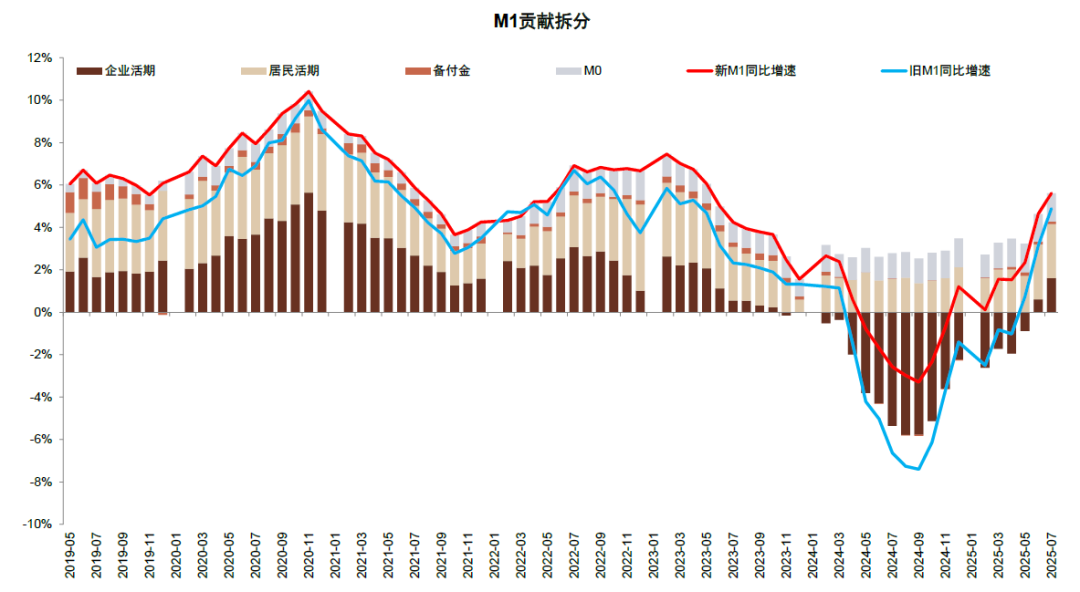
Group 1 - The article highlights signs of deposits moving towards the stock market since May, driven by factors such as increased M1 growth and a shift in deposit trends [1] - M1 growth reached 5.6% year-on-year in July, up from 2.3% in May, indicating a trend of deposit activation [1] - There is a notable increase in the popularity of equity funds, with a slowdown in fixed-income wealth management products compared to last year [1][9] Group 2 - The capital market has become more active, with daily trading volumes in A-shares exceeding 2 trillion yuan since August [2] - The number of new accounts opened on the Shanghai Stock Exchange increased by 26% in July compared to May, although it remains below the peak in October of the previous year [2] Group 3 - The article discusses the sources of deposits, including fiscal spending and international balance of payments, which have contributed to deposit creation [15] - The contribution of fiscal measures to deposit creation rose from 25% at the end of 2023 to 53% currently, while the contribution from entity credit decreased from 73% to 41% [15][23] Group 4 - Factors driving the movement of deposits to the stock market include improved risk appetite due to government stimulus policies and a recovery in stock market returns [31] - The average return on A-shares over the past 12 months has reached around 20%, prompting a shift in investment strategies [31][33] Group 5 - The potential for deposits to move into the stock market is estimated at 5-7 trillion yuan, based on excess savings, maturing deposits, and the activation of deposits [45][46] - The article notes that the actual movement of deposits will depend on macroeconomic conditions, policy expectations, and external factors [45][46] Group 6 - The shift of deposits to the stock market is expected to benefit banks by expanding interest margins and improving the outlook for credit demand [48] - The article suggests that while the stock market's attractiveness may reduce the appeal of high-dividend yields, it remains attractive for long-term funds [48]
中金:居民存款搬家潜力几何?
中金点睛· 2025-08-18 23:36
Core Viewpoint - The article discusses the potential for residents' deposits to shift towards the stock market, highlighting signs of this trend emerging since May 2023, driven by various economic factors and changes in investor behavior [2][30]. Group 1: Signs of Deposit Migration - Since May 2023, there have been indications of deposits moving towards the stock market, including an increase in M1 growth from 2.3% in May to 5.6% in July, suggesting a trend of deposit activation [2]. - The growth of fixed-income wealth management products has slowed compared to last year, while equity mutual funds and private securities investment funds have seen a rebound in growth [2]. - Non-bank deposits increased significantly, with a year-on-year increase of 1.4 trillion yuan in July, indicating that deposits may be entering brokerage margin accounts in preparation for market entry [2][9]. Group 2: Capital Market Activity - Since August 2023, the A-share market has seen daily trading volumes exceed 2 trillion yuan, with a notable increase in trading activity and a financing balance surpassing 2 trillion yuan [3]. - The number of new accounts opened on the Shanghai Stock Exchange increased by 26% from May to July, although it remains below the peak levels seen in October 2022 [3]. Group 3: Sources of Deposit Creation - The article estimates that residents have accumulated approximately 5 trillion yuan in "excess savings" from 2022 to 2024, which could potentially be used for investment [14]. - The contribution of fiscal measures to deposit creation has risen from 25% at the end of 2023 to 53% currently, while the contribution from entity credit has decreased from 73% to 41% [14]. - The weakening of financial disintermediation has led to a significant outflow of deposits from fixed-income products back into the banking system, contributing to the recent increase in deposits [15]. Group 4: Motivations for Deposit Migration - Improved risk appetite among residents, driven by government stimulus policies and positive economic expectations, has led to a shift in investment behavior towards the stock market [30]. - The current environment of weak returns from major risk assets like real estate and stocks has prompted funds to flow into higher-yielding investments, with the A-share market showing a 12-month average return of around 20% [30]. - The weakening of the US dollar has facilitated the return of overseas funds to the Chinese stock market, as investors seek better returns domestically [31]. Group 5: Potential for Deposit Migration - The potential for deposits to migrate to the stock market is estimated at around 5-7 trillion yuan, which could exceed the amounts seen during previous market rallies in 2016-2017 and 2020-2021 [42]. - The upcoming maturity of approximately 70 trillion yuan in fixed-term deposits in 2025 may drive residents to seek higher-yielding assets, as the re-pricing of these deposits will result in lower interest rates [40]. - The activation of deposits, driven by a favorable economic environment, could lead to an additional net increase of around 5 trillion yuan in resident demand deposits, which may also flow into the stock market [41].

2025年二季度保险业资金运用情况点评:负债扩张,哑铃结构持续
Guoxin Securities· 2025-08-18 13:58
Investment Rating - The investment rating for the insurance industry is "Outperform the Market" (maintained) [1][7][28] Core Viewpoints - As of the end of Q2 2025, the balance of insurance funds in China reached 36.2 trillion yuan, a year-on-year increase of 17.4% [2][3] - The insurance sector is increasing its allocation to long-term bonds to optimize asset-liability duration matching amid a backdrop of declining 10-year government bond yields and a scarcity of high-yield assets [9][24] - The stock investment scale for life insurance companies reached 2.7 trillion yuan, an increase of 605.2 billion yuan since the beginning of the year, while property insurance companies' stock investment scale reached 195.5 billion yuan, an increase of 35.4 billion yuan [2][24] Summary by Sections Insurance Fund Utilization - The insurance fund utilization balance reached a historical high of 36.2 trillion yuan, with a year-on-year growth rate of 17.4% [2][3] - Life insurance companies accounted for 90% of the total insurance fund utilization balance, with a year-on-year growth of 17.7% [6] - Property insurance companies had a fund utilization balance of 2.3 trillion yuan, growing 11.3% year-on-year [6] Bond and Equity Investments - The bond allocation for the insurance industry reached 17.9 trillion yuan, accounting for 49.3% of total investment, marking a historical high [11] - Life insurance companies' bond allocation was 16.9 trillion yuan, up 26.6% year-on-year, while property insurance companies' bond allocation was 0.95 trillion yuan, up 19.9% [11][24] - The stock allocation for the insurance sector reached 3.1 trillion yuan, with life insurance companies increasing their stock investments significantly [13][24] Asset Allocation Efficiency - The asset allocation efficiency of insurance funds decreased in Q2 2025, with a fund turnover rate of 35%, the lowest since Q3 2023 [22][24] - The report anticipates that the adjustment of preset interest rates and short-term behaviors will lead to an expansion in the industry's short-term premium scale, which may increase the asset allocation demand of insurance funds [24] Regulatory Changes - Recent regulatory adjustments have simplified the asset allocation standards for insurance funds, allowing companies with strong solvency to increase their equity investment limits [14][15] - The new regulations aim to enhance the investment space for leading insurance companies while maintaining strict controls for those with lower solvency [14][15]