红利策略

Search documents
红利策略全攻略系列之七:从红利增长到未来高股息
Shenwan Hongyuan Securities· 2025-07-12 15:35
Group 1 - The report emphasizes the transition from dividend growth to future high dividends, highlighting the need to anchor indices and reduce tracking errors due to new regulatory environments [7][8]. - The original dividend growth portfolio lacked bank stocks, which affected its capacity and dividend yield, making it less conventional for institutions that typically rely on banks for dividend allocation [7][8]. - The advantages of the dividend growth portfolio lie in its ability to predict future dividend increases while excluding stocks with declining future dividends, essentially seeking companies with future high dividends [10][11]. Group 2 - The future high dividend portfolio is expected to yield significant excess returns compared to the historical high dividend portfolio, with a backtest showing that selecting the top 100 stocks based on future dividend rates leads to better performance [11][13]. - Historical dividend yield is identified as a significant predictor of future dividend rates, with other factors like valuation, profitability, and growth also showing predictive capabilities, albeit weaker [14][16]. - A multi-factor approach is suggested for predicting future dividend rates, where historical dividend yield is prioritized, followed by growth factors to enhance the selection process [20][25]. Group 3 - The report proposes a combined strategy of high dividend and dividend growth by first constructing a stock pool based on predicted dividend growth and then filtering for high dividend yield stocks [29][39]. - The stock pool is derived from two dimensions: stable dividend ratios with growth expectations and consecutive years of increasing dividends, which helps filter out companies likely to reduce dividends in the future [34][39]. - A multi-factor scoring method is recommended for stock selection, focusing on dividend yield, valuation, and profitability, with the aim of constructing a robust dividend growth portfolio [40][43]. Group 4 - The Hong Kong stock market's dividend growth strategy is explored, showing that approximately 60% of stocks with dividends increased their payouts year-over-year [67][68]. - A backtest from December 2014 to April 2025 indicates that the known dividend growth portfolio outperformed the benchmark with an annualized return of 14.21% compared to 8.28% for the benchmark [68][70]. - The report concludes that a simple momentum-based dividend growth strategy in the Hong Kong market has not proven effective, as the performance of the constructed portfolio did not yield significant excess returns [71].
全球经济不确定性加剧,港股红利受关注,红利港股ETF(159331)午后翻红
Mei Ri Jing Ji Xin Wen· 2025-07-09 06:43
Group 1 - The core viewpoint of the article highlights the increasing demand for stable returns among investors amid global economic uncertainty and ongoing volatility in equity markets, with Hong Kong stocks becoming a focal point due to their low valuations and high dividend yields [1] - The attractiveness of dividend strategies has significantly increased in the context of a low interest rate environment and widening interest rate differentials between China and the U.S., as these strategies exhibit "bond-like" characteristics [1] - The Hang Seng Index's price-to-earnings ratio remains at historical lows, indicating that Hong Kong stocks are undervalued compared to major global indices, which enhances the appeal of dividend strategies [1] Group 2 - The Hong Kong Stock Connect High Dividend (HKD) Index, tracked by the dividend-focused Hong Kong ETF, is compiled by China Securities Index Co., Ltd., and includes 30 high dividend yield securities that are liquid and consistently pay dividends [1] - The index primarily focuses on high-quality companies with stable dividend capabilities, covering a wide range of industries but mainly concentrated in traditional sectors such as real estate and energy [1]
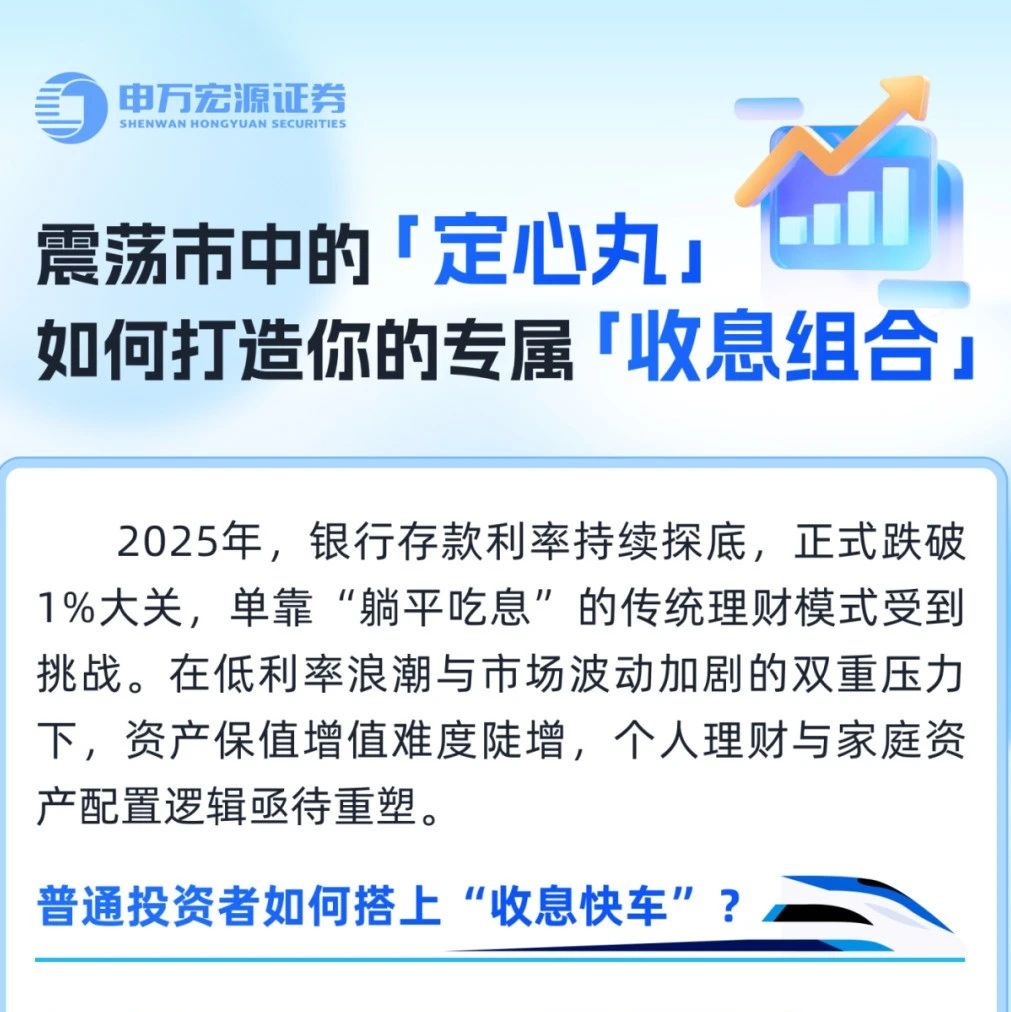
震荡市中的“定心丸”,如何打造你的专属“收息组合”?
申万宏源证券上海北京西路营业部· 2025-07-09 02:45
Core Viewpoint - The article discusses the challenges faced by traditional investment strategies in a low-interest-rate environment and suggests various tools for investors to build their own income-generating portfolios amidst market volatility [1]. Group 1: Investment Tools - Cash management products offer high liquidity and can be accessed anytime, providing better returns than traditional savings accounts [2]. - Bond ETFs track bond indices, such as the Fortune Government Bond ETF, which invests in policy financial bonds with low default risk and stable returns, suitable for long-term holding [3]. - Brokerage repurchase agreements allow investors to earn predetermined returns with flexibility in fund usage, combining investment and liquidity [4]. Group 2: "Fixed Income +" Strategy - The "Fixed Income +" strategy seeks to enhance returns while maintaining a stable base through the allocation of fixed-income assets and additional investments in stocks or convertible bonds [5][7]. - The strategy's risk and return profile is primarily influenced by the equity portion, despite the fixed-income base providing stability [7]. Group 3: Dividend Index Funds - Dividend strategies have gained attention due to their characteristics of high dividends and low valuations, providing strong downside protection and stable cash flow from leading companies [8][10]. - Reinvesting dividend income can leverage the power of compounding, significantly enhancing total returns over time, even with initially low dividend yields [11]. Group 4: Performance of Dividend Indices - Various dividend indices have shown attractive yields and volatility metrics, with the Hang Seng High Dividend Yield Index yielding 7.47% and the CSI Dividend Index yielding 6.12% [12][15].

创金合信基金魏凤春:下半年国内资产配置的变与不变
Xin Lang Ji Jin· 2025-07-09 00:32
Group 1 - The core viewpoint of the article emphasizes a significant decline in global risk premiums, easing U.S. debt pressures, and an increased probability of Federal Reserve interest rate cuts, while still advocating for a cautious approach [1] - The article highlights that technology remains the core of global asset allocation, while the upward trend in gold is weakening due to diverging factors [1] - The passing of the U.S. "Big and Beautiful Act" (BBB Act) and the gradual establishment of "reciprocal tariffs" are seen as reducing short-term political and economic uncertainties, leading to a new investment order [1] Group 2 - The article discusses the current hot topic of anti-involution policies within the context of a unified market, suggesting a potential repeat of the scenario where supply contraction leads to excess profits [2] - It predicts that after the Federal Reserve's interest rate cut in September, overseas capital may flow into China, potentially leading to a significant market rebound similar to last autumn [2] - The article notes a divergence among market participants regarding domestic equity assets, with a shift in focus towards technology growth and a reduction in the importance of low-volatility dividend strategies [2] Group 3 - The analysis indicates that global commodity prices are rising, driven by reduced supply from domestic anti-involution measures and increased demand from international restocking [3] - The article mentions a 4% increase in bank stocks over the past week, suggesting that dividend strategies remain effective despite adjustments in the technology sector [3] Group 4 - The article outlines that in the asset allocation system, fundamental factors play a decisive role while enhanced factors serve as auxiliary [4] - It emphasizes that investors should focus on fundamental changes rather than market momentum, which is often overlooked [4] Group 5 - The article presents quantitative observations indicating that stock investments are more favorable compared to bonds, with an equity risk premium (ERP) of 3.37% and a median excess return of 9.15% [5] - It notes that the stock valuation factor shows a high probability of positive returns, with a current one-year holding return probability of 69% [5] - The article states that the growth rate of net profit attributable to shareholders has increased from 16.20% to 35.1%, indicating an upward trend in the profit cycle [5] Group 6 - The article suggests that bond investment opportunities are weak, with low odds indicated by the valuation factor and a tightening funding environment [6] Group 7 - The article emphasizes that the economic growth target for 2025 is around 5%, with quarterly GDP growth rates projected to decline throughout the year [7] - It highlights that the effects of anti-involution on inflation need further observation, as current PPI and CPI data show limited positive factors for price changes [8] - The article discusses the necessity of broad credit over broad monetary policy, indicating that excessive monetary easing may have diminishing returns on economic stability [8] Group 8 - The article notes a shift in policy focus from short-term stimulus to long-term institutional building, reflecting a significant change in the global policy landscape [9] - It discusses the implications of the BBB Act on global financial markets and capital flows, suggesting that China's ongoing reforms are adapting to these complex changes [9] Group 9 - The article concludes that the dividend strategy remains effective in a low-growth, low-inflation environment, and that the capital structure remains unchanged with state-owned enterprises at the center [10] - It indicates that equity assets may outperform fixed income, but structural market conditions do not support significant overall increases [11] - The article highlights the competition between new technology and old cycles, suggesting that the current environment may not replicate past supply-side reforms [11][12]
华安基金:港股红利逆势上涨,险资配置红利正当时
Xin Lang Ji Jin· 2025-07-08 08:48
Market Overview and Key Insights - The Hong Kong dividend sector showed resilience last week, with the Hang Seng China Central State-Owned Enterprises Dividend Total Return Index rising by 1.11%, while the Hang Seng Index fell by 1.31% and the Hang Seng Tech Index dropped by 2.34% [1] - Foreign capital inflow expanded significantly, with net inflow into Hong Kong stocks reaching $916 million, compared to a mere $10 million the previous week, primarily driven by substantial inflows from passive foreign investments [1] - The insurance sector is increasingly focusing on dividend assets due to a combination of asset scarcity, low interest rates, accounting standard changes, and policy guidance [1] Insurance Capital and Market Dynamics - Insurance funds are expected to become a significant source of incremental capital in the stock market, with a requirement for state-owned large insurance companies to invest 30% of new premiums in A-shares starting January 2025, potentially adding thousands of billions in long-term funds annually [2] - The dividend yield of the Hang Seng China Central State-Owned Enterprises Dividend Index stands at 7.87%, significantly higher than the 5.41% yield of the CSI Dividend Index, with a price-to-book (PB) ratio of 0.63 and a price-to-earnings (PE) ratio of 6.88 [2] - The total return index has achieved a cumulative return of 119% since the beginning of 2021, outperforming the Hang Seng Total Return Index by 115% [2] ETF Overview - The Huaan Hong Kong Stock Connect Central State-Owned Enterprises Dividend ETF (code: 513920) tracks the Hang Seng China Central State-Owned Enterprises Dividend Index, reflecting the performance of high-dividend securities listed in Hong Kong with state-owned enterprises as the largest shareholders [3] - This ETF is the first in the market to combine the attributes of Hong Kong stocks, state-owned enterprises, and dividends, providing investors with opportunities to capitalize on the valuation restructuring of state-owned enterprises [3] ETF Performance and Holdings - The top ten weighted stocks in the Hang Seng China Central State-Owned Enterprises Dividend Index include China COSCO Shipping (4.6% weight, 13.0% dividend yield), Orient Overseas International (4.6% weight, 11.1% dividend yield), and New China Life Insurance (4.1% weight, 3.4% dividend yield) [5] - The performance of these stocks over the past 12 months shows varying degrees of decline, with China COSCO Shipping experiencing a 2.4% drop [5]

长期资金入市背景下,上半年获资金追捧的红利低波动ETF(563020)、恒生红利低波ETF(159545)等产品再迎布局时点
Mei Ri Jing Ji Xin Wen· 2025-07-08 06:45
Group 1 - The core viewpoint of the articles highlights the increasing popularity and performance of dividend-related ETFs amidst market volatility, with significant inflows and historical scale achievements [1] - In the first half of the year, dividend-related ETFs attracted over 17 billion yuan in net inflows, bringing their total scale to over 140 billion yuan [1] - The Hang Seng Dividend Low Volatility ETF (159545) and the Dividend Low Volatility ETF (563020) received net inflows of 1.5 billion yuan and 1 billion yuan respectively, reaching historical highs in scale [1] Group 2 - The current global uncertainty has led to a heightened demand for risk aversion among investors, making dividend assets attractive due to their stable cash flow and high dividend yield [1] - The policy environment continues to encourage listed companies to distribute dividends, which is expected to attract more funds to the dividend sector in the medium to long term [1] - June marks the peak period for annual dividend distributions, making it a favorable time for positioning in dividend assets as many companies implement dividends during this month [1] Group 3 - E Fund is noted as the only fund company that implements low fee rates across all its dividend ETFs, including products like E Fund Dividend ETF (515180), Dividend Low Volatility ETF (563020), and Hang Seng Dividend Low Volatility ETF (159545) [2]
A股市场上分红频次增多,同类规模最大的自由现金流ETF(159201)回调打开低位布局窗口
Mei Ri Jing Ji Xin Wen· 2025-07-07 05:55
Group 1 - The A-share market experienced fluctuations and corrections, with the Guozheng Free Cash Flow Index dropping over 0.25%, while stocks like Changhong Meiling and Zhongyuan Media led the gains [1] - As of July 6, a total of 688 listed companies have received bank support for stock repurchase and increase loans, with a cumulative loan limit exceeding 135.86 billion [1] - In 2023, 436 listed companies have received bank support for stock repurchase and increase loans, with a cumulative loan limit of 86.577 billion, indicating sustained interest in this new tool [1] Group 2 - The Free Cash Flow ETF (159201) closely tracks the Guozheng Free Cash Flow Index, addressing the limitations of traditional dividend strategies by focusing on internal growth capabilities and financial health [2] - The fund management fee is set at an annual rate of 0.15%, and the custody fee at 0.05%, both of which are among the lowest in the market, maximizing benefits for investors [2]
本周聚焦:5月重点省市信贷投放情况如何?
GOLDEN SUN SECURITIES· 2025-07-06 09:34
Investment Rating - The report indicates a positive outlook for the banking sector, suggesting that certain stocks may benefit from policy catalysts and cyclical recovery [3]. Core Viewpoints - The report highlights that while tariff policies may cause short-term impacts on exports, long-term domestic policies aimed at stabilizing the real estate market, promoting consumption, and enhancing social welfare are expected to support economic growth [3]. - The banking sector is anticipated to benefit from these policies, with specific banks such as Ningbo Bank, Postal Savings Bank, China Merchants Bank, and Changshu Bank being recommended for investment [3]. - The report also emphasizes the potential for continued dividends from banks like Shanghai Bank, China Merchants Bank, Jiangsu Bank, and Chongqing Bank, which are showing positive fundamental changes [3]. Summary by Sections Credit Growth - As of the end of May 2025, the overall loan growth rate in China was 6.6%, with household and corporate loans growing at 3.0% and 8.5% respectively [1]. - Provinces such as Sichuan, Jiangsu, and Anhui led in credit growth, with growth rates exceeding 9% [1][2]. - Corporate loans in Sichuan, Jiangsu, and Shandong showed impressive growth rates of 13.8%, 13.6%, and 13.4% respectively [2]. Key Data Tracking - The average daily trading volume in the stock market was 14,415.38 billion yuan, a decrease of 453.04 billion yuan from the previous week [4]. - The balance of margin financing and securities lending increased by 1.12% to 1.85 trillion yuan [5]. - The issuance of non-monetary funds decreased significantly, with a total of 53.28 billion yuan issued this week, down 273.46 billion yuan from the previous week [5]. Interest Rate Market Tracking - The issuance scale of interbank certificates of deposit was 2,435.10 billion yuan, a decrease of 4,828.40 billion yuan from the previous week [6]. - The average interest rate for interbank certificates of deposit was 1.62%, down 2 basis points from the previous week [10]. - The average yield on 10-year government bonds remained stable at 1.64% [10]. Sector Performance - The banking sector's performance is closely monitored, with specific stocks showing varying degrees of growth and decline [30]. - The report includes detailed charts tracking the performance of various financial stocks and their respective movements [30][36].




7月风格轮动观点:资金博弈重归成长-20250704
Huaxin Securities· 2025-07-04 09:34
Quantitative Models and Construction Methods 1. Model Name: High-Growth and Dividend Rotation Timing Model - **Model Construction Idea**: The model aims to identify effective timing signals for rotating between high-growth and dividend strategies based on macroeconomic and market indicators[9]. - **Model Construction Process**: 1. At the end of each month, the model selects effective signals from single-factor tests, including term spread, social financing growth, CPI and PPI quadrants, US Treasury yields, and capital flow indicators (ETF, insurance funds, foreign capital)[9]. 2. Each indicator provides a signal to either buy high-growth or dividend strategies. 3. The average score of these signals is used as the final score for allocation decisions[9]. - **Model Evaluation**: The model demonstrates a "defensive and offensive" characteristic, balancing risk and return by maintaining a 60% defensive dividend base and 40% growth allocation during volatile market conditions[9]. --- Model Backtesting Results 1. High-Growth and Dividend Rotation Timing Model - **Cumulative Return**: 259.92% - **Annualized Return**: 14.91% - **Maximum Drawdown**: 27.08% - **Annualized Volatility**: 23.16% - **Annualized Sharpe Ratio**: 0.64 - **Calmar Ratio**: 0.55[6] --- Quantitative Factors and Construction Methods 1. Factor Name: Term Spread - **Factor Construction Idea**: Reflects fixed-income market investors' expectations of future economic growth. A declining or low term spread is unfavorable for high-growth styles[13]. - **Factor Construction Process**: 1. Calculate the difference between 10-year and 1-year government bond yields. 2. For June 2025, the 1-year yield was 1.34% (down from 1.46% in May), and the 10-year yield was 1.65% (down from 1.67% in May). 3. The term spread for June 2025 was 0.31, up from 0.22 in May[13]. 2. Factor Name: Social Financing Growth - **Factor Construction Idea**: Serves as a leading macroeconomic indicator. Higher corporate financing demand indicates economic recovery expectations, supporting high-growth styles[13]. - **Factor Construction Process**: 1. Use the year-over-year growth rate of the total social financing stock. 2. For May 2025, the growth rate was 8.7%, unchanged from the previous month, continuing its marginal improvement since bottoming out in October 2024[13]. 3. Factor Name: CPI and PPI Quadrants - **Factor Construction Idea**: Timing effectiveness is higher than the CPI-PPI spread. When CPI and PPI rise simultaneously, especially when CPI rises faster, it indicates strong downstream demand and economic growth, favoring high-growth styles[16]. - **Factor Construction Process**: 1. Analyze CPI and PPI year-over-year changes. 2. For May 2025, CPI was -0.1% (unchanged from April), and PPI was -3.3% (down from -2.7% in April), indicating continued deflation and favoring dividend styles[16]. 4. Factor Name: US Treasury Yields - **Factor Construction Idea**: Rising US Treasury yields lead to foreign capital outflows and reduced global risk appetite, negatively impacting high-growth sectors with high valuations[16]. - **Factor Construction Process**: 1. Monitor the 10-year US Treasury yield. 2. As of June 2025, the yield remained at a high level of 4.35%, suppressing growth styles[16]. 5. Factor Name: Capital Flow Indicators - **Factor Construction Idea**: Reflects foreign capital's willingness to flow into the domestic market, influenced by factors like the USD index, RMB offshore exchange rate, and CDS spreads[17]. - **Factor Construction Process**: 1. Construct a composite index using the USD index, RMB offshore exchange rate, and CDS spreads. 2. A stronger USD, weaker RMB, and wider CDS spreads indicate reduced foreign capital inflow willingness[17]. --- Factor Backtesting Results 1. Term Spread - **June 2025 Value**: 0.31 (up from 0.22 in May)[13] 2. Social Financing Growth - **May 2025 Value**: 8.7% (unchanged from April)[13] 3. CPI and PPI Quadrants - **May 2025 CPI**: -0.1% (unchanged from April) - **May 2025 PPI**: -3.3% (down from -2.7% in April)[16] 4. US Treasury Yields - **June 2025 Yield**: 4.35% (remained at a high level)[16] 5. Capital Flow Indicators - **June 2025 Observation**: Foreign capital inflow willingness improved due to reduced ETF dividend net buying and increased foreign capital inflows[9][17]
[7月3日]指数估值数据(A股继续上涨;月薪宝创新高,再平衡的机会来了么;红利估值表更新;指数日报更新)
银行螺丝钉· 2025-07-03 13:47
Core Viewpoint - The overall market is experiencing an upward trend, with various sectors showing positive performance, particularly in technology and healthcare, while the Hong Kong stock market is showing mixed results [1][4]. Market Performance - The overall market has risen, closing at 4.9 stars, with large, mid, and small-cap stocks all experiencing similar gains [1][2]. - Growth style stocks are performing strongly, while value style stocks show slight fluctuations [3]. Sector Analysis - Technology, ChiNext, and pharmaceutical biotechnology sectors have seen significant increases [4]. - The Hong Kong stock market experienced a slight decline after a previous rise, with its dividend index continuing to increase [4]. Investment Strategies - The "Yuexinbao" investment strategy has reached a historical high, with plans to adjust the stock-bond ratio [6][7]. - The "Yuexinbao" and similar strategies benefit from declining deposit rates, leading to higher returns in 2023 compared to previous years [8]. Return Sources - Returns are derived from three main components: 1. **Equity Portion**: Focused on value style stocks, contributing stable returns through dividends and long-term price appreciation [9][11]. 2. **Bond Portion**: Emphasizes short to medium-term bonds due to current low yields in long-term bonds [12]. 3. **Rebalancing**: Adjusting the portfolio to maintain target allocations, which can enhance returns during market fluctuations [13][18]. Historical Performance - A rebalancing opportunity occurred in February 2024, where the "Yuexinbao" strategy saw a significant recovery, with stock assets increasing by approximately 30% from February to June [19][21]. Dividend Index Valuation - The current valuation of various dividend indices indicates some are still undervalued, but they are approaching normal valuation levels [29].