地缘风险

Search documents
贵金属日报-20251230
Guo Tou Qi Huo· 2025-12-30 11:20
Report Industry Investment Rating - Gold: ★★★, indicating a clearer upward trend and relatively appropriate investment opportunities currently [1] - Silver: ★★★, suggesting a clearer upward trend and relatively appropriate investment opportunities currently [1] Core View of the Report - Overnight, precious metals dropped significantly. Recently, the prospects of Fed easing and geopolitical risks have supported the strength of precious metals. However, the risks have been accumulating due to excessive gains driven by funds. Domestic and foreign exchanges have successively adjusted margins and trading restrictions. The short - term market volatility is high, and participation should be cautious. The platinum fundamentals continue to be in short supply, and the medium - term upward logic remains intact. There is a possibility that long - position funds may cover positions on dips. The recent IV has increased, and attention should be paid to the opportunity of selling PUT options [1] Summary According to Related Events - Trump is considering suing Powell for incompetence and may fire him. He also stated that if Iran continues to develop ballistic missiles, he supports a strike on Iran; if Iran develops nuclear weapons, he supports a rapid strike on Iran [2] - Regarding the Russia - Ukraine situation: - Russia claims that 91 Ukrainian drones attacked Putin's residence, while Ukraine denies it. - Zelensky requested a 50 - year security guarantee from Trump, and the issues of the Zaporizhzhia Nuclear Power Plant and territory remain unresolved in the 20 - point plan. - The Kremlin says there is no discussion about a call between Putin and Zelensky currently, but a call between Putin and Trump is expected to take place soon. - The Chief of the General Staff of the Russian Armed Forces says Russian troops are successfully advancing into the Ukrainian military's defense circle, and the advancement speed in December was the fastest in nearly a year. - Putin instructed to continue the work of establishing a security zone in Sumy and Kharkiv regions, aiming to complete it in 2026, and said it is necessary to continue actions to gain control of Zaporizhzhia city [2]
金银期价大幅下探,两个品种盘中跌停!
Zheng Quan Ri Bao Wang· 2025-12-30 04:01
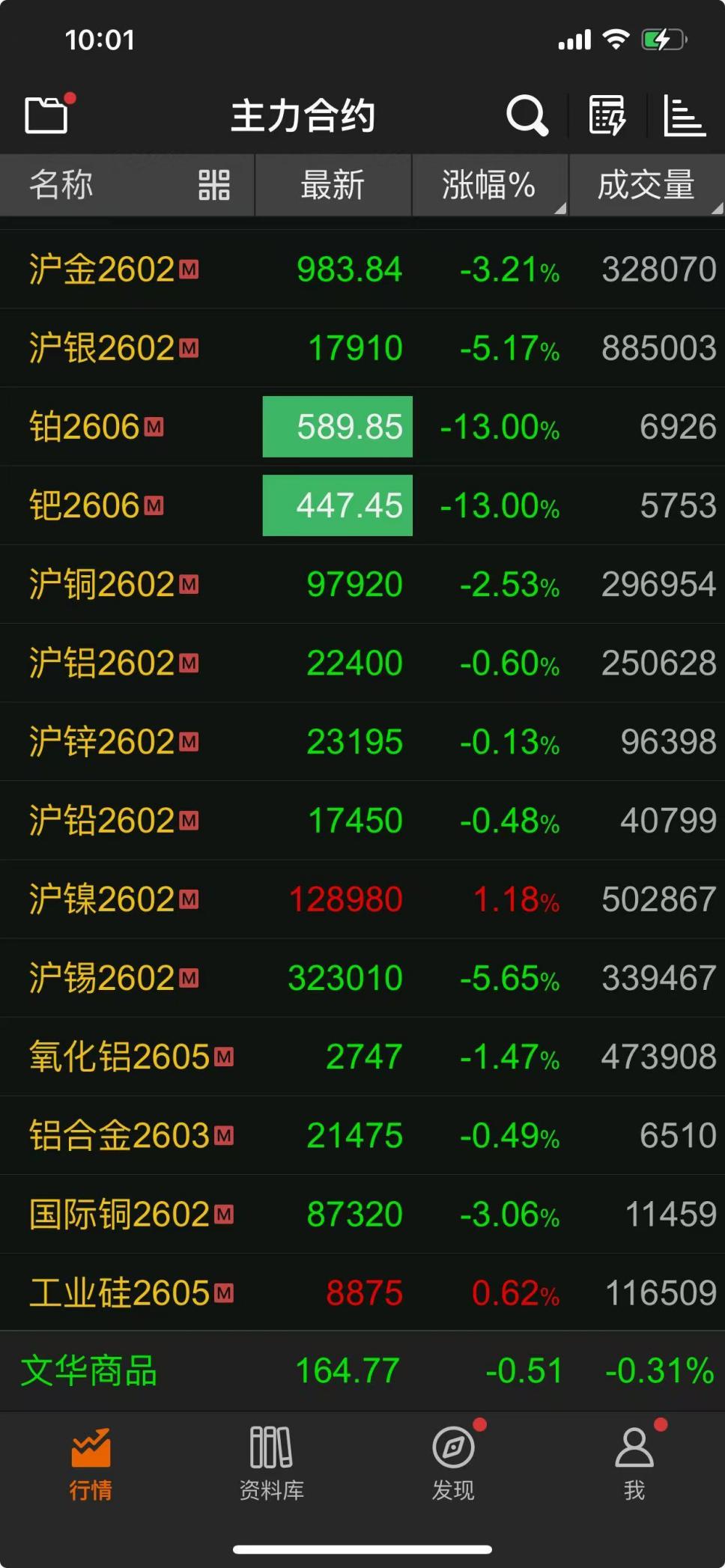
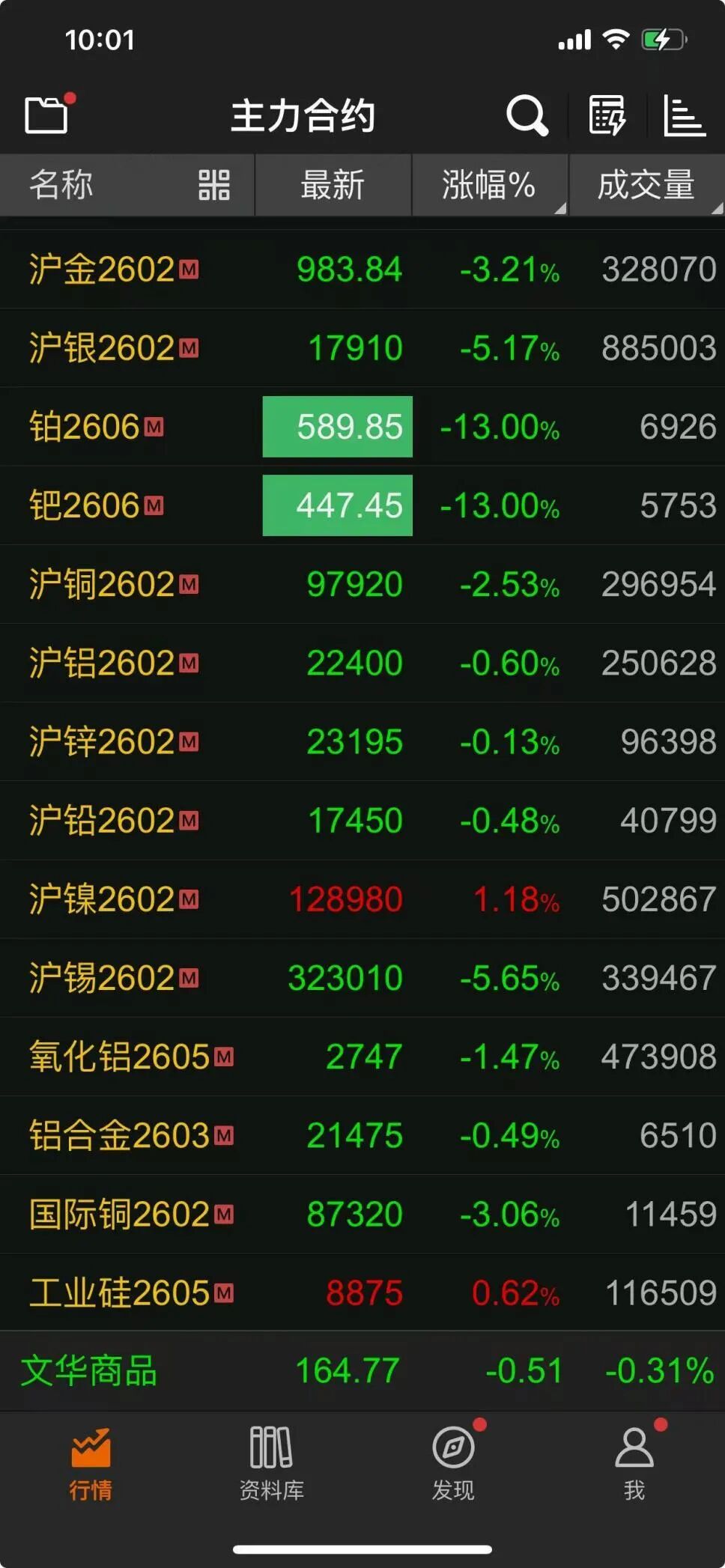
| 沪锡2602四 | | 323010 -5.65% | 339467 | | --- | --- | --- | --- | | 氢化铝2605圆 | 2747 | -1.47% | 473908 | | 铝合金2603网 | 21475 | -0.49% | 6510 | | 国际铜2602网 | 87320 | -3.06% | 11459 | | 工业硅2605四 | 8875 | 0.62% | 116509 | | 文华商品 | 164.77 | -0.51 | -0.31% | | 行情 | UHD 资料库 | 发现 | 我 | 本报记者 王宁 12月30日,国内期货市场金属板块大面积低开,沪银、沪金出现较大程度跌幅,铂和钯期货主力合约盘中更是跌停;同 时,沪铜、沪铝、沪锌、沪铅和沪锡等金属品种,也出现不同程度的下探。 分析人士表示,近日金属板块波动较大,包括白银和黄金等品种更是出现单边行情,但目前利好基本面的因素缺乏实质性 支撑,加之资金有获利了结可能,国内交易所也同步采取相关措施,贵金属等品种出现明显回调。 | 10:01 | | | ·Il ? CD | | | --- | --- | ...

金银期价大幅下探,发生了什么?
Zheng Quan Ri Bao Zhi Sheng· 2025-12-30 03:46
Core Viewpoint - The domestic futures market for metals experienced significant declines, particularly in precious metals like silver and gold, with major contracts hitting their daily limit down, indicating a lack of substantial support for the bullish fundamentals [1][4]. Group 1: Market Performance - On December 30, the metal sector opened lower, with notable declines in Shanghai silver and gold, and platinum and palladium futures hitting their daily limit down [1]. - The main contracts for Shanghai gold and silver reported declines of over 3% and 5% respectively, while platinum and palladium futures saw a drop of 13% [3]. - Other metals such as copper, aluminum, zinc, lead, and tin also experienced varying degrees of decline, with tin futures dropping over 5% [3]. Group 2: Analyst Insights - Analysts noted that recent volatility in the metal sector, particularly in precious metals, is attributed to a lack of supportive fundamentals and potential profit-taking by investors [1][4]. - Despite expectations of a more accommodative monetary policy from the Federal Reserve and geopolitical risks supporting precious metals, the rapid price increases have led to accumulated risks in related contracts [4]. - The overall sentiment in the precious metals market has been positive due to tight fundamentals for silver and platinum, but there is a need for caution as profit-taking may lead to short-term adjustments in prices [4].
美国不买了,李嘉诚港口烂在手里?中国获得巴拿马运河港口控制权
Sou Hu Cai Jing· 2025-12-29 10:16
Core Insights - The sale of the ports at both ends of the Panama Canal by Li Ka-shing has encountered complications as China has shifted its demands from merely participating in the acquisition to seeking control, leading to a stalemate in negotiations [1] - The BlackRock-TiL consortium is willing to invest a total enterprise value of $22.8 billion to acquire this significant port asset package, indicating a strategic judgment regarding capital and resources [3] - The asset package includes key strategic ports, specifically Balboa and Cristobal, which are crucial to the Panama Canal, a vital trade route for 3%-6% of global maritime trade [5][8] Company and Industry Summary - The transaction represents a significant restructuring for Hutchison Ports, which aims to optimize its asset structure and is expected to generate over $19 billion in cash proceeds after adjustments [12] - Hutchison Ports has held the concession rights for the two Panama ports since 1997, with the rights extended to 2047, highlighting the long-term strategic value of these assets [14] - In 2023, Hutchison Ports ranked sixth globally in terms of throughput, achieving a throughput of 43 million TEUs, with continued growth in volume and profitability across various ports [16] - The Panama Canal's operational stability is critical for global trade, especially for China, which leads in shipbuilding and holds a significant position in the global shipping market [18] - The ownership of the Panama Canal remains with Panama, and Hutchison Ports only holds operational rights, emphasizing that the sale is a commercial transaction and does not alter sovereignty [22] - The geopolitical landscape is influencing investment logic, with the U.S. government showing renewed interest in the Panama Canal, which complicates the transaction [24][26] - The sale is viewed as a strategic adjustment by Hutchison Ports to avoid entanglement in international political issues while optimizing its asset portfolio [28] - Following the announcement, Hutchison's stock price surged over 21%, reflecting market optimism regarding this strategic shift [30] - The transaction is indicative of a broader trend in global capital flows, where investments in critical infrastructure are increasingly balancing commercial value with geopolitical risks [32][34] - The sale serves as a signal in the international capital market, emphasizing the need for a balance between profit and risk management in the current global landscape [36]


中辉有色观点-20251229
Zhong Hui Qi Huo· 2025-12-29 07:19
1. Report Industry Investment Ratings - Gold: Long - term holding [1] - Silver: Control risks [1] - Copper: Long - term holding [1] - Zinc: Rebound under pressure, medium - long term short allocation [1] - Lead: Rebound [1] - Tin: Rise sharply [1] - Aluminum: Rebound [1] - Nickel: Rebound [1] - Industrial silicon: Under pressure [1] - Polysilicon: High - level adjustment [1] - Lithium carbonate: Cautiously bullish [1] 2. Core Views of the Report - The current precious metals market has entered a severely overbought zone, especially silver and platinum. They may either quickly correct to release pressure or digest gains through high - level consolidation. However, the bull market is not over as the long - term upward logic remains unchanged, including the Fed's interest - rate cut cycle, continuous gold purchases by global central banks, rising geopolitical risks, and long - term concerns about currency credit [3][4]. - For base metals, different metals have different market trends and investment suggestions based on their supply - demand fundamentals, macro - environment, and policy factors [1]. 3. Summaries According to Related Catalogs 3.1 Precious Metals (Gold and Silver) 3.1.1 Market Review - Loose liquidity, geopolitical events, and tariff issues have led to a large inflow of funds into precious metals [2]. 3.1.2 Basic Logic - This year, precious metals have been outstanding. Supply - demand imbalance, Fed rate cuts, and capital inflows have jointly driven the sharp rise of silver, platinum, and palladium. But other precious metals except gold face high - level volatility risks in the short term [3]. - The US dollar is depreciating, and the process of de - dollarization is ongoing. The Bloomberg dollar index is having its worst week since June, and the yield of the 10 - year US Treasury bond has dropped by about one basis point to 4.14% [3]. - China will implement strategic export controls on physical silver inventories from January 1, 2026, and the US will decide whether to impose tariffs on silver and platinum by January 17, 2026 [3]. - Geopolitical risks include the US military action in Nigeria and the ongoing Russia - Ukraine conflict [3]. 3.1.3 Strategy Recommendation - Gold is recommended for long - term holding due to geopolitical risks, improved liquidity, and continuous central - bank gold purchases. Silver has a long - term bullish logic but is currently in an overbought zone, so risks should be controlled [1]. 3.2 Copper 3.2.1 Market Review - The outer - market is closed for Christmas, and the domestic copper market has an independent trend. The Shanghai copper price has reached a new historical high, breaking through the 100,000 - yuan mark [5][6]. 3.2.2 Industry Logic - The global copper concentrate supply remains tight. The 2026 copper concentrate long - term contract TC is set at $0/ton. High copper prices have significantly suppressed demand, and it is the consumption off - season [6]. 3.2.3 Strategy Recommendation - Hold copper long positions and take partial profits at high prices. Be cautious about high - level corrections. In the medium - long term, copper is still favored as a strategic resource and asset allocation alternative to precious metals [1][7]. 3.3 Zinc 3.3.3 Market Review - The Shanghai zinc price fluctuates narrowly, and the outer - market is closed for Christmas [8][9]. 3.3.4 Industry Logic - The domestic zinc concentrate processing fee has decreased, and some high - cost smelters may reduce production. It is the consumption off - season, and the overseas zinc inventory has increased, suppressing the upside space [9]. 3.3.5 Strategy Recommendation - Enterprises are advised to sell hedging and actively lay out at high prices. In the medium - long term, zinc is a short - allocation in the sector [1][10]. 3.4 Aluminum 3.4.1 Market Review - The aluminum price continues to rebound, and the alumina price also shows a rebound [11][12]. 3.4.2 Industry Logic - For electrolytic aluminum, the cost of aluminum enterprises in south - western China may increase due to the approaching dry season. The inventory shows a mixed trend, and the demand is structurally differentiated. For alumina, the supply is excessive, and the inventory continues to accumulate [13]. 3.4.3 Strategy Recommendation - Take short - term profits on Shanghai aluminum and then wait and see. Pay attention to the change in aluminum ingot social inventory. The main operating range is [21700 - 22800] [14]. 3.5 Nickel 3.5.1 Market Review - The nickel price rebounds again, while the stainless - steel price rebounds and then falls [15][16]. 3.5.2 Industry Logic - Indonesia has significantly reduced the nickel - ore production target for 2026 and plans to tax associated metals. The nickel inventory is at a high level. The stainless - steel market is in the off - season, and the inventory has increased slightly [17]. 3.5.3 Strategy Recommendation - Take short - term profits on nickel and stainless - steel and then wait and see. Pay attention to the change in stainless - steel inventory. The main operating range of nickel is [120000 - 135000] [18]. 3.6 Lithium Carbonate 3.6.1 Market Review - The main contract LC2605 opens high and goes high, closing above the 130,000 - yuan mark [19]. 3.6.2 Industry Logic - The price remains above the 5 - day moving average. The supply increases slightly, and the demand is supported by high - level capacity utilization of downstream material factories. The total inventory decreases slightly. The early - than - expected resumption of production by CATL may slow down the increase [20]. 3.6.3 Strategy Recommendation - Wait and see in the range of [121700 - 135000] [21].
现货白银:早盘冲高回落,年内涨超160%或回调
Sou Hu Cai Jing· 2025-12-29 06:00
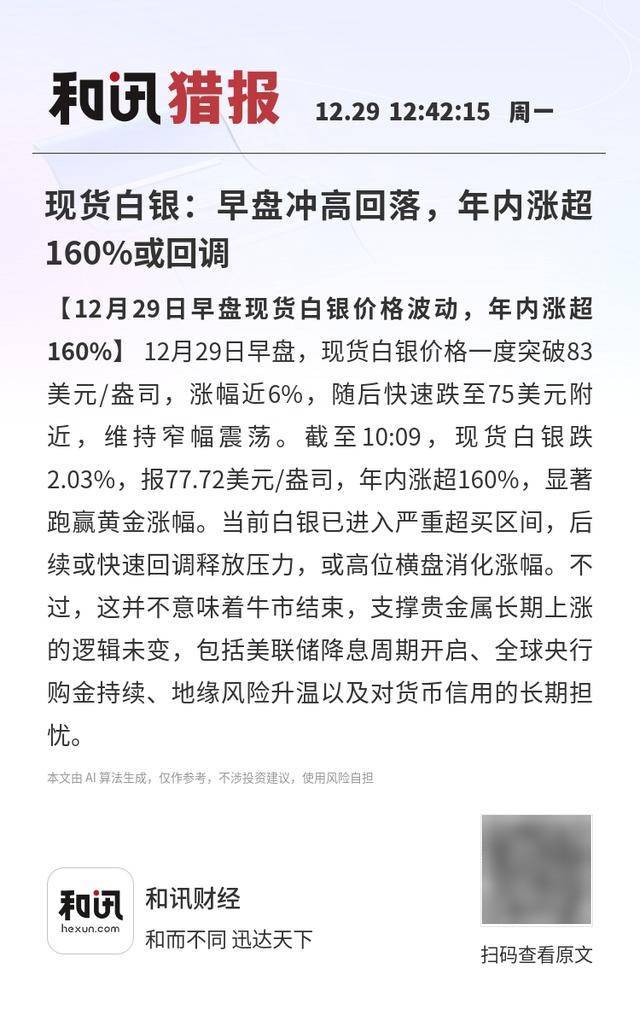
Core Viewpoint - The price of spot silver experienced significant volatility on December 29, with an annual increase exceeding 160%, outperforming gold significantly [1][2]. Price Movement - On December 29, spot silver prices briefly surpassed $83 per ounce, marking an increase of nearly 6%, before quickly retreating to around $75, maintaining a narrow trading range [1][2]. - As of 10:09 AM, spot silver was down 2.03%, priced at $77.72 per ounce, with an annual increase of over 160% [1][2]. Market Conditions - Silver is currently in a severe overbought territory, indicating a potential for rapid correction or high-level consolidation to digest gains [1][2]. - Despite the current market conditions, this does not signify the end of the bull market, as the underlying factors supporting long-term increases in precious metals remain intact [1][2]. Supporting Factors for Long-term Growth - Key factors supporting the long-term rise in precious metals include the onset of a Federal Reserve rate cut cycle, ongoing global central bank gold purchases, rising geopolitical risks, and long-term concerns regarding currency credibility [1][2].
白银价格高台跳水,振幅超10%机构称贵金属牛市并未结束
Xin Lang Cai Jing· 2025-12-29 04:48
Core Viewpoint - The price of spot silver experienced significant volatility, initially surpassing $83 per ounce with a nearly 6% increase, before quickly dropping to around $75, indicating a narrow trading range. Despite this fluctuation, silver has shown a remarkable annual increase of over 160%, outperforming gold significantly [1] Group 1: Price Movements - Spot silver prices reached a peak of $83 per ounce before declining to approximately $75, reflecting a volatile trading session [1] - As of 10:09 AM, silver prices were down 2.03%, trading at $77.72 per ounce [1] - The annual increase in silver prices exceeds 160%, indicating strong performance compared to gold [1] Group 2: Market Analysis - Current market conditions suggest that silver has entered a severe overbought territory, which may lead to a rapid correction or a slow digestion of gains through high-level consolidation [1] - The underlying factors supporting the long-term rise of precious metals remain intact, including the onset of a Federal Reserve rate cut cycle, ongoing global central bank gold purchases, rising geopolitical risks, and long-term concerns regarding currency credibility [1]
综合晨报-20251229
Guo Tou Qi Huo· 2025-12-29 02:32
Report Industry Investment Ratings No relevant information provided. Core Viewpoints of the Report - The overall market shows complex trends, with different commodities and financial products having their own characteristics. Some are influenced by supply - demand fundamentals, some by geopolitical factors, and others by macro - economic policies and seasonal factors. The market rhythm switches quickly, and most products are in a state of oscillation, with different potential investment opportunities and risks [2][3][14] - Different industries have different outlooks. For example, some industries like polycrystalline silicon and manganese silicon are expected to have a relatively positive trend, while others such as urea and PVC may face certain challenges in supply - demand balance and price trends [13][18][28] Summary by Related Catalogs Precious Metals and Base Metals - **Precious Metals**: International gold prices continued a moderate upward trend after the breakthrough, while silver, platinum, and palladium accelerated their rise, with a gain of over 10%. The Fed's easing prospects and geopolitical risks support the strength of precious metals. The spot shortage expectation makes silver, platinum, and palladium more favored by funds, and the gold - silver ratio has dropped significantly below the average. However, exchange restrictions are frequent, and market volatility is extremely high [2] - **Copper**: Copper prices continued to rise strongly last Friday. The Shanghai copper weighted reached a maximum of 102,700 yuan, and it is expected that the London copper will open at $12,700 - $12,800. The market has quickly reached the bullish targets of most overseas institutions for 2026. The target price of the copper market is raised, with the London copper at about $13,100 and the Shanghai copper at about 104,000 yuan [3] - **Aluminum**: The aluminum market's fundamentals are neutral, with poor apparent demand and spot feedback. Shanghai aluminum mainly followed the upward trend, with relatively mild fluctuations. Long - positions should be held with the 40 - day moving average as the support [4] - **Zinc**: In late December, domestic smelter overhauls increased, supporting the adjustment of Shanghai zinc above the annual line. In January, the pressure on the zinc ingot supply side is small, and with the late Spring Festival in 2026 and the expected good start, the consumption side is not pessimistic. Shanghai zinc is expected to oscillate in the range of 22,800 - 23,800 yuan/ton [7] Energy and Chemicals - **Fuel Oil & Low - Sulfur Fuel Oil**: High - sulfur fuel oil supply is mainly affected by geopolitical factors, with the shipping rhythm in the Middle East and Russia slowing down. The demand side may be boosted by improved refinery profits and the US blockade of Venezuelan oil exports. Singapore's inventory continues to accumulate, and the high - inventory pressure is still significant. Low - sulfur fuel oil supply is dominated by overseas refinery starts. The demand side of ship fuel consumption is continuously weak due to high - sulfur substitution [21] - **Asphalt**: Since December, the weekly shipment volume has remained below 400,000 tons, at a low level in the same period of the past four years. Last week, both social and factory inventories increased. The supply - demand of BU is marginally relaxed, but positive news has a significant boost. However, it will eventually return to the price - pressured pattern dominated by supply - demand relaxation [22] Agricultural Products - **Soybean & Bean Meal**: CBOT soybeans oscillated downward after reopening last Friday, and Dalian soybean meal rose first and then fell. In the future, attention should be paid to the specific export situation of US soybeans and whether the La Nina weather in South America can have a continuous impact [35] - **Cotton**: US cotton rebounded from a low level last week, and the weekly signing data improved, with increased Chinese purchases. Domestic Zhengzhou cotton rose continuously, and the market is bullish. Although this year's new cotton production has increased significantly, the commercial inventory is basically the same as the previous year, and the sales progress is relatively fast [42] Others - **Stock Index**: The previous trading day, the broader market oscillated with heavy volume, and the Shanghai Composite Index recorded an 8 - day consecutive gain. All major futures index contracts closed higher, with IC leading the gain. Industrial profits of large - scale enterprises from January to November showed a growth trend, and the RMB exchange rate broke "7" last week [47] - **Treasury Bonds**: On December 26, 2025, the 30 - year treasury bond futures had the largest increase of 0.36%. In December, the central bank's net MLF injection was 10 billion yuan, a consecutive tenth - month incremental renewal. Against the background of increased counter - cyclical adjustment policies, long - term interest rates have risen significantly recently [48]
“顶风”涨停,彻底涨疯了
Ge Long Hui· 2025-12-26 14:20
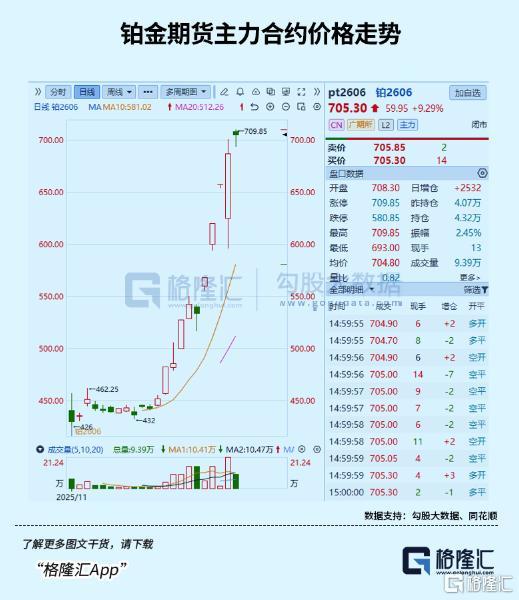
Core Viewpoint - The Chinese commodity market experienced a significant surge in prices for precious and non-ferrous metals, with multiple products reaching historical highs, driven by various market factors and government policy announcements [2][9][12]. Group 1: Price Movements - Precious metals and non-ferrous metals collectively surged, with platinum futures on the Shanghai Futures Exchange hitting a record high of 709.85 yuan per gram, marking a monthly increase of 61.9% [2]. - Silver futures also rose sharply, reaching 18,658 yuan per kilogram, with a total trading volume of 267.69 billion yuan, making it the largest contract by trading volume in the futures market [4]. - Copper futures peaked at 99,730 yuan per ton, closing at 98,720 yuan per ton, reflecting a 3.60% increase [5]. - Lithium carbonate futures surged by 8.12%, reaching a new high of 131,000 yuan per ton since November 2023 [6]. Group 2: Market Drivers - The recent surge in non-ferrous metals prices was catalyzed by a government announcement emphasizing the optimization of traditional industries, which raised expectations for a contraction in supply growth for aluminum and copper [9]. - International macroeconomic factors, including expectations of a shift in U.S. Federal Reserve monetary policy and rising geopolitical tensions, have also contributed to increased demand for precious metals as safe-haven assets [12][13]. Group 3: Supply and Demand Dynamics - The copper market is expected to face supply constraints due to recent mining accidents and declining ore grades, which are anticipated to drive prices higher in the long term [13]. - The zinc market is showing signs of recovery, with expectations of increased supply from new smelting capacities and a potential tightening of supply by 2026, which could lead to a bullish trend in zinc prices [14]. Group 4: Industry Performance - The non-ferrous metals industry is projected to see significant revenue growth, with a reported income of 2.82 trillion yuan in the first three quarters of 2025, reflecting a year-on-year increase of 9.3% [17]. - The net profit for the industry is expected to rise by 41.55%, with energy metals showing the most substantial profit growth of 385.53% year-on-year [17]. Group 5: Investment Strategies - Investment strategies are focusing on companies with strong resource reserves, scale, and integrated supply chains, while suggesting a cautious approach for retail investors during market volatility [19]. - Recommendations include building a diversified portfolio with leading copper and aluminum companies, gold ETFs for hedging, and targeting undervalued mining companies for potential value appreciation [19]. Group 6: Future Outlook - The non-ferrous metals market is anticipated to enter a sustained bull market in 2026, driven by global economic recovery and improved supply-demand dynamics [20].
黄金跌价了,金条降价,25年12月24日国内黄金、足金、金条最新价
Sou Hu Cai Jing· 2025-12-26 13:15
Group 1 - The core viewpoint of the article highlights the significant increase in domestic gold prices, with the price per gram generally surpassing 1400 RMB, alongside a rise in platinum and palladium prices, prompting domestic exchanges to implement risk control measures. Analysts attribute this to factors such as easing inflation, expectations of interest rate cuts, geopolitical risks, and central bank gold purchases, with Goldman Sachs predicting gold prices could reach 4900 USD by 2026 [1] Group 2 - Recent retail gold prices in domestic stores have shown a notable decline, particularly in cities like Haikou and Shenzhen, where the price difference for the same gold purity can reach approximately 17 RMB per gram, leading to a potential price gap of over 500 RMB for a 30-gram gold ornament [1] - The lower gold prices in Shenzhen are primarily due to its proximity to a major gold distribution center, resulting in abundant supply and competition, which helps to lower retail prices. In contrast, Haikou relies on external sourcing, leading to higher logistics costs and a greater markup due to strong tourism demand [1] Group 3 - There is a significant disparity in processing fees across different regions, which can greatly affect the overall cost of purchasing gold. For instance, processing fees for hard gold in Shenzhen may be around 100 RMB per gram, while fees in Hainan could be considerably higher, impacting the investment efficiency for consumers [3] Group 4 - The current market has seen increased transparency in pricing across various channels, yet substantial regional price differences and brand premiums remain. Consumers are advised to consider cross-city purchases carefully, as travel expenses may offset any potential savings from price differences [5] - There are objective pricing differences among brands, with similar gold ornaments showing significant price variations across different brands and sales channels. Consumers are encouraged to clarify their needs, focusing on standard gold bars or low-premium channels for investment, while for jewelry purchases, they should compare gold prices, processing fees, weight, and buyback policies to avoid hidden costs [6]